

Flooded Basement Repair in Alpharetta: The Job, the Cost, and Who to Call
Start with a five-minute check you can do right now, in your socks.
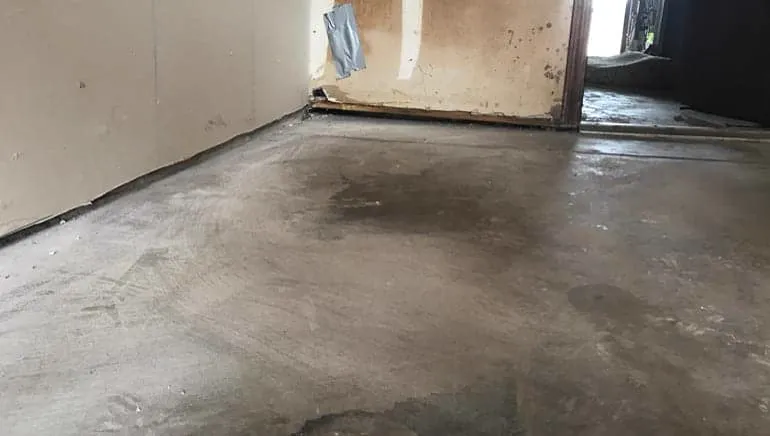
Go stand at the bottom of your stairs and look at one thing: the line where the wall meets the floor. That seam tells you more in five minutes than an hour of searching online, and it’s where most flooded basement repair Alpharetta jobs begin. If there’s a dark band along it, or a fine crust of white powder, you’ve already found your entry point.
Good news, and we mean it — that’s a very fixable problem. We’ve been doing this work around Metro Atlanta for more than twenty years, so we’ve seen that exact stain a few thousand times. Below is the honest version: what the work is, what moves the price, what’s included, and what you get in writing.
What should you look at first?
Walk the perimeter with a flashlight. You’re looking for three things, and none of them require you to know a thing about construction.
- The cove joint. That’s the seam where the wall meets the slab. It isn’t a crack — it’s a built-in gap from the day the house was poured, which makes it the easiest path water can take.
- The sump basin. Lift the lid. If the pump is caked, the float is leaning against the wall of the basin, or you can’t remember the last time you heard it run, that’s your clue.
- The window wells. Fill one with a hose. If the water sits there like a birdbath, the drain under it quit years ago.
Here’s the thing about that check: it separates two very different problems. Water sheeting in from a window well is a surface water issue. Water pushing up through the cove joint after four days of rain is pressure. Both get fixed, but they’re not the same job or the same price.

Before you go down there
If there’s standing water, kill the basement circuit at the panel before you step in. Not because anything dramatic is happening — just because water and outlets belong in different rooms. The National Weather Service flood safety page covers the basics well.
So what is the repair, in plain words?
Flooding and seepage aren’t the same animal. Seepage is a damp patch that shows up slowly. Flooding is bulk water arriving fast, and that usually points at one of four things: a failed sump, a blocked drain line, a window well with no working drain, or hydrostatic pressure in the soil.
Repair means giving that water an easier road than the one it’s taking through your house. We open a narrow channel in the slab along the affected walls, set perforated pipe in clean stone below floor level, and route everything to a sump basin. Then the pump throws it well away from the foundation — not two feet from the wall, where it would politely come right back.
Why does pressure build here in the first place? Georgia red clay. It drains slowly, so after a long soaking rain it holds water tight against the wall instead of letting it pass. That water leans on the wall, finds the hollow cores in block, and comes through the seam at the bottom. Nothing exotic — just physics being patient.
Sump pumps deserve their own paragraph, because they fail in boring, predictable ways. Power goes out mid-storm. The float sticks. The unit was undersized for the house from day one. There’s no check valve, so the discharge water drains right back into the basin, and the pump spends its life lifting the same gallon. A clogged discharge line does the same thing with more drama.
That’s a common find in the Windward area and around Haynes Manor, where a lot of original systems went in during the boom years and have simply aged out. It’s not a defect. A pump has a service life, same as a water heater, and replacing one is a genuinely small ticket.
Can you skip straight to the big job?
You can, but wait — there’s an easier first step most people never hear about, and it’s the reason we ask to walk the outside before we quote the inside.
A basement that floods only in heavy rain almost always has a surface water problem, not a groundwater problem. Surface water is the cheaper fix. We’re talking downspouts that dump beside the foundation, a grade that’s settled and now tilts toward the house, a patio that sends everything back at the wall. Fix those and the water never reaches the pressure stage at all.
The best flooded basement repair is sometimes the one we talk you out of. If two downspout extensions and a regrade solve it, that’s the quote you get.
We had a homeowner out near the Country Club of Roswell edge convinced they needed a full perimeter system. Two other companies had already told them so. What they actually had was a buried downspout crushed by a tree root, sending the whole back roof into one corner of the yard. Real talk: that repair cost a fraction of what they’d braced for.
Now, sometimes the answer really is the full system. Big Creek runs through the middle of this city, and lots near the floodplain can have honestly high groundwater. On those homes, surface fixes help but won’t finish the job. Either way, you deserve to know which house you own before anybody talks money. FEMA’s building science resources on protecting property from flooding lay out the same logic if you like reading the source material.

What does flooded basement repair cost?
Straight answer: it depends on how much wall is involved and how hard that wall is to reach. Anyone quoting a flat number over the phone is guessing, and you’d be paying for the guess. Still, here’s exactly what we weigh.
What moves the number
- Linear feet. One wall versus a full perimeter is the single biggest factor, by a wide margin.
- Access. An open storage basement is straightforward. A finished basement office with built-ins costs more, because there’s careful work before the real work.
- The sump. Some homes have a serviceable basin already. Many around here have one that came with the house in 1997.
- Outside conditions. Grading, downspouts and a silted footing drain may carry most of the blame — and that’s a smaller invoice.
- Wall condition. If a wall is cracked or bowing, structural work comes first. Drainage over a moving wall is money spent twice.
- Backup power. A battery backup adds cost. It also runs during the storm that took your power out, which is the same storm that floods basements.
Small drainage corrections land at the low end. A full perimeter system with a new pump, battery backup and careful work around a finished space sits at the high end. Most jobs fall between, and after we walk your house you get a written number with the scope spelled out line by line.
What’s included: labor, materials, the concrete we replace, hauling, and the warranty. What isn’t: rebuilding finished walls we opened, replacing ruined flooring, and structural repair, which gets priced separately. Better you hear that here than find it in fine print later.
One more honest note, on insurance. Standard homeowners policies commonly exclude surface flooding, and sump failure coverage is usually a separate endorsement you have to add on purpose. So call your agent and ask what your policy actually says. We’d rather you know now than assume.
What does this have to do with the air upstairs?
Here’s the part that surprises people, and it has nothing to do with the basement floor. It’s about the air in your bedrooms.
Air in a house moves upward. Whatever sits in the lowest level gets pulled up through the floors and into the rooms you actually live in. So a damp basement isn’t a basement problem — it’s a whole-house humidity problem wearing a disguise, and it’s why some homes smell musty on the second floor.
Drying matters, and speed matters more than most people expect. Standing water out first. Then wet organics — carpet pad, cardboard, drywall base — out of the room, because those hold moisture long after the floor looks dry. Then dehumidification until the readings hold steady. Mold can begin growing in roughly 24 to 48 hours, which is simply why we move fast, not a reason to panic.

Picture the after, though. The slab stays dry through a two-day storm. The stored bins aren’t sitting on blocks anymore. That basement office you’ve been working from since GA-400 traffic convinced you to stay home stops smelling like a tent, and the upstairs air follows. Better yet, you stop checking the radar out of habit.

Why does hiring local matter here?
Because a warranty is worth exactly as much as the company standing behind it. Ours is written before work starts, not handed over at the end, and we’ll walk you through what’s covered and what isn’t in plain sentences. If something needs attention in year six, you’re calling the same people who did the work — same crews, same shop, twenty-five minutes east in Lawrenceville.
Local also means we know this housing stock. Alpharetta’s boom-era subdivisions are now old enough that the original waterproofing has simply worn out, even on homes that look brand new from the street. We’ve been under houses from downtown Alpharetta City Center out to the streets near Ameris Bank Amphitheatre, and the story repeats: good homes, tired original systems.
Still figuring out what you’re dealing with? Our guide to standing water basement problems covers the symptoms, and every system we install is laid out on our basement waterproofing page. If cracks or settling are part of your picture, start with foundation repair instead. Comparing notes with family a few exits away? We cover the same ground for Duluth flooded basement repair.
Where we work around Alpharetta
We’re based in Lawrenceville, so Alpharetta is a straight shot up GA-400. We work throughout Milton, Johns Creek, Roswell, Cumming, Duluth and Sandy Springs, plus Suwanee, Peachtree Corners, Norcross and the wider Fulton area. If you’re anywhere along the Windward corridor or closer in toward downtown, odds are good we’ve got a truck nearby this week.
Questions Alpharetta homeowners ask us
Faster is better, and the first day or two is what counts. Get standing water out, then pull wet carpet pad, cardboard and any soaked drywall base out of the room, because those hold moisture long after the floor looks fine. After that, run a dehumidifier until readings hold steady. Mold can start in roughly 24 to 48 hours, so we move quickly rather than perfectly.
Because the cove joint is a seam, not a crack. Where the wall meets the slab there’s a built-in gap from the day the house was poured, and it’s the easiest opening water can find. When saturated clay pushes against the foundation, that seam is simply the path of least resistance.
Yes, as long as the source is handled instead of covered up. Below-slab drainage is stone and pipe with nothing to wear out, so it’s built to last the life of the house. The pump is the part with a service life, so plan on a replacement around the ten-year mark and you’re in good shape.
It depends mostly on how many linear feet of wall are involved and how hard that wall is to reach. Grading and downspout corrections sit at the low end, while a full perimeter system with a new sump and battery backup sits at the high end. We won’t quote a flat price sight unseen, but you’ll get a written number with the scope spelled out after we walk the house.
That’s actually encouraging news. Water that shows up only during heavy rain usually points at surface water rather than groundwater, and surface water is the cheaper fix. Even so, it’s worth handling, because the moisture affects the air in the whole house between storms.
Let’s find out what’s really happening under your Alpharetta home
The inspection is free, the estimate is free, and nobody pressures you at the end. We’ll show you where the water gets in and what it takes to stop it — even if the answer turns out to be smaller than you expected.
(678) 914-5112Serving Alpharetta and all of Metro Atlanta · $500 off projects over $3,500 · Live support 7am–8pm, 7 days a week