

Standing Water Basement Alpharetta: What’s Really Causing It
Where the water comes in, how to read the puddle, and what a fair estimate should say — in plain English.
There’s a cardboard box down there that was fine last month. You lift it, and the bottom peels away like a wet paper towel. That soft box is usually how a standing water basement Alpharetta homeowners are living with finally gets noticed — not with a dramatic flood, but with a box that gave up quietly while nobody was watching.
Good news? You are not the first person on your street to find one, and this is very fixable. Standing water has a cause, and causes can be found. Once you know what to look for, you’ll be able to walk your own basement and say something smarter than “there’s water down here.”
Where does the water actually come in?
Let’s back up a second, because standing water is a different animal than dampness. Damp air and a musty smell mean vapor. But a puddle means bulk water — real volume, arriving faster than it can evaporate.
And bulk water almost always comes from one of four places: hydrostatic pressure at the cove joint, a sump pump that stopped doing its job, a blocked drain line, or a window well whose drain quit years ago and now works like a bathtub with the plug in.

That first one deserves a name. The cove joint is the seam where your basement wall meets the floor slab, and those two pieces of concrete got poured on different days, so they never truly bonded.
Which means it isn’t a crack. It’s a hairline door running your whole perimeter. Water doesn’t have to break anything to use it — it just has to push, and Georgia red clay is very good at pushing.
Good news
Water at the cove joint is not a structural problem. A wet slab and a moving foundation are two separate conversations, and most homes we walk into are only having the first one. We’ll tell you plainly which one you’re in.
What is the puddle telling you?
Here’s the thing — where water sits is real information, and you can read it yourself before anyone shows up. Grab a flashlight and look at the shape of it.
A puddle parked in one corner points to a local entry: a window well, a pipe penetration, or one bad stretch of grading right outside that wall. So the fix is often smaller than people brace for.
Water spread thin across the whole slab tells a different story. That usually means pressure under the floor, pushing up through the cove joint all the way around — a bigger system, but also the most predictable repair we do.
One safety note, and we mean it. Never step into standing water while the power is on. Kill the circuit at the panel first, and if the panel itself is down there or you can’t reach it dry, stop and call an electrician. That’s not us being dramatic. That’s just the one rule with no exceptions.
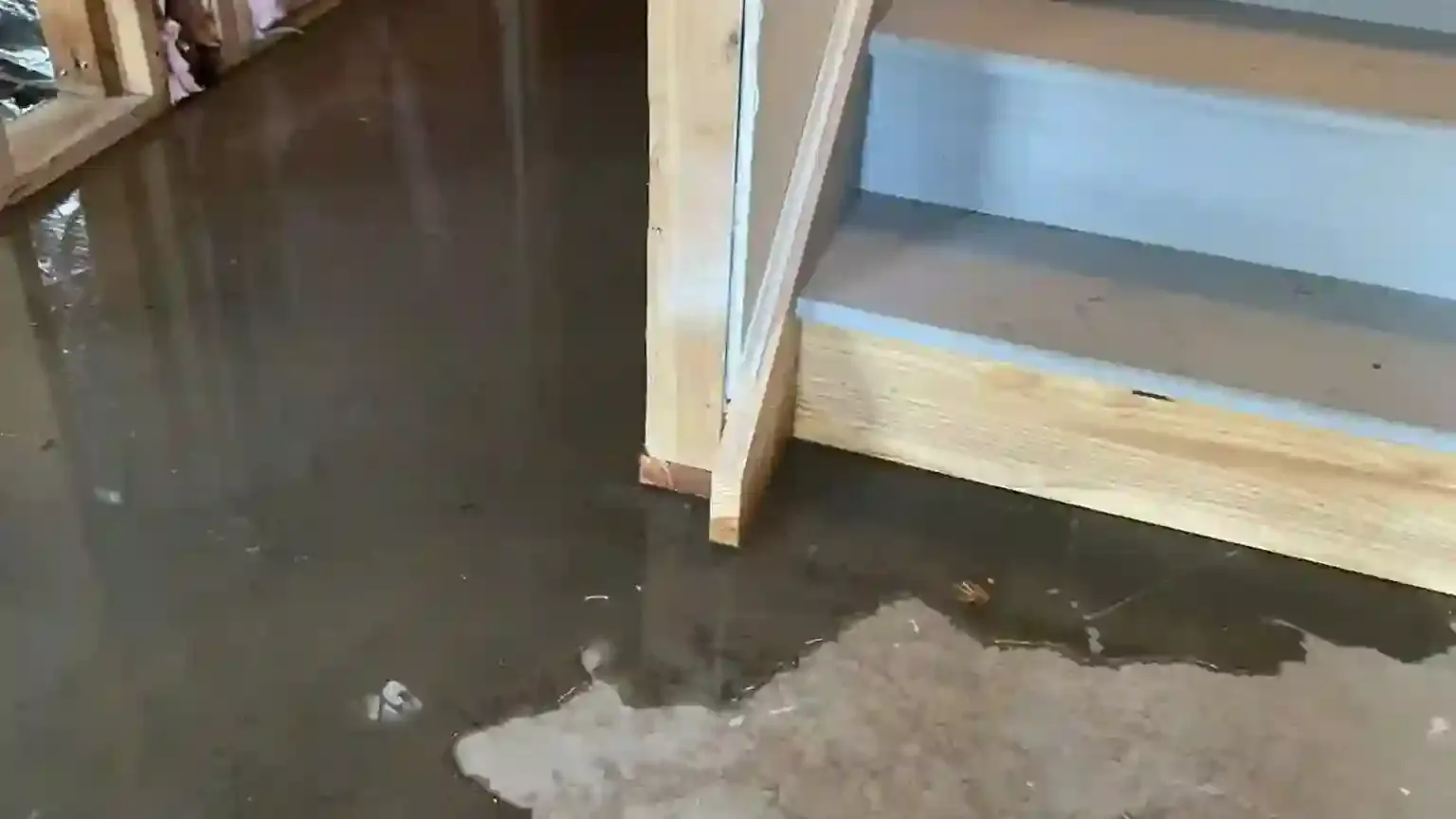
While you’re down there, check the sump. Pumps fail in boring, predictable ways: the power blinked during the storm, the float stuck against a wall, the pump was undersized from day one, the check valve is missing, or the discharge line is clogged. In other words, plenty of “flooded basements” are really “the pump had one bad night.”
Why did this start now?
Because your house didn’t change. Something around it did — and around here, the answer is usually the calendar.
Alpharetta’s boom-era subdivisions are now old enough that the original waterproofing has simply worn out, even on homes that still look brand new from the street. Those 1990s and early-2000s neighborhoods went up in one big wave, so a whole city’s worth of block and poured walls are aging out on the same schedule. Drain lines silt up. Original sump pumps hit twenty-something and quietly retire.
So a homeowner in Haynes Manor isn’t unlucky, and neither is the neighbor two doors down. Their system did its job for a long time and is now asking for a turn — a much better story than “something is wrong with my house.”
Then there’s our dirt. Red clay over weathered granite drains slowly, so after a long rain it holds water against the wall like a wet sponge pressed to a window. Pressure builds, and on block walls it pushes straight through the hollow cores. Up in The Hills at Windward we see it on graded lots where the yard falls back toward the house, and over in Crabapple on older walls that never had drainage to begin with.
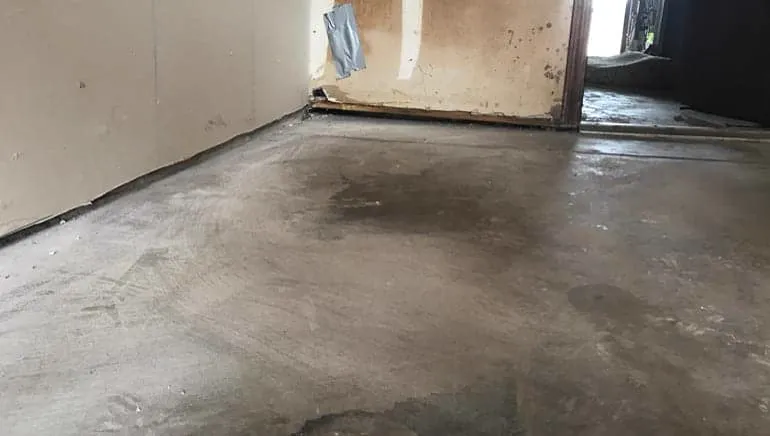
Geography plays a part too. The Big Creek floodplain runs right through town, so lots near the Big Creek Greenway can sit on genuinely high groundwater after a wet week. Meanwhile, homes on higher ground off Haynes Bridge Road usually have a surface-water story instead — gutters, downspouts and grading. Same puddle, two different fixes, which is exactly why guessing gets expensive.
Real talk: what decides whether the fix lasts?
Because this is the part nobody photographs, and it decides whether you’re dry in ten years or calling somebody again in three. It isn’t the pump brand. It isn’t the wall panels. It’s the stone.
A proper interior system is a channel cut along the perimeter of the slab, with perforated pipe bedded in clean washed stone under the floor. That stone is the whole trick, because it gives water somewhere to move before it reaches your floor instead of after. Bury the pipe in dirt instead and the line silts up quietly — and you won’t find out until the next big storm.
Here’s how the real repair goes, start to finish:
- Find the source first. We walk the outside — grade, gutters, downspout ends, window wells — then the inside.
- Open the perimeter. A narrow strip of slab comes up along the affected walls. Loud and dusty for a day or two, then done.
- Set pipe in clean stone. Below the floor, so water gets collected before it can pool on it.
- Build the sump right. Correctly sized pump, a working check valve, a sealed lid, and a discharge line that carries water well away from the house instead of back beside the foundation for a second try.
- Close it up clean. Fresh concrete over the channel, wall liner where it’s called for, and our mess hauled off.
Notice what’s missing from that list? Paint. Waterproof coatings are fine products, but a coating can’t beat pressure — it’s a raincoat on a submarine. That’s also why we warranty a drainage system in writing and not a bucket of sealer.
We stopped trying to block water years ago. Now we assume it’s coming, and we build it a better way out.
What should a fair estimate look like?
Ask for it in writing, and ask for four things specifically: how many linear feet of perimeter are being opened, what’s going in the trench, what pump is going in and how it’s sized, and where the discharge ends up. If an estimate can’t answer those, it isn’t an estimate — it’s a number.
Price moves with perimeter length, access, whether the basement is finished, and whether a new sump has to be dug. That’s why we walk it before we quote it. Our breakdown of basement flooding cost covers every factor behind the number, and the systems are explained on our basement waterproofing page.
One more thing worth knowing: standard homeowners insurance typically excludes groundwater seepage, and sump pump failure coverage is usually a separate rider you have to add on purpose. So it’s worth a five-minute call to your agent — ideally before storm season, not during it. FEMA’s guidance on protecting your property from flooding is a good read while you’re at it.
What should you do once a year after it’s fixed?
Here’s the short maintenance list we leave with every homeowner. None of it takes long, and all of it is the difference between a system that lasts and one that surprises you.
- Test the pump every spring. Pour a five-gallon bucket into the pit and watch it kick on, run, and shut off cleanly.
- Look at the float. It should swing freely, not rub the pit wall or a cord.
- Walk the discharge line outside. Make sure the end is clear, not crushed by a mower, and still pointed away from the house.
- Clean the gutters twice. Once after the leaves drop, once in spring. Then check that downspouts carry water at least six feet out.
- Check the grade. Soil should fall away from the foundation, not settle into a bowl against it.
- Empty the window wells. Leaves and mulch clog well drains faster than anything else.
- Think about a battery backup. Power tends to go out during exactly the storm you need the pump for.

Picture what that buys you. A hard spring storm rolls through and you don’t think about the basement at all. The floor is dry, the smell at the bottom of the stairs is gone, and instead of a room you apologize for you get a room you actually use — an office, a gym, storage you trust with things that matter.
Why does hiring local matter here?
Because we’ve spent twenty-plus years on these exact houses. We’re about twenty-five minutes east in Lawrenceville, so the crew that does your work is the crew that answers in year six. We’ve been out on nights when traffic was backed up from a show at the Ameris Bank Amphitheatre, and we’ve walked plenty of finished basement offices a work-from-home family can’t afford to lose.
We also know the problems that travel with water. If your walls show stair-step cracking too, that’s a foundation repair conversation, and we’ll say so instead of selling you drainage you don’t need. And if a relative one town over sees the same thing, we cover the Duluth standing water basement crowd too.

On timing: mold can begin growing on wet organic material — drywall, carpet pad, cardboard — in roughly 24 to 48 hours. So getting the water out beats waiting to see if it dries on its own. The CDC’s guidance on mold cleanup after flooding is the plain-language version, and it’s worth ten minutes.
Where we work around Alpharetta
Alpharetta is a straight shot up GA-400 from our shop, so we’re out this way constantly. We also cover Milton, Johns Creek, Roswell, Cumming, Duluth, Sandy Springs and the wider Fulton area. If you’re near the Windward corridor or over toward downtown Alpharetta, odds are we already have a truck nearby.
Questions Alpharetta homeowners ask us
Yes, when the fix matches the cause. A properly built drainage system with a correctly sized pump handles the water that reaches your foundation for the life of the house. The pump is the only part with a service life, so plan on replacing one about every ten years, the same way you’d plan for a water heater.
It depends mostly on how many feet of perimeter need drainage, how easy the space is to reach, and whether a new sump has to be dug. A single problem corner is a much smaller job than a full perimeter system. We walk it, measure it, and put a written scope in your hands before anyone talks price.
Twice a year still means water is getting in — you’re just only seeing it after the biggest storms. Sometimes the cause is small, like a clogged window well drain or a downspout dumping right at the wall. That’s why we look before recommending anything, because occasional water sometimes has a very simple answer.
For getting the water out today, absolutely — do that part right away. But a vacuum handles the puddle, not the reason the puddle showed up, so the water will come back with the next big rain. Think of it as drying the floor while the faucet is still running.
Roughly 24 to 48 hours on wet organic material like drywall, carpet pad and cardboard. So removal beats waiting it out. Get the water up, pull the soaked cardboard and padding, and run air across the space while you sort out the source.
Let’s find out exactly where that water is coming from
The inspection is free, the estimate is free, and nobody pressures you at the end. We’ll show you the entry point, explain the fix in plain English, and put the scope in writing — even if the answer turns out to be simpler than you expected.
(678) 914-5112Serving Alpharetta and all of Metro Atlanta · $500 off projects over $3,500 · Live support 7am–8pm, 7 days a week