

Basement Waterproofing in Peachtree Corners: What It Costs and What You Get
A plain-English look at the work, the price drivers, the warranty, and why hiring local usually saves you money.
“It’s not a lot of water. It just keeps coming back.” That is almost word for word how basement waterproofing Peachtree Corners calls begin, and the next sentence is usually, “we’ve already had somebody look at it once.” So you’re not starting from scratch here. You’re starting from tired, and you’d like a straight answer about what this takes and what it runs.
Good news, though: you’re asking at exactly the right stage. A damp corner that returns every spring is a well-understood problem, and the fix is more predictable than most home projects. Below is the whole thing in plain words — the work, the price drivers, what’s included, and the warranty.
What are you actually buying?
Short version? You’re buying water an easier way out of your yard than the path it currently takes through your house.
That’s really it. Water is lazy and endlessly patient, so it follows whatever route takes the least effort. On a lot of homes around here, that route runs along the seam where the basement wall meets the floor. So we don’t out-muscle it. Instead, we give it a better road.
Here’s the part that trips people up: concrete is porous. Water moves through solid, uncracked concrete by capillary action, wicking the way a paper towel pulls up a spill. That’s why a wall can be plainly wet without a single crack in sight. Your wall isn’t broken — it’s doing what concrete does.
Good news
A wet basement and a failing foundation are two different conversations. Most homes we walk only need the first one, and we’ll tell you plainly which one you’re in.
What does a real job look like start to finish?
Most interior systems follow the same shape, so you can picture the week before anyone rolls up. Here’s the honest order of operations:
- Find the source first. Before any number gets written down, we walk the outside — grading, gutters, downspouts, where water lands. Then we walk the inside. Fairly often the real fix is smaller than expected, because the trouble was outside the whole time.
- Open a channel at the perimeter. A narrow strip of slab comes up along the affected walls. It’s loud and dusty for a day or two, and then it’s over.
- Set drainage below the slab. Perforated pipe in clean stone, placed below floor level. That way water gets collected before it reaches your floor instead of after.
- Route everything to a sump. The pipe carries water to a basin, and the pump pushes it well away from the house — not two feet from the foundation, where it would simply come back for another lap.
- Close it up clean. Fresh concrete over the channel, wall liner where it’s called for, and our mess in our truck. Debris in your driveway isn’t a finish.
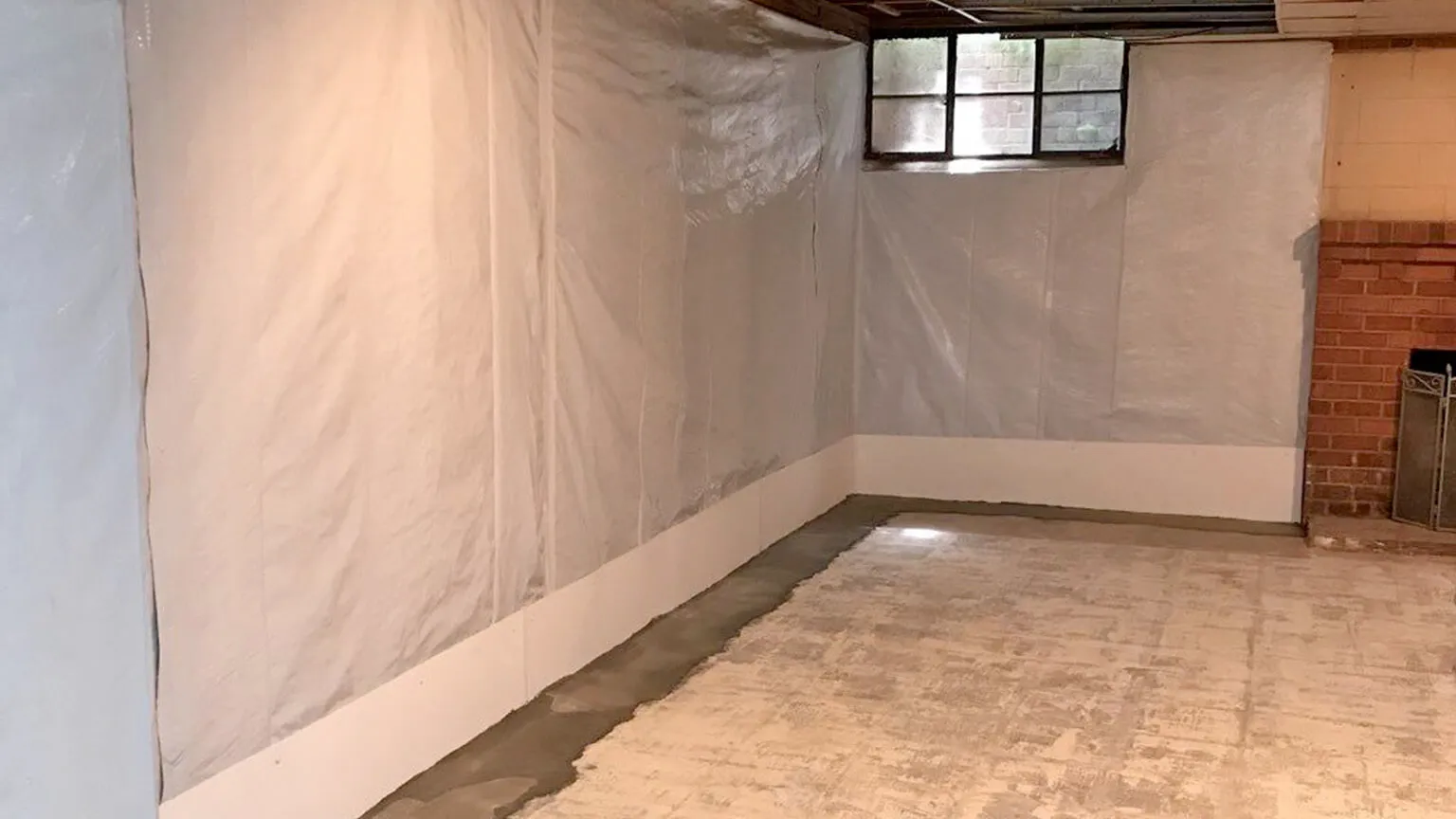
Notice what nobody did on that list? Painting. Waterproof paint is a fine product for what it is, but a coating can’t beat pressure. It’s a raincoat on a submarine.
Can we back up for a second?
Because there’s a question underneath the question you came here with. You typed in a price question. What you actually want to know is, “am I about to spend real money on the wrong fix again?”
That’s a fair worry, and here it’s an especially fair one. Peachtree Corners homes were mostly built before modern basement waterproofing was standard practice. Many of these houses never had a real system — they had a coat of tar and good intentions. So when a homeowner in Amberfield says the last patch lasted one season, that isn’t bad luck. It’s a 1978 detail doing what a 1978 detail does at fifty years old.
Twenty years in, the thing that changed how we work is simple: we stopped trying to block water and started routing it instead.
The other quiet culprit is the original drain tile. Clay or early perforated pipe silts completely shut over the decades, so the system your builder installed is still there doing nothing at all. Good news, though — that’s a known condition, not a mystery. We replace the path, and water starts leaving again. On the older streets near Spalding Corners, that’s most of what we find.

So what does it cost?
Straight answer: it depends on how much wall is involved and how hard that wall is to reach. Anyone quoting a flat number over the phone, sight unseen, is guessing — and you’d be paying for that guess. Still, you deserve to know what moves the number, so here’s what we’re weighing.
What drives the price up or down
- Linear feet. One wall is a different animal than a full perimeter. This is the single biggest factor, every time.
- Access. An open basement is straightforward. A finished one with a bar, a bath and built-ins costs more, because there’s careful work before the real work.
- Sump or no sump. Some homes have a serviceable basin already. Plenty don’t, or theirs is living on borrowed time.
- What’s happening outside. Sometimes regrading and rerouting downspouts handles most of it. That’s a smaller invoice, and we’ll say so.
- Wall condition. Bowing block means structural work comes first, since waterproofing a moving wall is money spent twice.
- The bluff factor. Steep lots sloping toward the river move more water and sometimes hit rock close to the surface. Both change the plan.
Small drainage corrections land at the low end. A full perimeter system with a new sump and battery backup in a finished basement sits at the top. Most basement waterproofing Peachtree Corners projects land in the middle, and after we walk the house you get one written number with the scope spelled out — not a “starting at.” Because a range isn’t a price. It’s a shrug with a dollar sign.
What’s included — and what isn’t?
Included: the diagnosis, the channel work, the below-slab drainage, the sump and discharge, wall liner where the plan calls for it, cleanup, haul-off, and the written warranty. Also included, and underrated, is the explanation — you’ll know why each piece is there before we touch anything.
Not included, unless we quote it separately: structural repair, mold remediation, replacing finished walls we had to open, and landscaping restoration. We’d rather show those as their own lines than bury them. Surprises belong in birthday parties, not invoices.
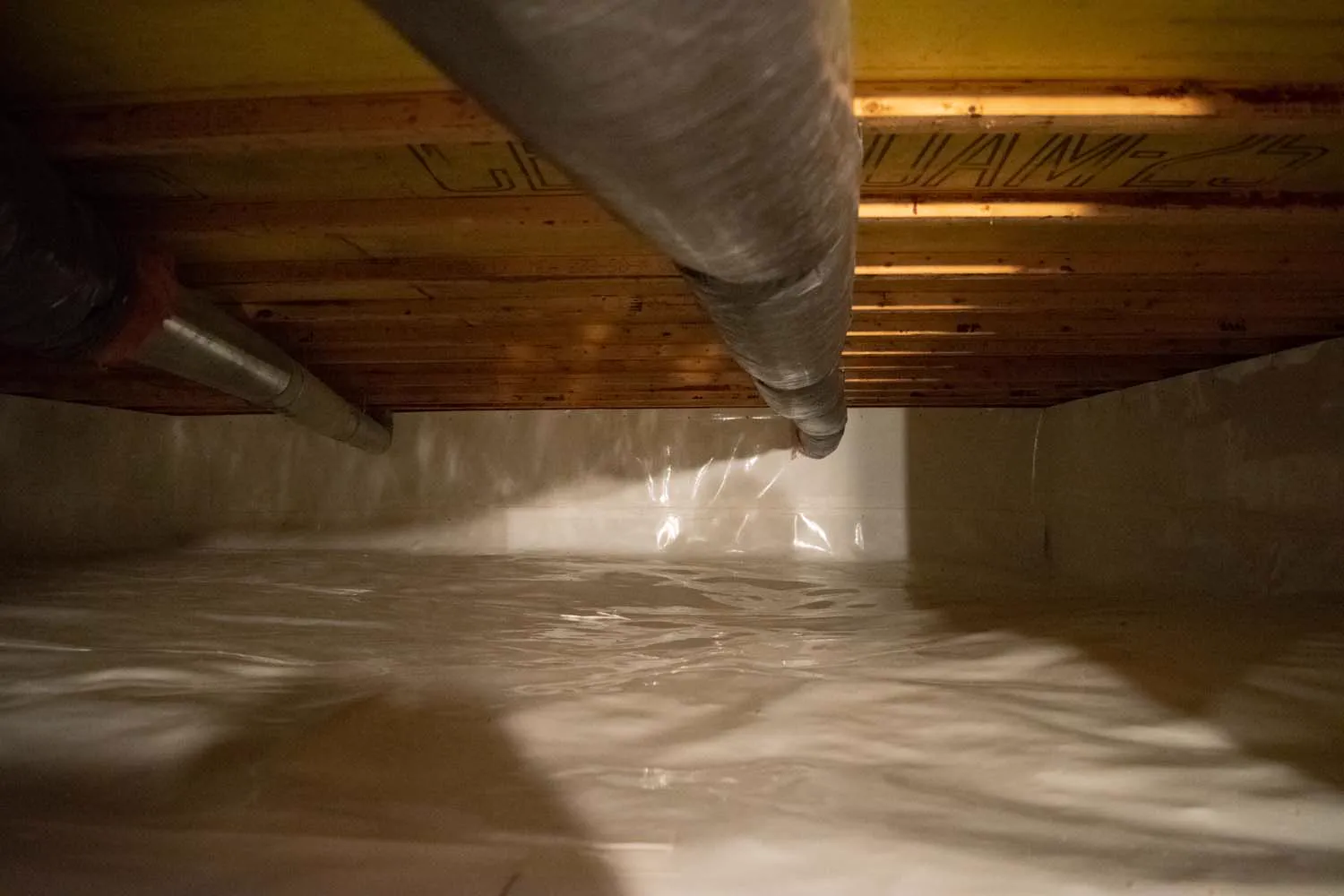
About the warranty: ours goes in writing before the crew starts, not after the check clears. That’s possible for one reason — you can’t honestly warranty a coating, but you can warranty a system built around how water actually behaves. If it ever needs attention, you call the same local number you called the first time.
Ever wonder about the rooms upstairs?
Here’s the part nobody connects to a damp basement. Air in a house doesn’t sit still — it rises. Warm air escapes through the attic, and replacement air gets pulled from the lowest, dampest level, so a good share of what you breathe upstairs started its trip downstairs.
That’s why symptoms show up in odd places. Sticky doors on the main floor. A hardwood seam that cups near the stairs, upstairs humidity your system fights all summer, plus a musty note in the laundry no candle quite covers. Good news — those are downstream effects, so handling the source usually settles them. The EPA’s guidance on moisture control explains the same idea in about ten minutes.

Now picture the after. Storms roll through, the forecast looks ugly, and you don’t go down to check. Instead of a room you apologize for, you get storage you trust, a workshop, or a place the kids can be loud. That’s the real product — not pipe in a floor, but a rainy weekend you get to ignore.
Why hire somebody local for this?
Because twenty-plus years here means we’ve likely worked a house near yours already. We know the hand-laid block behind Peachtree Station, and how differently water behaves on the flat parcels near Technology Park than on the slopes running toward Jones Bridge Park. We also know which streets off Peachtree Industrial Boulevard sit on rock about eighteen inches down.
That history matters for a boring reason: a warranty is only as strong as the company behind it. Same crews, same trucks, same county, year eight included. For a neutral read on our storm season, the National Weather Service office in Peachtree City keeps the local rainfall record.
Still sorting out what you’re looking at? Our guide to what causes a wet basement covers the symptoms one by one, and the waterproofing systems we install are laid out in full. If your house sits on a crawl space instead, crawl encapsulation is usually the better answer. Comparing notes with family one town over? We cover the same ground for Dunwoody basement waterproofing.
Where we work around Peachtree Corners
We’re based in Lawrenceville, about twenty minutes northeast, so we’re in this area constantly. That includes Norcross, Duluth, Berkeley Lake, Johns Creek, Dunwoody, Sandy Springs, Suwanee and Lilburn, plus Doraville, Tucker and the wider Gwinnett County area. If you’re near The Forum or anywhere along 141, odds are good we already have a truck close by.
Questions we get from this area
Yes, and you get it in writing before the work starts rather than after. Ask us to explain exactly what it covers and for how long, because a warranty nobody can summarize in one sentence isn’t much of a warranty. Since we’re local, the people honoring it are the same people who did the job.
Usually, yes. We open the bottom section of drywall along the affected walls only, do the work, and close it back up, so the room stays a room. It does add labor to the price, but it’s far cheaper than a gut job — and we’ll show you the plan before anything gets cut.
It protects value more reliably than it adds it. A documented system with a transferable warranty removes the moisture finding that stalls deals, and it turns unusable square footage into space a buyer can picture using. In a city where inspections routinely flag old foundations, that paperwork carries real weight.
Typically within a few days, and faster when you’re up against a closing date. Live support runs 7am to 8pm, seven days a week, so you’re not leaving a voicemail into the void. The inspection and the estimate are both free.
It depends mostly on linear feet of wall, access, and whether you need a sump. A single problem wall is a modest project, while a full perimeter with a new sump and battery backup sits at the higher end. We give you one written number after walking the house, never a phone guess.
Let’s find out what’s really going on down there
Every basement waterproofing Peachtree Corners project starts the same way: a free inspection, a free estimate, and no pressure at the end. We’ll show you where water is getting in and what it takes to stop it — even when the answer is simpler and cheaper than you figured.
(678) 914-5112Serving Peachtree Corners and all of Metro Atlanta · $500 off projects over $3,500 · Live support 7am–8pm, 7 days a week