

Waterproofing Options Snellville Homeowners Weigh: Inside System or Outside Dig?
A fair side-by-side of interior drainage and exterior excavation on a split-level with block walls — and a straight recommendation at the end.
Is this normal? That’s the question almost nobody wants to say out loud, and it’s the one we hear most. You’ve got a damp corner downstairs, a smell after rain, and a quiet worry that every house does this and you’re making a big deal of it. Most people comparing waterproofing options Snellville companies offer started right there.
So let’s answer it plainly. No, a wet basement isn’t normal, but it is extremely common and it’s very fixable. There are really only two families of repair, and once you understand how each behaves, choosing gets easy.
Option A: how does an interior drainage system work?
An interior system doesn’t fight water at the wall. Instead, it catches water underneath the floor and carries it away before it ever reaches your living space. Picture a gutter that lives below the slab.
Our crew opens a narrow channel in the concrete along the walls that leak. Perforated pipe goes in, packed in clean stone, sitting lower than your floor. Everything routes to a sump, and the pump moves water well away from the house. After that, the channel closes back up.
That’s the part worth underlining. Interior drainage collects water below the slab and routes it to a sump before it reaches the floor, instead of trying to block it at the wall. Because it never asks the block to hold anything back, it works the same on hollow block, poured concrete, or a wall somebody parged over in 1988.
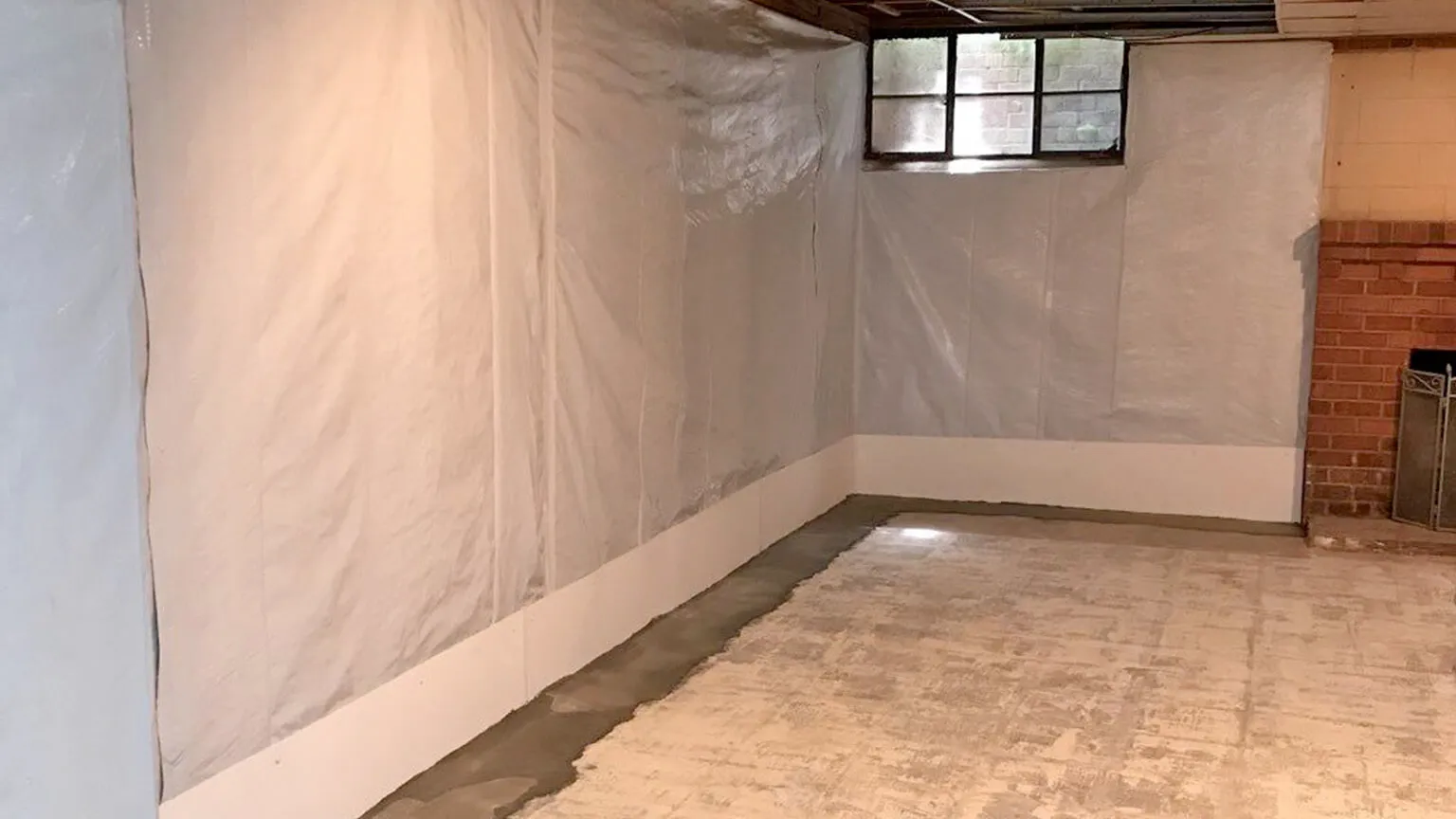
Why does that matter here? Because Snellville is a block-basement town. Split-levels and ranches built between 1975 and 1995 fill neighborhoods like Herrington and Ozora, and hollow block behaves differently than poured wall. Water gets into the cores, then finds the seam where wall meets floor.
Worth knowing
That seam has a name: the cove joint. It’s the most common entry point in homes of this era, and it usually has no crack at all. So if you’ve hunted for a crack and come up empty, you didn’t miss anything.
Option B: what does exterior waterproofing involve?
Exterior work goes after water earlier, before it touches the foundation. Soil gets dug out to the footing, the wall gets cleaned and coated with a membrane, and a drain pipe goes in at the base. Then the trench is filled back and the grading gets corrected.
On paper it’s the more complete approach, and we’ll say that plainly. Water never reaches the wall, which means the wall never has to fight. For a block wall with real bowing, relieving that outside pressure genuinely helps.
Still, exterior work is the more disruptive option, and on Snellville lots that disruption is very real. Split-levels sit into a slope, so one side may be eight feet below grade while another is barely two. Decks and sunrooms added over thirty years often sit right where a machine needs to be. Sometimes there’s no clean path in, and wanting one doesn’t create one.

Let’s back up — what are you really deciding?
Here’s the thing. When homeowners call asking which system to buy, that’s rarely the real question. The one underneath it is simpler: will this be fixed for good, or am I about to pay for another patch?
We understand why. Long-tenure owners around Kingsley Creek have often lived with the same damp corner for years, and many already paid somebody once. Hydraulic cement got troweled into a joint, a sealer got rolled on the wall, and it all looked great until the next hard spring. That’s not bad luck — it’s a coating being asked to do a drain’s job.
Water always wins the blocking fight eventually, because the pressure never stops and the coating always ages. So we stopped trying to block water and started routing it instead.
Twenty-plus years in, that’s the biggest shift in how we work. A sealer isn’t a scam, but it manages dampness, not pressure. Stone and pipe have nothing to wear out, which is why the fix holds.
A lot of Snellville basements were finished in the nineties, and the drywall has been quietly wicking water ever since. The fix there isn’t more drywall. It’s stopping the water first, then rebuilding once — and honestly, that order saves people money more often than it costs them.
Side by side, honestly
Enough theory. Here’s how the two compare when we’re standing in your basement with a flashlight and a moisture meter.
Interior drainage
- Work happens indoors, so weather never stops it
- Decks, patios and landscaping stay untouched
- Usually finished in one to three days
- Handles cove-joint seepage, the classic block leak
- Includes a sump pump, which needs occasional service
- Works on block, poured or parged walls alike
Exterior waterproofing
- Stops water before it reaches the wall at all
- Needs excavation down to the footing along that wall
- A longer job, and rain pauses the schedule
- Costs more, mostly for digging and putting things back
- Often blocked by an added deck, slab or tight side yard
- Also relieves soil pressure on a bowing block wall
Notice that neither column says “better.” On a given house one becomes obvious within twenty minutes of walking the lot, while the other turns into a conversation we can skip.
What actually decides it on a Snellville house?
Four things, more or less. They come up on nearly every inspection we run between Briscoe Park and the Towne Center at Snellville.
The deciding factors
- Where is water showing up? At the floor seam points inside. Down the wall face points outside.
- Is the wall moving? A horizontal crack or a bow means clay pressure, and that changes the plan.
- Can equipment reach the wall? An old deck, a sunroom or a slope often answers this before we do.
- What was already tried? Old patches tell us a lot about where water really travels.
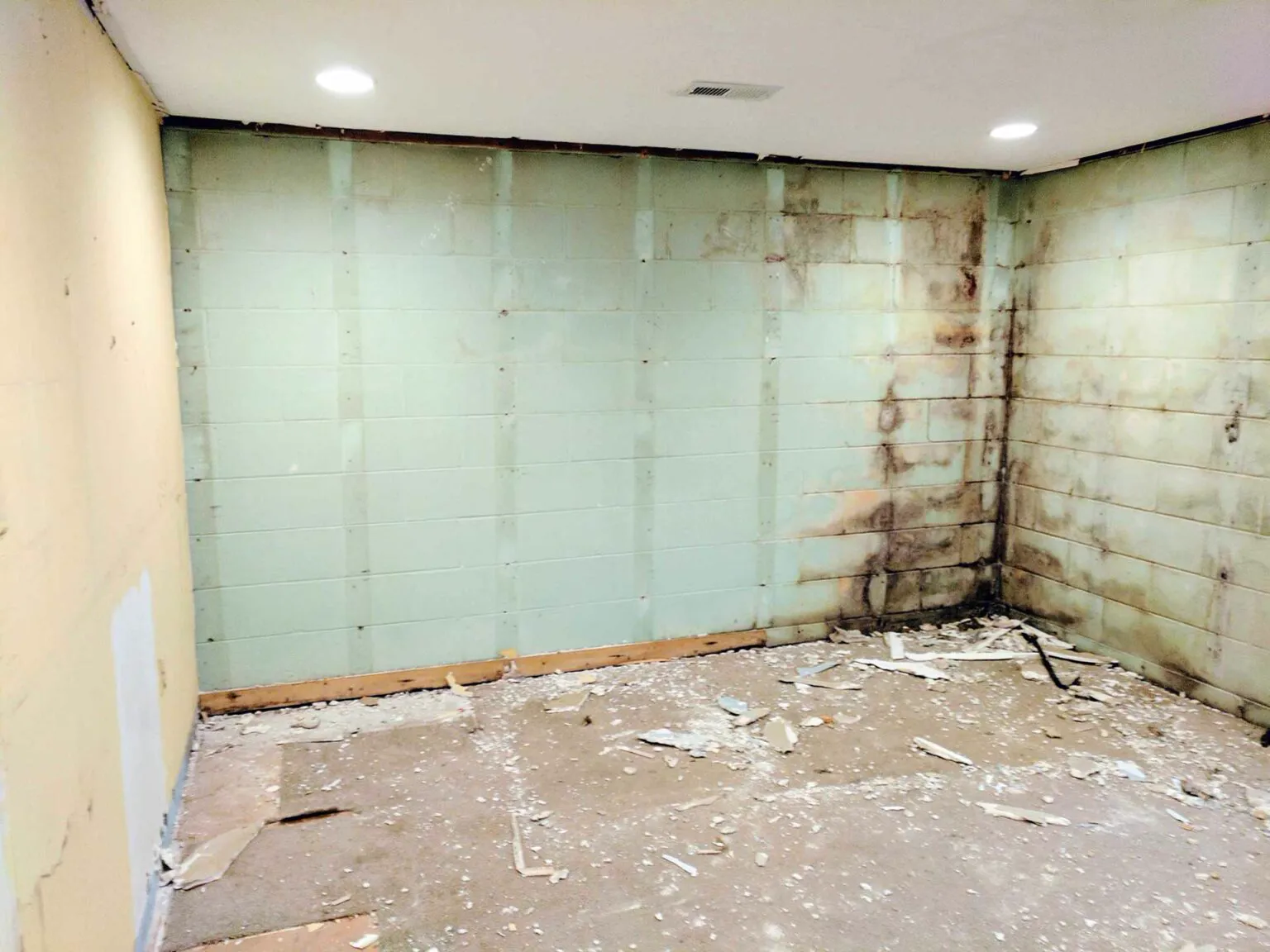
Red clay is the quiet character here. It swells when wet and shrinks when dry, so it presses on block walls and then pulls away, over and over, for decades.
Grade matters just as much. Homes off Dogwood Road often sit with the yard tipping gently back toward the foundation, which nobody notices until a storm turns the low side into a shallow pond. Fixing that alone won’t cure a cove-joint leak, but it takes real pressure off the system.
So which one do we actually recommend?
For most homes here, we recommend interior drainage first, paired with outside corrections that don’t need a machine — downspout extensions, regrading the low side, and clearing the gutters. That combination solves most of what we see in this zip code, and it does it without touching your yard.
We recommend full exterior work when the wall itself is struggling and access allows it. Bowing block or a wall that’s lost mortar deserves relief from the outside, so in that case the dig earns its cost. For the technical detail on each system, our basement waterproofing page walks through the components.
Sometimes we tell folks they need neither. If water only shows up in heavy storms and the downspouts dump right at the foundation, start there. A morning of drainage work has quietly saved more basements than anyone in this trade admits. Curious how this plays out on newer construction? Our breakdown of Buford waterproofing options covers homes built after 2000, where the math shifts.
What does this have to do with the air upstairs?
Ready for the part that surprises people? A damp basement isn’t only a basement problem. The symptoms often show up two floors away, which is why homeowners chase them separately for years.
Air inside a house travels upward. Warm air escapes through the attic, which pulls replacement air in from the lowest point — your basement or crawl space. So the air you breathe in the bedroom started its trip by that damp block wall. That’s why an upstairs closet can smell musty even though it’s dry up there.
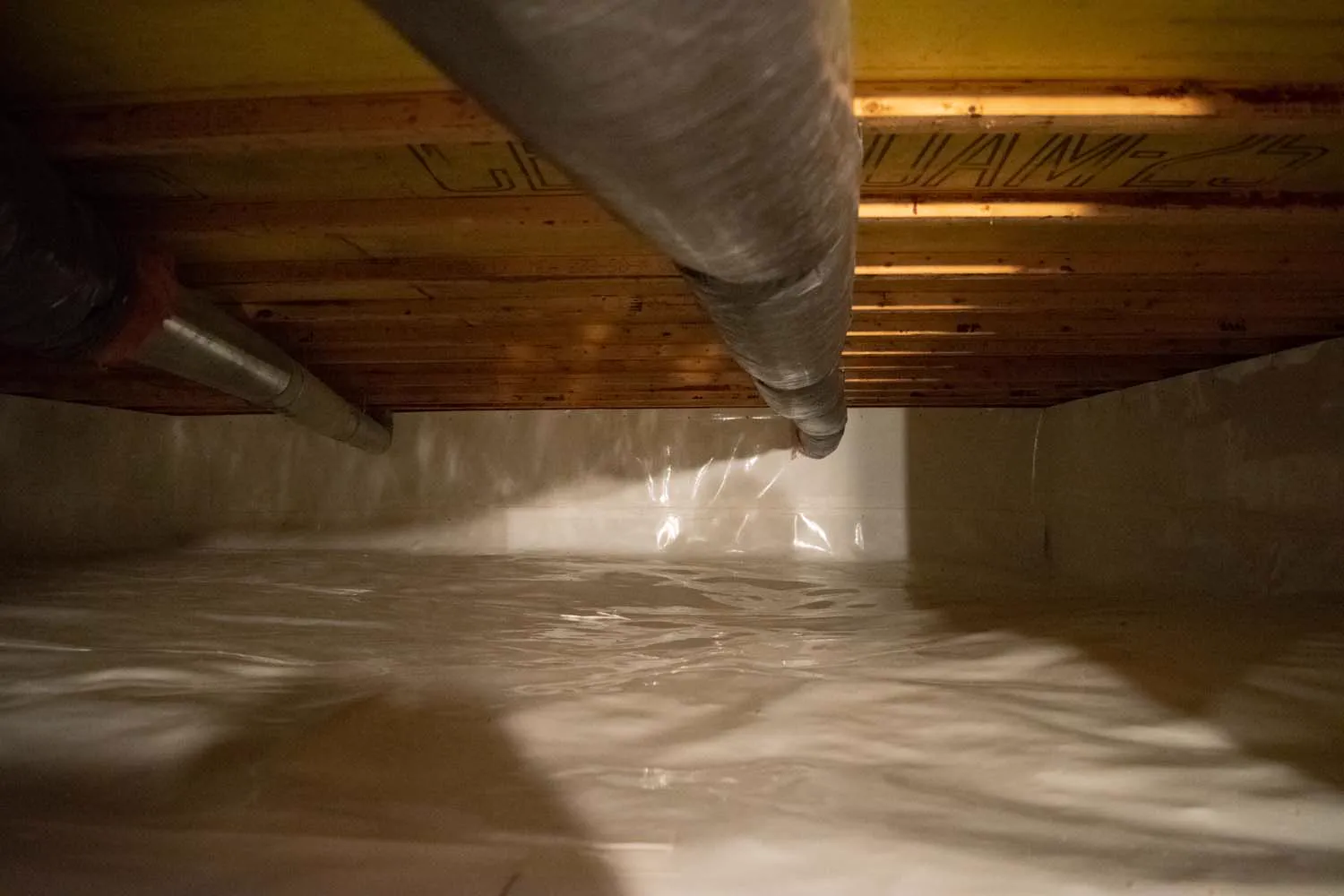
Moisture rides along for the trip. Aging crawl spaces do the same thing, pushing musty air up into the main floor until the whole house feels heavy in July. The EPA’s guide to mold and moisture explains the relationship well, and if you want the groundwater side of the story, the U.S. Geological Survey keeps a good plain-language primer.
Good news — control the moisture and that whole chain unwinds. If a crawl space is the source in your house, crawl space encapsulation is likely the conversation instead of drainage.

Picture the next storm
Here’s the outcome we’re really selling, and it isn’t pipe. Rain moves in overnight, the kind that used to send you downstairs with a flashlight. Instead you hear it, you notice it, and then you go back to sleep. In the morning the floor is dry, and the bottom of the stairs smells like nothing at all.
You’ll get the same crews and trucks from start to finish, plus a written warranty before any work begins. We’ll explain the plan in plain language and show you what we’re seeing. For a deeper look at older homes, our guide to the best basement waterproofing approaches goes further.
Where we work around Snellville
We’re based in Lawrenceville, roughly fifteen minutes north, so we’re in this part of Gwinnett almost every week. That includes Snellville, Grayson, Loganville, Lilburn, Stone Mountain, Tucker, Lawrenceville, Dacula and Centerville. Odds are we’ve already worked near you.
Questions Snellville homeowners ask us
Usually within a few days, and sooner when water is actively coming in. Live support runs 7 a.m. to 8 p.m., seven days a week, so a real person picks up. Both the inspection and the estimate are free.
It depends on how much wall is involved and how hard that wall is to reach. A short drainage correction sits at the low end, while a full perimeter system under a finished basement sits at the high end. Anyone quoting a flat price over the phone is guessing, so we walk the space first and hand you a written scope.
Most interior systems run one to three days from start to cleanup. Exterior excavation takes longer and pauses for rain. Either way you get a schedule up front, and our crew hauls its own mess away.
Only what sits along the walls we’re treating. We need about four feet of clear perimeter there, and everything in the middle of the room can usually stay put. We’ll tell you exactly which sections to clear before the first day, never on it.
Sometimes, and sometimes it’s a separate repair. A hairline vertical crack often stops mattering once water is routed away, but a horizontal crack or a bow means the wall is under pressure and needs structural attention as well. We’ll show you which one you have during the inspection and explain both paths.
Let’s find out what your Snellville basement is really doing
The inspection is free, the estimate is free, and nobody pressures you. We’ll show you where water is getting in, walk you through both approaches, and say honestly when the smaller fix is the right one.
(678) 914-5112Serving Snellville and all of Metro Atlanta · $500 off projects over $3,500 · Live support 7am–8pm, 7 days a week