

Waterproofing Cost Peachtree Corners: What the Job Really Involves
The steps in order, the things that move the number, and how to tell a finished job from a rushed one.
Picture two houses on the same street off Peachtree Parkway. Same builder, same year, same floor plan, and even the same shade of brick. One basement is bone dry every spring, while the other one grows a damp patch in the corner like clockwork. That gap is the whole story behind every waterproofing cost Peachtree Corners question we get asked.
So what’s different? Almost never the house. It’s the dirt, the slope, and whatever the original builder did or didn’t put in the ground back in 1978. Good news, though — once you can see those differences, pricing stops feeling like a mystery and starts feeling like math you can check.
What are you actually paying for?
Here’s the short answer: you’re paying for a path. Water shows up whether anyone invites it or not, so a real system gives it an easy route out instead of holding it back at the wall. Interior drainage collects water below the slab and carries it to a sump before it ever reaches your floor. That single idea separates a system from a patch.
Most jobs follow the same seven steps, and you should be able to repeat them back to any company that quotes you.
- The inspection. We walk the outside first — grading, downspouts, where the yard sheds water. Then we read the walls inside.
- The diagnosis. You get told where water enters and why. If the fix is smaller than you feared, we’ll say so.
- The written scope. Linear feet, materials, sump details and price, all on paper before anybody touches your house.
- Opening the channel. A narrow strip of slab comes up along the affected walls. It’s loud for a day, so plan accordingly if you work from home.
- Installing the drainage. Perforated pipe sits in clean stone below floor level, which is the part doing the real work.
- Routing to the sump. The pipe feeds a basin, and the pump pushes water well away from the foundation instead of dropping it right back beside it.
- Closing it up. Fresh concrete, wall liner where it’s called for, and our mess hauled off.
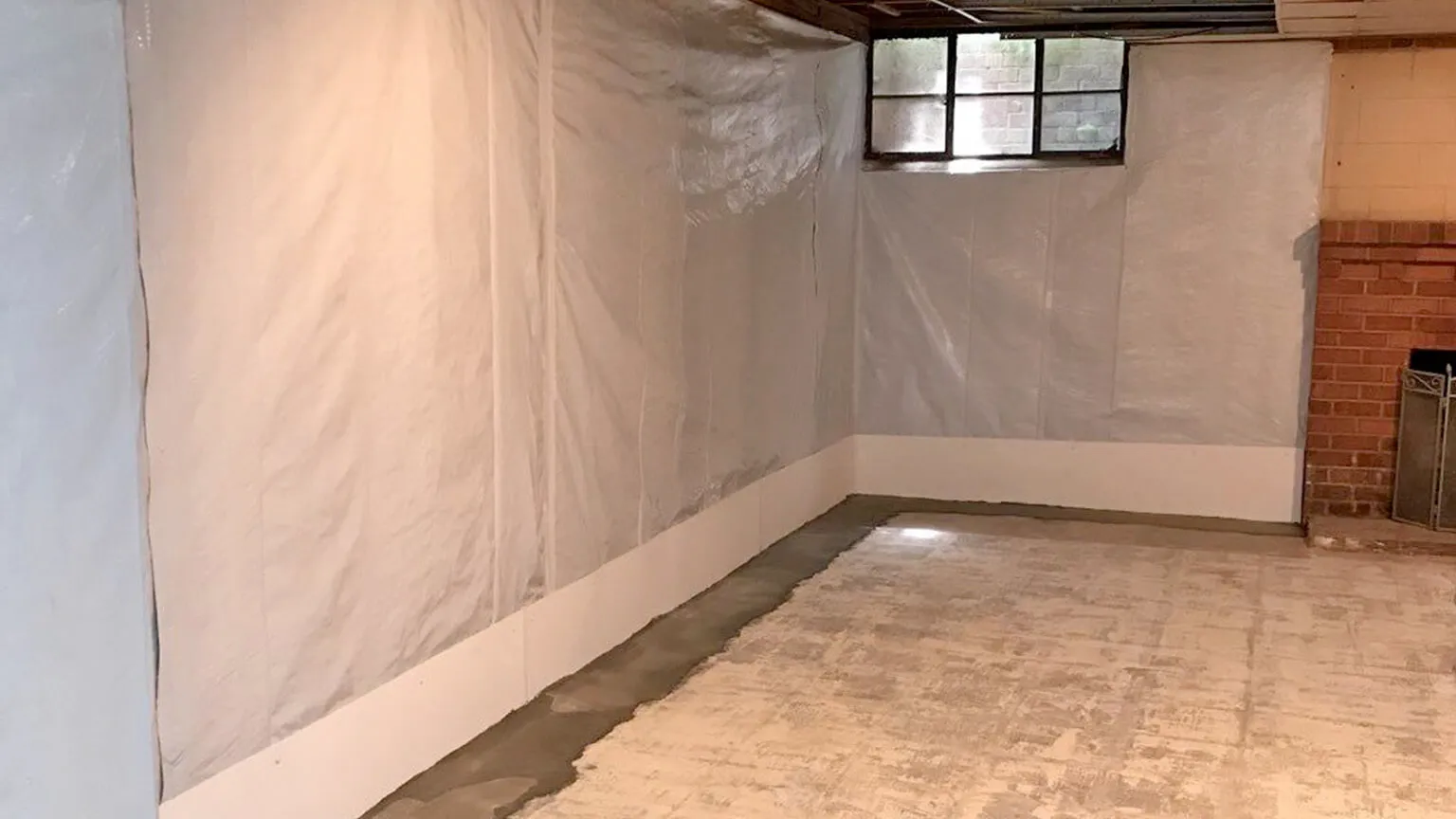
Notice what isn’t on that list? Paint. Waterproof coatings have their place, but a coating can’t beat pressure, and pressure is what we’re dealing with here. It’s a raincoat on a submarine.
Why do two estimates come back thousands apart?
This next part is the reason. Two companies can look at the same basement and hand you numbers that don’t even seem related, and it’s usually not because one of them is being greedy. They’re quoting two different jobs.
One is pricing a full perimeter system with a new basin and a sealed lid. The other is pricing four feet of channel under the worst corner and a coat of sealer. Both are real work, but only one is still working in year eight. So when you compare waterproofing cost Peachtree Corners quotes, read the scope before the total.
What actually moves the number
- Linear feet. One wall versus a full perimeter is the single biggest swing, and it isn’t close.
- Access. An open basement is simple. A finished one with a bar, built-ins and a bathroom means careful work before the real work starts.
- Sump and pump. Some homes already have a serviceable basin, while plenty of 1970s builds have none at all.
- What’s happening outside. Sometimes regrading and moving downspouts handles most of it, and that’s a much smaller invoice.
- Wall condition. Bowing or active cracking gets addressed first, because waterproofing a moving wall is money spent twice.
- Backup power. A battery backup costs more, but it runs during the storm that knocks out your power — which is the exact storm that matters.
Small drainage corrections land at the low end, while a full perimeter system with a new sump and backup sits at the top. Most homes fall in between. Either way, you get one written number with the scope spelled out — not a range, and definitely not a “starting at.”

One local wrinkle: houses here were mostly built before modern waterproofing was standard practice. Many never had a real system at all — they had a coat of tar and good intentions. On the oldest streets near Simpson Elementary we also find crawl spaces with torn or missing vapor barriers and water sitting on bare dirt. When that’s the case, crawl encapsulation is the better answer.
How long does it take, and what do you need to do?
Most interior systems run two to three working days. A single wall can wrap in a day, while a full perimeter with framing to remove and rebuild can stretch past a week. Concrete also needs time to cure, so give it a few days before the heavy shelving goes back.
Your prep list is shorter than you’d think:
- Clear about four feet along the walls we’re working on. Everything else slides to the middle.
- Move anything fragile upstairs, since jackhammers make dust travel.
- Point out the outlet you want the pump on, and mention if it’s a shared circuit.
- Plan for noise on day one, and maybe warn the neighbor who works nights.
That’s genuinely it. We’ll handle the heavy things, because asking a homeowner to wrestle a chest freezer alone isn’t much of a service.
What can you honestly do yourself?
Quite a bit, actually — and we’d rather tell you than sell you. Cleaning gutters and extending downspouts six to ten feet out solves a surprising number of damp corners, especially in the older canopy neighborhoods where fall leaf drop buries everything. Re-sloping the first few feet of soil away from the foundation is weekend work with a shovel. Sealing a hairline crack in a poured wall is a real DIY win too.
Here’s where it stops. Anything below the slab needs equipment, and anything structural needs an engineer’s eye. Cutting concrete blind is how a Saturday project meets a plumbing line. Groundwater also doesn’t respond to effort — the U.S. Geological Survey’s groundwater basics explain why the water table moves the way it does.
If you want to compare methods side by side before you call anyone, our breakdown of waterproofing options lays out interior, exterior and drainage-only approaches in plain language.
The number that changes how this looks
Ready for the one most homeowners have never done the math on? It isn’t about rain. It’s about push.
Engineers size basement walls for saturated clay pressing sideways at roughly 60 to 80 pounds per square foot for every foot of depth. Run that down an eight-foot wall and you’re looking at close to 2,000 pounds of sideways push on every single running foot of your foundation after a wet week. Now think about a bowing block wall in a house built in the early seventies, holding that back since Carter was in office.
That’s the honest reason sealer doesn’t hold. No coating argues with that kind of force, so we stopped blocking water years ago and started routing it instead. Relieve the pressure, give it an easy exit, and the wall stops fighting. Homeowners in Riverfield and down the bluff streets of River Station see this more than most, since those lots run steep toward the river.
Spring storms usually make the phone ring, and you can watch the pattern yourself through the National Weather Service office in Peachtree City.
How do you know the job was done right?
Fair question, since most of the work ends up buried under new concrete. Ask for photos during the dig — the stone bed, the pipe, the connection at the basin. Any crew doing it properly will gladly show you, and if nobody has pictures, that tells you something too.
After that, use this short list:
- The new concrete sits flush with the old floor, with no lip to trip on.
- The sump has a sealed lid, and the discharge line ends well away from the house.
- The pump kicks on when you pour a bucket into the basin, and it shuts off cleanly.
- Your warranty is written down, transferable, and short enough to read in one sitting.
- The basement is swept, and the debris left with the truck.

Then comes the part nobody puts in a brochure. The musty smell at the bottom of the stairs disappears, and storage you stopped trusting becomes storage again. Best of all, the next ugly forecast rolls through and you don’t think about it once.

We’ve worked all over this city — the newer builds around Town Center at Peachtree Corners, the established streets near The Forum on Peachtree Parkway, and the older ranch homes off 141. Want the full rundown of systems? Our basement waterproofing page covers it, and we break down Dunwoody waterproofing cost the same way.
Where we work around Peachtree Corners
We’re based about twenty minutes northeast in Lawrenceville, so this whole corridor is a short drive. That includes Norcross, Duluth, Johns Creek, Dunwoody, Berkeley Lake and Sandy Springs, plus Suwanee, Lilburn, Alpharetta and the rest of Gwinnett County.
Questions we get around town
It comes down to how much wall is involved and how hard it is to reach. A short drainage correction sits at the low end, while a full perimeter system with a new sump and battery backup in a finished basement sits at the top. Anyone quoting a flat price over the phone is guessing, so we walk it first and then put one number in writing.
Two to three working days covers most interior systems. A single wall can be done in one day, but a full perimeter with framing to remove and rebuild can run a week or more. After that, give the fresh concrete a few days to cure before you load the floor back up.
No, just the perimeter. We need about four feet of clear space along the walls we’re working on, so shelves and boxes shift toward the middle of the room. Anything fragile is better off upstairs for a few days, and we’ll help with the heavy pieces.
Sometimes, though they’re really two separate jobs. Drainage handles the water, but a crack that’s still moving needs its own repair first. Sealing a wall that’s shifting only buys you a season, so we’ll tell you plainly which situation your house is in during the inspection.
Neither one wins automatically — it depends on where water enters and what’s sitting on the soil outside. Exterior work stops water before it reaches the foundation, but it means excavating, and a deck, patio or mature tree changes that math quickly. Interior drainage is less disruptive and fits most homes in this area, especially on the steeper lots.
Let’s take a look at what’s going on down there
The inspection is free, the estimate is free, and nobody leaves you with a hard sell. We’ll show you where water is getting in, what it takes to stop it, and what it costs — even if the answer turns out simpler than you expected. Homeowners across Peachtree Corners call us for exactly this.
(678) 914-5112Serving Peachtree Corners and all of Metro Atlanta · $500 off projects over $3,500 · Live support 7am–8pm, 7 days a week