

Standing Water Basement Buford: Mild, or Worth Fixing?
Where the water came from, how to read the puddle, and what an honest repair actually looks like.
Why is there standing water in my basement? Because water found a way in faster than the floor could shed it — and almost always through a seam, a pump, or a drain, not through the concrete itself. That’s the short answer to nearly every standing water basement Buford homeowners call us about, and it’s a much better answer than most people expect.
Real talk: puddles look worse than they are. Bulk water on a slab is a plumbing-and-drainage story, not a broken-house story. So take a breath. This one is common, it’s readable, and it’s very fixable.
Before you go down there
Never step into standing water while power is on in that space. Kill the circuit at the panel first, and if the panel itself is down there, call an electrician or your utility. Everything else can wait ten minutes.
Where did the water come from?
Standing water means bulk entry, not damp air. Something let a volume of water through, and gravity did the rest. So the list of suspects is short.
Suspect one is the cove joint — the seam where your wall meets the floor slab, and the most common entry point in a Georgia basement. Those two pieces of concrete were poured on different days, so they never truly bonded. As a result, it isn’t a crack at all. It’s a doorway running your entire perimeter.
Suspect two is your sump pump. Pumps rarely die dramatically. Instead they lose power mid-storm, or the float sticks, or the pump is simply too small for the job. Sometimes there’s no check valve, so every gallon it pushes out slides right back down the pipe.
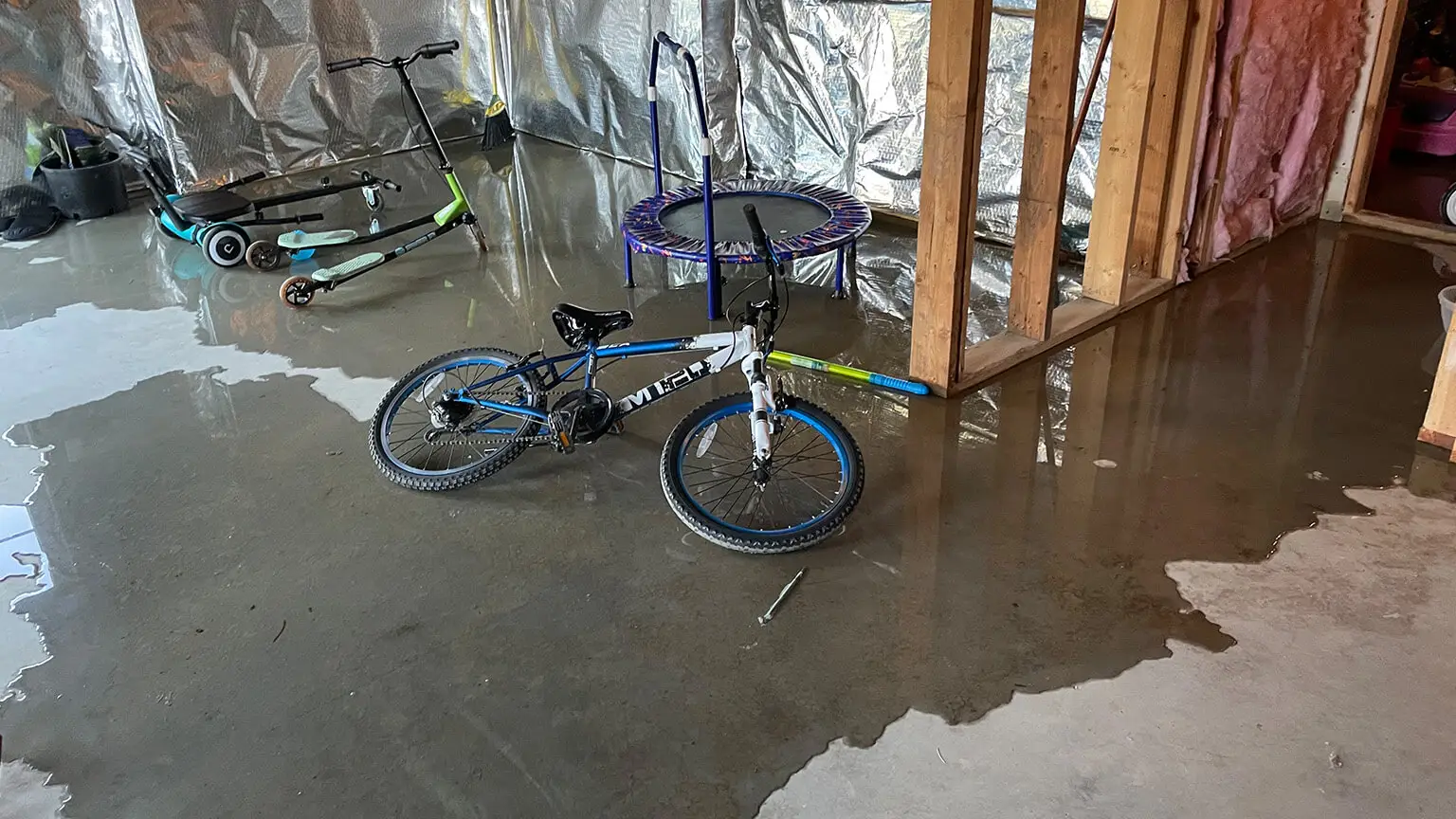
Suspect three is a blocked line, since drain tile silts up and discharge pipes get crushed or plugged with mulch. Suspect four is the one everybody forgets: a window well with no working drain. Fill a concrete box with rain and it becomes a bucket, and buckets leak inward.
Then there’s our dirt. Georgia red clay holds water tight against the wall long after the rain quits, so pressure keeps building for days. On block foundations it works through the hollow cores until it finds that bottom seam. That’s why plenty of homes flood the day after a storm.
What is the puddle telling you?
Here’s the thing — where the water sits is real information, and you can read it before we get there. Snap a photo, because it saves us both time.
Water in one corner usually points to a local entry: a cracked window well, a bad downspout outside that wall, or one tired stretch of cove joint. Water spread evenly across the slab tells a different story, since that pattern means pressure pushing up from underneath.
A wet line hugging every wall is classic pressure at the cove joint. Meanwhile, a dry perimeter with a puddle mid-floor is usually the sump pit or a plumbing line.
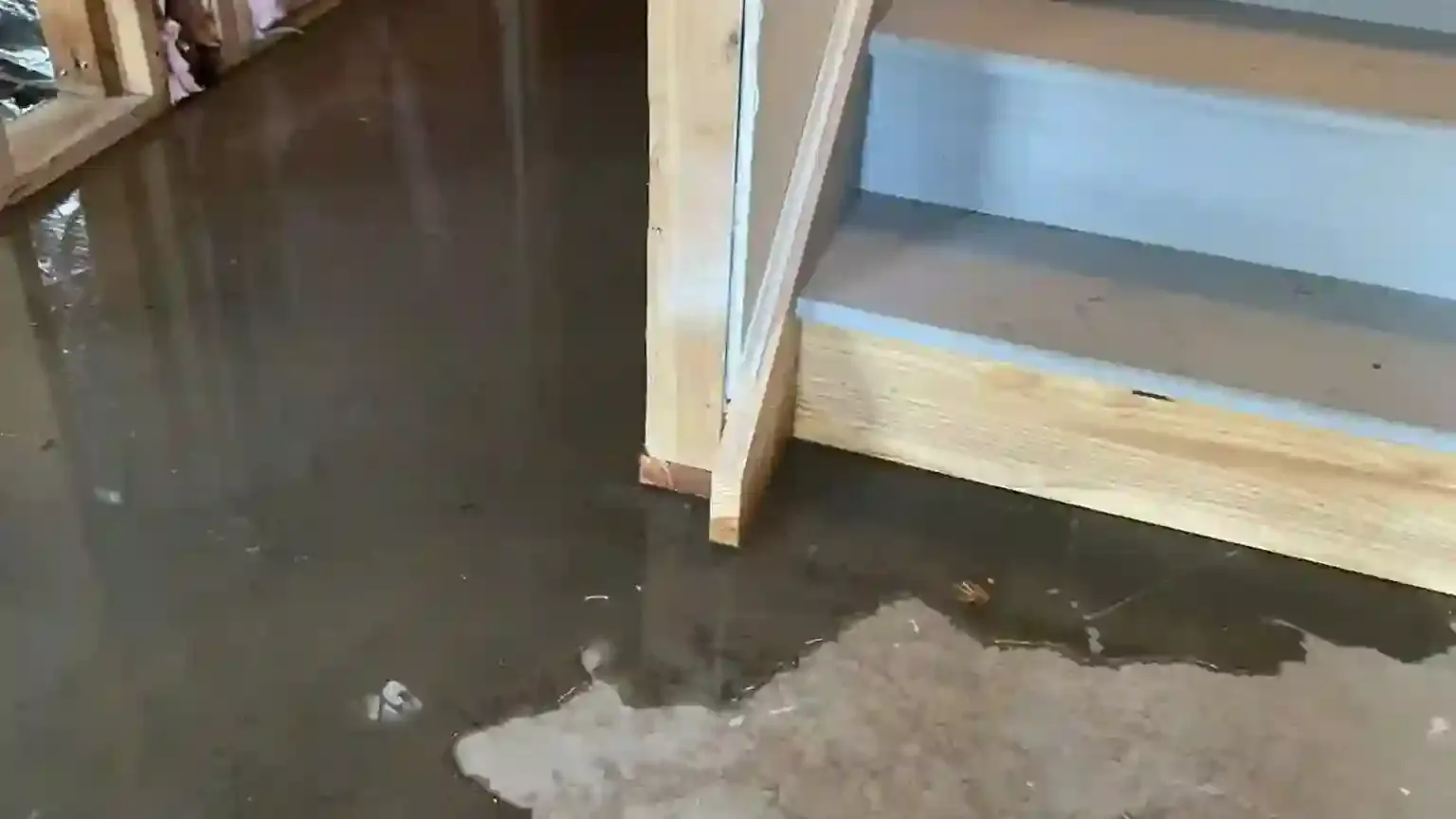
One more clue is worth its weight in gold. A basement that floods only in heavy rain almost always has a surface water problem, not a groundwater problem — and surface water is usually the cheaper fix. Gutters, grading and downspouts fall in that bucket, so we check outside first.
So is it mild, or worth fixing?
Fair question, and you deserve a straight answer. Nearly every standing water basement Buford homeowners show us lands in one of three buckets, and none of them are alarming.
Mild. A thin puddle once or twice a year, near one wall, dry again in a day or two. Usually the cause is outside the house, and so is the fix.
Moderate. Water arrives on a schedule — every real storm, same spots, a little farther each time. Now the drainage is out of room, and finishes start keeping score. Baseboards swell and tack strips rust.
Worth handling now. Water across the slab, a sump that runs constantly, or a floor that never fully dries between rains. That said, “handle it now” doesn’t mean panic. It means stop guessing, because the cause is knowable.

What happens if it’s left alone? Honestly, it holds steady a while, then slowly widens its territory, since a seam never tightens up on its own. The cost of waiting is rarely the concrete. It’s drywall, flooring, and whatever you stored down there.
What would we want to know if it were our house?
These are the questions we’d ask if the wet basement were ours, and they’re the ones most quotes skip. Three of them, in order.
First: does the house sit on a slope? Buford has serious grade changes, especially toward the lake and below Buford Dam. On steep lots, uphill runoff collects at the back of the house and stacks against one wall. We see that pattern constantly around Ivy Creek.
Second: how high is the water table? Living near Lake Lanier is wonderful right up until the water table decides your basement is part of the lake. On lake-corridor lots, sustained rain lifts groundwater for weeks, so the fix has to assume water is coming.
Third: how old is the original system? Much of Buford went up between the late nineties and the mid-2000s, so a whole city’s worth of builder-grade drainage and original pumps are aging out together. A homeowner over in Sardis isn’t unlucky — their system worked for two decades and is asking for a turn.
None of those questions are about selling you a bigger job. They’re about matching the repair to the real cause. If the answer is “one downspout,” we’ll say so and go home.
We stopped trying to block water years ago. Now we assume it’s coming, and we build it a better way out.
What does the real fix look like?
Let’s walk it, so nothing feels like a surprise. Every step comes back to one idea: give water an easier path than the one it’s using.
- Find the source first. We walk the grade, gutters and window wells, then read the water pattern inside.
- Fix the outside stuff. Extend downspouts, correct a back-pitched grade, drain the window wells. On “heavy rain only” homes, that alone can do most of the work.
- Open a channel at the perimeter. A narrow strip of slab comes up along the wet walls. It’s loud for a day or two, then it’s done.
- Set drainage below the floor. Perforated pipe in clean stone, under the slab, so water gets collected before it reaches your floor.
- Build the pump right. Correct size, a check valve, a sealed pit, and a battery backup so a power flicker isn’t the whole story.
- Close it up clean. Fresh concrete over the channel, wall liner where it’s called for, and our mess hauled off.
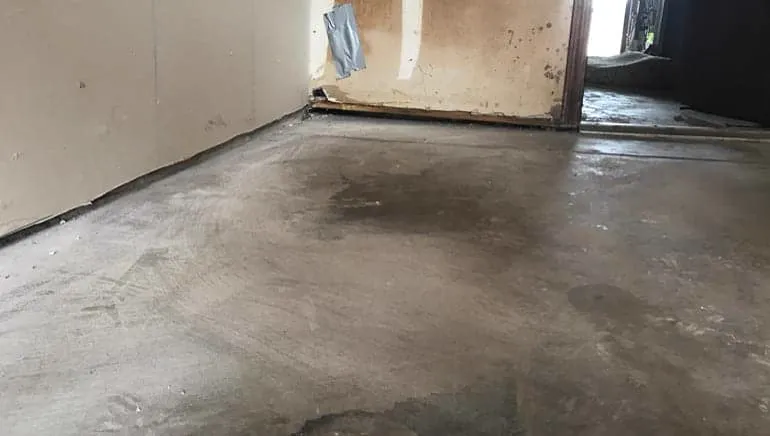
See what’s missing from that list? Paint. No coating beats pressure — it’s a raincoat on a submarine. That’s why we warranty drainage in writing instead of a bucket of sealer.
Wondering what it runs? It depends on how much wall is involved, whether the cause is outside or under the slab, and how hard the space is to reach — so we walk it before we quote it. Our breakdown of basement flooding cost covers every factor that moves the number, and the systems are explained on our basement waterproofing page. If you’re also seeing stair-step cracks, foundation repair is a separate conversation we’ll have honestly.
What does a wet floor have to do with the air upstairs?
More than most people realize. Air doesn’t stay in the basement — warm air leaves the house up top, which pulls basement air through the floors to replace it. So a real share of what you breathe in the living room started downstairs.
Which means standing water isn’t only a basement issue. Mold can begin on wet organic material — cardboard, paper, drywall backing — in roughly 24 to 48 hours, and that musty smell rides the same air current up the stairs. The FEMA building science library is a good neutral read on drying a space out quickly.
The good news is that it cuts both ways. Take the source away, keep humidity in check, and the whole house feels different within a week or two. Cleaner air upstairs is the benefit people mention most, and almost nobody expects it going in.
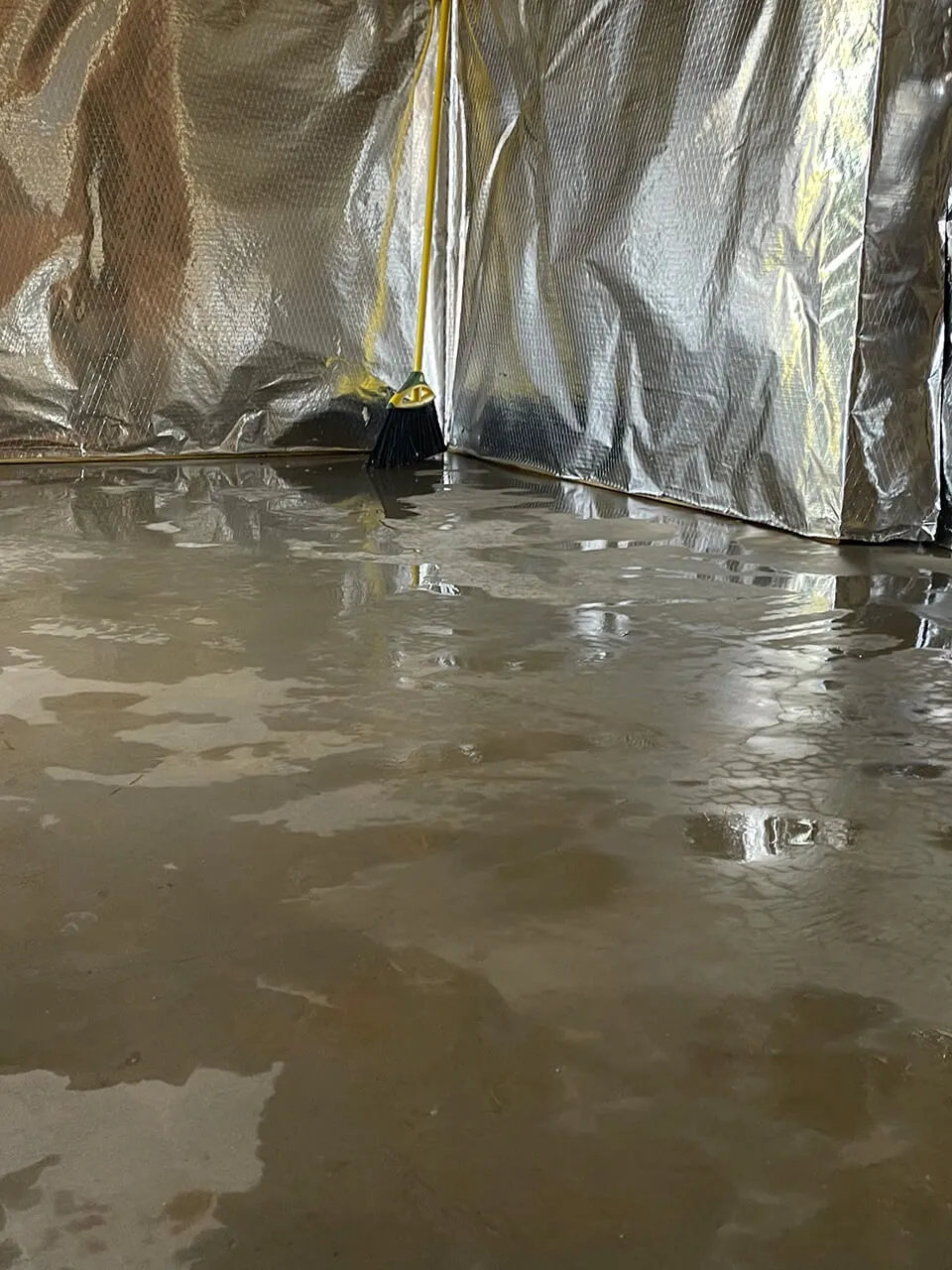
Picture the other side of it. The next ugly forecast rolls through and you don’t think about the basement at all — no towels, no shop vac at midnight, no wondering what got ruined. Instead you get storage you trust. For guidance during the storm itself, the National Weather Service flood safety page is worth five minutes.
Why does hiring somebody local matter here?
Because we’ve spent twenty-plus years on these exact houses, and Buford is its own place — not generic Gwinnett. Most homes we visit for a standing water basement Buford inspection sit within a few miles of each other. Walkout basements in the Mall of Georgia corridor neighborhoods behave differently than the older block foundations near downtown. We’ve worked plenty of streets off Buford Drive, and our shop sits about twenty minutes south in Lawrenceville. The crew that does the work is the crew that answers in year six.
You also get the boring stuff done right: written scope, proof of insurance, a real warranty, a clean job site. If a family member one town over sees the same puddles, we cover the Grayson standing water basement crowd too.
Where we work around Buford
Buford is a short run up I-85 from our shop, so we’re out this way most weeks. We also cover Suwanee, Sugar Hill, Braselton, Flowery Branch, Dacula, Gainesville, Lawrenceville and Duluth, plus the wider Gwinnett and Hall Counties area. If you’re near the lake, odds are we already have a truck close by.
Questions Buford homeowners ask us
It ranges widely, because the cause sets the price. Exterior corrections like downspout extensions and regrading sit at the low end, while a full perimeter drainage system with a new pump sits at the high end. What moves the number is how many walls are involved and whether we’re working under the slab. We put the range in writing before you decide anything.
That’s actually encouraging news. Flooding only during heavy rain usually points to surface water rather than groundwater, and surface water is normally the simpler and cheaper fix. Still worth looking at, though, since occasional flooding tends to become regular flooding over time.
For getting the water out today, yes, and you should absolutely do it. But a shop vac handles the symptom, not the source, so the same puddle returns with the next storm. Think of drying as first aid and drainage as the repair.
Mold can begin on wet organic material — cardboard, paper, drywall backing — in roughly 24 to 48 hours. That’s why fast drying matters more than perfect drying. Get the water up, move air across the space, run a dehumidifier, and pull anything soaked away from the walls.
Cut the power to that space at the panel before you step in the water. After that, take photos for your records, get the water out, and lift anything you care about off the floor. Then check outside — a clogged gutter or a disconnected downspout explains a surprising number of these.
Let’s find out where that water is coming from
The inspection is free, the estimate is free, and nobody pressures you at the end. We’ll show you the entry point, explain the fix plainly, and put the scope in writing — even if the answer is simpler than you expected.
(678) 914-5112Serving Buford and all of Metro Atlanta · $500 off projects over $3,500 · Live support 7am–8pm, 7 days a week