

Flooded Basement Repair Dunwoody Homeowners Can Actually Plan For
What the job involves, what it costs, and what you get in writing.
Here’s the calm version of the math nobody puts in an ad. A basement that takes on water today is a drainage job. That same basement three years from now is a drainage job plus flooring, plus drywall, plus whatever was stored down there. Nothing scary happens in between — it’s just that flooded basement repair Dunwoody homeowners handle early tends to stay one line item.
Good news, though: you’re reading this, so you’re already ahead of the version where it waits. Below is the honest walkthrough — the work, the price drivers, what’s covered, and why the company matters as much as the system does.
Is this flooding, or is it seepage?
Good place to start, because the two look alike on a wet floor and they aren’t the same job. Seepage is slow — a damp line along the base of the wall, a musty smell, maybe a chalky bloom on the block. That’s a smaller conversation.
Flooding is bulk water. It shows up fast and it puddles. Usually one of four things is behind it: pressure in the soil, a sump pump that quit, a blocked drain line, or a window well with no working drain sitting there like a bucket.
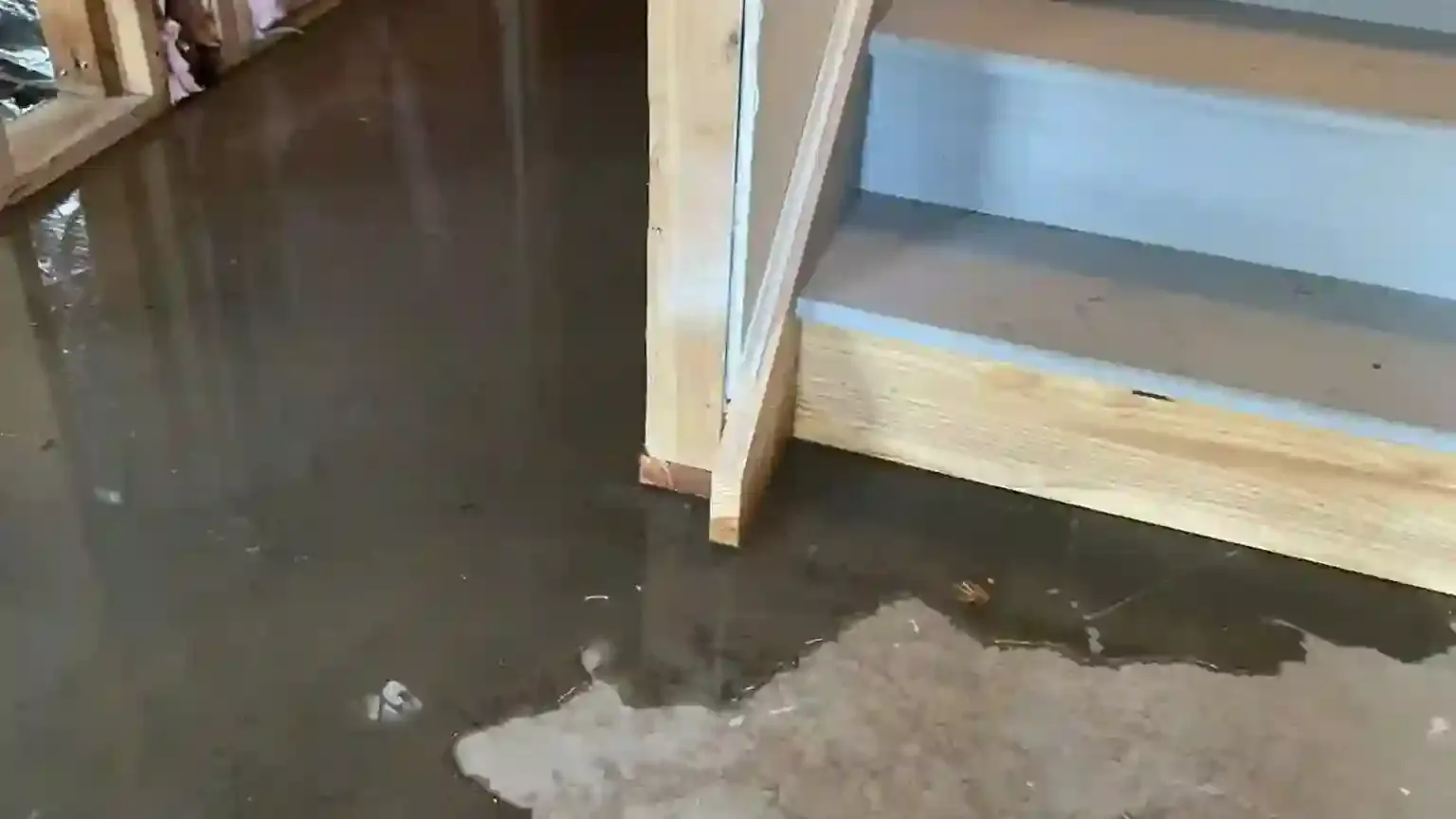
So where does bulk water get in? Usually the cove joint — the seam where your basement wall meets the floor slab. People hunt for a crack, can’t find one, and figure they’re missing something obvious. You’re not. A cove joint isn’t a crack at all. It’s a seam, and under pressure it’s the easiest door in the building.
Georgia red clay is the other half. Clay holds water instead of draining it, so after a soaking week the soil around your walls stays loaded. That pressure has to go somewhere, and on a hollow block wall it pushes straight through the cores.
Worth knowing
A basement that floods only in heavy rain almost always has a surface water problem, not a groundwater one — roof water, grading, a buried downspout that gave up. That’s usually the cheaper fix, and we say so when we find it.
There’s a Dunwoody-specific piece too. The split-levels and four-sides-brick ranches here were built when “waterproofing” meant a spray coat of asphalt on the outside of a block wall. Fifty years of clay later, those walls are telling on themselves. That’s not bad building — it’s the standard of the day reaching the end of its service life, same as a water heater.
What does the actual job look like?
Most follow the same shape, so you can picture it before a truck parks out front.
- Water out, safely. Power to that space goes off at the panel first. Nobody steps into standing water with live circuits — that’s the very first thing we check.
- Wet organics out, then dry it down. Soaked carpet, pad, cardboard and insulation hold moisture long after the floor looks dry, so they leave first. Then air movers and a real dehumidifier — not a box fan.
- Find the source. Grading, gutters, window wells, the old footing drain, the pump. We do this before we price anything, since a number written without it is a guess.
- Cut the perimeter channel. A narrow strip of slab comes out along whichever walls need it. Loud and dusty, and typically wrapped inside two days.
- Bury the drain line. Perforated pipe packed in washed stone, sitting under the floor rather than on it. That’s what lets us catch water before it ever reaches your slab.
- Send it somewhere useful. Everything feeds a basin, and the pump pushes it far enough from the house that the soil can’t just hand it back.
- Put it back. New concrete over the trench, liner on the walls that call for it, and every scrap of debris on our truck instead of your driveway.
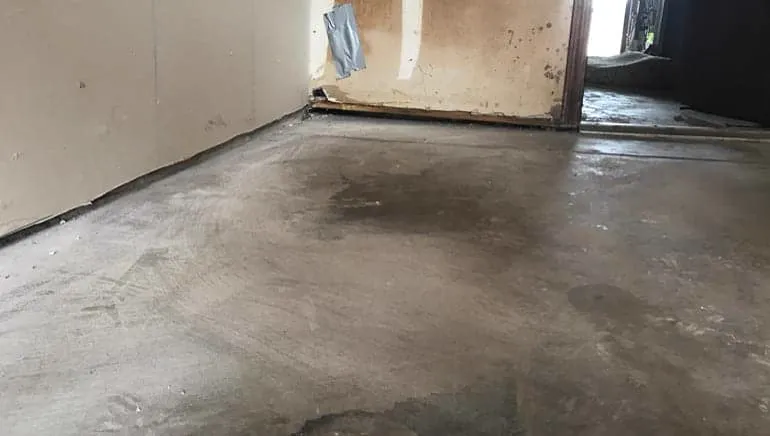
Real talk — what actually decides whether this lasts?
Pipe and stone are the easy part — any crew can set drainage. What decides whether you’re dry in year nine is the pump and the discharge end, and that rarely makes it into a sales pitch.
Sump pumps don’t fail mysteriously. They fail the same five ways every time. Power goes out during the storm, which is exactly when you need it. The float sticks against the basin wall. The pump is undersized. There’s no check valve, so water drains back down and the pump cycles itself to death. Or the discharge line is clogged, frozen, or crushed under a flowerbed.
A pump that can’t get water out of the yard is just an expensive noise. We spend as much time on the discharge as we do on the basin.
All five are preventable, which is the point. Backup power covers the outage, a properly sized basin covers the volume, a check valve stops the backflow. None of it is exotic — it’s just what gets skipped when somebody’s chasing a low bid.
Roots deserve a mention too. Dunwoody’s sixty-year-old oaks and poplars displace walls, lift slabs and crush drain lines without asking. Anywhere with mature canopy — the streets near Brook Run Park are a good example — we check the old lines before assuming they work.

If you want a neutral read on how homes are protected from water intrusion, FEMA’s building science library is a solid, no-sales-pitch resource.
So what does it cost?
The honest answer: it tracks with how much wall is involved and how awkward that wall is to reach. Phone quotes are theater — nobody can price a house they haven’t stood in. Here’s what we weigh, though.
What moves the number
- How much wall. Treating one problem wall and treating all four are wildly different tickets. Nothing else swings the price this hard.
- What’s in the way. An empty basement is quick. Paneling, built-ins and a finished ceiling from 1985 mean careful demo before we start the job you hired us for.
- Pump and backup. A sound basin saves you money. Battery backup adds some, and it earns it the night the power dies mid-storm.
- The yard. Sometimes gutters, dirt slope and a silted-up footing drain are the whole story. That’s a far smaller ticket, and we’ll happily tell you so.
- Wall condition. Bowing or cracked block gets stabilized first. Drainage bolted to a wall that’s still moving buys you a year, tops.
- Depth and slope. A basement cut into a hillside below street grade carries more soil load than one on flat ground.
Modest drainage corrections sit at the low end. A whole-perimeter system with a new sump, backup power and careful work around finished space sits at the top. Most land between, with the scope written out before anybody starts.
What’s covered, and what isn’t?
In the price: crew time, materials, the slab we pour back, debris removal, the warranty. Outside it: rebuilding finished walls we opened, replacing ruined flooring, and structural repair, which carries its own number. Better to know that up front than on page three.
You get the warranty on paper before the first cut, and we’ll walk you through it. Ask any company to sum theirs up out loud — that’s a quick way to learn how solid it is.
One more thing worth saying plainly, because it comes up on almost every flooded basement repair Dunwoody call: insurance. Most standard homeowners policies exclude surface flooding, and sump pump failure coverage is usually a separate endorsement you have to add on purpose. We’re waterproofers, not agents, so read your own policy — just read it before you need it.
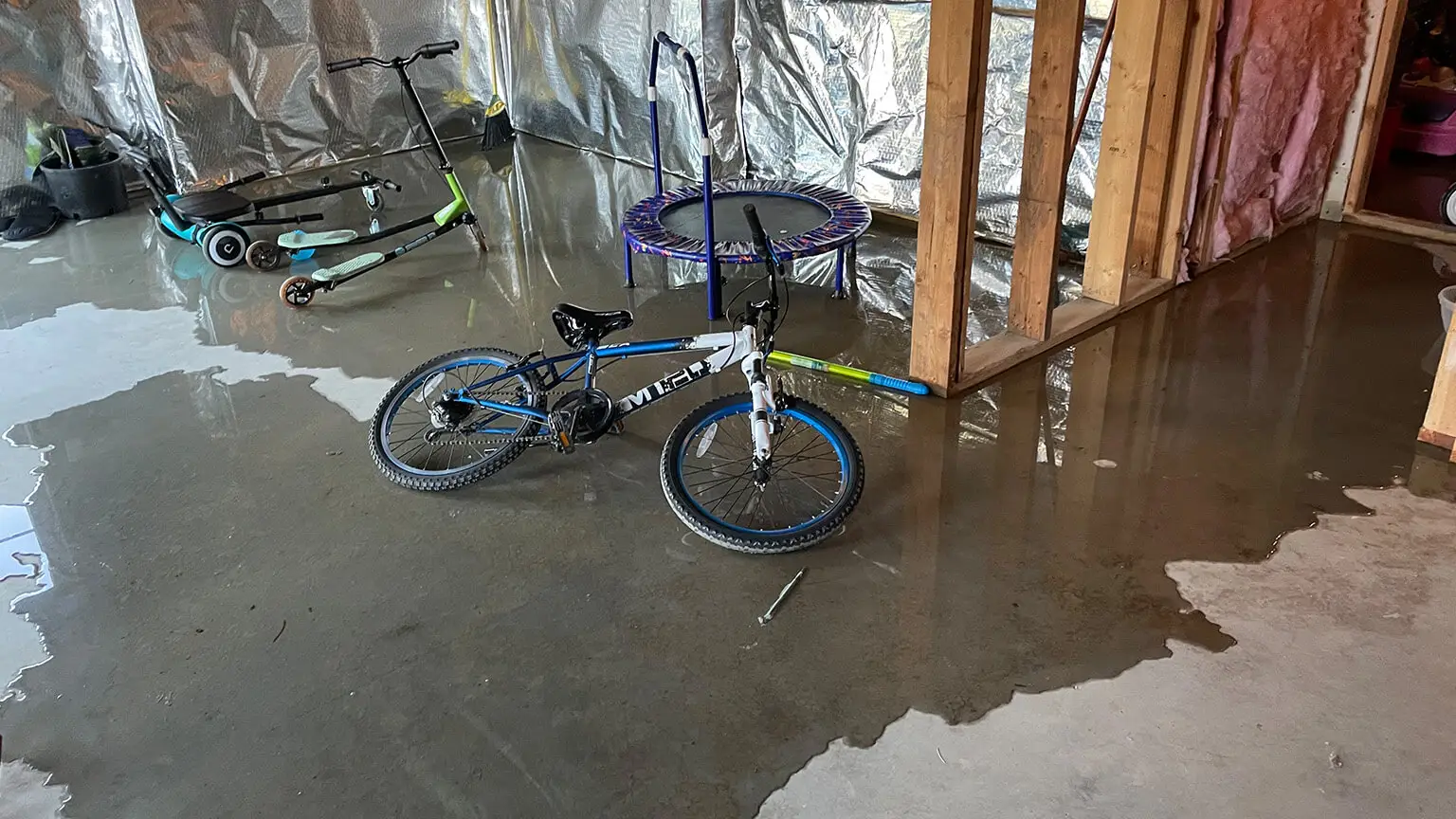
Want the number that reframes all of this?
One inch of water across a 1,000-square-foot basement is roughly 620 gallons. Not a dramatic inch. Not even over the top of your shoe. Still 620 gallons on your slab, soaking into everything porous in reach.
That reframes a lot. It explains why a shop vac feels like it’s losing, and why drying matters as much as pumping — mold can start in roughly 24 to 48 hours on wet organics, and the CDC’s guidance on mold after flooding covers that plainly. It also explains the discharge line, since moving 620 gallons ten feet does nothing if the ground hands it back.
Here’s the part we like, though. Once the system’s in, that inch never forms. Water gets caught below the slab and leaves before you’d see it. You get a dry floor, a space you can use, and a forecast that’s just weather again.

Why does hiring local matter for this one?
Because a piece of paper can only promise what the company signing it can still deliver in a decade. We’re past twenty years now, working out of Lawrenceville about half an hour up the road. Should year seven bring a question, the crew that answers is the crew that installed it.
Local also means knowing the housing stock. We know how 1970s block behaves on the sloped lots in Dunwoody Club Forest, we’ve worked below-grade basements over in Redfield, and we’ve been under plenty of the teardown rebuilds throughout the older streets — new house, same 1972 drainage. Between the Dunwoody Nature Center and the I-285 side of town, odds are we’ve been near your street.
Still sorting out what you’re dealing with? Our guide to standing water basement problems covers the symptoms, and every system we install is laid out on our basement waterproofing page. If your walls are bowing or cracking, start with foundation repair instead. Comparing notes with family across the perimeter? We cover the same ground for Roswell flooded basement repair.
Where we work around Dunwoody
Based in Lawrenceville, so Dunwoody is a straight shot. We also cover Sandy Springs, Brookhaven, Peachtree Corners, Chamblee, Doraville, Norcross and Tucker, plus Dunwoody Village and the wider DeKalb area. Near the Perimeter or over toward Winters Chapel, there’s usually a truck of ours close by.
Questions Dunwoody homeowners ask us
Still worth a look, and it’s often good news. Water that only shows up in big storms usually points to surface water — gutters, slope, a window well — which is typically the cheaper fix. We’ll tell you straight which kind you have.
For a small puddle caught early, sometimes. For real flooding, a fan moves air but doesn’t pull moisture out, so you need real dehumidification plus getting wet carpet, pad and cardboard out. A vac also never answers why the water came in.
Roughly 24 to 48 hours on wet organics like carpet pad, cardboard and paper-faced drywall. Speed beats perfection here. Water out, soaked materials out, then a dehumidifier running until the space is truly dry — not just dry to the touch.
Shut the power to that space off at the breaker panel before stepping into standing water. Then photograph everything for insurance, move what you can to dry ground, and start pulling out water and soaked materials. After that, get the source found — cleanup alone just sets up a rerun.
Our red clay holds water rather than draining it. Through a long rain the soil around your walls stays loaded, and that pressure pushes water in at the cove joint or through hollow block cores. Days later the ground drains, pressure drops, and the leak quits — so it seems to come and go.
Let’s find out where the water is getting into your Dunwoody basement
Free inspection, free estimate, no pressure at the end. We’ll show you the entry point, explain the fix in plain words, and leave you a written scope — even when the answer turns out cheaper than you expected.
(678) 914-5112Serving Dunwoody and all of Metro Atlanta · $500 off projects over $3,500 · Live support 7am–8pm, 7 days a week