

Flooded Basement Repair in Dacula: What the Job Involves and What It Costs
A builder’s choice from twenty years ago, a wet floor today, and the honest fix in between.
Somebody made a decision about your house before you ever saw it. A builder set the footing where the plan said, ran the downspouts to the closest patch of dirt, and moved on. That choice is still working every time it rains, which is why flooded basement repair Dacula homeowners call about is rarely a mystery once somebody actually looks.
Good news up front: this is fixable, and it’s work we’ve done every week for over twenty years. Below is the scope, the price drivers, and enough detail that you’ll know a fair estimate when one lands in your inbox.
What’s the difference between flooding and seepage?
This matters more than anything else here. Seepage is slow: a damp line along the base of the wall, maybe a chalky bloom on the block, and a musty smell after a wet week.
Flooding is different. It means bulk water — real volume, fast, spreading across the slab. That points to one of four things: hydrostatic pressure in saturated soil, a sump pump that quit, a blocked drain line, or a window well whose drain stopped draining sometime during the Obama administration.
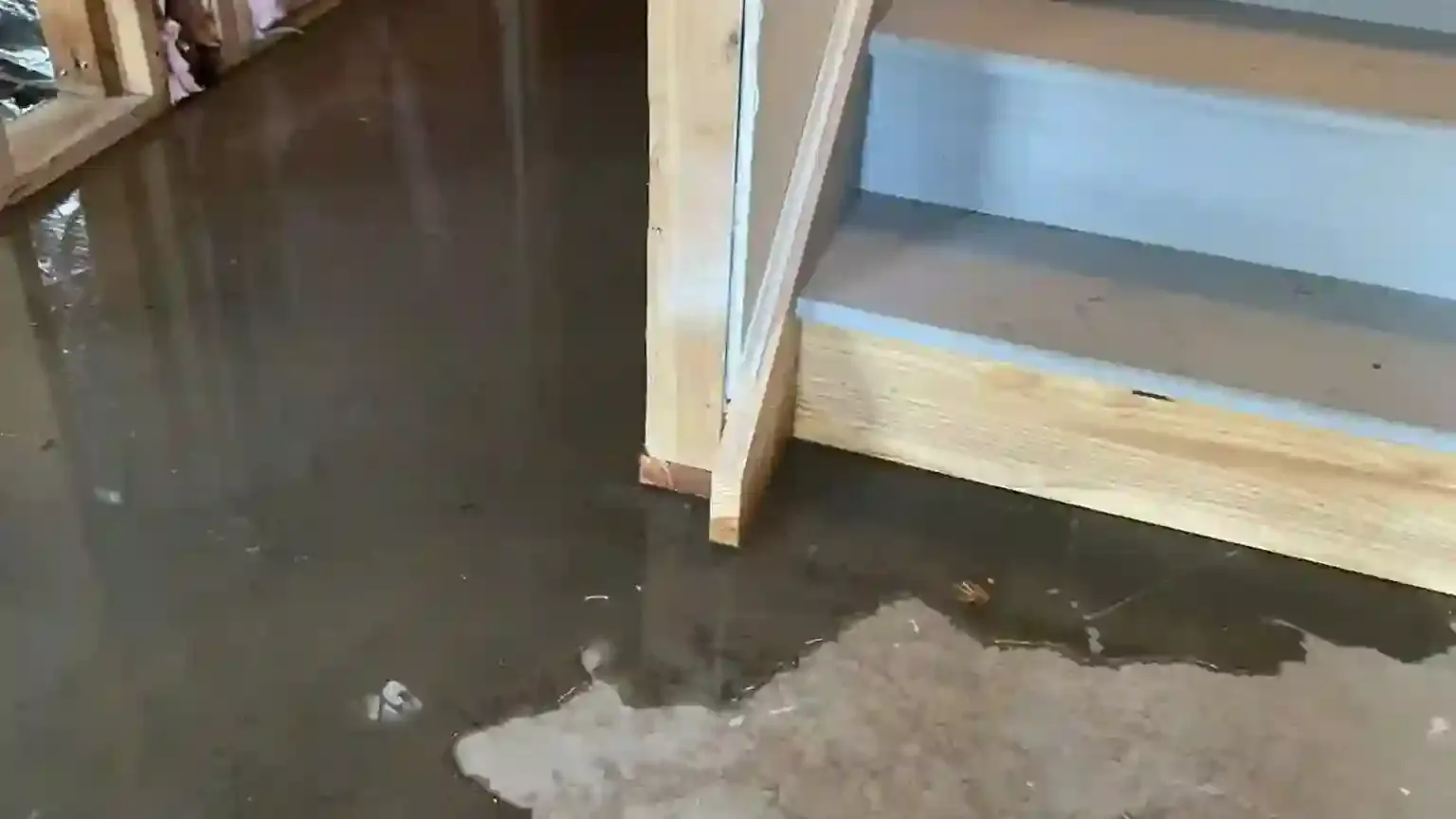
So where does it come in? Usually the cove joint — the seam where your wall meets the floor slab. Those get poured at different times, so they never truly bond. It isn’t a crack or damage. It’s a seam, and under pressure a seam is the easiest door in the building.
Now add our dirt. Georgia red clay doesn’t drink water so much as hold it, so after a long rain the soil against your wall stays loaded. Pressure builds, and on a block wall it pushes straight through the hollow cores. Out toward Dacula the lots get bigger, and so does the amount of water that has to go somewhere when a storm rolls through.
One safety note, said calmly
If there’s standing water down there, kill the circuit at the panel before you step in. Water and live outlets don’t mix. With the power off, you’re just dealing with a wet floor.
There’s a local wrinkle too. Much of Dacula was farmland first, and construction packed that soil down hard, so it sheds water instead of soaking it up. Rain that used to disappear now runs downhill hunting for the lowest opening — sometimes your foundation.
What does a real job look like?
Here’s the honest sequence, so you can picture the week before you agree to it.
- Get the water out and dry it fast. Standing water first, then wet organics — carpet pad, cardboard, soaked drywall bottoms. Then dehumidification, because mold can get started in roughly a day or two.
- Find the actual source. We walk the grade, downspouts, window wells and sump before we price anything. Plenty of these calls turn out to be one buried downspout that came apart.
- Open a channel at the perimeter. A narrow strip of slab comes up along the walls that need it. Loud, dusty, and usually a day or two.
- Set drainage below the slab. Perforated pipe in clean stone, placed below floor level, so water gets caught before it reaches your floor instead of after.
- Route it all to a proper sump. Correctly sized pump, sealed lid, a check valve so water can’t slide back down, and a discharge that ends well away from the house.
- Close it up clean. Fresh concrete, wall liner where needed, and our mess leaves in our truck.
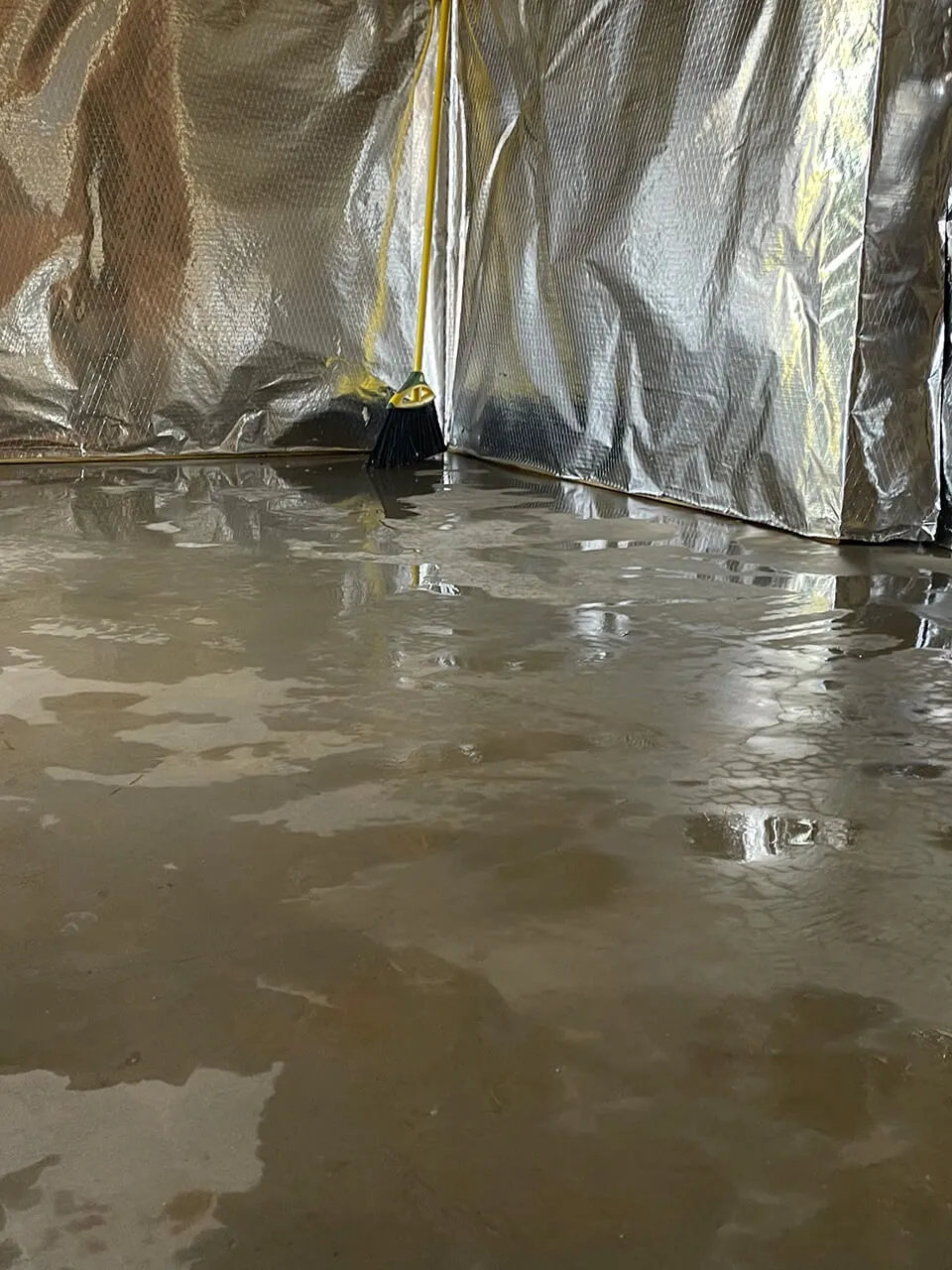
A word on sumps, because they fail in boring, predictable ways. Power goes out mid-storm. The float sticks against the basin wall. The pump is undersized, or there’s no check valve. Or the discharge is clogged and the pump runs hard against nothing, a lot like pedaling a bike with the chain off.
Twenty years in, here’s what we tell every homeowner: we’re not trying to block water. We’re giving it an easier path than the one through your house.
Now here’s where a lot of homeowners get steered wrong
Ready for the part that rarely comes up in a sales pitch? Most bad advice about a flooded basement isn’t dishonest — it’s just narrow. A company that installs one product will find a reason you need that product.
You’ll hear “seal the walls.” Coatings are fine for humidity, but paint cannot beat pressure — it’s a raincoat on a submarine. You’ll hear “get a bigger pump,” which helps only if the pump was the problem. And you’ll hear “excavate everything,” sometimes right, often a bigger invoice than the house needed. Real talk: most flooded basement repair Dacula homes need is narrower than the biggest quote in the stack.
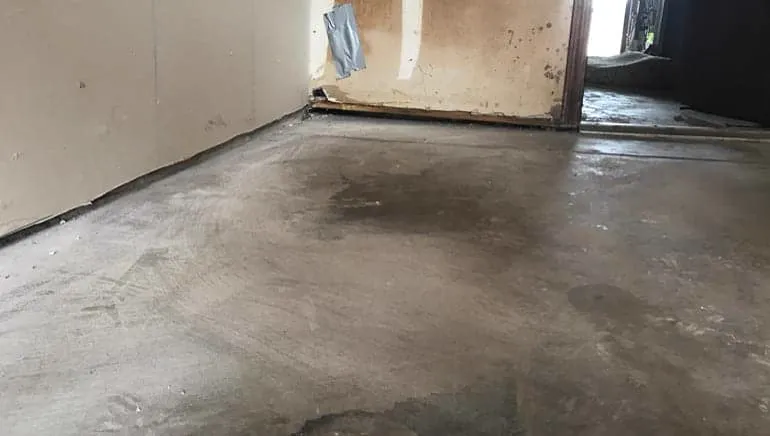
Insurance gets muddled the same way. Standard homeowners policies commonly exclude surface flooding and groundwater seepage, and sump failure coverage is usually a separate endorsement you add on. Don’t take our word for it — call your agent about your own policy. FEMA’s guidance on protecting property from flooding is a good place to start.
So what’s the fix for bad advice? Get two things in writing: where the water enters, and what each line of the scope is meant to stop. An estimate that can’t answer both is a price without a plan. Once you can ask those two questions, this stops feeling like a coin flip.
So what does flooded basement repair cost?
Straight answer: it depends on how much wall is involved and how hard it is to reach. Anybody quoting a flat number sight unseen is guessing, and you’d be paying for that guess. Here’s what we weigh.
What moves the number up or down
- Linear feet. One wall versus a full perimeter is the biggest factor by far.
- Access. An open basement is simple. A finished one means careful work before the real work.
- Sump work. A new basin, a right-sized pump, a check valve and battery backup all add cost — and backup power runs during the exact storm that takes the lights out.
- Outside conditions. Grading, downspouts and a silted footing drain sometimes carry most of the blame. That’s a smaller ticket, and we’ll say so.
- Discharge run. On bigger lots out here, getting water far enough from the house means a longer line and more trenching.
- Wall condition. Cracking or bowing means structural work comes first, priced separately.
Small drainage corrections and a pump swap land at the low end. A full perimeter system with a new sump, backup power and finished space to protect sits at the high end. Most jobs land between, and after we walk your house you get a written number with the scope spelled out line by line.
What’s included? Labor, materials, the concrete we replace, haul-off, and the warranty. What isn’t? Rebuilding finished walls we opened, ruined flooring, mold remediation, and structural repair. Better you know now than find it in fine print later. Our warranty is plain language, and the people who answer a warranty call are the people who did the work.
The house in Apalachee Farms that wasn’t what anyone thought
Want a real example? A homeowner in Apalachee Farms called after a spring storm left an inch of water across their basement. They were sure the foundation had cracked, and two earlier quotes agreed and priced full excavation.
Here’s what we actually found. The foundation was fine. Their sump discharge ran about eight feet out and dumped into compacted clay with nowhere to send it, so every gallon the pump moved came right back in through the cove joint. That pump wasn’t failing — it was on a treadmill.

The fix: a perimeter channel on two walls, a new sealed sump with a check valve and battery backup, and a discharge line carried well downslope. Two and a half days, at a fraction of the excavation quotes. They texted that summer after a long weekend of rain. Two words: still dry.
That’s the real outcome: a basement that stays a basement, storage you don’t lift onto blocks, and a forecast you get to ignore. If you’re drying things out before we arrive, the CDC’s guidance on mold cleanup after flooding is worth ten minutes.

Why does hiring local actually matter here?
Because a warranty is worth exactly as much as the company behind it. We’ve been at this over twenty years, twelve minutes west in Lawrenceville. If something needs a look in year seven, you’re calling the same crew.
Local also means we know the ground. We’ve worked the sloped lots in Providence Club, the early-2000s basements around Daniel Park hitting first-generation waterproofing failure, and homes on the low side of the ridge between Tribble Mill Park and Freeman’s Mill Park. If you commute west on GA-316, we’re already passing your street on the way to a flooded basement repair Dacula homeowners called about last week.
Still sorting out what you’ve got? Our guide to standing water basement problems covers what to check first, and every system we install is laid out on our basement waterproofing page. Comparing notes with family up the road? We cover the same ground for a Sugar Hill flooded basement. Seeing stair-step cracking in the block too? Start with foundation repair.
Where we work around Dacula
We’re based in Lawrenceville, so Dacula is a short drive. We work throughout Grayson, Buford, Auburn, Winder, Braselton, Snellville, Sugar Hill, Duluth and Suwanee, plus the wider Gwinnett area. If you’re along the Harbins corridor or out toward the Apalachee, odds are we’ve got a truck nearby.
Questions Dacula homeowners ask us
It depends on how many linear feet of wall are involved, whether you need a new sump, and how much finished space we work around. A drainage correction plus a pump swap sits at the low end, while a full perimeter system with backup power sits at the high end. You’ll get a written number with the scope spelled out after the free inspection.
That usually means the system holds up until a big rain, then gets overwhelmed. It’s still worth an inspection, because the fix for an occasional flood is often smaller — grading, a discharge line, or a properly sized pump. Two events a year is also two chances a year for wet material to sit long enough to grow mold.
For the cleanup, that’s a real start — get standing water out, then wet carpet pad and cardboard. But drying is not repair. A fan removes the water you can see, while the reason it came in is still outside the wall waiting on the next storm.
Roughly 24 to 48 hours on damp organic material like drywall, carpet pad or stored cardboard. That’s why the order matters: water out, wet material out, then dehumidify. Move quickly in those first two days and you usually avoid the problem entirely.
Shut the power to the basement off at the panel before you step into standing water. After that, take photos for your records, start removing water and wet material, and check whether the sump is running. Then call us and we’ll look at where it came in.
Let’s find out where the water is getting into your Dacula basement
The inspection is free, the estimate is free, and nobody pressures you at the end. We’ll show you the entry point, explain the plan in plain words, and tell you honestly if the fix is smaller than expected.
(678) 914-5112Serving Dacula and all of Metro Atlanta · $500 off projects over $3,500 · Live support 7am–8pm, 7 days a week