

A Flooded Basement in Sugar Hill: What the Fix Involves and What It Costs
Come down the stairs with us. Here’s exactly what we look at, and why.
The first thing we do is stop at the bottom step and just look. No tools yet, no talking. When a flooded basement Sugar Hill homeowners are living with brings us out, that first quiet minute tells us more than any brochure ever could — where the water went, where it came from, and how fast it moved.
Good news right up front: this is fixable, and we’ve been doing it for more than twenty years out of our shop in Lawrenceville. Below is the honest version — the work, the cost drivers, and what you get in writing.
So what are we actually looking at down there?
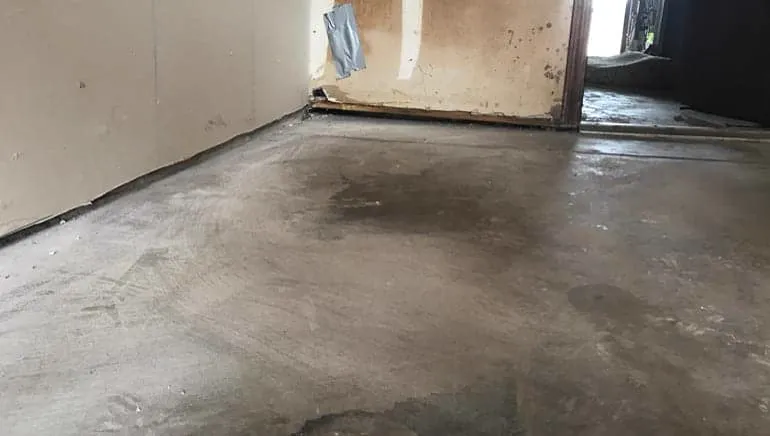
We start at the floor. Water leaves a map of itself — a silt line on the slab, a clean streak where it ran, a dark ring on a cardboard box. That map points back toward the entry point, and we follow it like breadcrumbs.
Then we go to the seam where the wall meets the floor. That’s the cove joint, and it’s the most common way bulk water gets in around here. It isn’t a crack or a flaw, either — it’s just a seam between two pours, so when pressure builds outside, that’s the easiest door in the house.

After that we check the sump, the window wells, and the discharge line. Then we walk outside and look uphill, because on your street the answer usually lives out there. Sugar Hill is named for a hill, and it earns it — water here doesn’t sit, it runs, and it runs toward whatever is downhill of it.
That’s why so many homes off Level Creek and around the Lanier Golf area have walkout or daylight basements cut into a grade. Great for natural light. Less great when four inches of rain takes the same shortcut you did.
Is flooding the same thing as a damp wall?
No, and it’s the most useful distinction we can give you. Seepage is slow — a damp patch, a musty corner, chalky white bloom on the block. Flooding is bulk water, which means something specific happened.
Usually it’s one of four things. Hydrostatic pressure from saturated soil pushing through the cove joint or through hollow block cores. A sump pump that quit. A blocked footing drain or discharge line. Or a window well with no working drain, quietly filling like a bathtub until it spills over the sill.
One safety note, plainly
Never step into standing water while the power is on. Kill the circuit at the panel first, and if you can’t reach the panel safely, leave it and call an electrician. Everything else can wait a few minutes.
Georgia red clay is the reason it lingers. Clay holds water instead of draining it, so the soil against your wall stays wet for days. As a result, pressure keeps building after the storm passes — which is why plenty of folks flood the day after the rain.
Sump pumps fail in boringly predictable ways, too. Power drops during the very storm you needed it for, a float sticks against the basin wall, the pump is undersized for a steep lot, or the discharge line clogs with silt. None of that surprises us, so none of it should worry you.
What does a real job look like, start to finish?
Most flooded basement Sugar Hill jobs follow the same shape, so you can picture the week before anyone parks a truck at your curb:
- Free inspection first. We walk inside and outside, find the source, and explain it in plain words while we’re standing there. You get the reason before you get a number.
- Get it dry. Standing water out, wet organics out — carpet pad, cardboard, soaked drywall. Then dehumidification, because damp air keeps feeding the problem.
- Open the perimeter. A narrow strip of slab comes up along the walls that need it. Loud and dusty, usually a day or two.
- Set drainage below the slab. Perforated pipe in clean stone, placed below floor level, so water is caught before it reaches your floor instead of after.
- Route it to a proper sump. New basin, correctly sized pump, real check valve, and a discharge line that carries water well away downhill.
- Close it up clean. Fresh concrete over the channel, wall liner where it helps, debris hauled off.
Step two is the one with a clock on it. Mold can begin growing on wet building materials within roughly 24 to 48 hours, so the drying window is short. The CDC’s guidance on mold cleanup after flooding covers the health side well.
Ready for the part most advice skips?
Search this problem online and almost every article ends at “install a sump pump.” Honestly, that’s where it should start. A pump only answers water that already got in, so the better question is what changed at your house this year.
Most of Sugar Hill went up between the early nineties and the mid two-thousands, so a whole city’s worth of original systems are reaching end of life on the same schedule. Footing drains silt up. Discharge lines crush. Builder-grade pumps age out. That’s a service life, same as a water heater, and it’s why a house that never flooded in twenty years suddenly does.

We stopped trying to block water years ago and started routing it instead. Blocking is a wrestling match. Routing is just plumbing that happens to be outdoors.
The other thing nobody mentions: insurance. Standard homeowners policies commonly exclude surface flooding, and sump pump failure is usually a separate endorsement you add on purpose. So pull out your own policy and read the water section before you assume you’re covered.
So what does it cost?
Honest answer: it depends on how much wall is involved and how hard it is to reach. Anyone quoting a flat price sight unseen is guessing, and you’d be paying for that guess. Here’s what we’re actually weighing.
What moves the price up or down
- Linear feet. One wall versus a full perimeter is the biggest factor, by a wide margin.
- Access. An open basement is simple. A finished one with built-ins takes careful prep before the real work starts.
- Pump and backup. A new basin, a correctly sized pump and a battery backup add cost — and the backup runs during the outage that caused the flood.
- The slope outside. Regrading, buried downspouts or a curtain drain uphill can carry most of the load. That’s a smaller ticket, and we’ll say so.
- Wall condition. Bowing or active cracks mean structural work comes first. Waterproofing over a moving wall is money spent twice.
- Water already in the room. Extraction, tear-out and drying equipment are their own line, separate from the system.
Small drainage corrections land at the low end. A full perimeter system with a new sump, battery backup and careful work around finished space sits at the high end. Most of the flooded basement Sugar Hill projects we quote land somewhere in between, and either way you get a written scope before anybody starts.
What’s included: labor, materials, the concrete we replace, hauling, and the warranty in writing. What isn’t: rebuilding finished walls we opened, replacing ruined flooring, and structural repair, which is priced on its own. Better you hear that here than find it in fine print later.
About the warranty — ours is transferable, and you get it on paper before work begins. A warranty is only worth as much as the company behind it, though. We’re twenty minutes down Peachtree Industrial Boulevard, so in year seven you’ll be calling the same crew that did the job.

What does a wet basement have to do with your air?
More than most people realize. Air in a house doesn’t stay put — warm air rises and leaves through the upper floors, so replacement air gets pulled up from the lowest, dampest level and travels through everything above it.
Which means the musty smell in the guest room isn’t really an upstairs problem. Wet materials downstairs feed the odor, and your own house acts like a chimney moving it around. That’s why folks tell us the whole place smells better afterward, and they’re not imagining it.
Fixing it is refreshingly ordinary: bulk water out, soaked materials out, dehumidification on, and a permanent path so water never sits again. After that, the basement goes back to being square footage you actually paid for.

Picture the next storm. Rain is coming down hard and you’re watching a movie instead of watching the stairs. That’s the actual product — not pipe, not stone, just a night where weather is only weather. If you like tracking it anyway, the National Weather Service flood safety pages are worth a bookmark.
Why go with a local company?
Because terrain knowledge isn’t a sales line here — it’s the job. We’ve worked the sloped lots over by Riverside, handled uphill runoff around the Lanier Golf area, and we know how the grade behaves toward Level Creek. If you’re anywhere between the E Center and The Bowl at Sugar Hill, odds are we’ve already been under a house near yours.
Want to compare notes? Our guide to basement flooding goes deeper on causes, and every system we install is spelled out on our basement waterproofing page. If cracks or settling are part of your picture, start with foundation repair instead. Helping family across the county? We cover the same ground for Lilburn flooded basement repair.
Where we work around Sugar Hill
We’re based in Lawrenceville, about twenty minutes south, so Sugar Hill is an easy run for our crews. We also work throughout Buford, Suwanee, Cumming, Gainesville, Duluth, Dacula, Snellville, Braselton and Flowery Branch, plus the wider Gwinnett and Hall County area. If you’re anywhere along the PIB corridor, there’s usually a truck close by.
Questions Sugar Hill homeowners ask us
Twice a year still means the water path exists year-round — it just needs enough rain to use it. Each event soaks materials again, so the damage adds up quietly even though the flooding doesn’t. The fix is the same either way, and catching it at this stage is genuinely the cheaper version.
For a small, clean spill caught right away, sometimes yes. A fan moves air but doesn’t remove moisture, though, so water hiding under carpet pad or inside block cores stays put. For anything more than a puddle you want extraction plus real dehumidification, and the wet materials have to come out.
Mold can begin on wet building materials within roughly 24 to 48 hours, which is why drying speed matters more than almost anything else. That’s not a reason to panic — it’s just a reason to move. Get standing water out, pull soaked organics, and run a dehumidifier the same day if you can.
Kill power to the basement at the panel before you step into any standing water. After that, take photos for your insurance, move what you can lift to dry ground, and start removing water. Then call someone to find the entry point, because drying alone doesn’t stop the next one.
Because red clay holds water against your wall instead of draining it, so pressure builds until it finds the weakest seam. On a sloped lot, uphill runoff piles onto that too. Light rain never builds enough pressure to push through, which is why the problem looks like it comes and goes.
Let’s find out where the water is getting into your Sugar Hill basement
The inspection is free, the estimate is free, and nobody pushes you at the end. We’ll show you the entry point, explain the fix in plain words, and tell you honestly if it’s smaller than you feared.
(678) 914-5112Serving Sugar Hill and all of Metro Atlanta · $500 off projects over $3,500 · Live support 7am–8pm, 7 days a week