

How to Choose the Best Basement Waterproofing Norcross Homes Actually Need
Three centuries of houses sit in this city, and they don’t all get the same answer. Here’s how to tell a real plan from a sales pitch.
Picture the finished thing first. A clean concrete channel runs the base of the wall, the floor is dry enough to sit on, and the air smells like nothing at all. That’s the whole point of the best basement waterproofing Norcross crews can put in — not a product, just a room you stop worrying about. Now let’s work backward and figure out how you get there without overpaying.
Good news right away: this is a solved problem. Water follows simple rules, and once somebody actually reads your house, the fix stops being mysterious. The hard part is picking who reads it.
What makes a Norcross basement its own puzzle?
Age spread, mostly. This city has houses from three different centuries sitting within a few miles of each other. Downtown holds genuinely old homes on stone and brick, the 1960s and 1970s brought block basements out along the Beaver Ruin area, and later decades added poured walls and crawl spaces. Each one leaks for its own reason.
Then there’s the ground. Red clay holds water like a sponge that never quite wrings out, so pressure builds against a wall for days after a storm passes. Closer to the Chattahoochee the soil turns to river-bottom pockets, which means seasonal groundwater sitting higher than anybody expects. That’s why a house near Thrasher Park and a house out past Holcomb Bridge Road can have the same wet corner from two completely different causes.

Here’s the detail that decides most jobs. The cove joint — the seam where the basement wall meets the floor slab — is the single most common water entry point in a Georgia home. In a 1970s block basement that seam is straight and predictable. In an 1800s stone foundation downtown it wanders, and sometimes part of the floor is still dirt. Same physics, very different day of work.
What should a good company be doing differently here?
Look outside before looking down. Any crew worth hiring in this city walks the yard first, since on older lots the source is often above ground. Downspouts dumping at the wall, a patio sloping the wrong way, decades of leaf litter clogging a drain line — those are cheap fixes, and an honest contractor will point at one even when it costs them the bigger sale.
After that, they should name your foundation type out loud. Old lime mortar breathes and shifts a little on purpose, so jamming rigid cement into a stone joint just hands the pressure to the next weak spot. Block walls hold water inside their hollow cores, which is a different problem needing a different answer. Poured walls usually leak at cracks and tie holes. Three houses, three plans.
Worth knowing
Seepage and structural trouble are two separate conversations. Plenty of old stone foundations seep while staying perfectly sound. You should be told clearly which one you have before anyone brings up money.
Real talk: if someone quotes the same system for an 1800s stone wall and a 1970s block basement, they aren’t looking. They’re reciting. That’s the honest test for the best basement waterproofing Norcross has available — diagnosis first, product second.
Plain language matters too. Groundwater follows simple rules, which the U.S. Geological Survey lays out without any jargon. So if a contractor can’t explain your leak in kitchen-table words, that’s worth noticing. We do plenty of these visits in Spanish, because a fix nobody understands isn’t really a fix.
Does everybody need the big expensive system?
Nope — and this is the part most homeowners are relieved to hear. The expensive-sounding version usually isn’t the one you need. Full-perimeter interior drainage with a new sump is the right call sometimes, but plenty of wet basements dry out from work that never touches the concrete.
We had a homeowner near the Peachtree Station edge convinced she was facing a full system. Two downspouts were emptying about a foot from the wall, and years of added mulch had built the grade up above the block. Extending the drain lines and cutting the grade back fixed it, which cost a fraction of what she’d braced for. Her basement did not need surgery. It needed a haircut.

Of course, the opposite happens too. A house sitting low along the Indian Trail corridor, with water pushing up through the cove joint, won’t be talked out of it by gutter work. The point isn’t cheap versus expensive. It’s matched versus guessed.
So bring one question to every appointment: what’s the smallest thing that would actually solve this? A company willing to answer that honestly is telling you how they’ll treat you later. For the mechanics behind each system, our guide for local homes walks through them.
How do you read an estimate without a degree in this?
Read the scope, not the number. A real estimate names the walls, the linear feet, how deep the drainage sits, where the water discharges, and what happens to any dirt floor. If all you got was a total and a signature line, that isn’t an estimate — it’s a guess wearing a nice font.
What a solid Norcross estimate spells out
- Which walls, and how many feet. One wall versus a full perimeter is the biggest price swing there is.
- Your foundation type, named. Stone takes more hours than block. That’s real labor, not a surcharge.
- Drainage depth. Below the slab, not beside it. Bargain bids quietly cross that line.
- Where the water goes. It has to leave the property, not tour the flower bed and come home.
- Exterior corrections. Grading and downspouts sometimes are the fix, so price them honestly.
- Warranty terms in writing. What’s covered, for how long, and who answers the phone in year six.
Prices swing widely because houses do, so get your number after somebody has stood in your basement. We won’t hand you a flat figure over the phone, since that figure would be fiction you’d end up paying for.
What should you ask before you hire anyone?
Five questions do most of the sorting. Ask each company the same ones, then compare the answers instead of the totals.
Five questions worth asking
- “What kind of foundation do I have?” They should answer instantly and specifically.
- “What did you find outside?” If nobody walked the yard, nobody looked for the source.
- “Will you photograph the pipe before the concrete goes back?” Yes should come fast.
- “Where does the water discharge?” They ought to walk you out and point at the spot.
- “Who’s actually on my job?” Same crews every time, or a sub you meet on day one?
Red flags are simpler than people expect. A firm price over the phone means nobody measured anything, and pressure to sign today is a sales tactic rather than a scheduling reality. Also be careful with waterproof paint sold as a system, because a coating can’t out-argue water pressure. It’s a raincoat on a submarine.
One more thing worth checking: does the company understand our weather? Rain here arrives in bursts, especially through spring, and that rhythm shows up in records from the National Weather Service Peachtree City office. Crews who plan for burst rainfall size drainage differently.
What do the years after the fix look like?
Nobody compares this part, yet it’s the part you live with. Here’s the honest timeline.
Week one. Fresh concrete cures, and the sump cycles a few times during rain. That’s the system working, not a warning light. Meanwhile the damp smell fades quickly, because the source got cut off instead of covered up.
Year one. You clear a full spring of storms and one heavy fall leaf drop, which under the old tree canopy around here is a genuine test. Better yet, you stop checking the basement after every rain. A homeowner over toward Lillian Webb Park told us the strangest part was realizing months had gone by without thinking about it.
Year ten. Stone and pipe under a slab have nothing to wear out, so the drainage keeps quietly doing its job. The pump is the one part with a service life — plan on replacing it somewhere around the ten-year mark, same as a water heater.
That’s the feeling worth paying for. Not “the leak stopped,” but “my family and my house are looked after.” Storms roll through and you hear rain instead of your stomach dropping.

Why are we a fit for this city?
Because the variety here is the whole job, and we like that kind of work. Volume contractors prefer one template, but 1800s stone, 1970s block and newer poured walls don’t cooperate with templates. Twenty-plus years around Metro Atlanta means we’ve been in all three, often in the same week.
You’ll also get answers. We’ll show you the water path, explain why one wall gets treated and another gets left alone, and hand over photos from under the slab before the concrete goes back. If your house sits on a crawl space instead, the honest recommendation is often crawl space encapsulation. Curious how newer subdivisions compare? Our Loganville best basement waterproofing guide covers that side, and the basement waterproofing service page shows exactly what we install.
Where we work around here
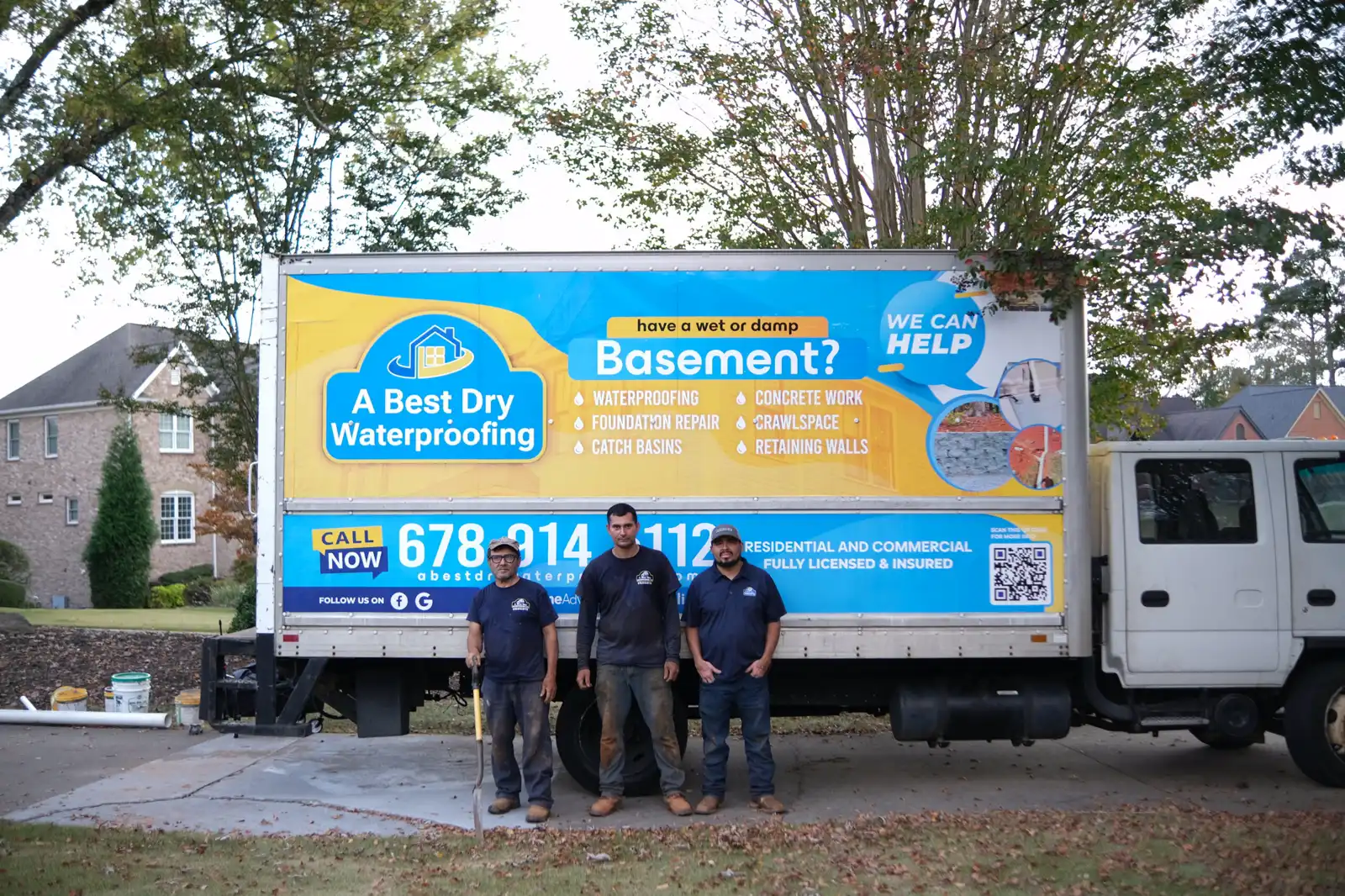
We’re based in Lawrenceville, roughly twenty minutes northeast, and we’re in this part of Gwinnett constantly — Norcross, Peachtree Corners, Duluth, Lilburn, Doraville, Tucker, Berkeley Lake, Suwanee and Snellville, plus the wider Gwinnett area. Whether your house sits downtown on old stone or in a 1970s subdivision, odds are a truck is already nearby.
Questions Norcross homeowners ask us
Usually, yes. We open a narrow strip of flooring and wall along the base, do the work, and close it back up, so the rest of the room stays untouched. It adds about a day to the schedule, but you keep your finished space.
It helps in two ways. A documented, warrantied system removes a question buyers and inspectors always ask, and a dry basement becomes usable square footage instead of storage nobody trusts. Sellers here tend to notice the difference at the inspection stage.
Often within a few days, and sooner right after a storm. Live support runs seven a.m. to eight p.m., seven days a week, so call whenever it suits you. The inspection and the estimate are both free.
It depends mostly on how much wall is involved and how hard it is to reach. Exterior corrections like regrading and drain lines sit at the low end, while a full perimeter system with a new sump sits at the top. We won’t quote a flat number over the phone, since that number would be a guess you’d end up paying for.
Most interior systems run two to four working days. Older stone foundations downtown take longer, because mortar work and uneven floors add hours. Exterior-only fixes are often finished in a single day.
Let’s look at your Norcross basement together
We’ll walk the house with you, show you where water is getting in, and explain the plan in plain language — stone, block or poured, whatever you’ve got. Free inspection, free estimate, and no pressure at the end of it.
(678) 914-5112Serving Norcross and all of Metro Atlanta · $500 off projects over $3,500 · Live support 7am–8pm, 7 days a week