

Basement Flooding Johns Creek: What the Water Is Actually Telling You
Bulk water on the floor is a different problem than a damp wall. Here’s how to read it, what it costs to wait, and what the real repair looks like.
Here’s the honest math on waiting. Handle it this spring and you’re usually dealing with water, a pump and a drain line. Handle it three springs from now and you’re dealing with all of that plus the flooring, the bottom two feet of drywall, the baseboard and whatever was stacked in the corner. Nothing dramatic happens in between — that’s the part worth knowing. Basement flooding Johns Creek homes see doesn’t usually get scarier over time. It just gets more expensive, quietly, one storm at a time.
Good news? Water on a basement floor is one of the most fixable problems in the whole house. It has a source, the source has an address, and once we find it the repair is ordinary work we do most weeks of the year.
Is this flooding, or is it seepage?
People use both words for the same thing, but they’re two different problems with two different fixes. Seepage is slow. It shows up as a damp ring, a musty smell, or a wall that feels cool and clammy after a rainy week.
Flooding is bulk water. You get a visible sheet across the slab, or an inch standing in the low corner, and it arrives fast during or right after a storm. That difference matters, because bulk water almost always means one of four things: pressure in the soil, a sump pump that didn’t do its job, a blocked drain line, or a window well with a dead drain. In other words, something specific happened — and specific things can be found.
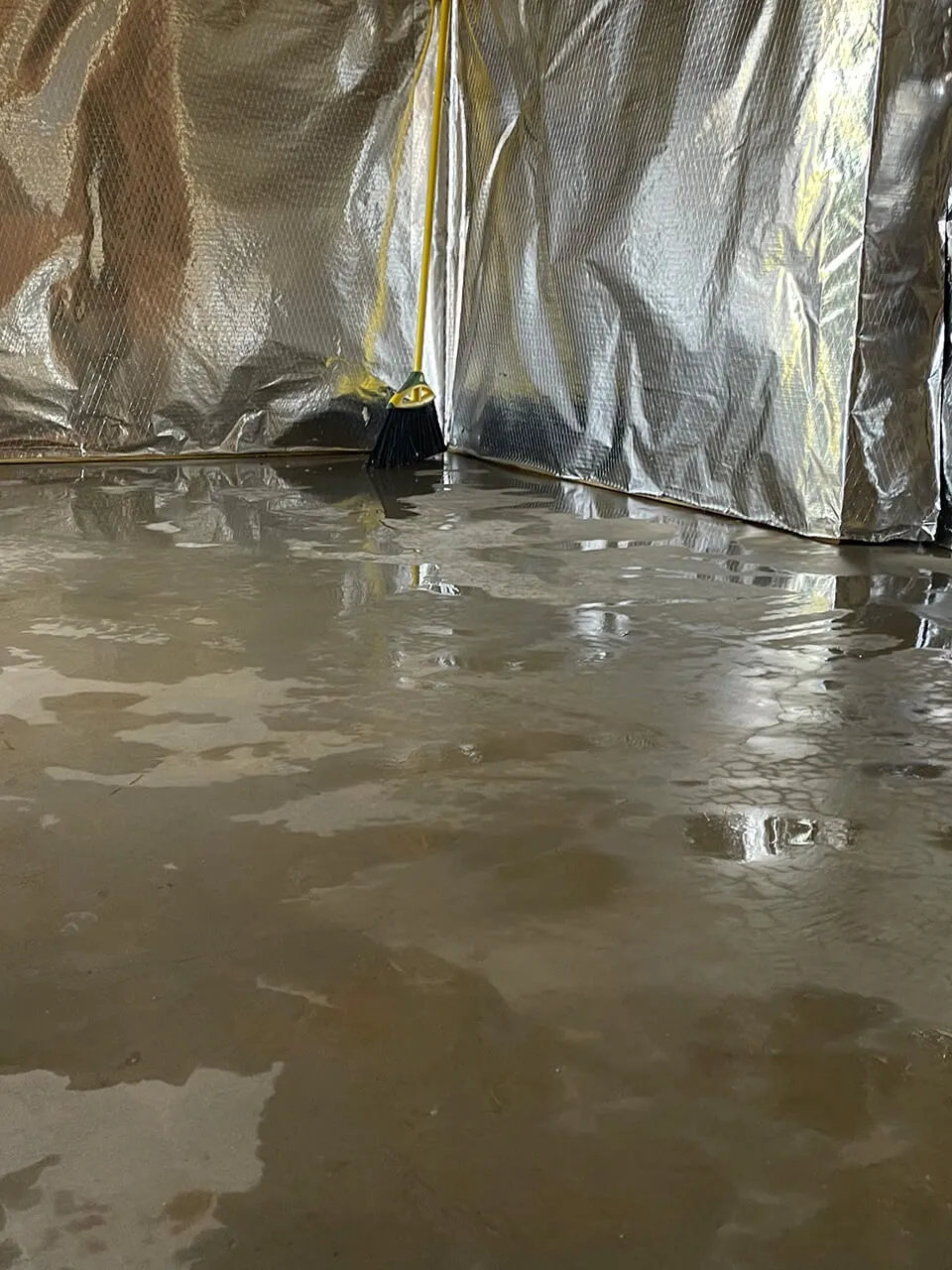
There’s a shortcut worth knowing, too. A basement that floods only in heavy rain almost always has a surface water problem rather than a groundwater problem. Meanwhile, a basement that stays wet for days after the sky clears is usually dealing with the water table. That first one is normally the cheaper fix, which is a nice thing to hear for once.
Before you go down there
If there’s standing water, kill power to the basement at the panel first, then step in. Water and live circuits don’t mix, and this one takes thirty seconds. The National Weather Service flood safety guide covers the rest of the basics plainly.
So where is the water coming in?
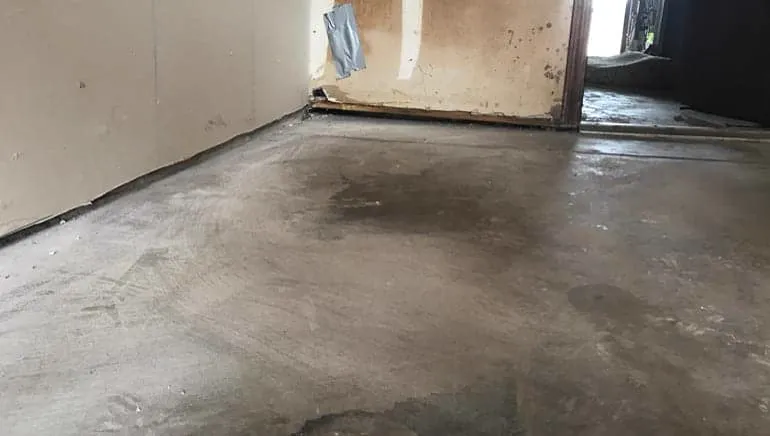
Most of the time it’s a seam, not a crack. The spot where your basement wall meets the floor slab has a name — the cove joint — and those two slabs of concrete were poured on different days, so they never truly bonded. As a result you’ve got a hairline door running the entire perimeter of the room.
Under pressure, that door opens. Georgia Piedmont red clay is the reason. Clay holds onto water instead of letting it drain, so after a long rain the soil against your wall stays soaked and heavy. All that weight has to go somewhere, and the easiest path is that seam — or straight through the hollow cores of a block wall, which fill up like a row of drinking glasses.
Then there’s the sump pump, which fails in about five predictable ways. Power goes out mid-storm, exactly when it’s needed. The float sticks. The pump was undersized for the house from day one. There’s no check valve, so every cycle dumps water right back down the pipe. Or the discharge line is clogged or crushed out in the yard, which means the pump runs beautifully and moves nothing.
Now here’s the local part. Johns Creek was largely built in one big wave, mostly between the late eighties and the mid-2000s. That means a whole city’s worth of original waterproofing systems and drain tile are aging out on roughly the same schedule. So when a homeowner in Falls of Autry Mill calls us the same week as a neighbor, it isn’t bad luck. Those systems ran quietly for twenty-five years and are simply asking for a turn.
Terrain plays a role as well. This side of Fulton County rolls downhill toward the Chattahoochee, so walkout and daylight basements got cut right into the slopes. On streets off Jones Bridge Road, and on the wooded lots near Autrey Mill Nature Preserve, groundwater sits higher and pushes harder after a wet stretch. Plus the everyday stuff adds up: downspouts dumping two feet from the wall, mulch beds built up until the grade tilts back toward the house, irrigation running on a timer through a rainy March.
What should you do in the first hour?
Fair question, and the order matters more than the speed. First, power off. Second, get standing water out with a pump or a wet vac. Third — and this is the step people skip — pull out the wet organic stuff. Cardboard boxes, carpet pad, area rugs, particleboard shelving. Those hold moisture long after the floor looks dry.
After that, dry the air, not just the floor. A dehumidifier plus real airflow does the heavy lifting here. The reason we push on this: mold can start growing on wet organic material in roughly 24 to 48 hours, so the clock is about drying speed, not damage severity. FEMA’s building science guidance is a solid read if you want the deeper version.
One more piece nobody enjoys but everybody should hear. Standard homeowners policies commonly exclude surface flooding, and coverage for sump pump failure is usually a separate endorsement you have to add on purpose. We’re not insurance people, so please check your own policy — better to read it on a calm Tuesday than during a storm.

What happens after the crew leaves?
Let’s talk about the part nobody puts in a brochure. Most of what homeowners actually worry about isn’t the install week — it’s month seven, when the truck is long gone and a big storm rolls through at 2 a.m. So here’s how that goes.
You get the written scope and the warranty document in a folder, not a promise from memory. You know the pump model, where the discharge exits, and which breaker feeds it. That’s the difference between owning a system and hosting one. Even better, the crew that installed it is the same local crew that answers when you call, because our shop is about twenty minutes east in Lawrenceville.
Maintenance is genuinely small. Pour a bucket of water into the sump pit twice a year and watch the pump kick on. Walk the discharge line after leaf season so nothing’s blocking the outlet. Check that downspouts still carry water well away from the wall. That’s about fifteen minutes a year, which is less than most people spend deciding what to watch.
Our goal isn’t a dry basement on install day. It’s a basement you stop thinking about on the tenth rainy night.
Around here, that reassurance matters. Homeowners in Country Club of the South and The Standard Club compare proposals line by line, and honestly, they should. Ask every company for the scope in writing, proof of insurance, and a warranty someone can explain in one sentence. If a bid can’t survive those three questions, it isn’t a bid.
What does the actual repair involve?
The whole idea is simple: stop trying to block water, and give it an easier path than the one it’s using. Here’s how that plays out on a typical job.
- Find the source before touching anything. We walk the grade, the gutters, the window wells and the discharge line outside, then read the stains inside. Sometimes the answer is a $200 exterior fix, and we’ll say so.
- Open a channel at the perimeter. A narrow strip of slab comes up along the affected walls. Loud and dusty for a day or two, then done.
- Set drainage below the floor. Perforated pipe in clean stone, under the slab, catching water before it reaches your floor instead of after.
- Build the sump right. Correctly sized pump, a real check valve, sealed lid, and a discharge line routed well away from the foundation. A battery backup is worth asking about, since power tends to leave right when you need the pump most.
- Close it up clean. Fresh concrete over the channel, wall liner where it’s called for, dehumidification where the space needs it, and our mess hauled off.
Wondering about the number? It depends on how much wall is involved, whether the space is finished, and how hard the sump discharge is to route — so we walk it before we quote it. Our breakdown of flooding cost covers every factor that moves the price, and the systems themselves are explained on our basement waterproofing page. If you’re also seeing stair-step cracks or a sticking door, foundation repair is a separate conversation we’ll have honestly.
What does the timeline look like from here?
Ready for the reframe? Picture the next ten years instead of the next ten days.
Week one. The floor is dry and the air smells like a room again, not a basement. The channel disappears into the slab, so unless you know where to look, you don’t see it. Meanwhile the dehumidifier pulls the last of the moisture out of the walls and the space finally stabilizes.

Year one. You go through a full March storm season and nothing happens. That’s the moment most people describe to us later, because it’s when the worry actually turns off. The space becomes usable again — a playroom, a gym, storage you trust with the things you can’t replace.
Year ten. The stone and pipe under your slab have nothing to wear out, so the drainage is still doing exactly what it did on day one. Somewhere in there you’ll swap the pump, the same way you’d swap a water heater. Plus, when you sell, a documented and warrantied system answers the question every buyer’s inspector asks before they ask it.
That’s the feeling we’re really installing. Not a dry floor — protection. Your family and your house looked after, storm after storm, without you thinking about it.

Why does local experience matter for this?
Because we’ve spent twenty-plus years on these exact houses. We know poured walls behave differently than hollow block does under the same pressure. We’ve worked the sloped lots on the streets running down toward the river, and plenty of homes minutes from Newtown Park. We know a 1990s system near its end looks different than a young system with a clogged line — and that telling those apart saves you real money.
We also know how things run in Johns Creek. Clean job sites, clear communication, HOA coordination for anything exterior, and a written warranty you can hand to the next owner. If a family member one town over is seeing the same thing, we handle the Alpharetta standing water basement calls too.
Where we work around Johns Creek
Johns Creek sits about twenty minutes from our Lawrenceville shop, so we’re out this way constantly. We also cover Alpharetta, Duluth, Suwanee, Roswell, Milton, Peachtree Corners, Berkeley Lake and Norcross, plus the wider Fulton area. If you’re along the 141 corridor or over toward State Bridge, odds are we already have a truck nearby.
Questions Johns Creek homeowners ask us
Because the seam where the wall meets the slab is the weakest point in the room. Wet clay presses on the foundation from every side, and that seam is an unbonded joint rather than solid concrete. So water takes the easy path and rises at the edge of the floor.
It can be stopped for good, as long as the fix matches the cause. Sealers and paint fail because they try to block pressure. A properly built drainage system plus a reliable sump gives water somewhere to go, which is why it keeps working year after year.
It depends on how much wall is involved, whether the basement is finished, and whether the fix is outside, inside or both. Exterior corrections like grading and downspout routing land at the low end. A full perimeter system with a new sump sits much higher, so we walk the space and put a real number in writing — free.
That’s actually good news, because flooding only in heavy rain usually points to surface water rather than groundwater — often the cheaper fix. Still worth looking at, though. Twice a year is enough to keep finishes damp and slowly work on the drywall and flooring.
For cleanup, they’re a fine start — get the water out, pull the wet cardboard and carpet pad, then run a dehumidifier alongside the fan. For the cause, no. Drying the room handles today’s water, while the source still decides what happens during the next storm.
Let’s find out where the water is getting in
The inspection is free, the estimate is free, and nobody pressures you at the end. We’ll trace the source, explain the fix in plain English, and put the scope in writing for you — even if the answer turns out simpler and cheaper than you expected.
(678) 914-5112Serving Johns Creek and all of Metro Atlanta · $500 off projects over $3,500 · Live support 7am–8pm, 7 days a week