

Flooding Cost Johns Creek Homeowners Can Actually Plan Around
The two separate jobs behind every flooded basement, what moves each number, how long it takes, and what you can honestly handle yourself.
Is this normal? That’s the question people almost whisper, usually the morning after a storm, right after finding water spread across the slab. So before we get into the flooding cost Johns Creek homeowners plan for, let’s answer the quiet one first. No, standing water isn’t normal. But it’s common here, it has a cause we can point at, and it’s very fixable.
Good news up front: most basements we walk into don’t need anything dramatic. They need water sent somewhere else.
Why does this happen to so many houses at once?
Because Johns Creek went up in one big wave, mostly between the late eighties and the mid-2000s. So a whole city’s worth of original waterproofing and drain tile is aging out on roughly the same schedule. When your neighbor two doors down has the same problem, it isn’t a coincidence.
Georgia red clay does the rest. It swells when it soaks, which presses on foundation walls. That force is called hydrostatic pressure, and it pushes water through openings you’d never see. Water isn’t picky — it takes the easiest door.
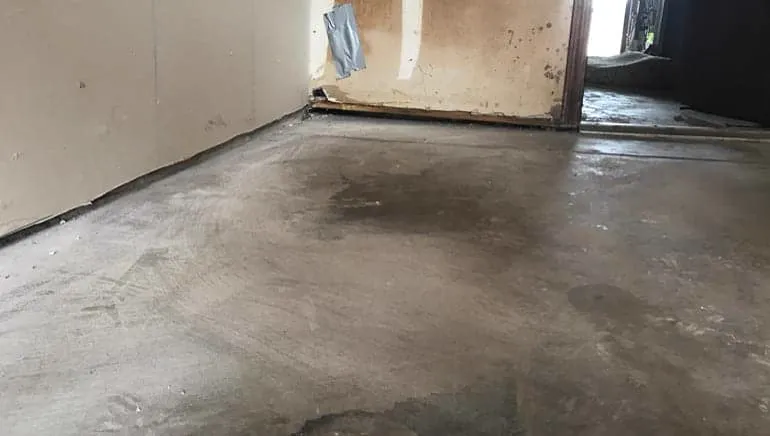
Usually that door is the cove joint, the seam where your basement wall meets the floor. It’s rarely a true seal, so saturated ground rides that seam straight into the room. If your water shows up along the base of the wall, you’ve found the culprit.
What are you actually paying for?
Here’s the thing that makes quotes confusing. A flooded basement is two separate jobs, billed separately.
Job one is getting the water out and drying the space. Extraction, hauling out ruined material, dehumidifiers running for days, then a check that the framing and slab are truly dry — not just dry to the touch.
Job two is making sure it doesn’t happen again. That’s drainage, the sump, the discharge line, and any grading outside. Different equipment, different day, different math.
Plenty of folks pay for job one, skip job two, then repeat job one next spring. That’s the expensive version of cheap.
Worth knowing
Drying and waterproofing are different trades. A quote covering both should say so in writing, item by item. If it doesn’t, ask.
What does the process look like, in order?
Surprises are the worst part of any repair, so here’s the whole sequence.
- Make it safe. If power is anywhere near the water, it goes off at the breaker first.
- Extract the standing water. Pumps and truck-mounted extractors, not buckets.
- Remove the wet organic material. Carpet, pad, soaked drywall and any insulation holding water.
- Dry the structure. Air movers plus dehumidifiers, with moisture readings taken daily instead of guessed at.
- Find the source. Free, and it’s where the real plan comes from. We look outside first — grading, downspouts, where the yard sends water.
- Install the permanent fix. Interior drainage below the slab, wall liner, a properly sized sump, and a discharge line carrying water away from the house.
- Test it while you watch. We run water through the system, then you get the warranty in writing.
Timeline-wise, drying runs three to five days and the waterproofing side runs one to three days on site. They don’t always happen back to back, since fresh concrete likes a few days before you load it up. Either way, it’s a week or two total.

What moves the number up or down?
Straight talk: nobody can price this over the phone. Still, you deserve to know what we’re weighing while we walk your basement, so these are the real drivers behind flooding cost in Johns Creek.
Six things that set the price
- How much water came in. A damp strip along one wall and four inches across a finished floor aren’t the same job.
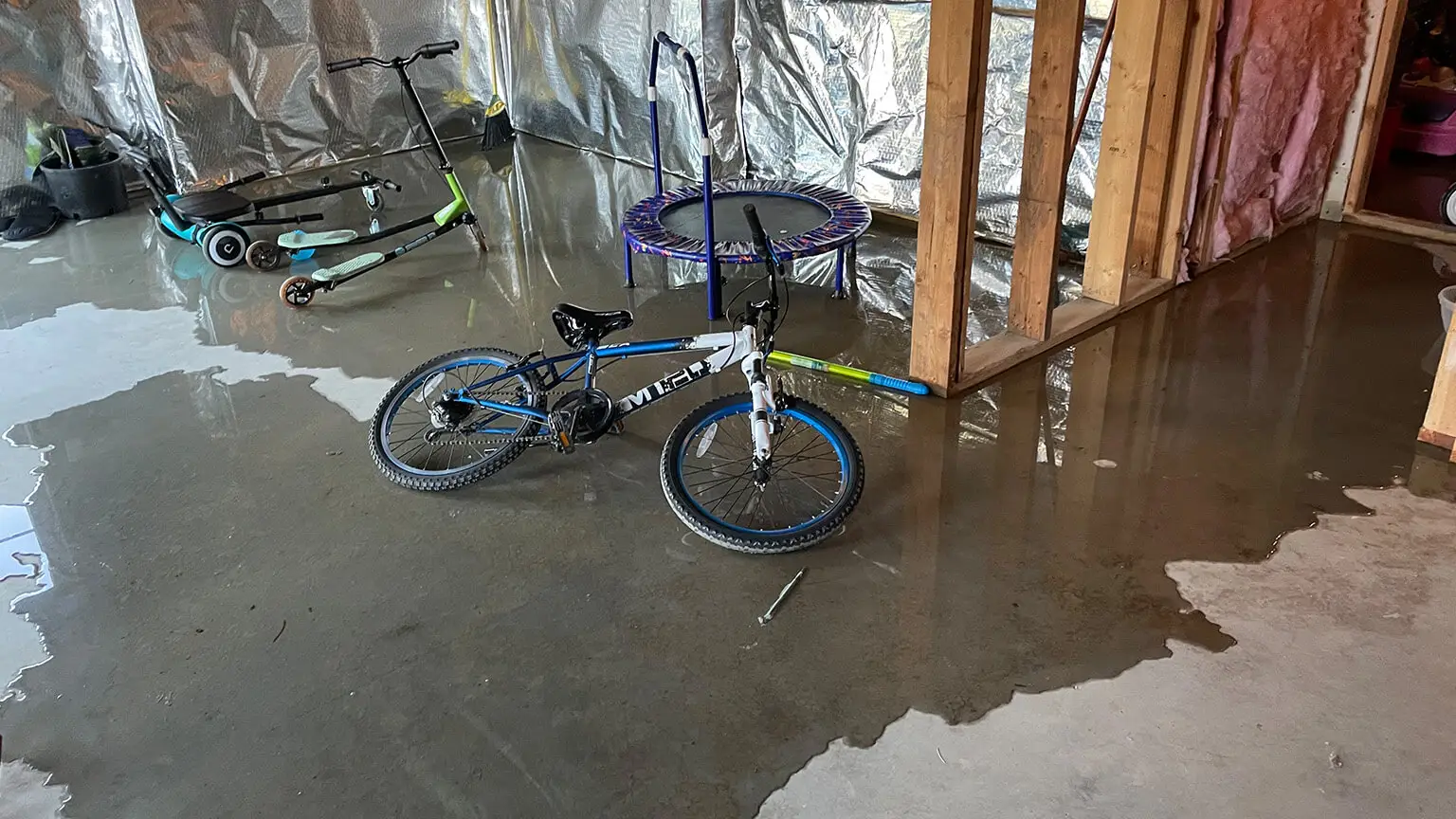
- How long it sat. Twelve hours is a drying job. Four days is drying plus replacement.
- How much wet organic material leaves. Carpet, pad, drywall and insulation hold water like a sponge, so haul-off adds up.
- Finished or unfinished. A bar, built-ins and a bathroom mean careful work before the real work starts.
- Whether drainage is part of the fix. Regrading and moving two downspouts sits at one end. A full perimeter system sits at the other.
- Sump and backup power. A battery backup costs more, but it runs during the storm that kills your power — the same storm that fills basements.
Small exterior corrections land at the low end, while a full interior system in a finished basement sits at the top. Most homes land between, and you’ll get one written number with the scope spelled out. Comparing across the county line? Our breakdown of Alpharetta basement flooding cost uses the same drivers, and our page on basement drying covers the dry-out half by itself.
What changed our thinking after twenty years?
Early on, we treated the sump pump as the hero. Twenty years in, we treat it as the part most likely to let you down — and that shift changed how we quote every job.
Pumps don’t fail randomly. They fail five predictable ways. Power goes out mid-storm, which is the exact hour you need it. The float sticks against a wall or a stray toy. The pump is undersized for the lot. There’s no check valve, so water drains back down and the pump cycles itself to death. Or the discharge clogs and quietly recycles the same water.
That list matters here. A pump installed with the house is now 25-plus years old, and we still find original units around Medlock Bridge and Sugar Mill doing a young pump’s job. They’ve earned retirement.
We stopped selling pumps and started selling systems. A pump moves water. A system assumes the pump will have a bad night and covers for it.
So every proposal now addresses the failure point: correct sizing, a check valve, a clear discharge run away from the wall, and battery backup where the lot calls for it. FEMA’s guidance on protecting property from flooding makes the same argument — redundancy is the point. The result is simple: the next storm becomes weather again instead of an event you supervise.

Will insurance cover any of it?
Sometimes, and you should hear it plainly. Standard homeowners policies commonly exclude surface flooding and groundwater seepage, while coverage for sump failure or water backup is usually a separate endorsement you add on purpose.
That said, policies vary, so pull yours out and call your agent before assuming either way. Take photos before anything gets moved, too — the room, the water line on the wall, the damaged items. Claim or no claim, that’s two minutes with your phone.
Can you handle part of this yourself?
Yes, and more than most companies will admit.
Real DIY wins: extending downspouts six to ten feet out, cleaning gutters twice a year, regrading soil so it slopes away from the foundation, clearing window wells, and testing your sump with a bucket of water. Those five handle a fair share of minor moisture complaints for the price of a nice dinner.
What DIY genuinely can’t reach: two things. First, anything below the slab, since you can’t set drain tile without opening concrete and no product in a bucket beats saturated clay. Second, real structural drying. A shop vac and a box fan pull surface water, but not moisture out of framing, subfloor and concrete — and that decides whether you’re dry or just dry-looking.
Speed matters, so this is the one place we get firm. Mold can begin growing on wet organic material in roughly 24 to 48 hours, which is why we push to get fans running the same day. The CDC’s guidance on mold cleanup after flooding lays out the same window. Dry it fast and the problem mostly doesn’t start.
What about the rooms nobody connects to this?
Here’s the part that surprises people. A wet basement doesn’t stay a basement problem, because air in a house moves upward. Warm air escapes near the roof, which pulls replacement air in from the lowest point. A share of what you breathe upstairs started its trip by that damp corner.
So the musty smell at the bottom of the stairs turns up in the hall closet. Humidity climbs with it, which is why the AC runs longer. Folks blame the thermostat. Usually it’s the slab.
Water travels sideways too. Steady moisture against a foundation keeps clay swelling and shrinking, and that cycle widens hairline cracks over time. It isn’t urgent — it’s just worth knowing that stopping the water protects more than the floor it sits on. If you’ve noticed movement, our page on foundation repair explains how we sort cosmetic from structural.
How do you know the job was done right?
Ask for four things and you’ll sort careful work from fast work in a minute. Moisture readings on paper at the start and end of drying. Photos of the stone and pipe before concrete goes back down. A written scope naming linear feet, sump location and where the discharge ends. And a live test while you watch.
After that, the proof shows up on its own schedule. The floor stays dry through a hard spring storm, and the dehumidifier you were emptying twice a day sits quiet in the corner. Better yet, when the radar lights up over Medlock Bridge Road, you check it out of curiosity instead of dread.
We’ve worked this side of the county for over twenty years, from the sloped walkouts near Autrey Mill Nature Preserve to the older lots toward The Standard Club and the streets around Emory Johns Creek Hospital. Same crews, same trucks, same phone number in year seven. Our full range of basement waterproofing systems is on the service page.

Where we work around Johns Creek
Our shop sits about twenty minutes east in Lawrenceville, so we’re in Johns Creek constantly. We also cover Alpharetta, Duluth, Suwanee, Roswell, Milton, Peachtree Corners, Berkeley Lake, Norcross and the wider Fulton County area. Along the 141 corridor or off State Bridge, odds are we have a truck nearby already.
Questions we get from Johns Creek homeowners
It comes down to two numbers: drying the space out, and stopping the water from coming back. Small exterior corrections and a quick dry-out sit at the low end, while a full perimeter system in a finished basement sits at the top. We give one written number after walking the house, never a guess over the phone.
That’s still worth a look, because occasional flooding usually means the water is always there and only occasionally wins. Two dry-outs a year cost more over time than fixing the source once. The inspection is free, so you can find out before deciding anything.
For a small spill on bare concrete, often yes. For anything that soaked carpet, pad, drywall or insulation, no — that water is inside the material, and household fans don’t pull it out. Commercial dehumidifiers plus air movers do, and moisture readings tell you when it’s actually finished.
Roughly 24 to 48 hours on wet organic material like carpet pad, drywall and cardboard boxes. That’s the whole reason we push to get equipment running the same day you call. Dry it quickly and you usually skip the problem entirely.
Cut power to the basement at the breaker before you step in, then take photos of everything for your records. After that, lift what you can off the floor and call for extraction. The faster the water leaves, the smaller the whole job stays.
Let’s find out what your basement actually needs
The inspection is free, the estimate is free, and nobody pressures you at the end. We’ll show you where the water gets in, what it takes to dry things out, and what it costs to keep it from coming back in Johns Creek.
(678) 914-5112Serving Johns Creek and all of Metro Atlanta · $500 off projects over $3,500 · Live support 7am–8pm, 7 days a week