

Foundation Settling Johns Creek: How to Read Your Cracks Before You Worry
A calm, plain-English guide to crack shapes, sticking doors, and which ones actually need a repair.
Give us five minutes before you spend five hours reading forums. Grab a flashlight, walk your basement or crawl space, then walk the four outside corners of the house. You’re not counting cracks — you’re reading their shape, because shape is what separates normal aging from the kind of foundation settling Johns Creek homeowners really do need to address.
Good news up front: most of what you find on that walk is cosmetic. Houses move a little. Concrete shrinks as it cures. So a crack by itself isn’t a verdict — it’s a clue, and clues can be read.
What are your cracks actually saying?
Cracks have handwriting. A thin vertical line in a poured wall is usually curing shrinkage — concrete gives up water as it hardens and pulls in on itself. That happens in the first year or two, then stops. In other words, it’s a scar, not an injury.
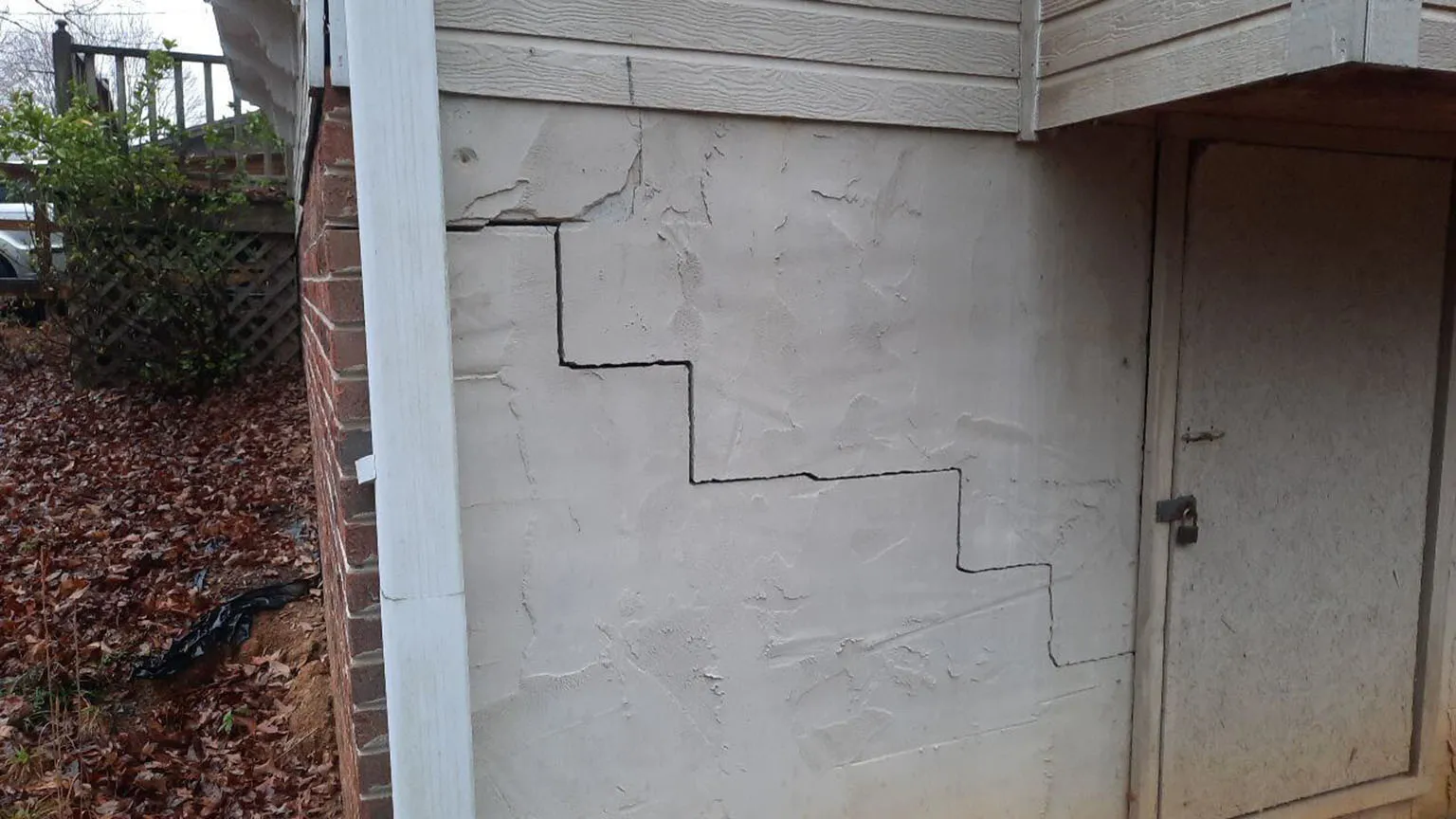
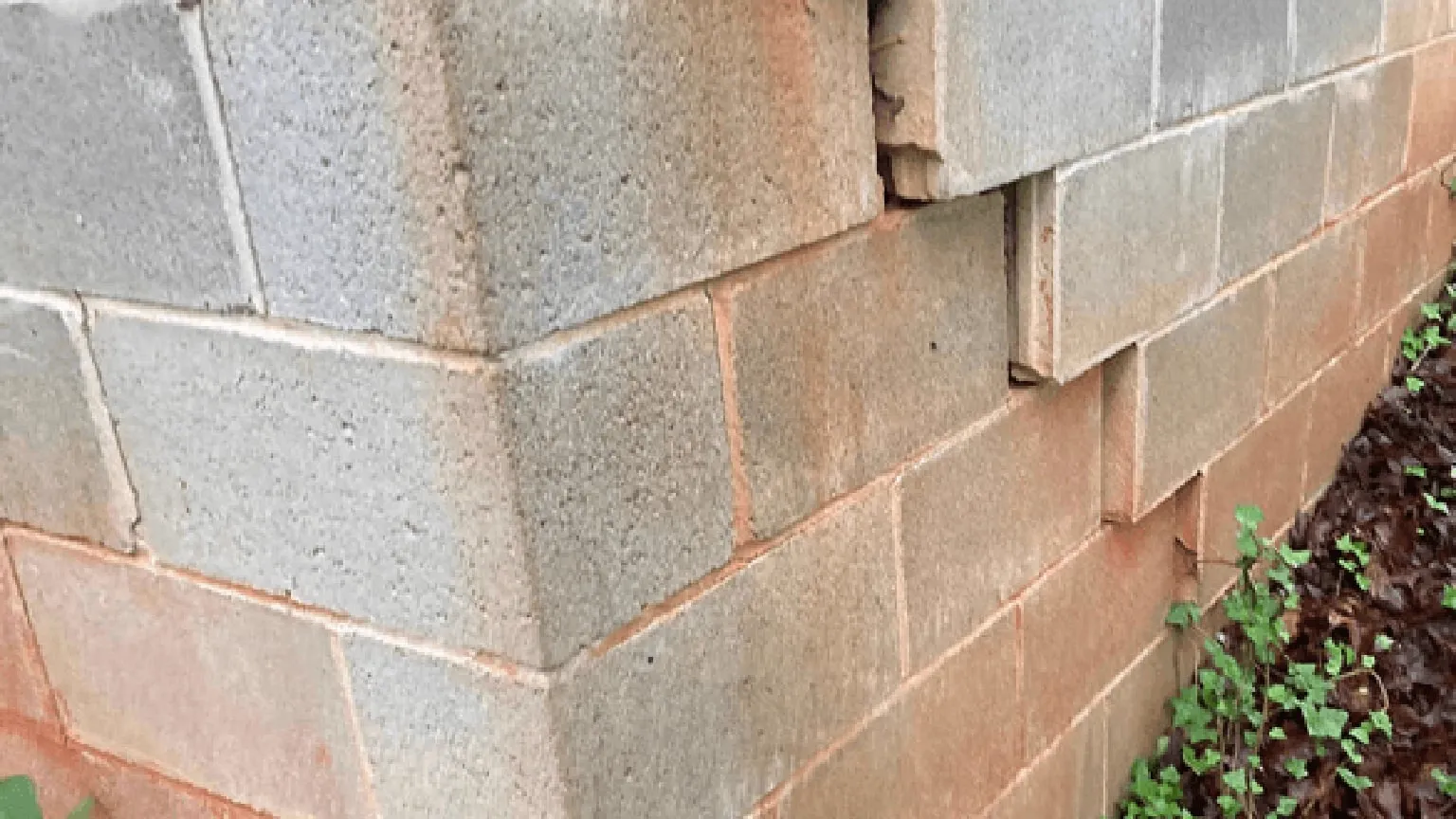
Stair-step cracks are the ones we slow down for. Those climb the mortar joints in block or brick like a little staircase. Since mortar is softer than the block around it, a wall splits along that path whenever one part of the footing drops more than the part beside it. That’s differential settlement, and it’s the real subject here.
Then there’s the pattern that means something else entirely. A horizontal crack running straight across a block wall isn’t settlement — it’s lateral pressure, soil leaning in from the side after the ground outside takes on water. Same wall, different repair. That’s why we read direction first and width second.
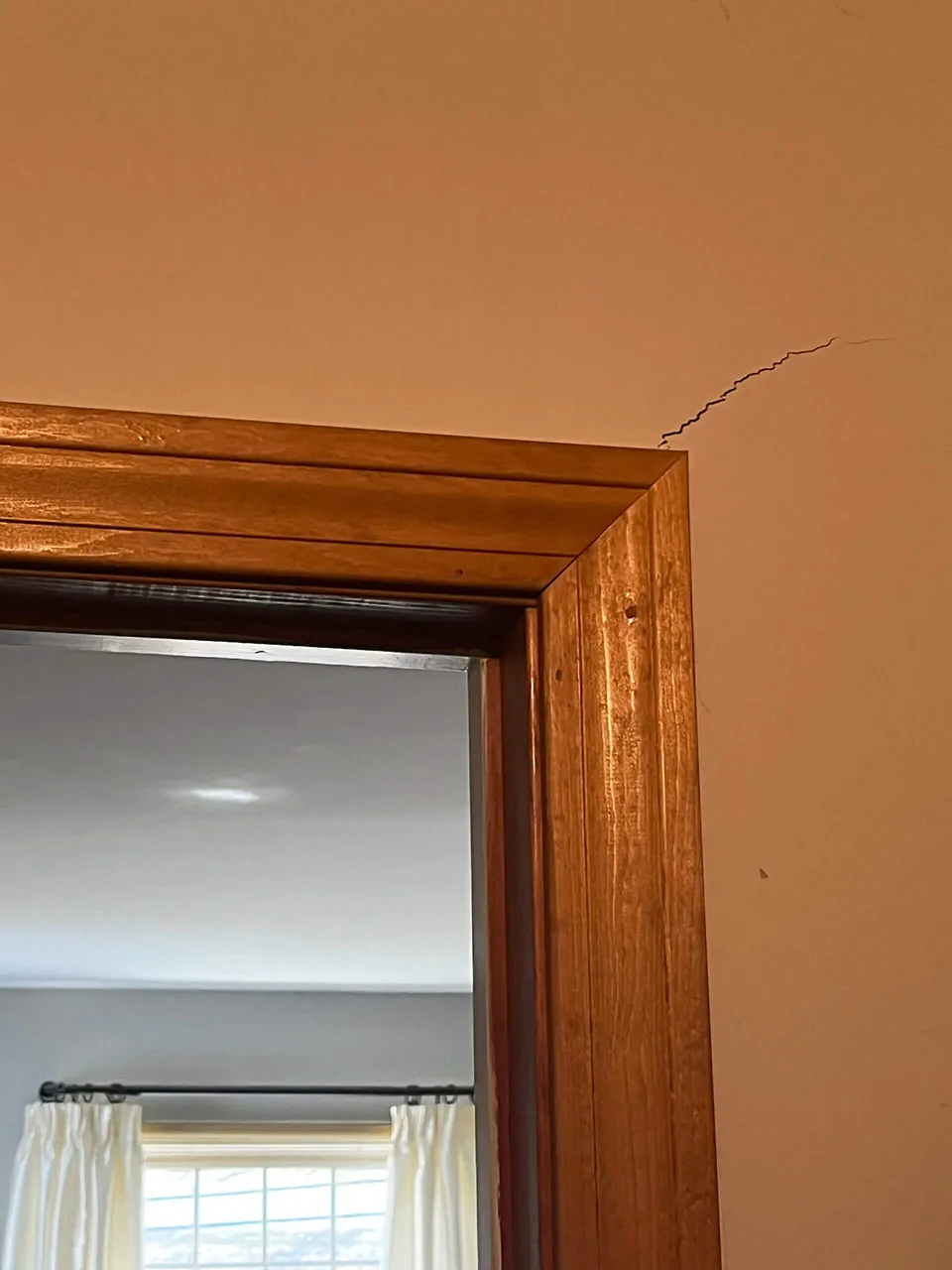
Diagonal cracks angling up from a door or window corner are stress points, because corners are the weak spot in any opening. Drywall does it too: nail pops, a gap at the top of a door frame, a hairline heading for the ceiling.
Why does the ground under here move?
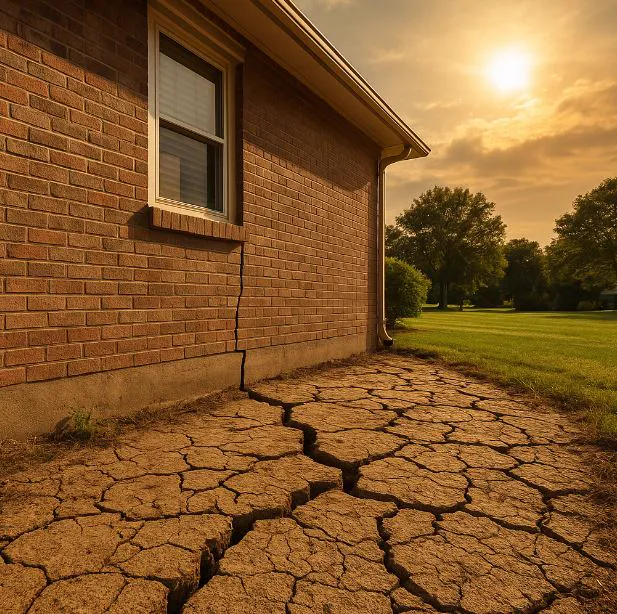
Short answer: red clay. Georgia Piedmont clay is expansive, which is a polite way of saying it changes size with the weather. Soak it through a wet March and it swells. Bake it through a dry August and it shrinks and pulls away from itself.
Now picture that under one corner of your footing, season after season. Up a little, down a little. Nothing dramatic happens on any given day, but a foundation answers to the total of a few hundred small moves. That slow cycling causes most settlement around metro Atlanta — far more often than anything built wrong.
Curious what’s under your yard? The USDA’s Web Soil Survey maps your parcel down to the soil series, and University of Georgia Extension explains how our clay behaves. Fair warning: soil maps are a rabbit hole.
Terrain plays a part too. This side of Fulton County drops toward the Chattahoochee, so plenty of homes sit with one side of the foundation deep in a hill and the other near daylight. As a result, the two sides don’t dry at the same rate — and uneven drying makes uneven settling.
So how worried should you be?
Honestly? Less than the internet suggested. Nearly every home around here carries some cosmetic cracking, and a little movement in the first years after construction is expected. What matters isn’t whether a crack exists. It’s whether that crack is still moving.
Here’s how to find out for free. Draw a pencil line across each end of the crack, write the date beside it, then measure the widest point with a ruler. Check again in three months, and once more after that — you want one wet season and one dry season in the sample. If nothing changed, the crack is dormant, and dormant cracks often need nothing beyond sealing. Your phone can measure it too, though a pencil has never needed a software update.
Worth acting on
Cracks that widen month over month. Doors that bind worse each season instead of easing back. A floor slope a marble will follow. Brick veneer separation wide enough to slip a coin into. Any one of those means it’s time to measure — not time to panic.
What if active movement gets left alone? Plainly: it usually continues, because the thing driving it is still there. Movement doesn’t heal itself. That said, it rarely becomes urgent overnight. The real cost of waiting is that a crack you could have sealed turns into a wall that needs support.
Real talk: the part of this job that decides whether it lasts
Want the piece most estimates skip? Piers get the attention, and they’ve earned some — a good pier carries your footing on soil or rock that ignores the weather. Even so, piers only handle the load. They don’t touch the reason the soil moved.
So if water around your footing keeps swinging soaked to bone-dry, you’ve steadied one section and left the rest on the same ride. That’s why every scope we write covers the outside too: downspout discharge, grade slope, and where the roof sends a storm. Steady soil moisture is the unglamorous half of the work, and it’s the half that decides whether you think about this again.
Better yet, it’s the half you can start this weekend. Run downspouts well past the beds. Keep mulch from creeping up the siding. During a long drought, water the foundation line a little — that one surprises people. Clay wants consistent, not dry.
Piers hold the house steady. Drainage keeps the ground from moving to begin with. Do only the first one and you’ve bought half a repair.
What does the repair actually look like?
Let’s walk it start to finish, because nobody enjoys surprises in their own back yard.
- Measure before we price. We shoot floor elevations, read the crack pattern inside and out, check the grade, and work out which part of the footing moved.
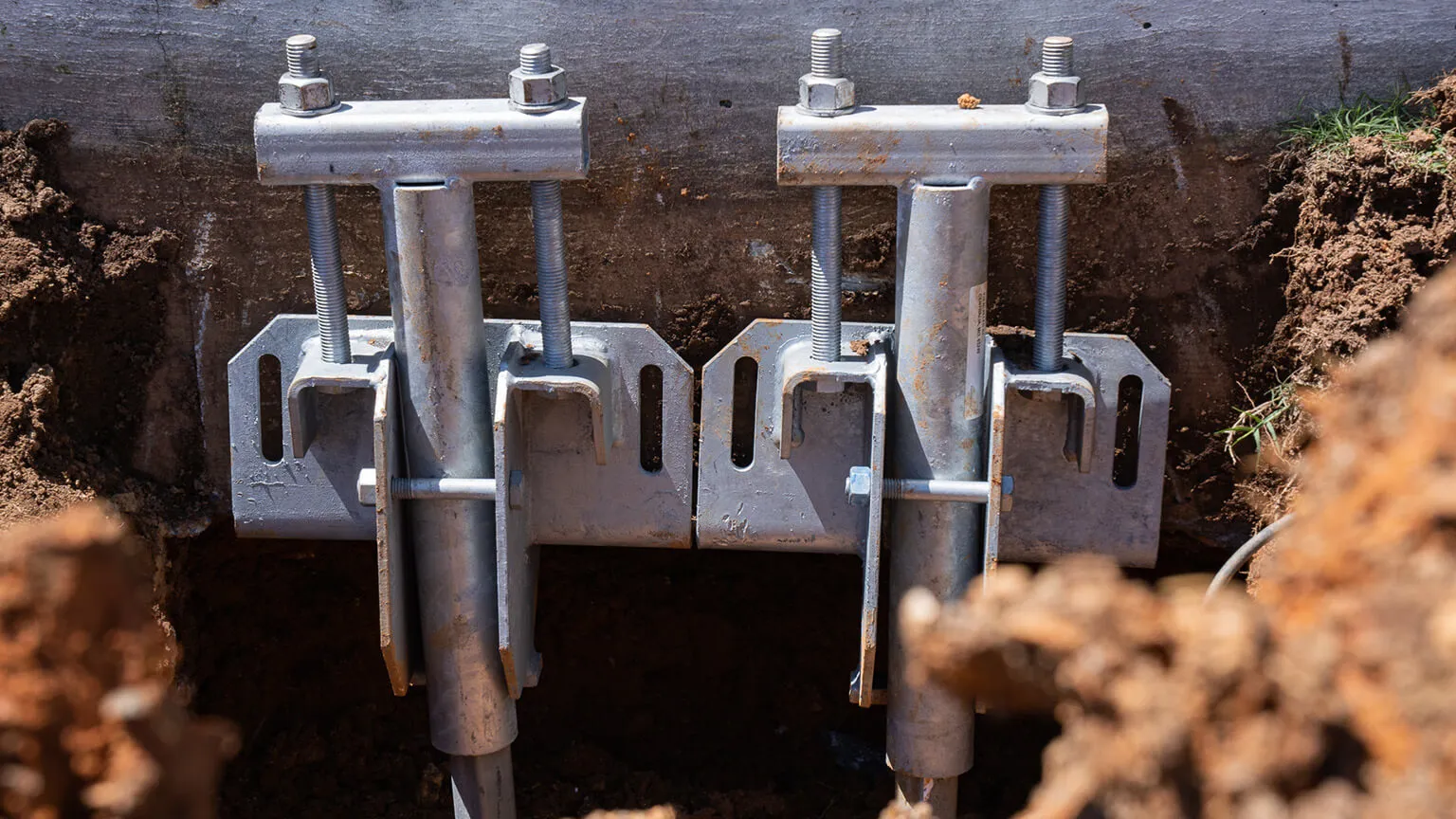
- Stabilize with piers where they’re needed. Helical piers turn into the ground like a giant lag bolt, so they suit lighter loads and tight access. Push piers use the weight of the house to drive steel down to firm soil, which fits heavier walls.
- Treat sunken slabs separately. A garage floor or patio that dropped doesn’t need what the house needs — slab piers or injected support usually handle it.
- Choose stabilize or lift, honestly. Stabilizing stops the movement. Lifting tries to bring things back toward level, and while some recovery is normal, chasing perfect can crack finishes that are fine today.
- Correct the water, never as an option. Regrade, extend discharge, fix drainage. Then backfill, clean up, and haul our mess off.
Notice that two of those five steps aren’t piers at all. Meanwhile, the question we hear most is what it runs, and the honest answer is that it depends — how many piers, how deep they go, the access around the house, and whether drainage work rides along. Our breakdown of foundation cost covers those drivers, and the methods are laid out on our foundation repair page. If you’ve got one dormant crack and nothing else, crack repair is a shorter conversation.
A house near McGinnis Ferry Road that turned out fine
Here’s one that stuck with us. A homeowner in Sugar Mill called about a stair-step crack on the back corner of a block foundation, plus a guest room door that had stuck since summer. They’d read enough online to expect the worst. But that corner of the footing sat over a low spot where two downspouts had emptied for twenty-some years.
We marked the crack, shot the floors, and asked for eight weeks before quoting anything major. Meanwhile the downspouts got extended past the bed line and a shallow swale carried water off that corner. The crack hadn’t grown by the second visit, though the elevations confirmed the corner had dropped. So we set helical piers along that one wall and left the other three alone.
One wall, not four. That’s the takeaway we’d love you to keep: the honest scope is usually smaller than the frightening one, and a company that keeps shrinking your job is one that expects to hear from you again.
Why does the age of this city matter?
Because Johns Creek went up mostly in one long wave, from the late eighties through the mid-2000s. Whole neighborhoods share a build era, a soil profile, and a drainage design. So the original grading, gutters and discharge lines in a place like Medlock Bridge age out on the same schedule. Sump pumps installed with the house are 25-plus years old now, and a pump that quietly quits changes the moisture picture around a footing fast.
Which means what you’re seeing isn’t a fluke on your street. Neighbors comparing notes at the mailbox have good reason to. In fact, nearly all the foundation settling Johns Creek homeowners call us about traces back to water sitting in one spot until the clay there starts behaving differently than the clay beside it.
Why hire people who already work these streets?
We’ve spent twenty-plus years on houses just like yours, and our shop sits about twenty minutes east in Lawrenceville. So we’ve read block walls in Doublegate, walked sloped back yards minutes from Johns Creek Town Center, and worked the neighborhoods behind Emory Johns Creek Hospital. Patterns repeat here, so we usually know what we’re seeing before we’re off the driveway.
We also know how folks do business here. You want a written scope, proof of insurance, a warranty you can actually read, and a clean job site — the same standard we’d want at our own houses. If your HOA needs exterior work approved, we’ll help with that paperwork. And if a relative one town over sees the same thing, we handle Alpharetta foundation settling too.
Picture the after. The door latches first try in July and again in January. Those pencil marks stay exactly where you drew them. Instead of checking a crack every few weeks, you get through a whole rainy spring without thinking about the foundation once. That’s the real product — a house you stop worrying about.
Where we work around Johns Creek
Johns Creek is a quick run from our shop, so our trucks are out this way most weeks. We also cover Alpharetta, Duluth, Suwanee, Roswell, Milton, Peachtree Corners, Berkeley Lake and Norcross, plus the wider Fulton area. Whether you’re along the 141 corridor or closer to State Bridge, odds are we’re already nearby.
Questions Johns Creek homeowners ask us
Generally it helps, since what worries buyers is movement nobody addressed. A documented repair answers the inspector’s question before it gets asked. Keep the invoice, any engineer’s notes, and the warranty together in one folder for closing day.
Most pier jobs on one or two walls run a few days from setup to cleanup, and drainage corrections usually add a day. Deep piers, tight access, or a stretch of hard rain can stretch that. We’d rather give you a realistic window than a hopeful one.
Often yes, and plenty of homeowners do. We’d steady the section that’s actually moving first, handle water management next, then come back for cosmetic sealing once things have held through a season. Each phase gets written out so you know what it costs and what it buys.
It does, and you’ll have the document before anyone picks up a shovel. Read the covered and not-covered lists with us so there are no gray areas later. Also ask whether it transfers to the next owner, because that detail matters at closing more than people expect.
We dig where the piers go, so that strip of ground gets disturbed. Sod and small plants come up first and go back down after, and we backfill, tamp and regrade before we leave. It looks rough for a couple of weeks, then the lawn quietly forgets the whole thing.
Let’s take a look at that crack together, Johns Creek
The inspection is free, the estimate is free, and nobody gets pressured at the kitchen table. We’ll measure what’s moving, tell you plainly if the answer is “seal it and watch it,” and put whatever we recommend in writing.
(678) 914-5112Serving Johns Creek and all of Metro Atlanta · $500 off projects over $3,500 · Live support 7am–8pm, 7 days a week