

Foundation Settling Alpharetta Homeowners Notice First — and What’s Behind It
Sticking doors, stair-step cracks, a floor that feels a little off. Here’s how to read the signs and what an honest repair looks like.
Here’s something worth knowing before you worry: if it’s happening at your house, it’s probably happening two doors down too. That’s the honest starting point for foundation settling Alpharetta homeowners run into. Your street was graded by one crew, in one season, on one kind of dirt — so when the ground moves, it tends to move for the whole block.
Good news? A crack over a doorway is a symptom, not a verdict. Plenty of what we get called out to look at turns out to be old news that quit moving years ago, and the cases that are still active are ordinary work for us.
So why is the whole street doing this?
Blame the dirt — Georgia red clay, specifically. Clay is expansive, which is a fancy way of saying it drinks. Soak it with a wet March and it swells. Bake it through a dry August and it shrinks back down.
Now picture that under a concrete footing, twice a year, for thirty years. The soil lifts a little, then pulls away a little, and the house rides along whether it wants to or not. That slow seasonal cycling causes most foundation settling Alpharetta homeowners ever see — not bad concrete, and not a builder who cut corners.

Timing matters as much as soil. Most of this city went up between roughly 1985 and 2005, so a whole map’s worth of homes hit the same age together. Streets around Milton Park and Nesbit Ferry still look sharp from the curb, but the drainage that came with them is thirty years into a job it was never going to do forever.
That’s usually where we find the real culprit. Downspouts that carried water safely away in 1995 now empty beside a mature shrub bed, and grade that once sloped away has been softened by decades of mulch. As a result, one corner gets soaked every storm while the far corner stays dry — and uneven moisture is exactly what makes clay move unevenly. You can look up the soil under your own lot through the USDA Web Soil Survey.
What are the cracks actually telling you?
Quite a lot, once you know how to read them. The pattern matters far more than the length, so here’s the short course.
Thin vertical cracks in a poured wall. Usually the least exciting thing we look at. Concrete shrinks as it cures, so these show up early, run straight up and down, and then sit there for decades doing nothing.
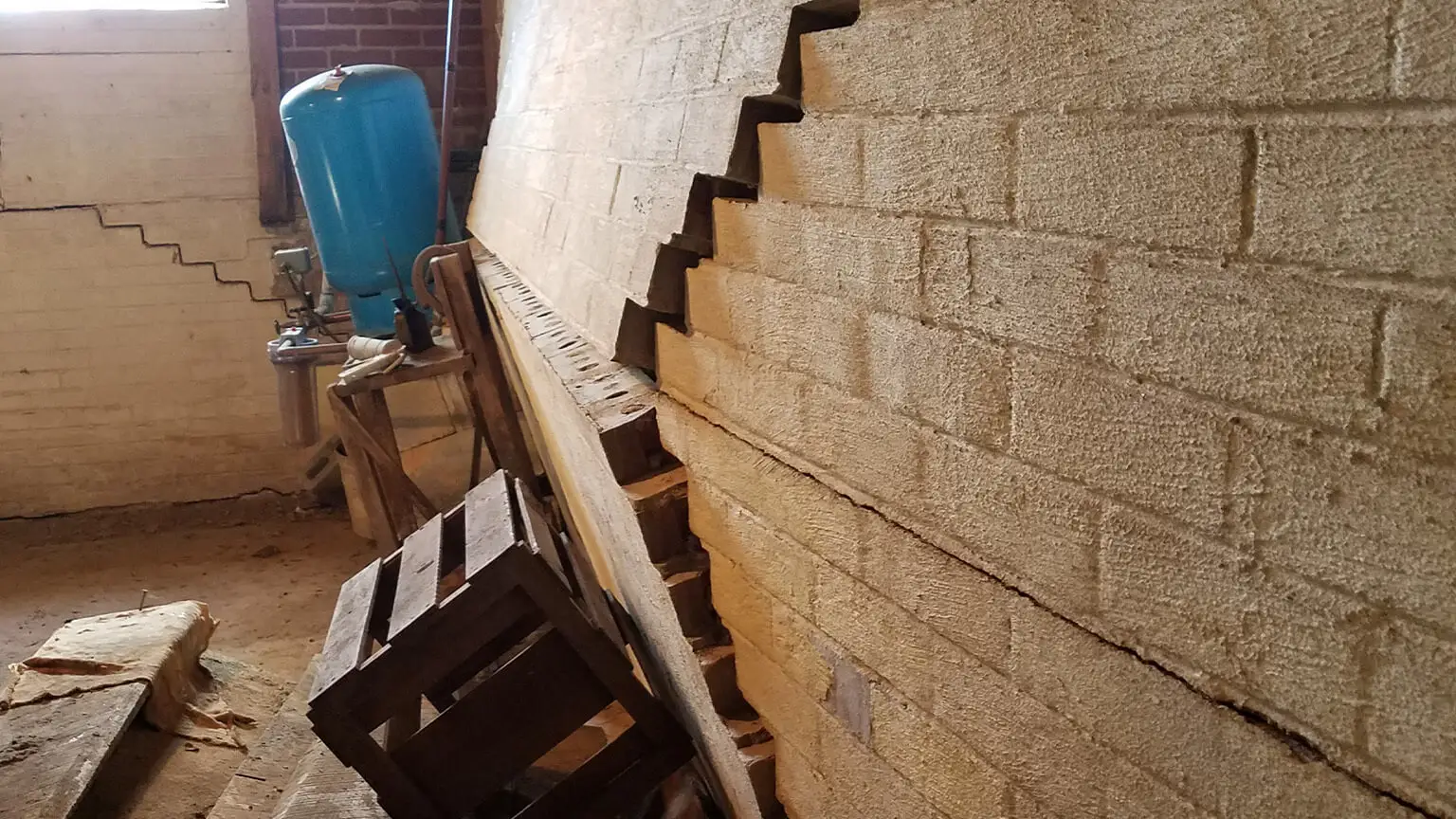
Stair-step cracks in block or brick. When a crack climbs the mortar joints like a staircase, one part of the wall has dropped more than the part beside it. That’s differential settlement, and it’s the pattern that earns a closer look.
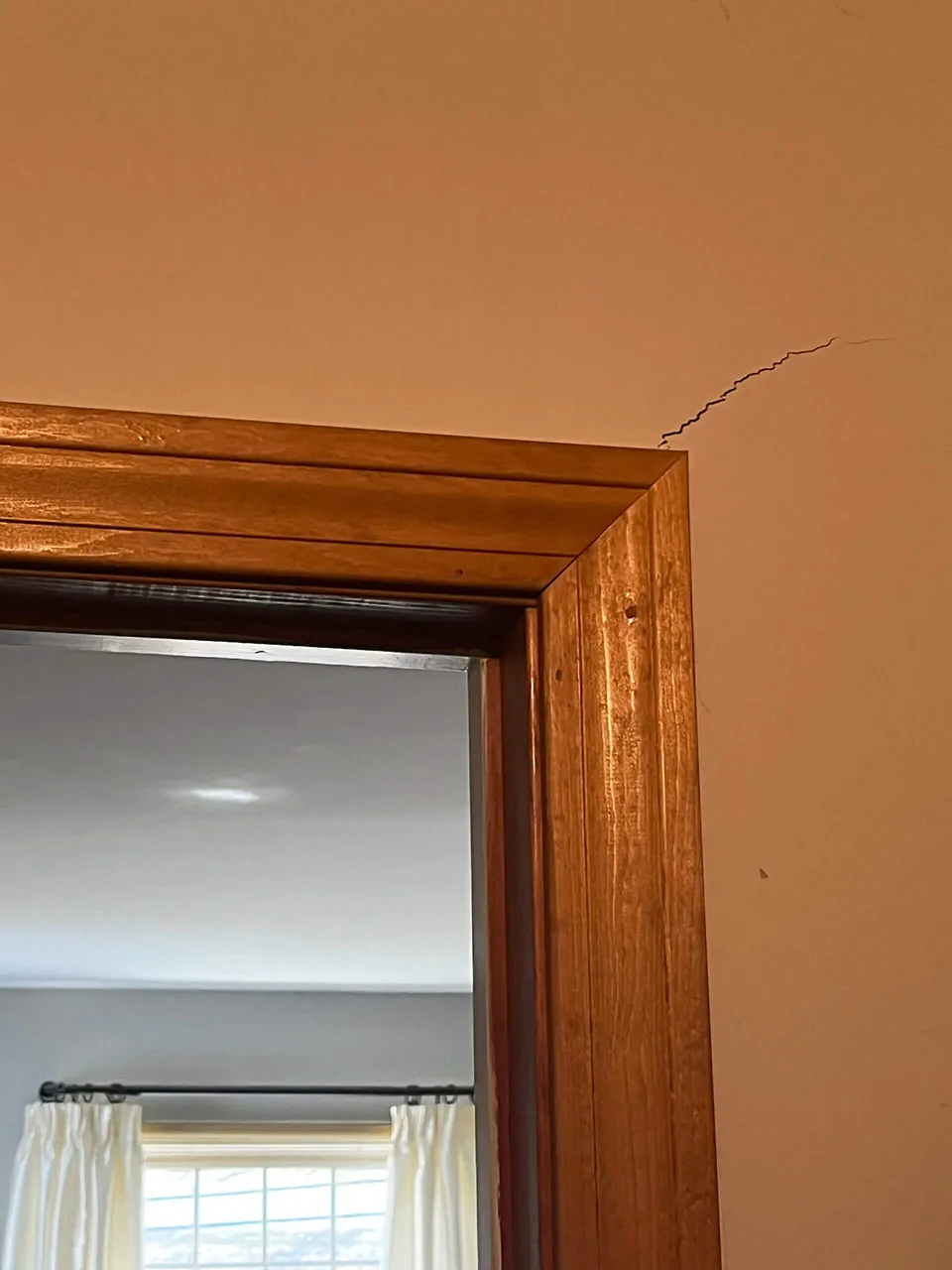
Diagonal cracks off a door or window corner. Corners are where stress piles up, so that’s where a wall gives first. Upstairs cracks fanning out from a door frame — plus doors and windows that suddenly stick — are often the very first thing a homeowner notices, well before anyone thinks about the foundation.
Horizontal cracks in a block wall. This one’s different, and it matters to separate it out. A crack running side to side means soil is pushing on the wall from outside rather than dropping out from underneath. Different cause, different repair — braces or anchors instead of piers.
Walls aren’t the only tell, either. Nail pops in the ceiling, a gap opening at the top of a door frame while the bottom still fits, brick veneer pulling away from trim, floors that send a dropped pen rolling toward one wall with real purpose. Any one alone is minor. Two or three together are worth measuring.
Mild, or actually worth acting on?
Straight answer: most cracks in most houses here are cosmetic. Some settlement in the first several years after construction is normal, since fresh backfill compacts and the house finds its seat. We say that on inspections more often than we recommend piers.
What separates old news from active movement isn’t width — it’s change. A quarter-inch crack that hasn’t budged in twenty years is calmer than a hairline that grew last spring. That’s why we always ask what it looked like a year ago.
Better yet, you can answer that yourself for free. Draw a pencil line across the crack at its widest point, write the date beside it, then measure the gap with a ruler. Check again in three months, and again after a wet season and a dry one. If the mark still lines up, the crack is dormant and may only need sealing.
Here’s what moves a crack from “watch it” to “let’s look at it”:
- The gap widens measurably over several months of tracking
- Doors and windows get harder to close season after season
- A floor slopes enough to see with a level, not just to feel
- Separation you could slide a coin into at brick, trim, or a corner
- New cracks showing up in a second room after the first one
Good news
Foundation issues move slowly. That means you have time to measure, ask questions and get a second set of eyes — and it’s why we’d rather hand you a monitoring plan than a proposal you don’t need.
Is a patch the same thing as a fix?
Not even close, and this fork in the road decides whether you do this once or three times. Filling a crack treats the line in the wall. Supporting the footing treats the reason the line showed up. Only one of those is still working in year ten.
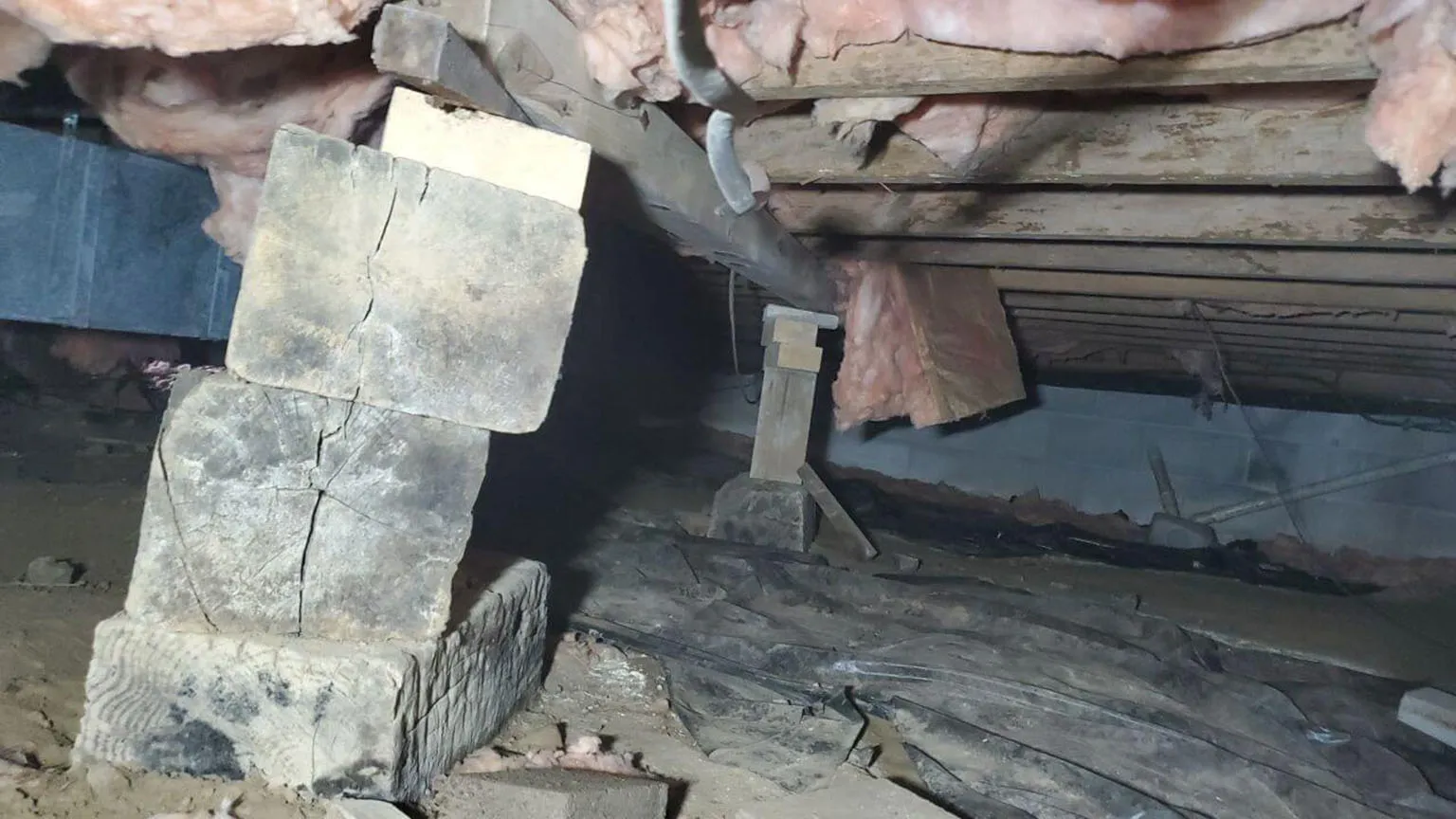
We’ve crawled under plenty of homes and found a previous “solution” made of stacked blocks and a wood shim under a sagging girder. Somebody was trying, honestly. But loose blocks sit on the same shifting clay as everything else, so that pier just rode the movement down with the house.
Cosmetic repair does have a place, to be fair. Once movement has stopped, sealing and patching is exactly the right last step. The order is what matters — patch first and you’ll be repainting that wall every couple of years, which is a rough way to spend a Saturday.
We’d rather tell you a crack is dormant and hand you a caulk recommendation than sell you a repair the house isn’t asking for.
What does the real repair look like?
Simpler than most people expect. The whole idea is to stop asking the clay to hold your house up, and instead reach past it to something that doesn’t care about the weather.
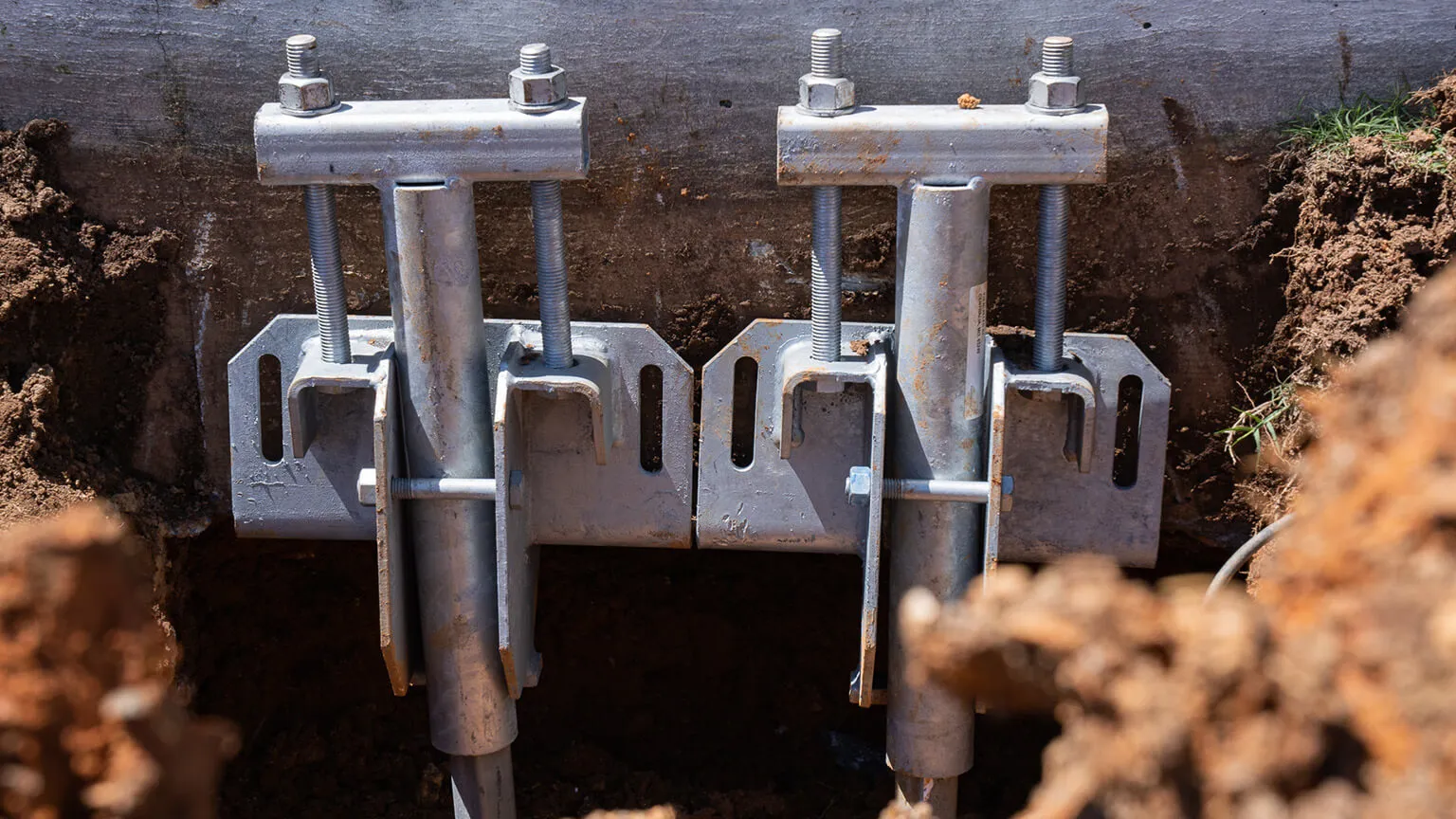
Helical piers are steel shafts with plates welded on, turned into the ground like a giant screw until the torque says we’ve hit capacity. Push piers, also called resistance piers, get driven down using the weight of the house until they reach load-bearing soil or rock. Slab piers do the same job under a settled concrete floor. Which one fits depends on your soil, your foundation and how much house sits over that spot.
Then comes the part worth understanding before anyone quotes you. Stabilizing means movement stops where it is. Lifting means bringing the house back toward level. Lifting is sometimes possible, but it isn’t always wise, because a home that’s settled slowly for twenty-five years has plumbing, tile and trim that all adjusted to the new shape. So we talk through what’s realistic first, and you decide.
Drainage is the quiet half of every foundation settling Alpharetta repair we do. Steady soil moisture around the footing is what keeps clay from cycling, which means extending downspouts and correcting grade does real structural good. Not glamorous, but effective. The standards behind all of it come from the model codes published by the International Code Council.
Wondering what it runs? It depends on how many piers, how deep they go, and how easy that side of the house is to reach — so we walk it before we quote it. Our breakdown of foundation repair cost lists every factor that moves the number, and the methods are laid out on our foundation repair page. If sealing is all you need, foundation crack repair is the shorter road.
What do week one, year one and year ten look like?
Fair thing to ask, since nobody signs a contract for the construction. They sign it for what comes after.
The first week. A crew digs narrow access holes along the footing, sets brackets and piers, then backfills. Two to four days on a typical home. It’s loud outside and mostly boring inside, which is exactly how you want it.
The first year. Sod grows back and you stop noticing where the holes were. Meanwhile, you get to watch your pencil marks do absolutely nothing through a wet spring and a dry August — the first season the clay swells and shrinks without your house going along for the ride.
Year ten. Honestly, the goal is that you can’t remember which corner it was. Piers bear on soil that doesn’t respond to weather, so once the load transfers there’s nothing left to wear out. What changes is smaller and better: doors that latch, a floor that stays put, one less thing on your mind when the forecast turns ugly.
That’s the real product. Not a perfect house — a calm one. You should be able to sit through a long Georgia storm without wondering what your foundation is up to.
Why does hiring local matter for this?
Because these houses aren’t a mystery to us. We’ve worked the older block walls out toward Hopewell Plantation and the poured walls in newer pockets closer in, and the two behave differently under identical soil. We know which streets off Mansell Road drain toward the house instead of away from it. Ball fields at Wills Park and the parking decks over at Northwinds office park sit on the very same clay your footing does, so nobody here is guessing about the dirt.
Our shop is about twenty-five minutes east in Lawrenceville, which means the crew doing the work is the crew still answering the phone years later. You get a written scope, proof of insurance, a real warranty and a clean job site. And if your sister across the county line sees the same cracks, we handle Duluth foundation settling just as often.
Where we work around Alpharetta
Alpharetta is a short run west for us, so our trucks are out this way constantly. We also cover Milton, Johns Creek, Roswell, Cumming, Duluth, Sandy Springs, Suwanee and Norcross, plus the wider Fulton area. If you’re along the GA-400 corridor or near downtown Alpharetta, odds are we’re already close by.
Questions Alpharetta homeowners ask us
Most pier work on a typical home wraps up in two to four working days, and a drainage correction on its own can be a single visit. Larger homes needing piers on two sides run longer. You’ll get a day count in writing before we start, so your week isn’t a guessing game.
Often, yes. When one corner is doing all the moving, we can support that section now and plan the rest for later. That said, we’ll tell you honestly whether staging actually saves money or just splits the same bill into two trips.
Yes, and you get the terms on paper before anyone digs. Ask what’s covered, how long it lasts, and whether it transfers if you sell the house. A warranty you can read through in a minute is worth more than a long one nobody can explain.
Less than most people picture. Piers go in through small excavations right at the footing, so we’re working a narrow strip along the house rather than the whole lawn. We put the soil, sod and mulch back when we finish, and by the next growing season you’d have to know where to look.
Usually not an emergency, but it is a separate problem from settling and it does deserve a measurement. A wall leaning inward is answering soil pressure from the side, not ground dropping underneath. Most bowing walls get handled with braces or anchors on a normal schedule, once we know how far it has moved.
Let’s take a look and tell you straight
The inspection is free, the estimate is free, and nobody leans on you at the end. We’ll measure what’s moving, explain what the cracks mean in plain English, and put the plan in writing — including the times the honest answer is “keep an eye on it.”
(678) 914-5112Serving Alpharetta and all of Metro Atlanta · $500 off projects over $3,500 · Live support 7am–8pm, 7 days a week