

Foundation Repair Options Alpharetta Homeowners Get Pitched — and How to Pick
Helical piers, push piers, foam lifting, wall straps — or honestly nothing yet. Here’s how each works and which we’d write on your estimate.
The call usually opens the same way. “There’s a crack in my basement wall, and I can’t tell if it’s a big deal or a nothing deal.” Then, ten seconds later: “And the first quote I got about knocked me over.” If that’s been your week, you’re in the right place — because the foundation repair options Alpharetta homeowners get pitched run from a tube of sealant to a truckload of steel.
So let’s lay them out fairly, with the good and the bad of each. By the end, you’ll know which column your house belongs in.
Why do the same streets keep calling?
Because Alpharetta went up in waves, and each wave ages together. Most of the city was built between 1985 and 2005, so a lot of block and poured walls are hitting the same birthday at once. Here’s the local truth: the original drainage and waterproofing on these homes has simply worn out, even on houses that look brand new from the curb.
Terrain adds to it — rolling lots, graded pads, walkout basements, and the Big Creek floodplain cutting through the middle of town. Newer product behaves differently, though. The Avalon district townhomes and the Foundry at Roswell edge sit on slabs and shallow crawls, so they show different symptoms. And since half of Alpharetta works from a finished basement office, a hairline crack behind a desk gets noticed fast. That’s actually good news. Early is cheap.
What’s actually moving down there?
Our dirt, mostly. Georgia red clay over weathered granite holds water, swells when it’s wet, then pulls back in when it dries. That cycle runs under your footing every year, so the soil supporting one corner isn’t always the volume it was last spring. The UGA extension service explains how our soils behave in plain language.
Settlement shows up when that support shrinks away, or was never compacted well on a graded pad. Poor drainage speeds it along, because roof water landing beside the wall keeps one strip of clay swinging between soaked and bone dry. Curious about your own lot? The federal Web Soil Survey maps it parcel by parcel. None of this is mysterious — the fix just has to match the cause.
Option A: how do helical piers work?
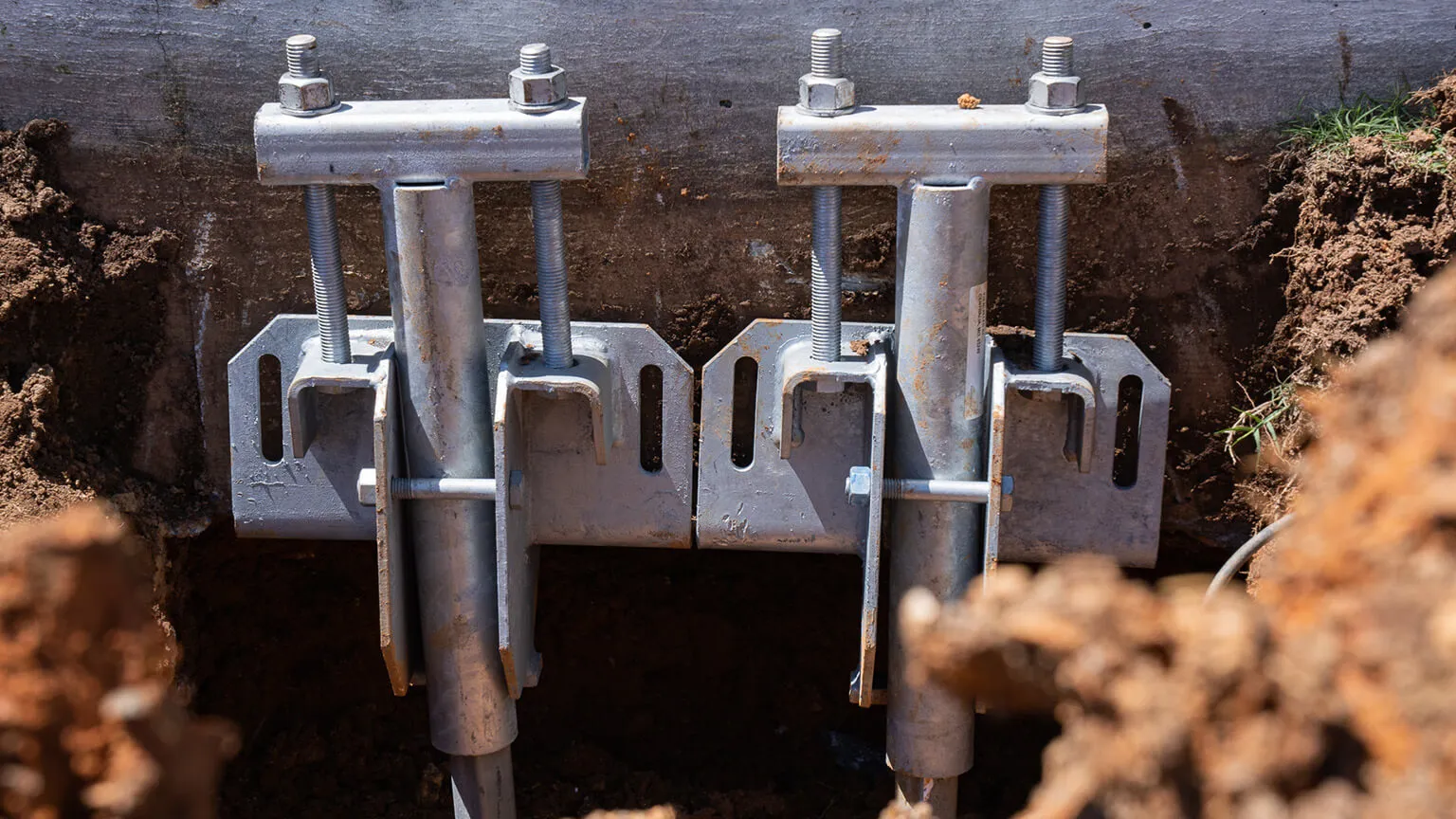
Picture a big steel screw. A helical pier is a shaft with helix plates, and a machine turns it into the ground while reading torque the whole way down. Turning gets harder as the soil gets denser, so the machine is measuring capacity while it installs. It keeps going until it reaches soil dense enough to carry the load, and then a bracket transfers the foundation onto it. Depth comes from resistance, not from a number picked in advance.
Where it shines: lighter structures. Porches, stoops, sunrooms, additions and townhome sections don’t weigh enough to fight back, and helicals don’t need them to.
What sets the price: count and depth. More piers cost more, deeper soil costs more, and hand-digging past a deck adds hours.
Option B: what about push piers?
A push pier skips the screw. Steel pipe sections get pressed straight down using your home’s own weight as the pushing force, until the pipe reaches something it can’t move through. That moment is called refusal.
Notice the trade there. You don’t pick the depth — the soil picks it. One wall might stop at twelve feet while another keeps going, which is normal, not a sign somebody guessed wrong.
Where it shines: heavy homes. A two-story full-brick house gives plenty of weight to drive against. The honest limit: a light structure can’t provide that resistance. Push piers under a wood-framed sunroom will lift the sunroom before the pipe goes anywhere, which is exactly why both products exist.
How do the two compare?
Helical piers
- Turned in; torque gives measured capacity
- Works under additions and light framing
- Can be installed before a structure exists
- Good in tight, hand-dug access
- Priced per pier and per foot of depth
Push piers
- Driven by the home’s own weight to refusal
- Best under heavy masonry and two-story homes
- Depth set by soil, not chosen up front
- Reaches dense bearing strata dependably
- Not suited to porches or light framing
Read those columns again and the real lesson shows up. The question was never which pier is stronger. It’s which one your structure can actually install, and weight and access settle that before anybody talks price.
Where do homeowners get steered wrong?
Now here’s where a lot of homeowners get steered wrong, and it costs real money. Somebody sees a crack, hears the word “foundation,” and gets quoted piers. But piers fix settlement — a house going down. Plenty of Alpharetta cracks come from a different force pushing sideways.
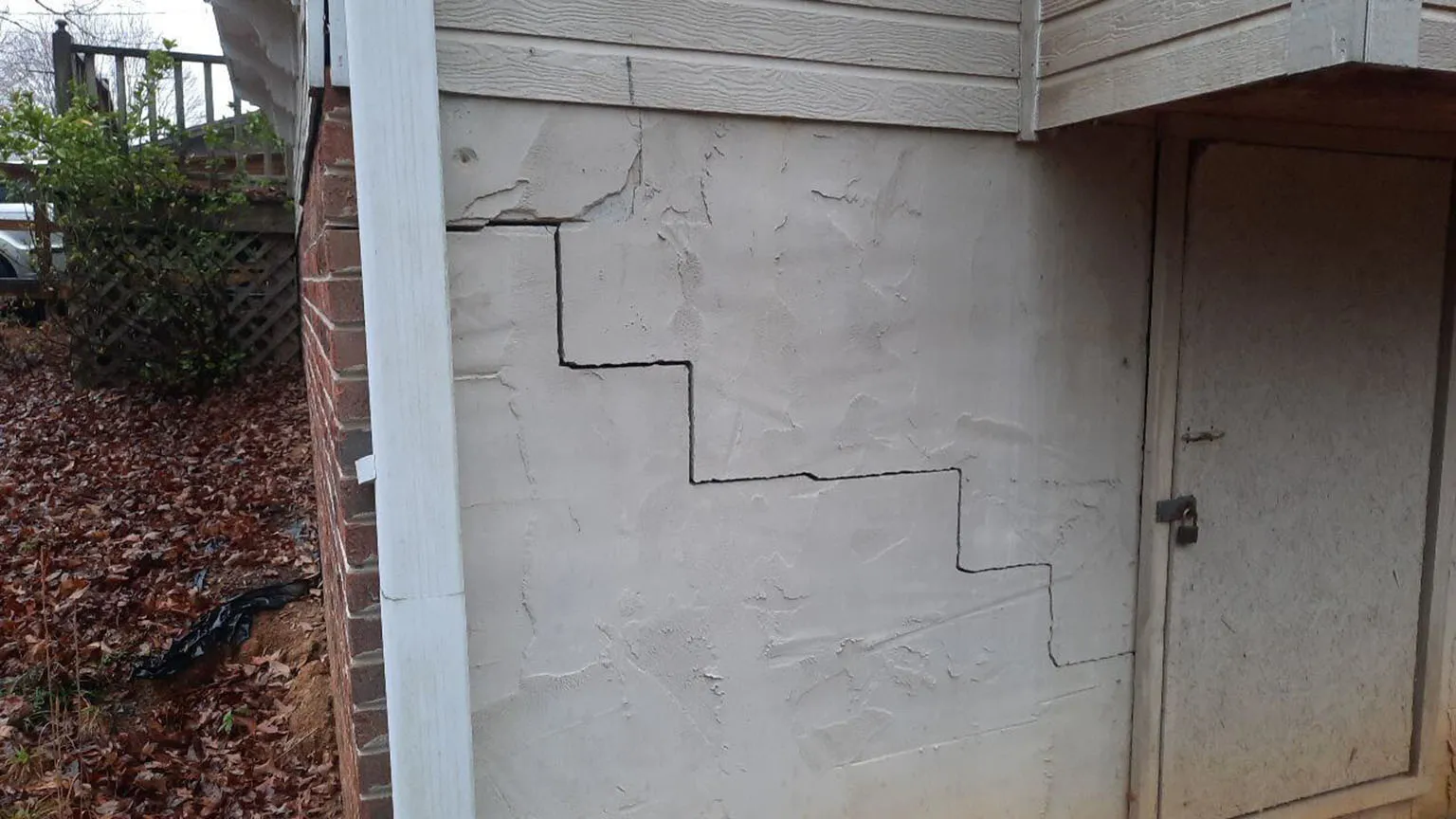
Saturated clay leans on a basement wall from outside. When that push wins, block bows inward and a long horizontal crack opens partway up, often with stair-stepping at the corners. Piers do nothing there, because nothing settled. What works instead is carbon fiber straps bonded up the wall, or steel beams anchored to the floor and joists for heavier movement.
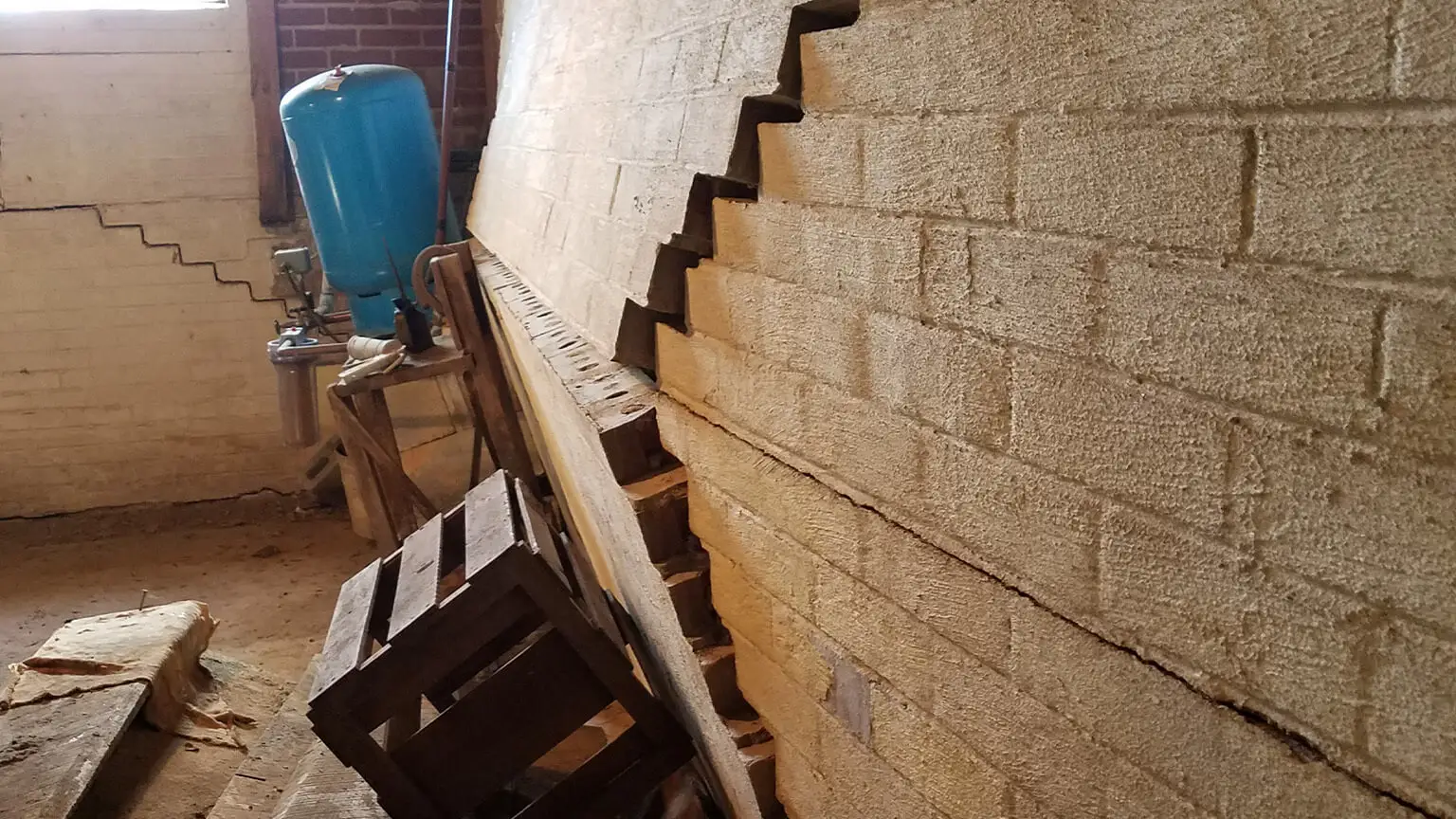
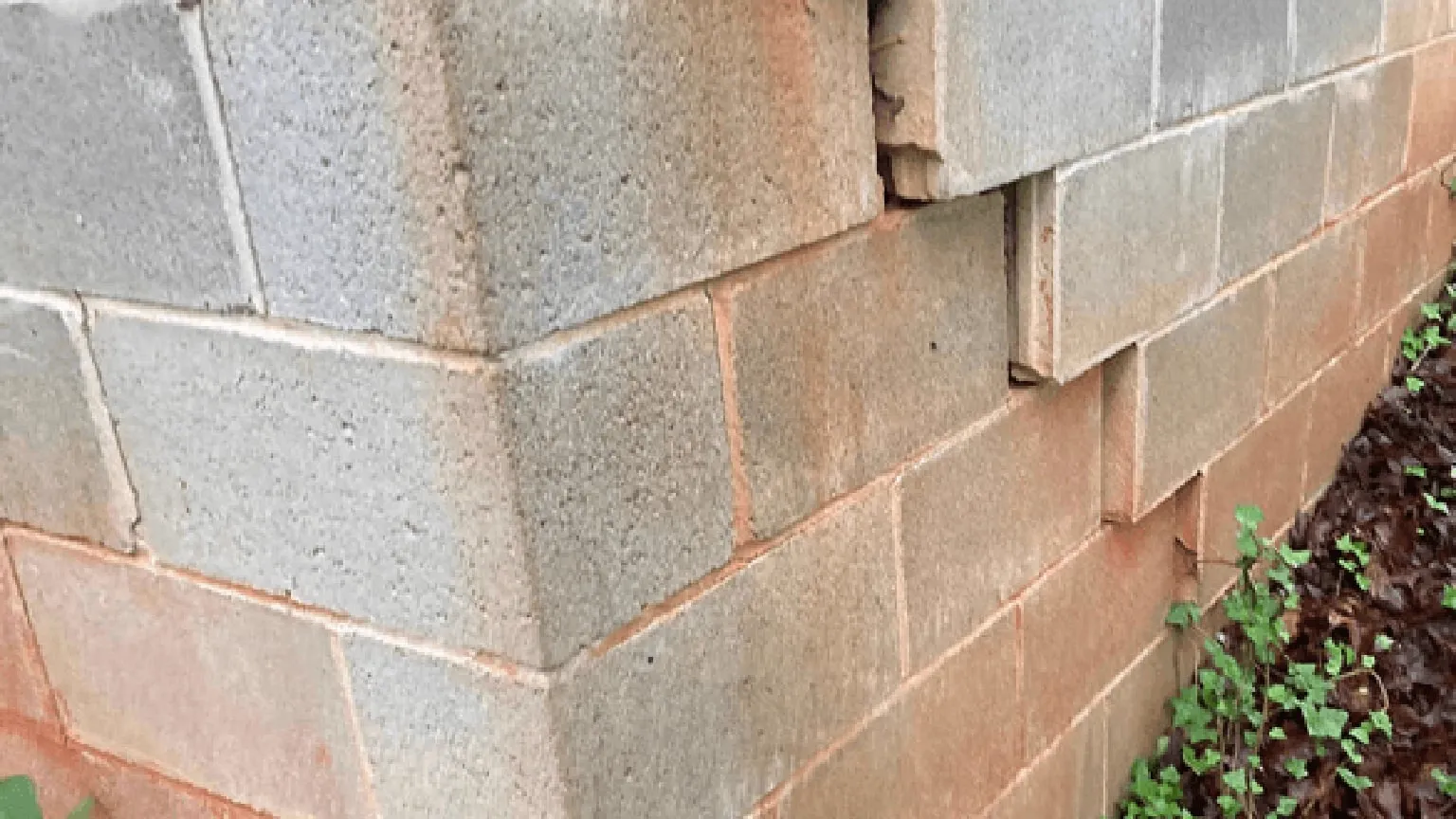
So how do you tell them apart at home? Settlement brings diagonal cracks that are wider at one end, a floor sloping one direction, and doors sticking on one side. Lateral pressure brings that horizontal line plus a wall you can measure out of plumb. Either way, both have well-proven repairs.
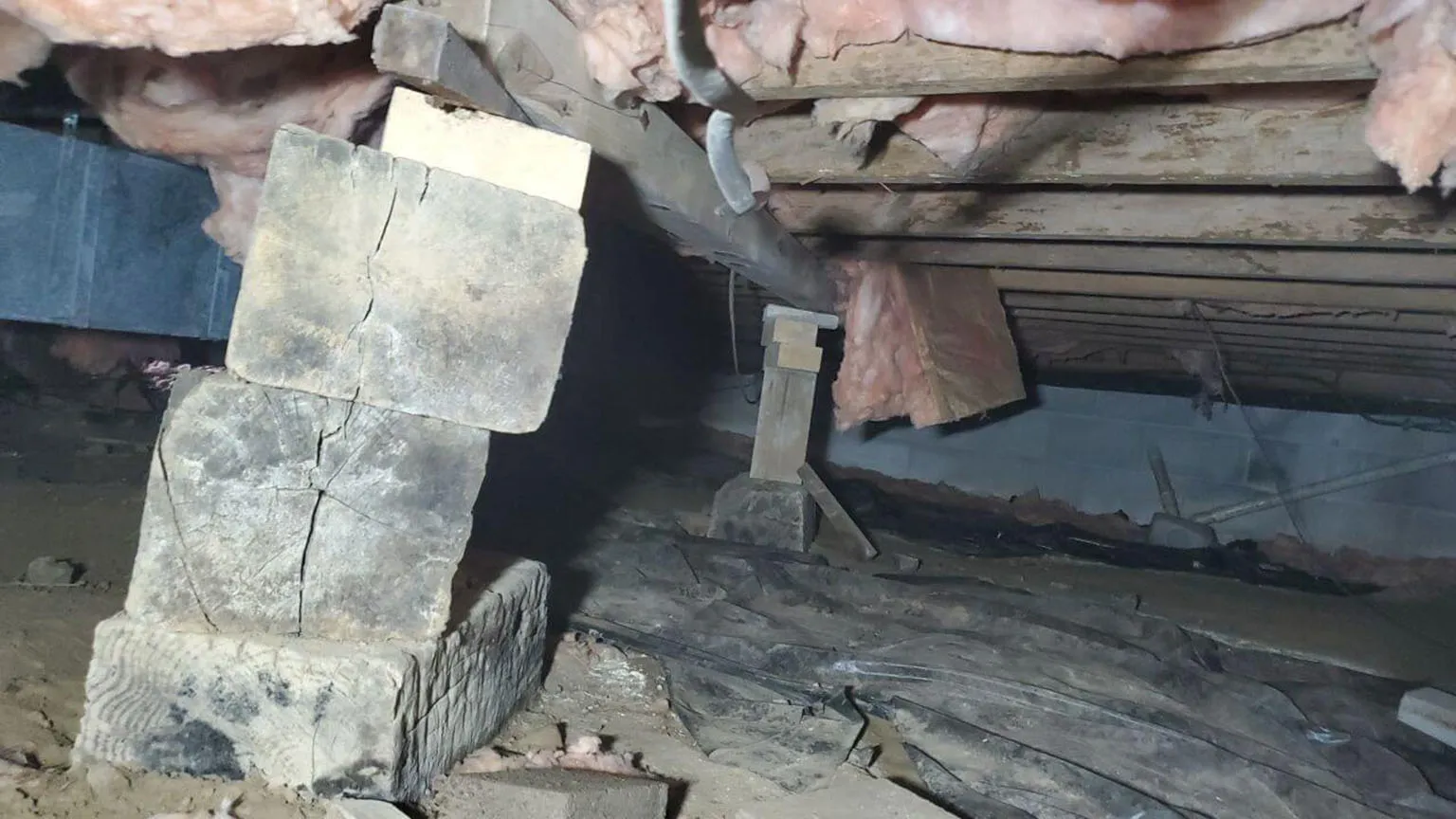
One more thing we find in older homes: a previous owner’s homemade pier. Stacked wood, loose block, a jack from the garage. It held for a while, but it isn’t carrying anything down to load-bearing soil.
What about the slab, the garage and the driveway?
Different problem, and cheaper than most people fear. When the sunken concrete is an interior slab in a slab-on-grade home, slab piers go through the floor and carry that section down to firm soil — something perimeter footing work never touches.
For a driveway, garage floor or walkway, polyurethane foam lifting is usually the smarter buy. Small holes, expanding foam under the slab, voids filled and concrete raised back toward level. You can generally park on it the same day. One caution, though: foam lifts slabs, it does not underpin a footing. Out by the newer builds off Mansell Road, foam handles a sunken approach slab beautifully — but the house still gets piers when the house is what moved.
Is the goal to stabilize, or to lift?
This one is a decision, not a product. Stabilizing means the piers halt further movement and the house stays right where it sits today. Lifting means the system pushes the structure back toward its original elevation.
Lifting sounds better, naturally. Sometimes it is — a corner that dropped recently can often come back, closing cracks and squaring doors as it rises. But a house that settled slowly over twenty years has made peace with its shape. Force it up and you can open fresh cracks upstairs, crack tile, and stress plumbing that was fine that morning.
That’s why we set the goal with you before the first pier goes in. Sometimes we take back an inch and stop on purpose. It isn’t timidity — it’s protecting the finished parts of your house you already paid for.
When is the right answer almost nothing?
More often than the ads suggest. A crack that hasn’t changed width in six months is dormant, and a dormant crack in a plumb wall usually needs sealing and a monitor. We’ll mark it, gauge it, and ask you to check it each season.
The other frequent answer is water. Gutters that actually carry, downspouts run six feet out, and soil graded to fall away keep moisture around the footing steady all year. Steady clay doesn’t swell and shrink much, and clay that stays put doesn’t move a footing. Least glamorous line on any estimate, and one of the most effective.
A pier nobody needed is the most expensive thing we sell. So we measure, we watch the numbers for a season when there’s time, and we let the house tell us how big the job has to be.
What happened at a home near Windward?
A homeowner near Windward called us about a diagonal crack over a basement window and a back door that had quit latching. She’d already been quoted a full row of push piers along the rear of the house, and that number cost her a night of sleep.
What we found was narrower. The rear sunroom addition had dropped about an inch and a half at one corner, while the main house measured level and its cracks hadn’t budged in months. That addition was also far too light for push piers, which explained why the first plan felt off to her.
Four helical piers went under the addition, turned to a measured torque, and we recovered most of that inch and a half before stopping on purpose. Then we regraded the corner and ran two downspouts well out into the yard. The main house got sealant and a monitor. Her final bill landed well under the first quote, the door latches, and two years on that gauge still reads the same.
So what would we write on your estimate?
Here’s how we’d rank the foundation repair options Alpharetta homes usually need, and it starts smaller than you’d expect. First, fix water. Gutters, extensions and grade come before steel every time, since unstable soil moisture is what started the movement.
Second, match the pier to the weight. Heavy masonry and two-story homes get push piers driven to refusal. Additions, porches and townhome sections get helical piers, because torque gives us capacity on a structure too light to drive against. Third, treat a bowing wall as its own project with straps or beams. Fourth, use foam for flatwork, never as a stand-in for underpinning.
And if your crack is dormant and your walls are plumb? We’ll seal it, hand you a monitor, and tell you to call us in a year — even though that estimate is worth almost nothing to us.
What moves the number on a pier job
- How many piers. Two corners is a very different job from a whole rear elevation.
- How deep they go. Soil sets the depth, so a lot near the floodplain can run deeper than one on a ridge.
- Access. A clear side yard beats hand-digging past a deck, a pool or mature shrubs.
- Lift versus stabilize. Chasing elevation adds time, monitoring and interior touch-up.
- Finished space. If the crack hides behind a basement office wall, somebody opens it and puts it back.
Why does a local crew matter here?
Because pier depth is a local skill. We’ve worked lots from downtown Alpharetta City Center out past Avalon for years, so we know where the dense strata tends to show up and where it hides. Plus, in year seven, you’re calling the same people who signed the paperwork.
Want to keep reading? Our service page walks through foundation repair start to finish, and our local guide covers what separates the best foundation repair crews. If your issue is one crack, start with foundation crack repair. Neighbors east of here can read the same comparison for Duluth foundation repair options.
Where we work around Alpharetta
We’re based in Lawrenceville, about twenty-five minutes east, so we’re up this way most weeks. We also serve Milton, Johns Creek, Roswell, Cumming, Duluth, Sandy Springs, Suwanee and Peachtree Corners, plus the wider Fulton County area.
Questions Alpharetta homeowners ask us
Usually not an emergency, but it is a repair worth scheduling. Walls bow slowly, across seasons, as wet clay leans on them. When the bow is small and the block hasn’t sheared, carbon fiber straps often hold it right where it is in about a day of work.
Look for change, not for a crack. Doors that started sticking this year, a diagonal crack wider at one end, or a floor that slopes one direction all point to movement. A crack that has looked the same for years is usually just concrete being concrete, and our free inspection includes measurements either way.
It covers a wide range, because the repairs do. Sealing a dormant crack sits at the very low end, foam lifting a driveway lands in the middle, and pier work is priced by how many piers you need and how deep the soil makes them go. You get a written scope with the count and the method spelled out, never a phone guess.
Sometimes, though not always. Georgia humidity swells wood, so a door that binds every August and frees up in October is just being a door. What matters is a pattern — several doors on one side of the house sticking and staying stuck, alongside a diagonal crack or a sloping floor.
They’re steel shafts with helix plates, turned into the ground by a machine that reads torque as it goes. Rising torque means denser soil, so the pier gains capacity while it installs and the depth comes from resistance rather than a set number. A bracket then transfers your foundation’s weight onto them.
Let’s find out which repair your Alpharetta home actually needs
The inspection is free, the estimate is free, and nobody leaves you with a scary number and a deadline. We’ll measure the movement, show you what we found, and say plainly if the smaller fix is the right one.
(678) 914-5112Serving Alpharetta and all of Metro Atlanta · $500 off projects over $3,500 · Live support 7am–8pm, 7 days a week