

Standing Water Basement Duluth: What’s Really Causing the Puddles
Where the water gets in, how to read what you’re seeing, and what an honest repair actually looks like — in plain English.
Here’s the thing nobody tells you: by the time you see a puddle, the clock has usually been running for months. Water was already arriving in small amounts, drying between storms, and leaving almost no trace. So a standing water basement Duluth homeowners discover on a Saturday morning is rarely a brand-new problem. It’s an old, quiet one that finally got big enough to say hello.
Good news? That’s the easier version of this story. Nothing broke overnight, and the cause is almost always something ordinary we can point at with a flashlight.
Why is standing water different from just being damp?
Because damp is vapor and puddles are bulk. A damp basement means moisture is drifting through concrete as gas, which is slow and mostly a comfort issue. Standing water means liquid found an actual opening and walked in.
That matters, because you’re not chasing humidity anymore. Instead, you’re looking for a door — and doors are findable things.
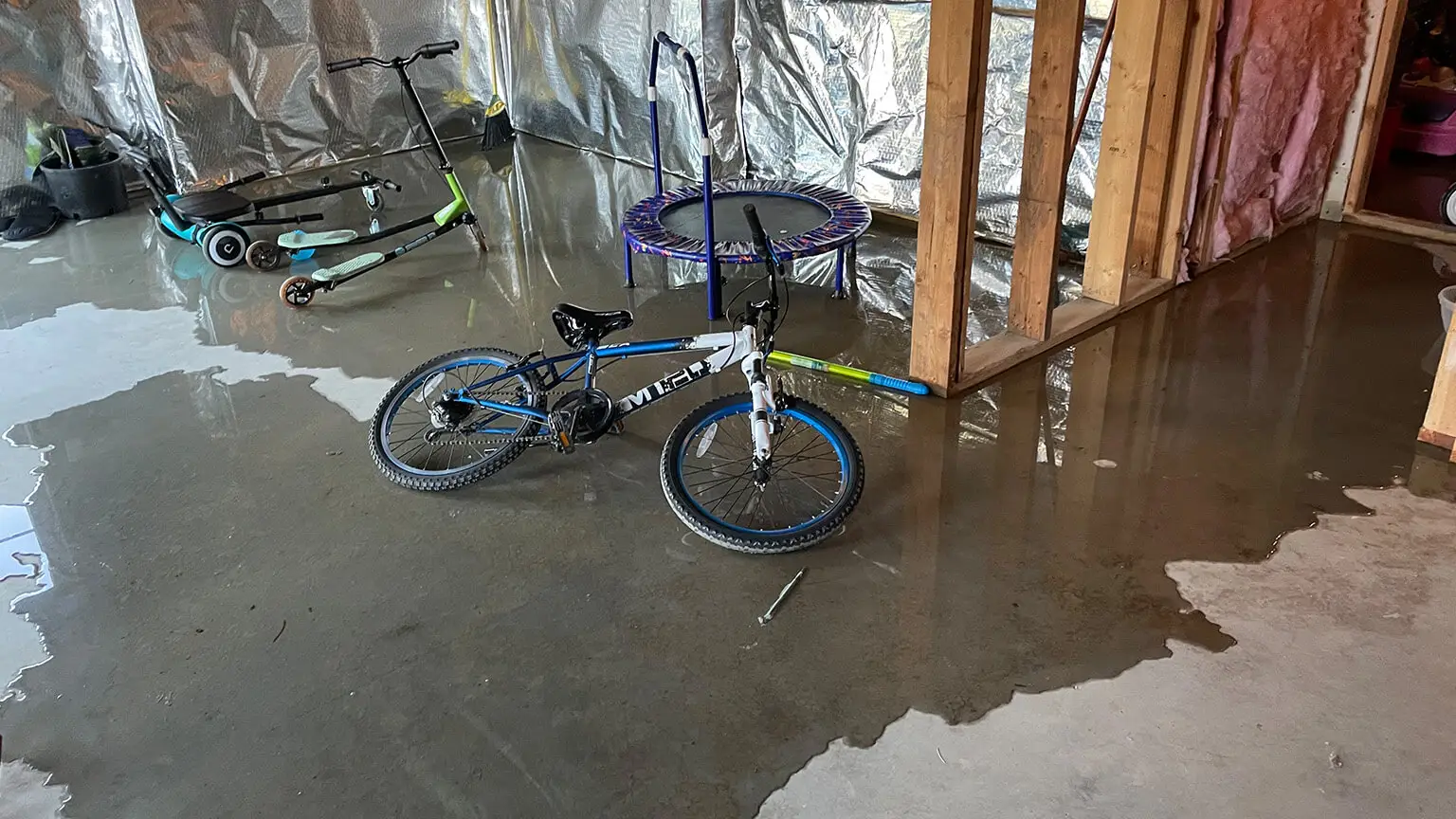
One quick safety note before we go further. Never step into standing water while the power is still on down there. Go to the panel, kill the basement circuits, and then take a look.
Good news
Bulk water almost always has a single main entry point, not twelve. Once we find it, the repair is normal work — the kind our crews do most weeks of the year.
So where is it actually coming in?
In our experience around Duluth, it’s usually one of four things. None of them are exotic, and all four are fixable.
1. The cove joint. That’s the seam where your wall meets the floor slab. Those two pieces of concrete were poured at different times, so they never bonded — which leaves a hairline gap running your whole perimeter. When wet soil pushes, water uses that seam first. It isn’t a crack or damage. It’s a door that was always there.
2. Pressure through block walls. Georgia red clay holds rain against the wall instead of draining it away. Hollow block has open cores inside, so water fills those cores like a stack of cups and finds the lowest way out. That’s why puddles often show up two days after the storm.
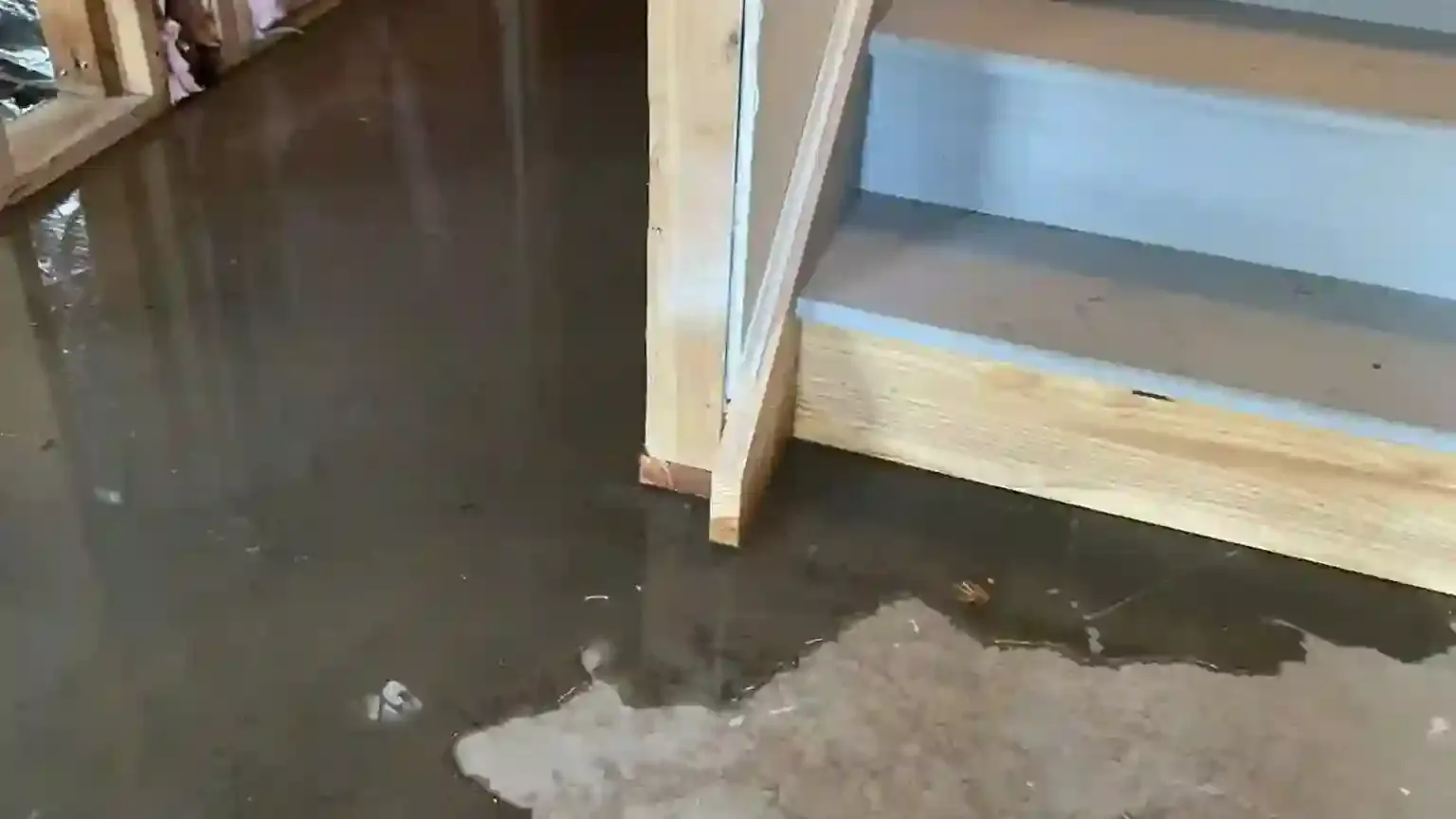
3. A sump pump that quit. Pumps don’t fail randomly; they fail in about five predictable ways. Power goes out mid-storm, the float sticks, the pump is undersized, there’s no check valve, or the discharge line is clogged. Every one of those has a simple answer.
4. A window well or drain line with nowhere to go. Window wells are supposed to drain. After twenty years of leaves and silt, plenty have turned into buckets sitting against your glass. Same story with a buried line that’s crushed, root-filled, or packed with sediment.
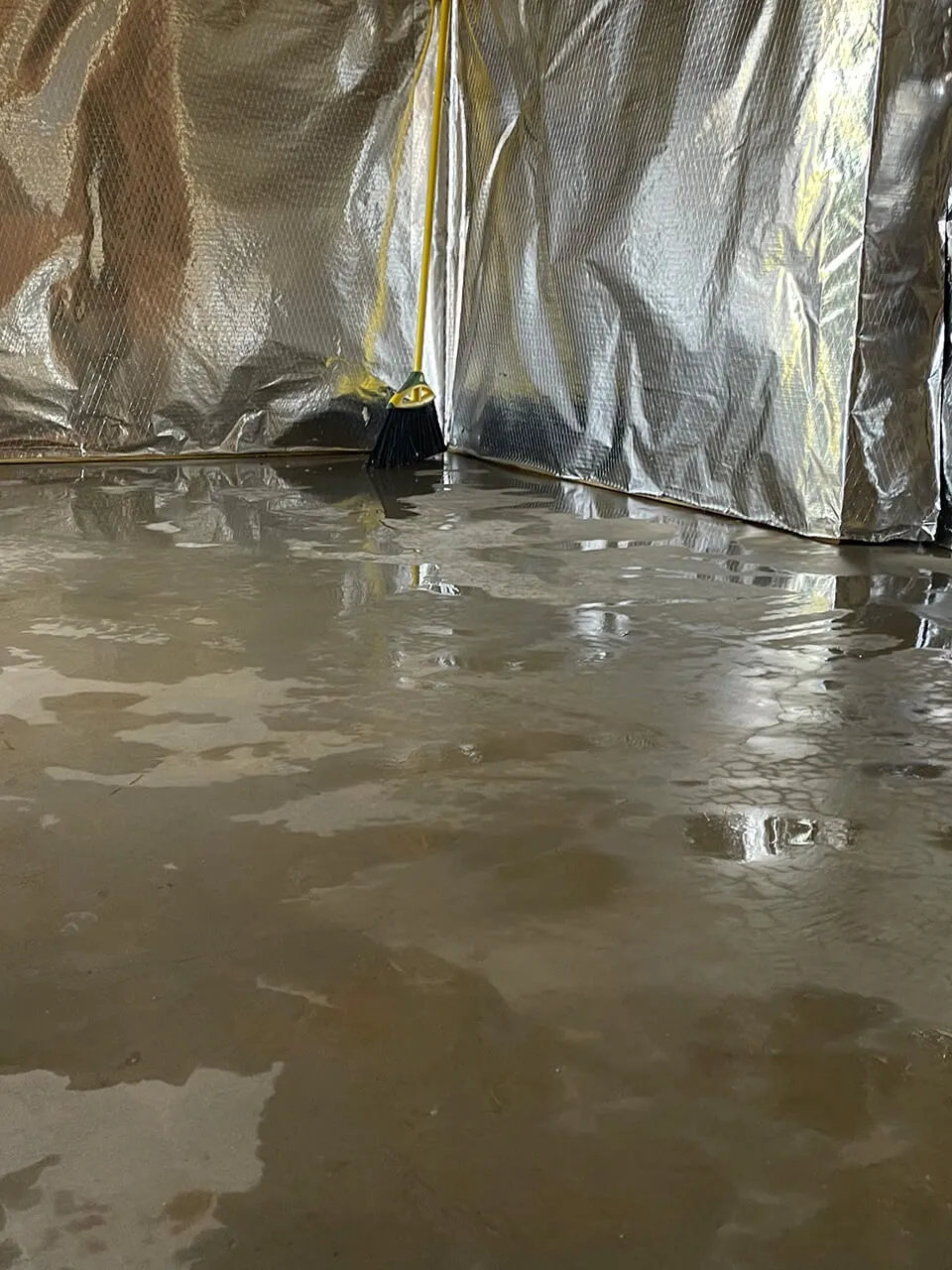
Want a free clue before we arrive? Look at where the water sits. A puddle in one corner points to a local entry, like a well or a single bad seam. Water across the whole slab points to pressure from underneath. Your basement leaves notes.
How bad is this, really?
Fair question, and you deserve a straight answer instead of a sales pitch. We generally sort what we find into three buckets.
Mild. A shallow puddle at one spot after a heavy rain, gone in a day or two. Often the fix is outside — a downspout, a regraded bed, a cleaned-out window well.
Moderate. Water shows up on a schedule. Baseboards feel soft, boxes have a stained ring, and there’s a chalky white bloom low on the walls.
Active. Water sheets across the slab, or the sump runs almost nonstop through a wet week. Even so, active does not mean urgent. It means we should stop guessing and go look.

What happens if it’s left alone? Plainly: it holds steady, then slowly widens, because clay keeps swelling and seams keep opening. Also, mold can begin on wet organic material — drywall paper, carpet pad, cardboard — within roughly 24 to 48 hours, so drying speed matters more than almost anything else. The CDC’s guidance on mold after flooding covers that timeline well.
The cost of waiting is rarely the concrete, though. It’s the flooring, the trim, and the things you stored down there.
Patch or fix — what’s the difference?
This is where most of the money in this industry gets wasted. A patch treats the spot where water appeared. A fix treats the reason it appeared there.
Sealing a cove joint with hydraulic cement is a patch. So is rolling waterproof paint on a block wall. Both can look great for a season, and both try to hold back pressure with a coating — which is a raincoat on a submarine. Water is patient, so it moves eight feet down the wall and comes in there instead.
We stopped trying to block water years ago. Now we assume it’s coming, and we build it an easier way out than the one it’s using.
Here’s what an actual fix looks like, step by step, so nothing feels like a surprise:
- Find the source first. We walk the outside — grading, gutters, downspouts, window wells — then the inside. Sometimes the answer is smaller than expected, and we say so.
- Open a channel at the perimeter. A narrow strip of slab comes up along the affected walls. It’s loud and dusty for a day, then it’s done.
- Set drainage below the floor. Perforated pipe in clean stone, under the slab, so water gets collected before it reaches your floor.
- Route it all to a sump. Proper size, a working check valve, and a discharge line that carries water well away from the house.
- Close it up clean. Fresh concrete over the channel, wall liner where it’s called for, and our mess hauled off.
Notice what’s missing from that list? Paint. That’s also why we warranty a drainage system in writing and never a bucket of sealer.
Curious what it runs? A standing water basement Duluth repair is priced mostly by how much wall is involved and how hard it is to reach, so we walk it before we quote it. Our breakdown of basement flooding cost covers every factor that moves the number, and the systems themselves are explained on our basement waterproofing page. If you’re also seeing stair-step cracks or doors that stick, our foundation repair page is the better starting point.
Ready for the number that reframes this?
One inch of water across a 1,200-square-foot basement is roughly 750 gallons. That’s about three tons of water sitting on your slab. Suddenly “just a little water down there” sounds a lot heavier — because it literally is.
Three tons is also why a shop vac feels like it’s losing. It isn’t your technique. You’re bailing out a pool while the source keeps refilling it. The National Weather Service flood safety pages explain what a long wet stretch does to the soil around a house.
Now picture the other side. The next big August storm rolls through and you don’t go downstairs to check anything. The floor is dry, and the smell at the bottom of the stairs is gone. Instead of a room you apologize for, you have an in-law suite, an office, or a space the kids can actually use.
Why does knowing Duluth matter here?
Because Duluth basements are working basements. In-law suites, home offices, kids’ spaces. So a standing water basement Duluth call usually isn’t storage getting damp — it’s somebody’s bedroom. That changes how fast we move and how carefully we protect what’s already finished.
Geography plays a part too. The Chattahoochee wraps the north and west edge of the city, so lots near Rogers Bridge Park sit closer to seasonal high groundwater. Out at The River Club and Rivermoore Park, rolling golf-course terrain means walkout basements cut straight into a slope — beautiful to live in, and the downhill wall takes the brunt of every wet week.
Age matters as well. Much of Duluth went up between the mid-eighties and the mid-2000s, so a whole city’s worth of original drainage is silting up on roughly the same schedule. In Howell Farms we’ve found twenty-five-year-old sump pumps that worked faithfully and then quietly retired. That’s a water heater story, not a house story.

Our shop sits about fifteen minutes away in Lawrenceville, so we’re on Duluth Highway (GA-120) constantly. We’ve pulled water out of homes minutes from the Gas South District, on streets where half the block was built by the same crew in the same year. Word travels fast here, which keeps us sharp. If a relative one exit up has the same problem, we handle the Suwanee standing water basement calls too.
Where we work around Duluth
Duluth is a short drive from our Lawrenceville shop, so we’re out this way most weeks. We also cover Johns Creek, Suwanee, Berkeley Lake, Peachtree Corners, Norcross, Lawrenceville, Sugar Hill and Snellville, plus the wider Gwinnett area. If you’re near PIB, Pleasant Hill or Sugarloaf Parkway, odds are we have a truck nearby.
Questions Duluth homeowners ask us
It depends on how much wall is involved, how hard the area is to reach, and whether a sump and discharge line are part of the job. One problem corner sits at the low end, while a full perimeter system with a new pump sits much higher. We walk the space and put a real number in writing first, and the inspection is free.
Then you likely have a pressure problem that only shows up when the soil is fully saturated, which is normal here after a long spring rain. Water is still arriving; it just needs the right conditions. Often the fix is smaller than people expect, especially when the cause is a downspout or a window well.
For cleanup, absolutely — get the water out and the air moving as fast as you can. For the cause, no, because a vacuum removes the result and not the reason. Think of it as drying the floor while the faucet is still running upstairs.
Mold can begin on wet organic material within roughly 24 to 48 hours, which is why speed matters more than anything else right after water shows up. Pull out soaked cardboard and carpet pad, run fans, and get air moving across the slab. Then handle the source so you’re not repeating the drill next storm.
Kill the power to the basement at the panel before you step into any water — that’s step one, every time. After that, lift what you can off the floor, start removing water, and take a few photos for your records. Then call us and we’ll come find where it got in.
Let’s find out where the water is getting into your Duluth basement
The inspection is free, the estimate is free, and nobody pressures you at the end. We’ll show you the entry point, explain the fix plainly, and put the scope in writing.
(678) 914-5112Serving Duluth and all of Metro Atlanta · $500 off projects over $3,500 · Live support 7am–8pm, 7 days a week