

Flooded Basement Peachtree Corners: What the Repair Really Costs
Where the water comes in, what a real job looks like, and how to spend your money once instead of twice.
Most people believe a flooded basement Peachtree Corners homes get after a big storm means somebody messed up outside — a gutter came loose, a downspout dumped in the wrong spot, something simple. Honestly? That’s rarely the whole story. When bulk water shows up on your slab, it usually means the ground around your house is holding more water than it can shed, and your home has no working path to move it out.
Good news, though. That’s a solvable problem, and it’s the kind of work we’ve done around here for more than twenty years. You’re not looking at a mystery — you’re looking at a plumbing route that was never built, or one that quit working a long time ago. Below is the honest version: what the fix is, what it costs, what you get in writing, and why calling a local crew tends to be the cheaper decision over ten years.
Flooding and seepage — same puddle, different problem?
Yes, and the difference is the whole ballgame. Seepage is slow. It shows up as a damp line, a musty smell, or a chalky white bloom on the block. Flooding is bulk water, which means real volume arriving fast, and that points at something specific: hydrostatic pressure under the slab, a sump pump that quit, a drain line packed shut, or a window well with nowhere to send what falls into it.
Here’s the number that makes it click. One inch of water across a 1,000-square-foot basement is more than 600 gallons. So when the shop vac feels like you’re bailing out a boat with a coffee cup, you’re not imagining things — you’re just badly outnumbered.
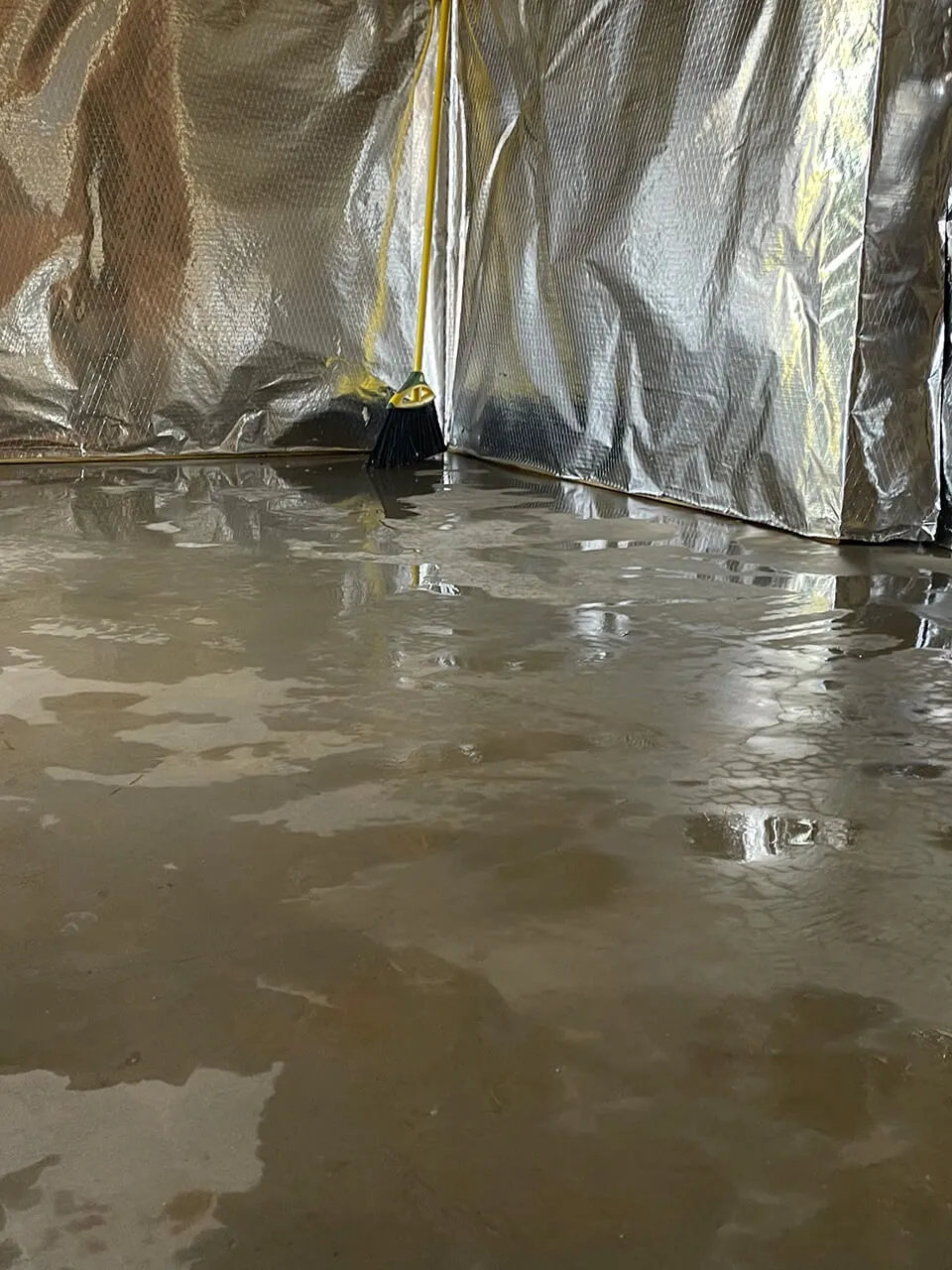
Where does it come in? Most of the time, the cove joint — the seam where your wall meets the floor slab. That’s not a crack. It’s a joint, built into the house on purpose, and under pressure it becomes the easiest door in the building. Georgia red clay holds water tight against the wall after a long rain, so pressure builds, and hollow block cores fill and push water through that seam.
Before anything else
If there’s standing water and the power is still on down there, don’t step in it. Kill the circuit at the panel first, then go look. The National Weather Service flood safety guide walks through the same basics in plain language.
Why this city, so often? Because of when it was built. Peachtree Corners homes went up mostly before modern basement waterproofing was standard practice, and plenty of them never had a real system — they had a coat of tar and good intentions. That tar did its job for a couple of decades. Fifty years later, it’s asking for help.
What does a real job actually look like?
Start to finish, it goes about like this. No surprises, no mystery truck days.
- Diagnosis first, price second. We walk the yard — grading, downspouts, where roof water lands, whether the yard drains still move water. Then we walk the basement and read the stains, because water leaves a map.
- We check the pump and the discharge. Sump pumps fail in predictable ways: power loss mid-storm, a stuck float, a unit too small for the volume, a missing check valve, or a discharge line clogged shut. That’s a short list, and every item on it is testable.
- We open a channel at the perimeter. A narrow strip of slab comes up along the walls that need it. Dusty and loud for a day or two, then done.
- Drainage goes in below the slab. Perforated pipe in clean stone, set below floor level, so water gets caught before it reaches your floor instead of after it ruins the carpet.
- Everything routes to a sump and out. The basin collects, the pump lifts, and the discharge carries water well away from the house — not two feet from the foundation, where it just gets in line to try again.
- We close it up and clean up. Fresh concrete over the channel, wall liner where it helps, debris hauled off. A pile of busted slab by your garage is not a finished job.
Now, if the water is already down and things are wet, the order matters. Standing water out first. Then wet organics out — soaked carpet pad, cardboard boxes, drywall that wicked up. After that, dehumidification, and give it days rather than hours. Mold can get started in roughly 24 to 48 hours, so speed genuinely helps here.

One thing we check on almost every older home over near Neely Farm: the crawl space. A torn or missing vapor barrier with standing water underneath keeps the whole house damp, and it’ll fight your dehumidifier forever. Fixing that is usually straightforward, and the smell in the house changes within a week.
You can’t seal your way out of water pressure. You route it. Everything else is decoration.
What happens after the crew packs up?
Here’s the part nobody puts in a sales pitch, and it’s the part that decides whether you feel good about this in year three. The day the truck pulls away, you don’t have a dry basement yet — you have a working system and a house that still needs to finish drying out.
So we tell people what to expect. The new concrete cures over about a month, and it may look slightly damp on top while it does. That’s normal curing moisture, not a leak. Also, the first big storm after install is the one you’ll actually watch, and we’d rather you call us during it than sit there wondering.
Then there’s the humidity side. A basement that flooded has months of moisture stored in block, framing and anything porous down there. Drainage stops new water, but a dehumidifier is what pulls the old water back out of the air, so we usually recommend running one through that first summer. Think of it as the difference between stopping the leak and drying the towel.
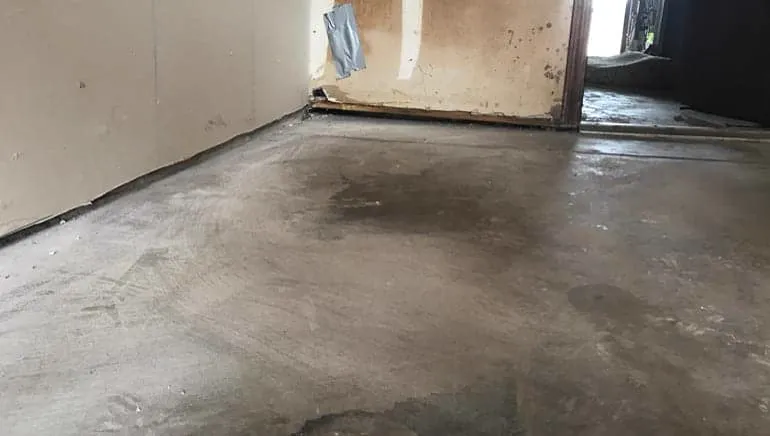
What about insurance? Real talk: standard homeowners policies commonly exclude surface flooding, and sump pump failure coverage is usually a separate endorsement you have to add on purpose. We’re not insurance people, so check your own policy and call your agent. FEMA’s building science guidance is a solid neutral read on protecting a property before you make that call.
Okay — so what does it cost?
Straight answer: it depends on how much wall is involved and how hard that wall is to reach. Anyone quoting a flat price over the phone is guessing, and guesses get padded. Here’s exactly what we weigh instead.
What moves the number up or down
- Linear feet of wall. One wall is a small job. A full perimeter is a different animal. This is the single biggest factor.
- Access. An open, empty basement is quick. A finished one with built-ins and a bar means careful demo before the real work starts.
- Sump and pump. Some homes have a serviceable basin. Many of the 1970s and 1980s houses here need a proper basin, a correctly sized pump, a check valve and a discharge line that actually goes somewhere.
- Battery backup. It adds cost. It also runs during the exact storm that drops the power — which is the storm that floods basements in the first place.
- What’s happening outside. Grading, buried downspouts and a silted-shut footing drain can carry most of the blame. That’s a smaller ticket, and we’ll say so even though it’s a smaller invoice.
- Wall condition. Bowing block or an active crack means structural work comes first. Drainage installed against a moving wall is money spent twice.
Small drainage corrections land at the low end. A full perimeter system with a new sump, a battery backup and careful work around finished space sits at the high end. Most jobs land somewhere in the middle, and after we walk your house you get a written number with the scope spelled out line by line — not a range scribbled on a business card.
What’s included, and what isn’t?
Included: labor, materials, the concrete we replace, the pump and hardware, hauling the debris, and the warranty in writing. Not included: rebuilding the finished walls we had to open, replacing ruined flooring, and structural repair, which gets priced on its own. Better you hear that now than find it in the fine print later.
The warranty is the part worth reading twice. Ours covers the system we install, it’s written down before work starts, and it transfers when you sell — which matters a lot in a city where home inspections drive so many of these calls. Ask any company to explain their warranty in one sentence. If they can’t, that tells you something.

We had a homeowner over in River Station who’d been quoted two very different jobs — one company wanted to excavate the entire back of the house, another wanted to spray a coating and call it a day. What their house actually needed was a perimeter channel on two walls, a real sump with backup power, and two downspouts routed away from the uphill corner. Three days. It has stayed dry through two spring storm seasons since.
What should you do every year once it’s fixed?
This is the short list we leave with every customer, and it takes about an hour a year. Do it and the system will outlive your mortgage.
- Test the pump twice a year. Pour five gallons of water into the basin and watch it run. Spring and fall, right around the time clocks change.
- Check the discharge line outside. Make sure it’s clear, not crushed by a mower, and not buried under mulch. Frozen or clogged discharge is a top-five failure.
- Clean the gutters in late fall. The tree canopy here is heavy, and leaf drop buries gutters and yard drains fast. Homes near Wellington Lake deal with this every single year.
- Walk the grading after a hard rain. If water sits against the foundation for hours, the dirt needs a little help sloping away.
- Look at the battery backup. Batteries have a service life. Replace on schedule, not after the storm proves it.
- Peek at the crawl space vapor barrier. Torn or shifted plastic is a ten-minute fix while it’s small.

Picture that for a second. The next long soaking week rolls through, you hear the rain on the windows, and you roll over and go back to sleep. Downstairs stays a room instead of becoming a project. That’s the actual product — not pipe and stone, but a Saturday you don’t spend with a wet-vac.
Why does local matter for this one?
Because a warranty is only as good as the company standing behind it, and our shop sits about twenty minutes northeast in Lawrenceville. Call us in year seven and you get the same outfit that did the work, not a call center. Twenty-plus years in one market builds a different kind of knowledge, too.
We know the block basements on the older streets. We’ve worked the steep bluff lots that drop toward the Chattahoochee, we’ve been under houses off Holcomb Bridge Road, and we’ve spent plenty of days on that side of town between Curiosity Lab and Town Center at Peachtree Corners. If your neighbor had water for the first time this spring, that’s not a coincidence — it’s a whole generation of original systems aging out on the same schedule.
Still figuring out what you’re dealing with? Our overview of basement flooding covers the warning signs, every system we install is laid out on our basement waterproofing page, and if the walls are cracking or the slab is lifting, start with foundation repair instead. Comparing notes with family across the county line? We cover the same ground for Dunwoody flooded basement repair.
Where we work around Peachtree Corners
We’re based in Lawrenceville, so Peachtree Corners is a short run down the parkway. We work throughout Norcross, Duluth, Johns Creek, Dunwoody, Berkeley Lake, Sandy Springs, Suwanee, Alpharetta and Lilburn, plus the wider Gwinnett area. If you’re anywhere along 141 or over toward the river bluffs, odds are good we’ve already been under a house on your street.
Questions Peachtree Corners homeowners ask us
It comes down to how much wall we treat and how hard that wall is to reach. A drainage correction outside sits at the low end, while a full perimeter system with a new sump and battery backup sits at the high end. After we walk your house you get a written number with the scope spelled out, and the inspection costs nothing either way.
That’s still worth solving, because twice a year usually means the ground gets saturated and the house has no path to shed it. The good news is that occasional flooding often has a smaller, cheaper cause than constant flooding. We’d rather find that and tell you than sell you a full system you don’t need.
For a small spill, sure. For real flooding, remember that one inch across a 1,000-square-foot basement is over 600 gallons, so a shop vac is a losing race. Fans move air but don’t remove moisture, which is why a dehumidifier does the real work after the water is out.
Roughly 24 to 48 hours on wet organic material like cardboard, carpet pad and drywall. So the priority order is water out, wet materials out, then dehumidify and keep it running for days rather than hours. Acting quickly in that first day makes the biggest difference.
Kill the power to the basement at the panel before you step into standing water. After that, get the water out, move soaked items up and out, and take photos for your insurance company. Then call us and we’ll come find where it got in.
Let’s find out where the water is getting into your Peachtree Corners home
The inspection is free, the estimate is free, and nobody pressures you at the end. We’ll show you the entry point, explain the plan in plain words, and tell you honestly if the fix is smaller than you expected.
(678) 914-5112Serving Peachtree Corners and all of Metro Atlanta · $500 off projects over $3,500 · Live support 7am–8pm, 7 days a week