

How Serious Is Basement Flooding in Peachtree Corners? A Straight Answer
Where the water came in, what it’s telling you, and why the fix is usually smaller than the puddle makes it look.
Here’s the thing nobody tells you: a flood and a leak are two different problems, and mixing them up is why so many repairs miss. A damp wall is water squeezing slowly through concrete. But basement flooding Peachtree Corners homeowners deal with is bulk water — gallons at once, arriving through an opening, a failed pump, or a drain that quit. So the two get fixed in completely different ways.
Good news? That’s actually great news for you. Bulk water leaves evidence, and evidence means we can find the source instead of guessing at it. Most of the time the cause is one specific thing, and one specific thing is a lot cheaper to fix than a whole mystery.
So what’s the difference between flooding and seepage?
Seepage is patient. Water works through porous block over hours, leaves a dark ring near the floor, and dries back out in a few days. Flooding shows up fast. You hear the storm, you go downstairs, and there’s water moving across the slab like it has somewhere to be.
That speed matters because it points to a door, not a sponge. Water traveling that quickly came through a real opening — a cove joint under pressure, a window well with a dead drain, a sump that stopped, or a discharge line packed with silt. Your basement, to be clear, was never meant to have a water feature.
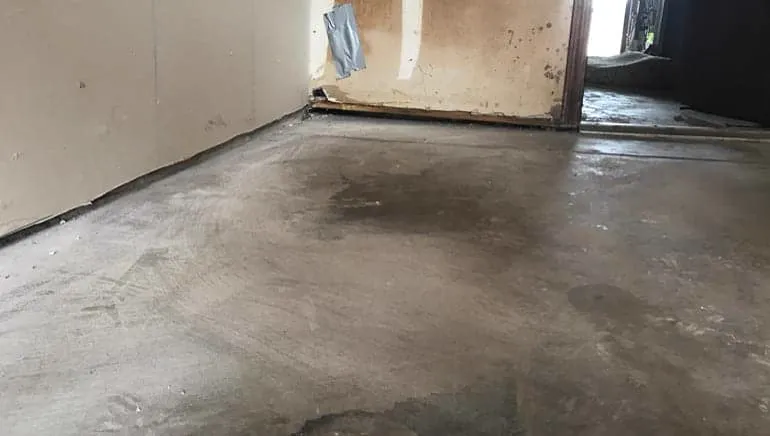
Now for the piece most homeowners have never heard named. The seam where your wall meets the floor slab is called the cove joint, and it is the most common way bulk water gets in. Those two slabs of concrete were poured on different days, so they never truly bonded. In other words, it isn’t a crack — it’s a seam, and it runs your entire perimeter.
When Georgia red clay stays saturated after a long rain, it holds that water right against your foundation instead of letting it drain away. Pressure builds. Then it pushes through the hollow cores of a block wall and out the easiest exit it can find, which is almost always that seam. Nothing broke. Physics just won a round.
Worth knowing
Water at the cove joint is a drainage conversation, not a structural one. Those are two very different discussions, and most homes we walk into are only having the first. We’ll tell you plainly which one you’re in — even when the answer is the cheap one.
Can the puddle itself tell you anything?
More than you’d expect. Where water settles is a map, and reading it takes about ninety seconds.
Water in one corner, or a wet fan spreading from a single spot, points to a local entry. Maybe a window well filled up. Perhaps a downspout dumps right there. Maybe one section of the cove joint is the low point of the whole floor.
Water across the entire slab is a different story. That pattern usually means pressure came from underneath, and the whole floor took it at once. Still fixable, and honestly the repair for it is the one we do most often — it just needs a perimeter solution rather than a spot repair.

One safety note, said calmly and only once. If there’s standing water down there, don’t step into it while power is on. Kill the circuit at the panel first, and if the panel itself is in the wet area, call an electrician instead of reaching for it. That rule is simple, and it’s the only part of this article we’d ask you to follow exactly.
After that, air it out and get the wet stuff up. Mold can start on damp cardboard, carpet pad, or drywall in roughly a day or two, so speed helps more than scrubbing does. The CDC’s guidance on mold cleanup after a flood lays out the basics in a few minutes of reading.
What changed our thinking after twenty years of this?
We used to walk into a flooded basement and go straight to the wall. Find the entry point, seal the entry point, done. It seemed obvious. Twenty-plus years later, we start somewhere else entirely — outside, before the water ever reaches the house.
Here’s what flipped it for us. A basement that floods only in heavy rain almost always has a surface water problem, not a groundwater problem. And surface water is usually the cheaper fix by a wide margin. If the floor is dry through an ordinary wet week and only turns during a real storm, the culprit is probably roof water and grade, not the water table.
Think about how much water lands on a house. A soaking Georgia storm drops thousands of gallons on an average roof, and every gutter aims that at a downspout. If the downspout ends two feet from the wall, you’ve built a small river and pointed it at your foundation. That’s why we start with a tape measure and a walk around the house.
The wall isn’t usually the problem. The wall is where the problem finally shows up.
Peachtree Corners makes this especially worth checking, because of how these homes were built. Most of the housing stock here went up between the early seventies and the mid-nineties, before modern basement waterproofing was standard practice. Plenty of these houses never had a real system at all — they had a coat of tar and good intentions.
Fifty years is a long run for good intentions. In Historic Peachtree Corners we regularly find original clay drain tile silted completely shut, which means the system technically exists and functionally doesn’t. Over in Wellington Lake, we see hand-laid block walls that have been leaning into clay pressure for decades. Meanwhile the tree canopy that makes these streets beautiful buries gutters and yard drains every single fall.

Terrain plays a part too. The western edge of town drops toward the Chattahoochee in real bluffs, and if you’ve ever walked the trails at Jones Bridge Park you know how steep that land gets. Homes cut into those slopes catch water moving downhill, so grading matters even more than usual. Not far away, the flatter ground east toward Peachtree Industrial Boulevard has the opposite issue — water sits instead of running off.
How do you tell mild from serious?
Fair question, and you deserve a real answer rather than a scary one. We generally sort what we find into three groups.
Mild. A thin sheet of water after an unusual storm that’s gone in a day. Nothing finished is damaged. Basically, the house met a rain event it wasn’t set up for, and one outside correction may handle it.
Moderate. Water shows up on a schedule now. Every heavy rain, same corner, same depth. Baseboards are soft, boxes are ruined, and the pump runs long. At this point the pattern is established, so guessing has stopped being useful.
Active. Inches of water, multiple entry points, or a sump that can’t keep pace. Even then, this isn’t an emergency in the dramatic sense. It’s a system that needs replacing, the same way a twenty-five-year-old water heater eventually does.
What if you leave it alone? Honestly, it usually holds a similar pattern for a while and then slowly worsens, because silted drains keep silting and clay keeps doing what clay does. The real cost is rarely the concrete. It’s the flooring, the stored belongings, and the resale inspection later — and around here that last one comes up constantly, since a moisture finding can put a whole closing on a clock.
What does the actual repair look like?
Let’s walk it, so nothing feels like a surprise on install day. The whole idea is simple: stop fighting water, and give it an easier path than the one it’s using.
- Find the source first. Downspouts, grade, window wells, yard drains, then inside. Sometimes the fix is a hundred-dollar afternoon, and we’ll say that out loud.
- Handle the pump and its line. Most sump failures are boring and predictable — power loss mid-storm, a stuck float, no check valve, or a clogged discharge line. A battery backup covers the most common one.
- Open a perimeter channel. A narrow strip of slab comes up along the affected walls. Loud and dusty for a day or so, then quiet again.
- Set drainage below the floor. Perforated pipe in clean stone, under the slab, catching water before it reaches your floor instead of after.
- Route it out and close up clean. Everything runs to the sump and well away from the house. Fresh concrete over the channel, wall liner where it’s needed, our mess hauled off.

Notice what’s missing from that list? Sealing paint. Coatings have their place, but a coating can’t beat pressure, and a flooded basement is a pressure story. That’s also why we warranty a drainage system in writing rather than a bucket of product.
Curious what it runs? It depends on how much wall is involved, what’s finished, and how easy the outside is to reach — so we look before we quote. Our breakdown of flooding cost walks through every factor that moves the number, and the systems themselves are explained on our basement waterproofing page.
Want to hear one that wasn’t what they thought?
We got a call from a homeowner over in Amberfield after a spring storm. Four inches of water, ruined boxes, the works. They’d already gotten one estimate for a full perimeter system and were bracing for the number.
So we walked the outside first, like always. Two downspouts had been rerouted years earlier during a landscaping project and now emptied into a bed that sloped gently back toward the house. On top of that, one basement window well had no functioning drain — it was a bucket sitting against the foundation. During a hard rain, that well filled and poured straight over the sill.
The floor pattern backed it up. Water was heaviest at that one corner and thinned out across the room, which is a local entry signature, not a pressure signature. The interior perimeter didn’t need touching at all. What they needed was extended downspout lines, regraded beds, and a real drain in the window well.
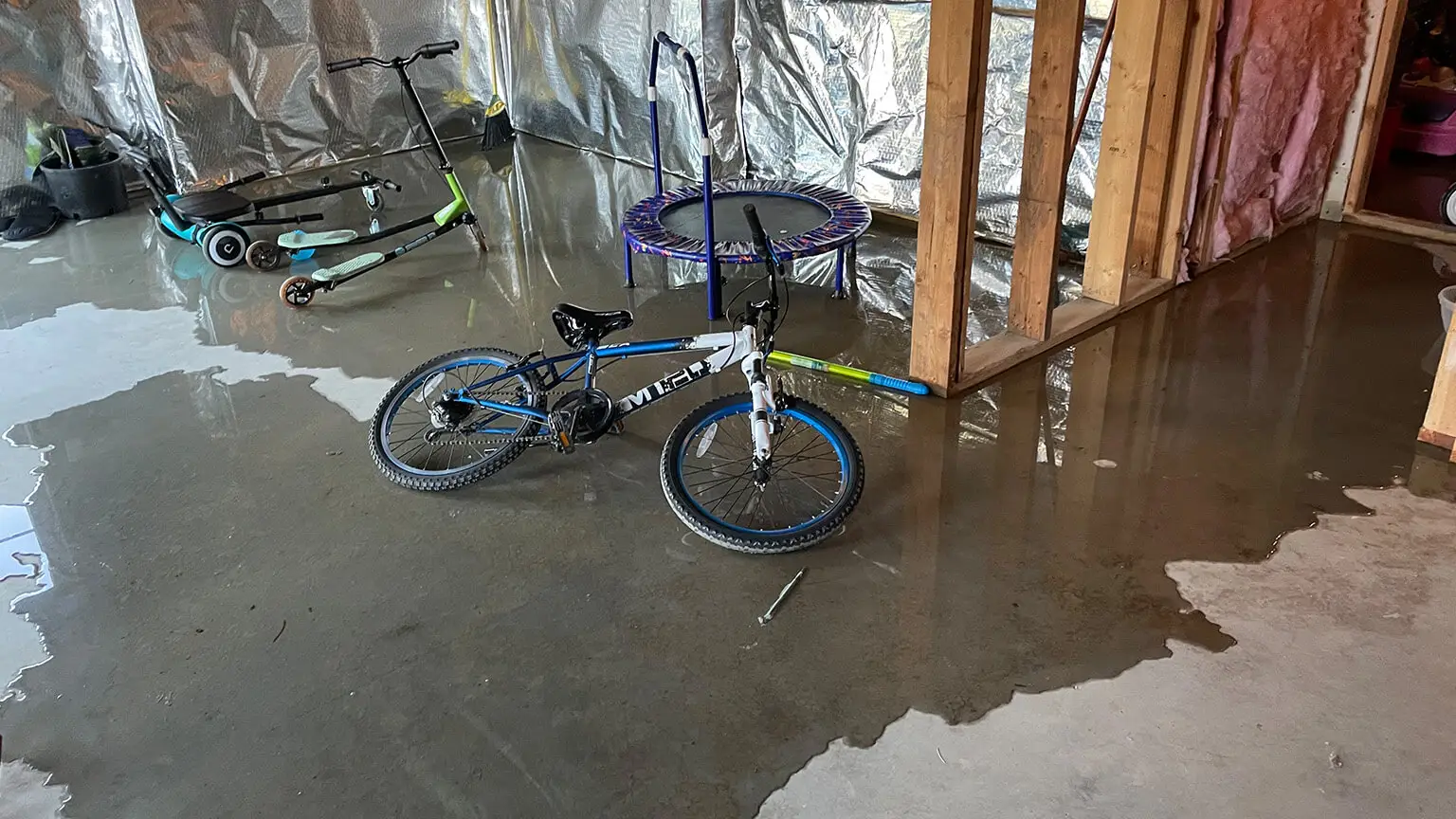
That basement has been dry through two storm seasons since. We tell that story a lot, because it’s the whole reason we inspect the way we do. Sometimes we walk a house and the honest answer is that a full system is the right call, and we’ll show you exactly why. But sometimes it isn’t, and we’d rather be the company that told you so.
Here’s what the other side of this feels like. A serious forecast rolls through and you don’t think about the basement at all. No trip down the stairs at eleven at night with a flashlight. Instead of a room you keep half-empty on purpose, you get storage you trust, a playroom, maybe a whole floor of house back. That’s the actual product — not the pipe, the peace of mind.
Why does a local crew matter for this?
Because these are the houses we’ve worked for twenty-plus years. We know the 1970s block basements here behave differently than the poured walls in newer construction. We’ve been on plenty of sloped lots near the bluffs and plenty of flat ones over by the Curiosity Lab side of town. Our shop sits about twenty minutes northeast in Lawrenceville, which means the crew doing the work is the crew that picks up the phone in year six.
We also work fast when there’s a closing date attached, since inspection findings during a resale are one of the most common reasons folks here call. Written scope, proof of insurance, a real warranty, clean site — that’s just the standard. For a broader look at protecting a home from water, FEMA’s building science resources are a solid neutral read. And if you’re seeing cracks or settling alongside the water, our page on foundation repair covers that side of things. Neighbors one town over dealing with a Dunwoody standing water basement get the same treatment.
Where we work around Peachtree Corners
Peachtree Corners is a short run from our shop, so we’re out this way most weeks. We also cover Norcross, Duluth, Johns Creek, Dunwoody, Berkeley Lake, Sandy Springs, Suwanee and Lawrenceville, plus the wider Gwinnett area. If you’re anywhere along Peachtree Parkway or over toward Peachtree Industrial Boulevard, odds are we already have a truck nearby.
Questions Peachtree Corners homeowners ask us
For cleanup, often yes — pull the water, pull out anything soaked, and run air across the space. But that handles the mess, not the reason the water arrived. If it happened once during a record storm, watch it. If it happens every heavy rain, the source is worth finding.
Roughly 24 to 48 hours on wet organic material like cardboard, carpet pad, drywall or wood. That’s why drying speed matters more than scrubbing. Get soaked items out, move air through the room, and pull wet insulation rather than letting it sit.
Cut power to the basement at the panel before you step into standing water, and call an electrician if the panel itself is down there. After that, take photos for your records, remove what you can, and start drying. Then figure out the source once things are safe and calm.
That pattern usually points to surface water rather than groundwater, which is good news because it’s often the cheaper fix. Roof water, grade sloping toward the house, or a window well with no working drain are the usual suspects. We check all of that outside before recommending anything inside.
It depends on the cause, so read your policy or call your agent before assuming either way. Sudden events like a burst pipe are commonly covered, while groundwater seepage and long-term moisture usually aren’t. Sump pump failure is often a separate rider you can add.
Let’s find out where that water is really coming from
The inspection is free, the estimate is free, and nobody pressures you at the end. We’ll walk the outside and the inside, show you the entry point, and put the plan in writing — even when the honest answer turns out to be the small fix.
(678) 914-5112Serving Peachtree Corners and all of Metro Atlanta · $500 off projects over $3,500 · Live support 7am–8pm, 7 days a week