

Basement Drying Options Roswell Homeowners Choose Between — Compared Honestly
Pro structural drying, or a shop vac and a couple of fans? Here’s how each one works, and which one your basement really needs.
Start with the finished picture. Two days after the storm, the basement floor is chalk-dry under your hand. The air smells like nothing at all. A meter pressed to the bottom of the wall reads the same number it reads upstairs, and the boxes are back on the shelf. That’s the goal, and there are really only two basement drying options Roswell homeowners pick between to get there.
So let’s work backward from that dry floor. One path is a crew with extraction gear, air movers, commercial dehumidifiers and a moisture meter. The other is you, a shop vac, two box fans and a rental dehumidifier from a store on Crossville Road.
What does “dry” actually mean down there?
Here’s what most people miss. Dry isn’t a look — it’s a measurement. A slab can feel dry to your palm while the drywall behind it still holds enough water to keep the cavity damp for weeks. Good news: that gap closes easily once you know it exists.
In this town, water also gets a head start. Roswell is built on hills, and water always wins on a hill unless somebody gives it somewhere better to go. That’s the whole job, and it’s why so many of our calls come from lots cut into a slope.
One clue before we compare, because it saves people money. A basement that floods only in heavy rain almost always has a surface water problem, not a groundwater problem — and surface water is usually the cheaper fix. Plenty of folks in Roswell Farms have been relieved to hear that.
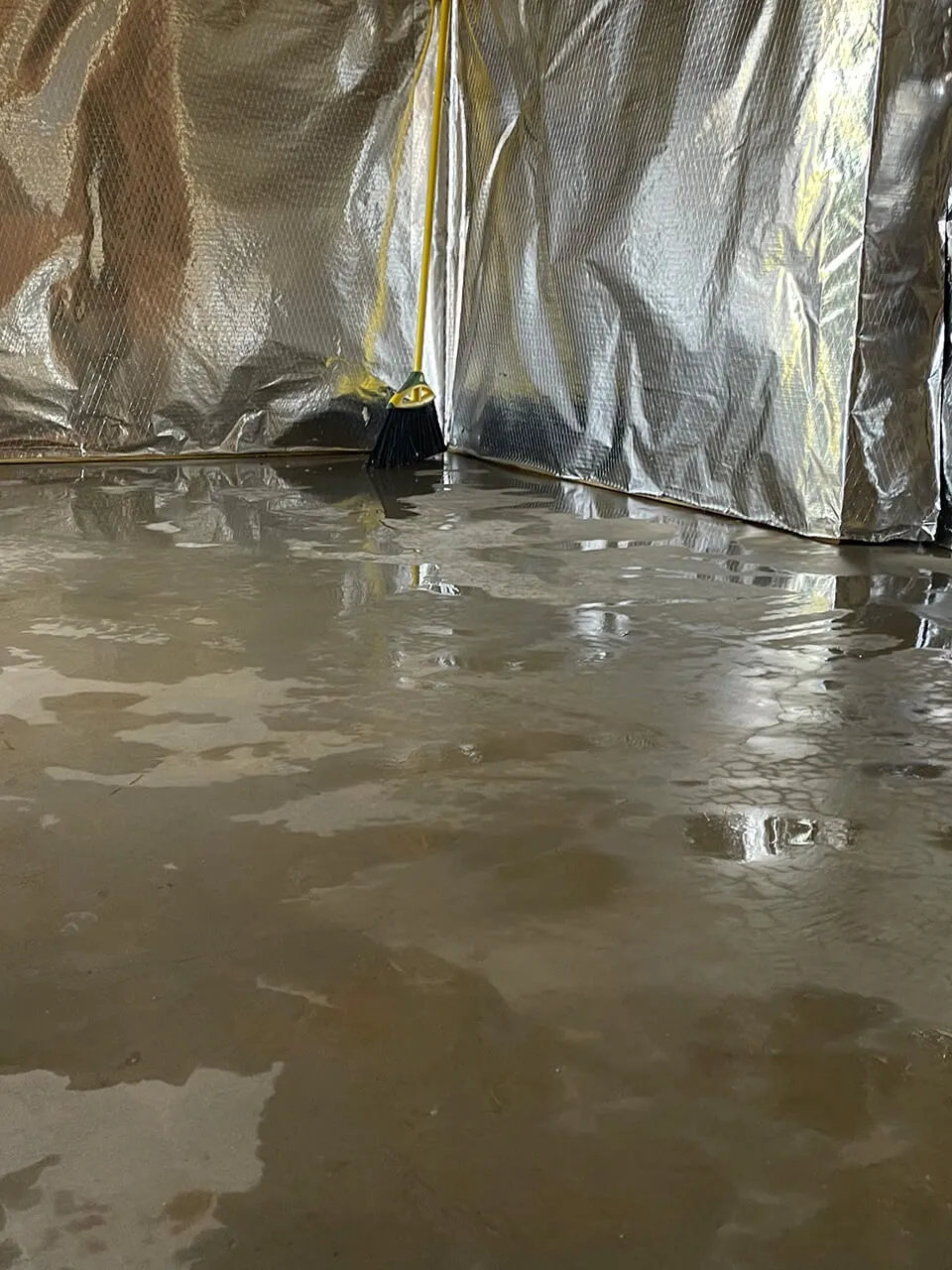
Option A: what does professional structural drying involve?
Picture four steps. First, extraction — standing water gets pulled out with real equipment, not mopped. Then air movers get aimed on purpose, low and along the walls, so moving air peels moisture off concrete instead of stirring the room around.
Next comes commercial dehumidification. Those units pull far more water out of the air per day than a household model, which keeps wet materials releasing moisture instead of stalling halfway.
Last, somebody writes numbers down. We take moisture readings at the start, then daily, in the same spots. Because when the wet wall reads the same as a wall that never got touched, you’re finished — not guessing.
When it wins: lots of water, water that sat overnight, water inside finished walls, or anything from a sewer backup.
What it costs: price rides on square footage, days of equipment, and how much material comes out. Small unfinished areas sit at the low end; soaked finished walls sit much higher.
The trade-off: your basement sounds like a small airport for a few days.
Option B: when is a shop vac and a fan enough?
Real talk: more often than our industry likes to admit. If clean rainwater came in across a bare slab, you caught it the same day, and nothing soft was sitting in it, you can absolutely handle that yourself.
Vacuum every bit of standing water first, including the low corner you can’t see from the stairs. Then set fans blowing along the floor and walls, not down at a puddle. After that, run the dehumidifier with doors and windows shut, since one fighting the outdoors is just an expensive space heater. Give it three or four days.
When it wins: small volume, clean water, quick response, unfinished space. That’s a real category, and it covers a good share of the calls we take.
What it costs: a few days of rental and some electricity.
The trade-off: household gear removes far less water per day, and you have no readings — only a hunch. If something is trapped behind a finished wall, this dries the part you see and leaves the part you don’t.
Before you go down there
Never step into standing water while the power is on. Kill the circuits at the panel first, and if the panel sits in the wet area, call an electrician. The National Weather Service flood safety guidance says the same thing, and it’s the one rule we don’t bend.
What’s the small detail that changes the answer?
Here’s a detail that sounds minor and absolutely isn’t: wet organic material has to come out. Not dried in place — out. Carpet pad, the bottom edge of drywall, and insulation inside a finished wall hold water like a sponge and hand it back for weeks. Drywall even wicks upward, so a two-inch flood leaves a wall damp a foot up.
So the classic mistake is drying the surface while the cavity stays soaked. The floor feels great, the fans come down — and three weeks later there’s a smell nobody can find.
Good news, though: this is simple when you expect it. A neat cut a foot up the wall, wet pad and insulation pulled, air into the open cavity, and the problem goes away. We did exactly that on a hillside house near Hembree last spring, and the rebuild was smaller than the homeowner expected.
Speed is the other half. Mold can begin growing on wet organic material in roughly 24 to 48 hours, which the CDC’s guidance on mold cleanup after flooding lays out plainly. That’s why how fast you start matters more than how big the equipment is. A homeowner with two fans who started at 9 p.m. is ahead of a crew arriving Thursday.

How do the two compare, straight across?
Professional structural drying
- Extraction reaches water you can’t
- Dehumidifiers that pull far more per day
- Documented meter readings
- Reaches cavities behind finished walls
- The only right call after a sewer backup
- Costs more, takes over the room
Shop vac, fans and a rental unit
- Cheap, and you can start tonight
- Fine for clean water on bare slab
- Works if you caught it same day
- No readings — you’re going on feel
- Can’t reach inside a wall cavity
- Slower, so wet organics sit longer
Neither of the basement drying options Roswell homeowners weigh is automatically “better.” The honest answer comes down to four questions.
The four questions that decide it
- How much water? A damp strip is a different job than an inch across the floor.
- How long did it sit? A few hours is manageable. A weekend away changes the plan.
- Anything soft trapped in a wall? Pad, drywall and insulation matter more than volume.
- Where did it come from? Clean rainwater is one conversation. A sewer backup is never DIY, because that one’s about health.
So which one would we pick for your house?
You want a recommendation, not a shrug. If the water was clean, under an inch, caught within a day, and the space is unfinished — do it yourself. Vacuum, fans, dehumidifier, four days. Save your money for the drainage that stops the repeat.
Bring in a crew when any one of these is true: it sat overnight, it reached finished walls or carpet, it covered a large area, or it came from a sewer line. There, the equipment isn’t the point. The readings are, because you need proof the cavity dried.
And here’s the part nobody expects a waterproofing company to write down. We’ve told plenty of homeowners here to keep the checkbook closed. One house near Old Mill Park had a downspout emptying three feet from the foundation on a downhill grade — a Saturday morning and an extension pipe, not a project.
Either way, drying is half the conversation. Around here water often travels sideways on shallow bedrock and slips in where the wall meets the floor. For the fix rather than the cleanup, see our guide to the best basement drainage setups, or the systems on our basement waterproofing page.
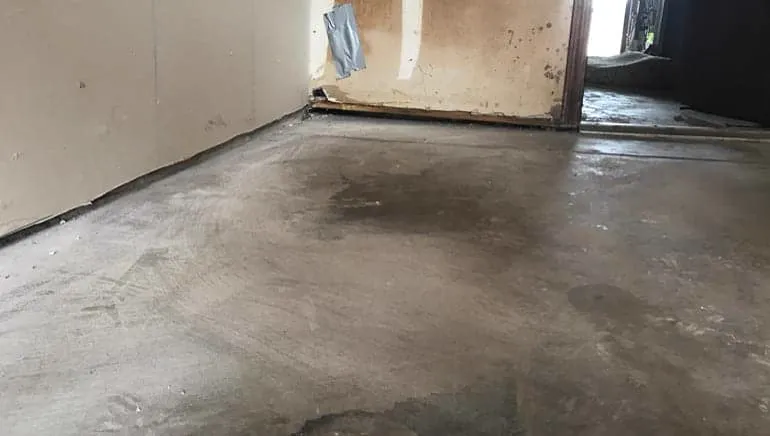
What does this have to do with the air upstairs?
More than most people expect, and this is what turns a chore into a priority. Air moves upward in a house, so basement air gets pulled through floor gaps and stair openings into the rooms where you live. A damp lower level isn’t sealed off from anything.
That musty smell in an upstairs hallway of an older Steeplechase home very often starts twelve feet below it, in a cavity nobody opened.
Better yet, it works in your favor too. Get the basement genuinely dry, hold the humidity down, and the whole house smells cleaner. Homeowners tell us they notice it in the bedrooms first.
That’s the real reason we care about readings instead of hunches. It isn’t about concrete. It’s about the air your family breathes on the floor above, which is the difference between a basement you tolerate and a home that feels looked after.

How do you keep from doing this again next spring?
Because our storms come down a slope, the fixes start outside. Gutters and downspout extensions do more work in Roswell than almost anywhere else we serve.
After that, check the grade, then whether a retaining wall is quietly steering water toward the house. Older homes over by Bulloch Hall have their own version of this, where a dirt-floor cellar under a stone foundation needs a gentler approach than a 1980s subdivision basement does.
If you’re also seeing stair-step cracks or a floor gone uneven, that’s a separate conversation about foundation repair, worth sorting out before any wall gets closed back up. Neighbors one town north can read the same breakdown in our Milton basement drying options guide.

Where we work around Roswell
We’re based in Lawrenceville, about thirty minutes east, and we’re in Roswell most weeks. We also cover Alpharetta, Milton, Sandy Springs, Johns Creek, Marietta, Duluth, Suwanee and Peachtree Corners, plus Norcross and the wider Fulton area.
Questions Roswell homeowners ask us
Because the seam where the wall meets the floor is the easiest opening in the structure. On our hillsides, water often runs sideways on shallow bedrock and reaches that joint under pressure. So it shows up at the edge of the slab even though the wall looks fine.
In most homes, yes, as long as the water gets routed rather than blocked. That usually means good gutters and extensions, corrected grade, and a drainage system carrying water to a pump and away from the house. Systems need occasional service, but the flooding itself stops.
It depends on how much wall is involved, whether a sump and pump are needed, and how much finished space comes out first. Outside corrections like extensions and regrading sit at the low end, while a full perimeter system sits at the high end. You get a written number with the scope spelled out, never a phone guess.
That pattern is good news, because water that shows up only in heavy rain is almost always surface water. Surface water is generally the cheaper thing to correct, often with gutter, downspout and grading work outside. We’d still take a look, since twice a year is enough to keep materials damp in between.
Sometimes, honestly. For clean rainwater on a bare slab that you caught the same day, a vacuum, fans and a rental dehumidifier will do it. It is not enough when the water sat overnight, reached carpet pad or drywall, or came from a sewer backup, since those need extraction, wet material removed, and verified readings.
Let’s figure out what your Roswell basement actually needs
The inspection is free, the estimate is free, and there’s no pressure. We’ll show you where the water gets in, walk you through the basement drying options Roswell homes really need, and say plainly if the smaller fix is right.
(678) 914-5112Serving Roswell and all of Metro Atlanta · $500 off projects over $3,500 · Live support 7am–8pm, 7 days a week