

How to Choose the Best Basement Drainage Roswell Homes Actually Need
Which drainage route fits your lot, how to compare bids honestly, and the questions that sort a real crew from a sales visit.
Ask your neighbor. If water showed up on your basement floor after that last long rain, odds are the house two doors down had the same morning. That’s not a coincidence, and it’s the first clue about what the best basement drainage Roswell homeowners can buy really looks like. Your street shares a hill, a soil type, and usually a builder — so it shares a water problem too.
Good news, though: shared problems are usually solvable ones. Water follows rules, and once somebody figures out which rule your lot is following, the fix stops being a mystery.
Why is it happening to the whole street?
Because water travels sideways here. Roswell sits on red clay over granite, and shallow bedrock means rain can’t soak straight down. Instead it runs along the top of the rock, downhill, until it meets the first thing in its way — often the back wall of a basement cut into a slope.
That’s why one line keeps holding up: Roswell is built on hills, and water always wins on a hill unless somebody gives it somewhere better to go. Giving it somewhere better to go is the whole job.
Now add the age of the street. Many hillside subdivisions off GA-400 went up in the 1970s and 1980s, back when “drainage” often meant a thin gravel bed and a hope. Those systems silt up over decades. So when four houses on a cul-de-sac get wet the same spring, nobody did anything wrong — the street just hit its birthday together.
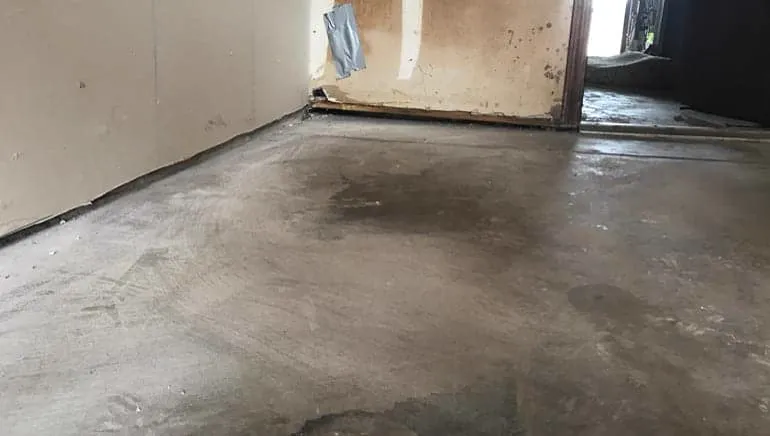
What are your actual options?
There are four, and they solve four different problems. So the best basement drainage Roswell lots call for is simply the one that matches your entry point. A weaker crew picks the one they sell.
Interior perimeter drain. A channel cut into the slab edge, wrapped in stone, running to a sump basin. It exists for one reason: the cove joint, the seam where your wall meets your floor. Under pressure from saturated soil that seam is where water shows up most often, and an interior drain relieves that pressure instead of arguing with it.
Exterior footing drain. Here the crew digs along the outside of the foundation, cleans the wall, adds a membrane, and lays new pipe in stone at the footing. It stops water before it ever touches your wall. Of course, it also means excavation — and a patio, a deck, or thirty-year-old landscaping changes that math fast.
Regrading. Sometimes the ground beside your house slopes gently toward it. Six feet of corrected soil moves a surprising amount of water — the least glamorous line on an estimate, and occasionally the most important.
Downspout extensions and buried lines. A roof sheds real volume in a Georgia storm, so dropping it beside the foundation is like watering a plant you don’t want. Carrying it twenty feet downhill is cheap, and it surprises people.
Worth saying out loud
The cheapest correct fix is sometimes entirely outside the house. If regrading and two downspout lines solve it, we’ll say so — even though that’s a much smaller invoice for us. Right-sized beats big.
Here’s the thing about Roswell houses specifically
Which house are you in? This city holds three cities’ worth of housing stock, and the right answer changes with each one.
In the Historic Roswell and Canton Street district, and along the older stretches near Mimosa Boulevard, you’ll find stone, rubble and brick foundations that predate waterproofing as a concept. Some have dirt-floor cellars. Those homes need a light touch — nobody should jackhammer character out of a house built when Bulloch Hall was new. So we lean toward exterior water management and careful interior collection, because preserving the wall matters as much as drying the room.
Out in the subdivision belt — Steeplechase and the hillside streets around it — the story flips. Poured or block walls, walkout basements, original drainage that quietly retired. Those homes respond beautifully to an interior perimeter system paired with outside corrections. The hardest part is usually moving the treadmill.

Then there are the creek-corridor lots, including homes near the ground the Big Creek Greenway follows. Faster runoff, more volume at once, so the system gets sized for it.
Red clay earns its own sentence too. Clay drains slowly, so it holds water tight against your wall for days after the storm ends. That’s why folks call on a sunny Tuesday, and why grading and downspouts matter more here than homeowners expect.
How do you read a drainage bid?
Start with one question: did they find the entry point before pricing anything? A real inspection walks the yard, checks the gutters, sees where the lot sheds water, then goes downstairs. A number quoted without stepping outside describes a product, not your house.
Next, look for measurements. Linear feet of treated wall, slab depth, where the discharge ends, pump size. Any bid for the best basement drainage Roswell homes need should read like a plan, not a promise.
Questions to ask before you sign anything
- Where is the water entering, and how do you know? A confident answer cites something they saw.
- Why this route instead of the cheaper one? They should explain it in one plain sentence.
- How many linear feet, and why that section? Vague coverage means a vague price.
- Where does the discharge end up? Well downhill, never back beside the foundation.
- Check valve? Battery backup? Always a fair question.
- Is the warranty transferable, and what voids it? Ask for it on paper before the deposit.
- Who’s on the crew? Your own people, or whoever’s free that week?
Red flags get easier to spot after those questions. Be careful with a firm price over the phone, or a discount that disappears at midnight, since honest pricing doesn’t need a timer. And if the only recommendation on offer is the biggest one, that’s a catalog talking.
On cost, we’ll be straight. Outside corrections land at the low end, a partial interior run sits in the middle, and a full perimeter system with a new sump and backup in a finished basement lands at the high end. Footage, access and finished space move the number. You get one written figure after we walk it — never a “starting at.”
What about the sump pump?
Pumps don’t fail randomly. They fail in about five predictable ways, and knowing them makes you a better shopper. Power drops mid-storm, exactly when the pump is needed. A float sticks against the basin wall. The unit is undersized. There’s no check valve, so water drains back down. Or the discharge line clogs at the far end.
Every one of those has an easy fix. Right-sized pump, a float with room to swing, a check valve, a discharge you can actually inspect, and a battery backup for the power-loss problem. Ask about that backup by name — a good company will have raised it first.

One practical note: standard homeowners insurance typically excludes groundwater seepage, and sump pump failure coverage is usually a separate rider. That’s a fifteen-minute call to your agent, not a worry. Either way, the drainage is what keeps the water out, and that part is on your side of the ledger.
Want a neutral second opinion? The National Weather Service flood safety pages and FEMA’s building science guidance are plain-English and free. Read them before your estimates and you’ll hear the difference in the room.
Once it’s fixed, what do you do every year?
Very little — and that’s the point. A good system is boring, but a short annual pass keeps it that way. Here’s the list we hand every homeowner when we finish.
Your once-a-year, thirty-minute checklist
- Clean the gutters twice — late fall and spring. Overflow undoes good grading fast.
- Walk the downspout lines. Find each outlet, confirm it’s open and still pointed downhill.
- Test the sump. Pour a bucket into the basin and watch it kick on, then shut off cleanly.
- Listen for the check valve — a soft thunk when the pump stops.
- Replace the backup battery every few years.
- Top up the soil along the foundation. Clay settles, so keep the slope running away from the house.
- Glance at the cove joint after a long rain. Dry seam, happy house.
Picture the after. It’s March, a storm parks over north Fulton for six hours, and you don’t go check. The pump runs once, and you go back to whatever you were doing. That’s the goal — not just a dry basement, but a storm you no longer have to think about.

Why we might be a good fit
We’re about thirty minutes east of you in Lawrenceville, and we’ve been at this more than twenty years. On a hillside lot that buys you pattern recognition — how these subdivisions were originally drained, and how the historic foundations downtown behave when somebody rushes them. Licensed, insured, same crews, written scopes. If we warranty it, you’re calling us.
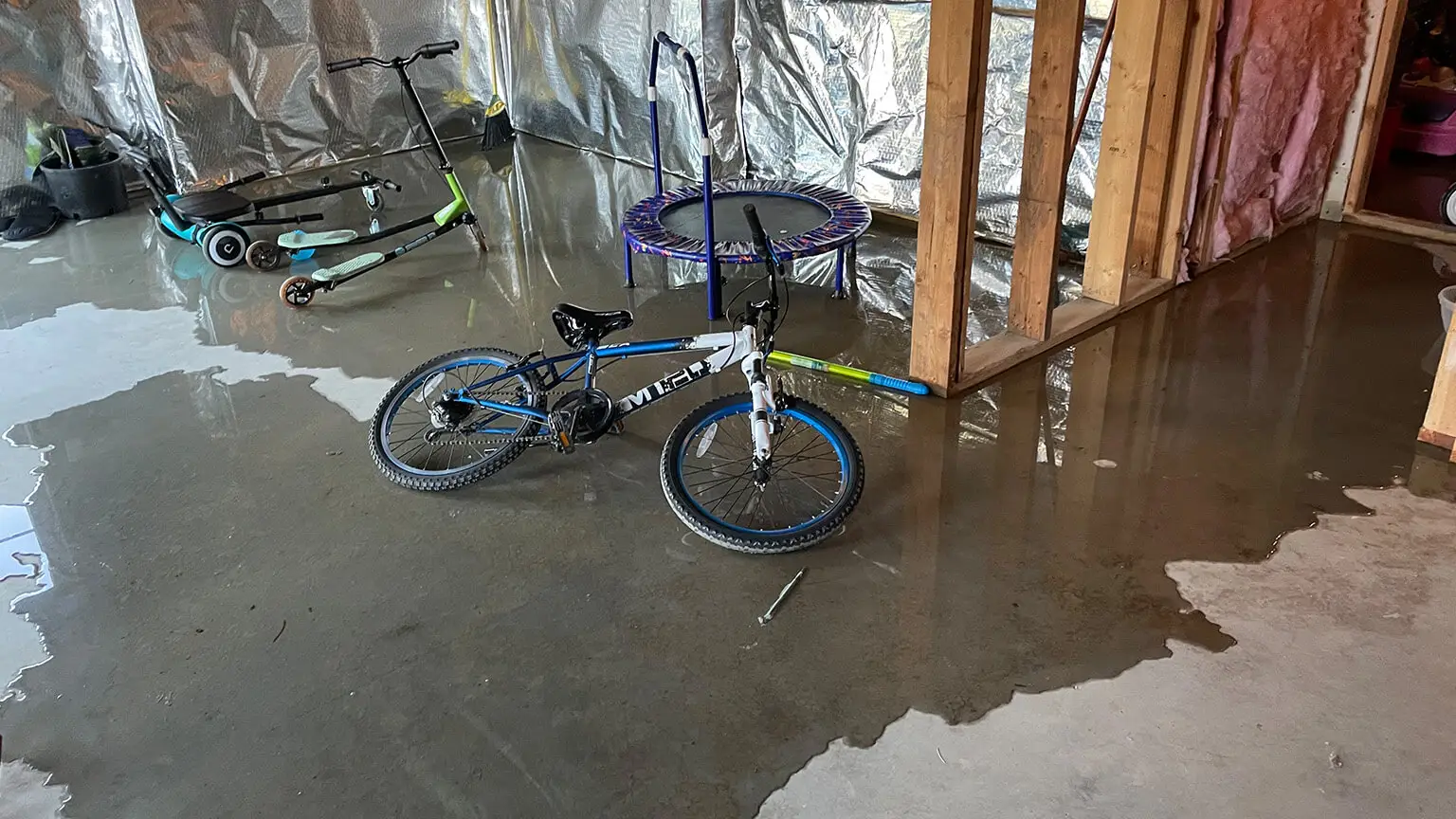
Still sorting it out? Our guide to flooded basement repair covers the first hour, and the basement waterproofing work we install is laid out step by step. Seeing stair-step cracks too? Start with foundation repair. One town over, we cover Milton best basement drainage.
Where we work around Roswell
We’re on these hills constantly, from the historic streets downtown to the sloped cul-de-sacs off the main corridors. Beyond Roswell, we work in Alpharetta, Milton, Sandy Springs, Johns Creek, Marietta, Dunwoody, Cumming, Woodstock and Peachtree Corners, plus the wider Fulton County area.
Questions Roswell homeowners ask us
It depends on the route the water is taking. Grading and downspout work sits at the low end, a partial interior run lands in the middle, and a full perimeter system with a new sump and battery backup in a finished basement sits at the high end. After we walk the lot and the basement, you get one written number with the scope spelled out.
That’s still worth a look, though it often means a smaller fix. Occasional water usually points to a specific trigger, like a clogged downspout line or a low spot in the yard. We’d rather find that trigger than sell you a system you don’t need.
For the cleanup, yes, and it’s the right first move. For the cause, no, because the water will follow the same path next storm. Think of the vacuum as first aid and the drainage as the actual repair.
Damp materials can start supporting growth within a couple of days, so drying quickly matters. Pull up wet carpet padding, move soaked boxes out, and get air moving. Then handle the source, since controlling moisture is what keeps it from coming back.
Safety first: if water is near outlets, a panel, or a water heater, shut that circuit off or wait for help. After that, take photos for your records, remove what you can, and start drying. Then note where the water appeared first, because that detail helps us find the entry point fast.
Let’s find out where the water is getting into your Roswell basement
The inspection is free, the estimate is free, and nobody pressures you at the end. We’ll show you the entry point, explain why we’d pick one drainage route over another, and put it in writing — including when the honest answer is smaller than you expected.
(678) 914-5112Serving Roswell and all of Metro Atlanta · $500 off projects over $3,500 · Live support 7am–8pm, 7 days a week