

How to Choose the Best Basement Waterproofing Dunwoody Homes Actually Need
What sets these houses apart, how to read an estimate, and the questions that tell you who really knows this town.
Here’s the piece almost nobody mentions while you’re shopping for the best basement waterproofing Dunwoody has on offer: the water usually isn’t coming in where you think it is. Homeowners point at a crack. Meanwhile, the real doorway is the flat seam down at the bottom, where the wall meets the floor.
That seam is called the cove joint, and in Georgia homes it’s the single most common entry point there is. Good news, though — once you know that, everything about comparing companies gets easier. Because the crew that talks to you about the cove joint is usually the crew that has actually stood in a few hundred basements around here.
What makes a Dunwoody basement different?
Short answer: age and slope. Most of this town went up between the mid-1960s and the mid-1980s, so you get split-levels, four-sides-brick ranches, and two-stories with block basements underneath. Back then, waterproofing meant a sprayed coat of asphalt on the outside of a block wall and a handshake. Fifty years of Georgia clay later, those walls are telling on themselves.
Then there’s the terrain. Dunwoody is hilly, and plenty of homes sit below street grade with the basement cut into a slope. So water doesn’t have to work hard to find you — gravity is doing the delivery. Add sixty-year-old oak roots pushing through old drain lines, and you’ve got the local recipe.
That’s why the signature problem here isn’t a puddle. It’s bowing and cracked block walls from five decades of clay pressure. Don’t let that land heavy, though, because it’s very fixable when it’s caught and handled properly. Walls get supported, water gets routed away, and the pressure stops building.
Good news
A wet basement and a structural problem are two separate conversations. Most homes we walk only need the first one, and we’ll say so plainly rather than selling you the bigger version.
What should a good company do differently here?
Start outside. Any crew worth hiring walks the grade, the downspouts and the tree line before it ever picks up a flashlight. In a neighborhood like Redfield, where lots roll and the canopy is heavy, half the story is written in the yard. We’ve had homes over near Wynterhall where the fix started with two downspout extensions and a regrade, and the inside work turned out much smaller than the homeowner expected.
Next, they should read the wall, not just the floor. Block walls hold water inside their cores, so a company that only checks the slab is missing half the picture. What’s more, a bowed course of block changes the order of operations — the wall gets stabilized first, and drainage comes after.
Finally, they should explain the plan in words you’d use yourself. Dunwoody homeowners ask good questions and hate being rushed, which honestly makes our job easier. If somebody can’t tell you why they’re doing each step, that’s your answer.
The best compliment we get isn’t “you were the cheapest.” It’s “you were the only one who explained it.”
If you want the deeper walk-through of the systems themselves, our page on the waterproofing systems we install lays out each one. And if you’re comparing notes across the river, we cover the same ground for Roswell best basement waterproofing too.
So what’s the myth?
Here’s the one we hear on almost every estimate in this town: “exterior waterproofing is always better than interior.” It sounds right. Stop the water outside, before it ever touches the house — of course that’s better, right?
Real talk: sometimes it is. Exterior work can be the right call, and we do it when the site calls for it. But “always” is where it falls apart, and Dunwoody is exactly the place where it falls apart the fastest.
Think about what’s sitting on the soil around one of these homes. Mature hardwoods with roots you can’t cut without losing the tree. Patios, decks and 1990s additions. Digging an eight-foot trench around all of that isn’t just expensive — it can cost you a forty-year oak, which no drainage system will ever give back.
Interior drainage does the same job from the other direction. A narrow channel comes up along the perimeter, perforated pipe goes into clean stone below the slab, and everything routes to a sump that pushes water well away from the house. Since it collects at the cove joint, it catches water right where it’s already entering. In other words, dry floor, and you keep your yard.
The honest version is that the site decides, not the sales pitch. That said, if a company can explain why they’d pick one over the other on your lot, you’re probably talking to the right people.
How do you read the estimate?
Line by line, and out loud if it helps. Most people land on the best basement waterproofing Dunwoody has by comparing paperwork, so this is where the real differences show up. A good estimate reads like a plan. A weak one reads like a receipt for something that hasn’t happened yet.
What a strong estimate spells out
- Linear feet, by wall. Not “basement perimeter.” Which walls, how many feet, and why those.
- Depth of the drainage. Below the slab or on top of it? Below is the one that works.
- Where the water goes. Discharge should end well away from the foundation, downhill if the lot allows.
- Sump details. Basin size, pump horsepower, and whether a battery backup is included or optional.
- Wall work, if any. Bowing or cracking should appear as its own line, handled before drainage.
- Cleanup and concrete. Who hauls the spoil, and who patches the floor back.
- The warranty, in writing. What’s covered, for how long, and whether it transfers when you sell.
Cost moves with those same items. Small drainage corrections land at the low end, while a full perimeter system with wall stabilization and a backup pump sits at the high end. We won’t publish a flat price, because a number given over the phone is a guess and you’d be paying for it.
Red flags worth walking away from
A price that expires today. Nobody’s foundation cares what day it is, so pressure like that is about the seller, not your house. A quote given without anybody going downstairs is another — you can’t price what you haven’t seen.
Watch for a plan that’s only paint, too. Coatings can’t beat pressure, and pressure is what you’ve got. Also be careful with subcontracted crews you’ll never meet twice; when year six rolls around, you want the same people who did the work.
The number that reframes the whole thing
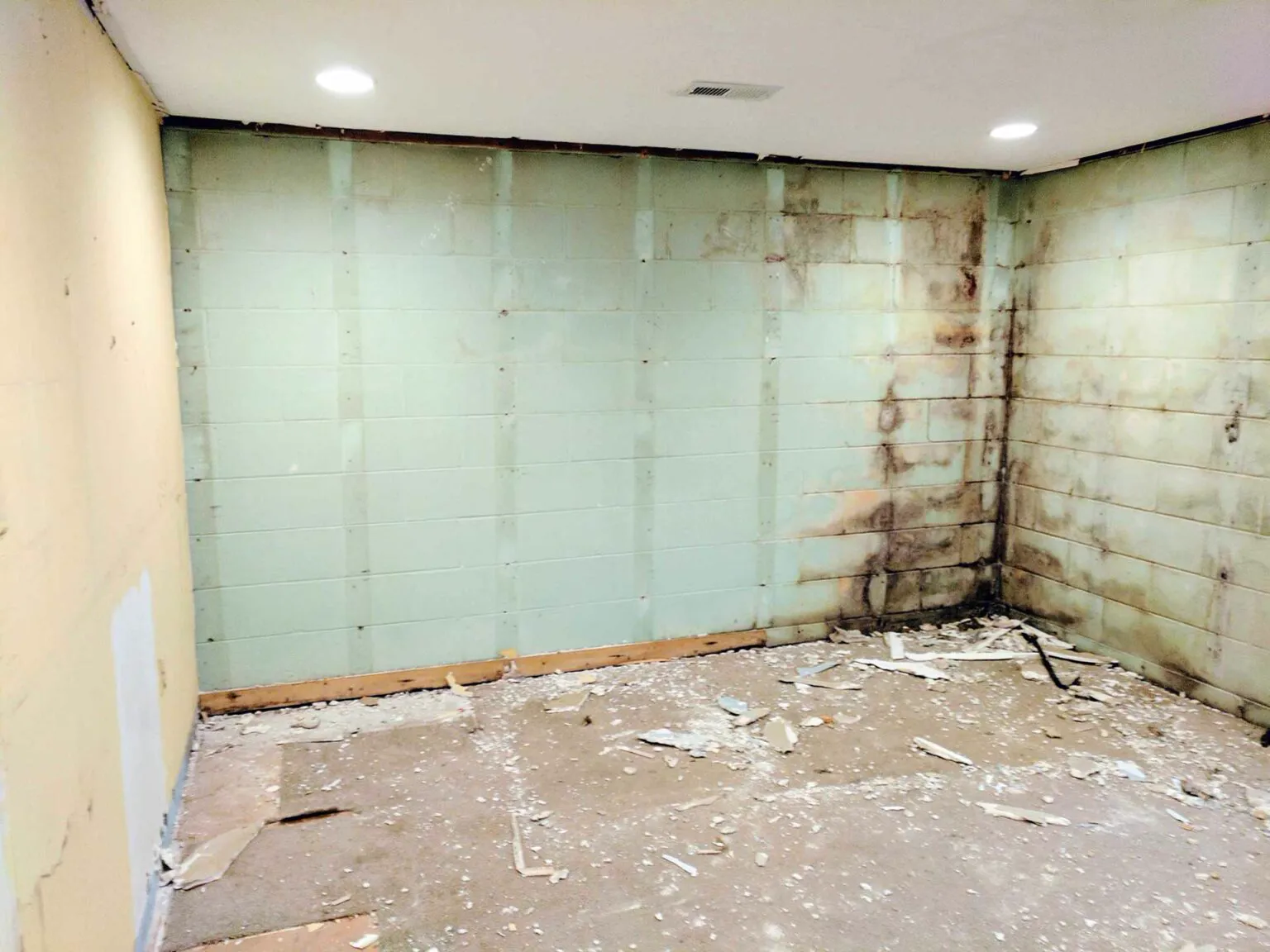
Ready for it? Saturated clay presses against a foundation wall at roughly 60 to 80 pounds for every square foot, and that force stacks with depth. On a single ten-foot stretch of an eight-foot block wall, you’re looking at several tons leaning in — quietly, every time the ground gets wet.
Now the bowed walls make sense, don’t they? Nothing failed suddenly. Instead, a wall did its job for fifty years against a load nobody designed it to hold forever. Relieve the water and you relieve the pressure, which is the whole reason drainage and wall repair belong in the same conversation. The U.S. Geological Survey’s groundwater basics explains how that water moves through soil if you want the science behind it, and the National Weather Service office in Peachtree City tracks the storms that keep filling it.
Here’s what the other side looks like. The floor stays dry through a hard spring storm rolling up GA-400. That basement smell at the bottom of the stairs is simply gone. Better yet, the room stops being storage you apologize for and turns into a room you use — a workshop, a guest space, somewhere the kids can be loud. Most of all, you stop checking the forecast with a knot in your stomach.

Why are we a good fit for these homes?
Because we’ve spent twenty-plus years on exactly this housing stock. We know the block basements in Branches and the way water travels on the sloped lots near Brook Run Park. We’ve worked homes a short walk from the Dunwoody Nature Center, where creek-side soil stays wet long after the rain quits.
That history matters for a boring reason: a warranty is only worth as much as the company behind it. Same local crews, same trucks, same phone number in year ten. If you’d rather start with the basics, our overview of basement waterproofing for this area covers the symptoms first. And if your house is one of the older ranches sitting on a crawl space instead, crawl space encapsulation is usually the better answer.
Where we work around Dunwoody
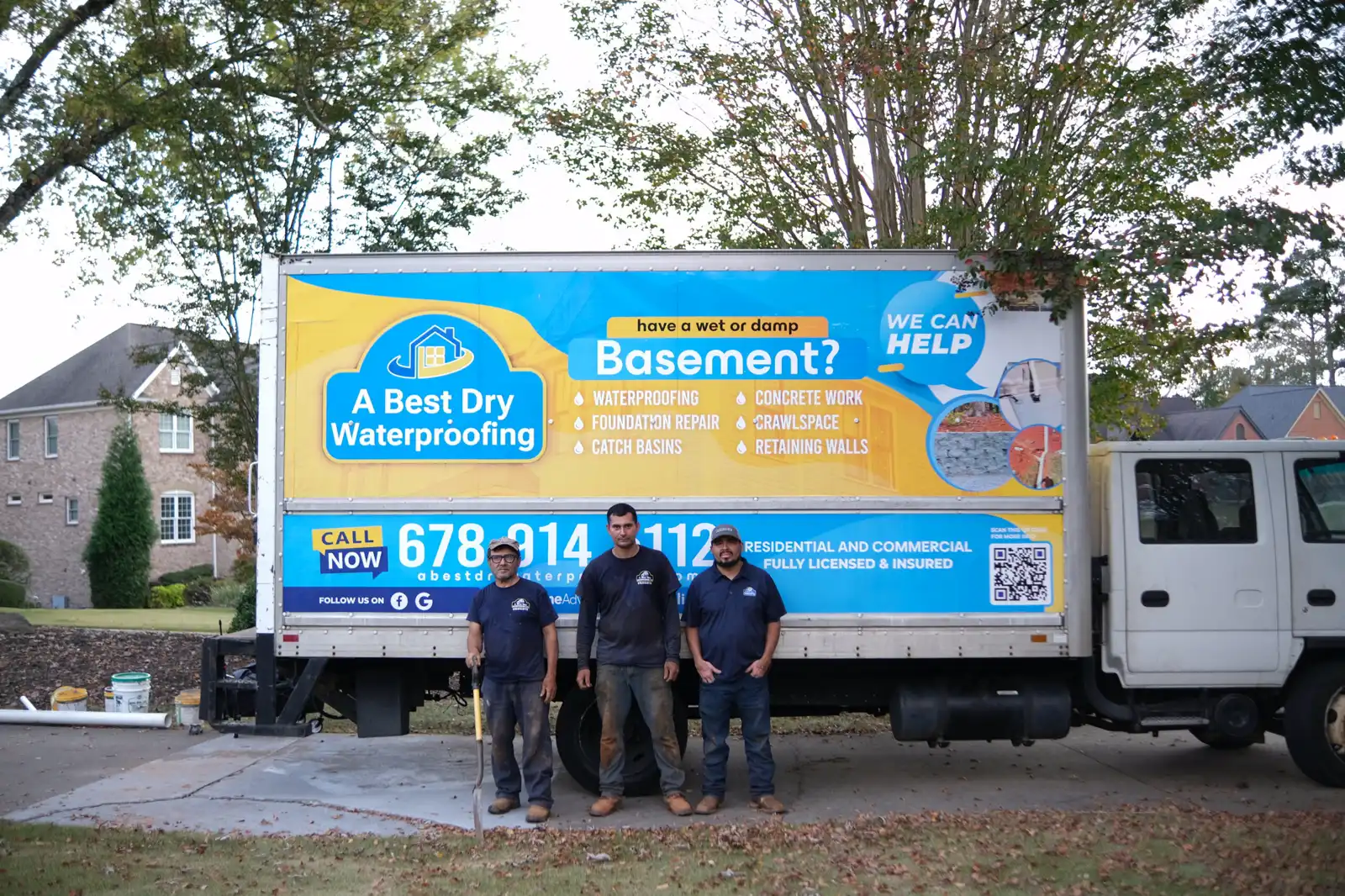
We’re based in Lawrenceville, which puts Dunwoody about half an hour up the road — close enough that we’re usually here a few times a week. Along with Dunwoody, we work throughout Sandy Springs, Brookhaven, Peachtree Corners, Chamblee, Doraville, Norcross, Tucker and Atlanta, plus the rest of DeKalb County. If you’re anywhere near the Perimeter, odds are we’ve already got a truck nearby.
Questions Dunwoody homeowners ask us
The drainage itself is built to last the life of the house, since it’s pipe and clean stone below the slab with nothing to wear out. The pump is the part with a service life, so plan on swapping one somewhere around the ten-year mark. Think of it the same way you think about a water heater.
Yes, and you get it in writing before anybody starts, not after. Ask us to read it out loud with you so there’s no guessing about what’s covered. Also ask whether it transfers if you sell, because that matters more than people expect.
Usually, yes. We open only the bottom section of wall and floor along the affected perimeter, then close it back up. Finishing work does add labor to the job, so it costs a bit more than an open basement — but you keep your room.
It helps in two ways. A dry basement is usable square footage, and a documented, transferable warranty answers the question every buyer’s inspector is going to ask anyway. Around here, where most buyers know the housing stock is older, that paperwork carries real weight.
Often within a few days, and sometimes sooner if we already have a crew on that side of town. The inspection and the estimate are both free. Give us a call at (678) 914-5112 between 7 a.m. and 8 p.m., any day of the week.
Let’s take a look at your Dunwoody basement
The inspection is free, the estimate is free, and nobody leaves you with a decision to make today. We’ll show you where the water is getting in, what it would take to stop it, and whether the fix is smaller than you feared.
(678) 914-5112Serving Dunwoody and all of Metro Atlanta · $500 off projects over $3,500 · Live support 7am–8pm, 7 days a week