

Wet Basement in Dacula: What’s Really Causing It, and How It Gets Fixed
You didn’t decide to stop using that room. It just sort of happened, one damp spring at a time. Here’s how you get it back.
There’s a room down there you don’t really go into anymore. Maybe it was going to be the playroom, or the gym, or the place the holiday bins live. Then one March you noticed a damp edge on the floor, so you moved a few boxes onto pallets and shut the door. That slow surrender is the real story behind almost every wet basement Dacula search — and honestly, it’s one of the easiest stories to rewrite.
Good news right up front: this is common out here, it’s very fixable, and the cause usually sits outside the wall rather than in it. So let’s take it apart slowly, because you should understand your own house before anybody hands you a number.
Why does water act differently out here?
Because the lots are bigger. Out toward Dacula you’ve got real yard, and when a storm rolls through, all that water has to go somewhere. A quarter-acre lot in town sheds rain onto a street in minutes, but an acre out past Harbins Road holds it, spreads it, and walks it slowly toward the lowest thing around. Sometimes the lowest thing is your foundation.
Then there’s the dirt itself. Much of this area was farmland before it was subdivisions, and construction traffic packed that red clay down hard. Compacted clay doesn’t drink water — it sheds it, like a driveway with grass on top. That’s why folks in the Hamilton Mill area can water the lawn all summer, then watch a two-inch rain sit in puddles for a day.

Geography plays a part too. The Apalachee and Mulberry River basins run through this part of Gwinnett, so plenty of lots sit closer to seasonal groundwater than anyone mentioned at closing.
What’s actually pushing water through solid concrete?
Two words cover most of it: hydrostatic pressure. When clay soaks up rain it swells, and swollen soil presses on everything it touches. A basement wall can face thousands of pounds of that pressure at once, which is why water doesn’t need a crack to get in — under enough force it moves through concrete the way it moves through a sponge.
That’s also why a perfectly sound wall can still get damp. In fact, most walls we inspect are structurally fine and simply outmatched by what’s outside them. If groundwater is new territory for you, the U.S. Geological Survey’s groundwater basics lays out the science without trying to sell you anything.
Worth knowing
Seepage and structural movement are two different conversations. We’ll tell you clearly which one you’re having — and if it’s only seepage, we’ll say so before anyone talks money.
Is yours mild, or is it something more?
Fair question, and most folks with a wet basement in Dacula can sort it out tonight. None of this is bad news. It just shows where you sit on the scale.
Reading the signs
- Musty smell, no visible water. Moisture is arriving as vapor. Mild, and often solved outside.
- White chalky bloom on the block. That’s efflorescence — minerals left behind after water passed through.
- One damp corner after heavy rain. Very common, and usually a single downspout is doing all the damage.
- Water tracking along the floor-and-wall seam. Pressure is winning at the joint, which points toward drainage.
- Standing water that lingers for days. Time to have somebody look. Still fixable, just a bigger scope.
What if you leave it alone? Nothing dramatic happens overnight, honestly. Moisture problems just widen slowly — stored things get ruined, humidity climbs, and simple repairs turn into less simple ones. So the goal is knowing which stage you’re at.

What would we want to know if it were our own house?
Here’s the honest answer: we’d want to know where the water starts before we spent a dollar on where it ends up. Most homeowners get quoted an interior system first. Sometimes that’s right, but we’d walk the outside first every single time.
We’d check the downspouts, since roof water dumped beside a wall causes more damp basements around here than groundwater does. We’d look at grade, especially where mulch beds have crept up an inch a year. Then we’d ask about the septic system, because a drain field on a big lot can keep soil near a foundation saturated for weeks after a wet stretch. Plenty of homes along the Harbins corridor sit on exactly that setup, and it’s a detail a lot of contractors never think to ask about.
Last, we’d want to know the home’s age. Houses built in the early 2000s are hitting first-generation waterproofing failure — the tar coating and thin footing drain the builder used have simply aged out. That’s not a scandal. It’s a twenty-year part turning twenty.
Most of the time the wall isn’t failing. Something outside the wall is delivering more water than the ground can carry away — and that’s a much friendlier problem to own.
Does a newer house get a pass?
Not really, and that surprises people. We get calls from Dacula Road new construction owners who assumed a young house couldn’t do this. But newer homes sit on the most heavily compacted ground of all, and the backfill hugging the foundation stays looser than the packed soil around it.
Water finds that loose ring and drops straight to the footing. Builders call it the clay bowl effect, and your basement is the bowl. The upside? A young foundation is usually in great shape, so the fix is about drainage rather than repair.
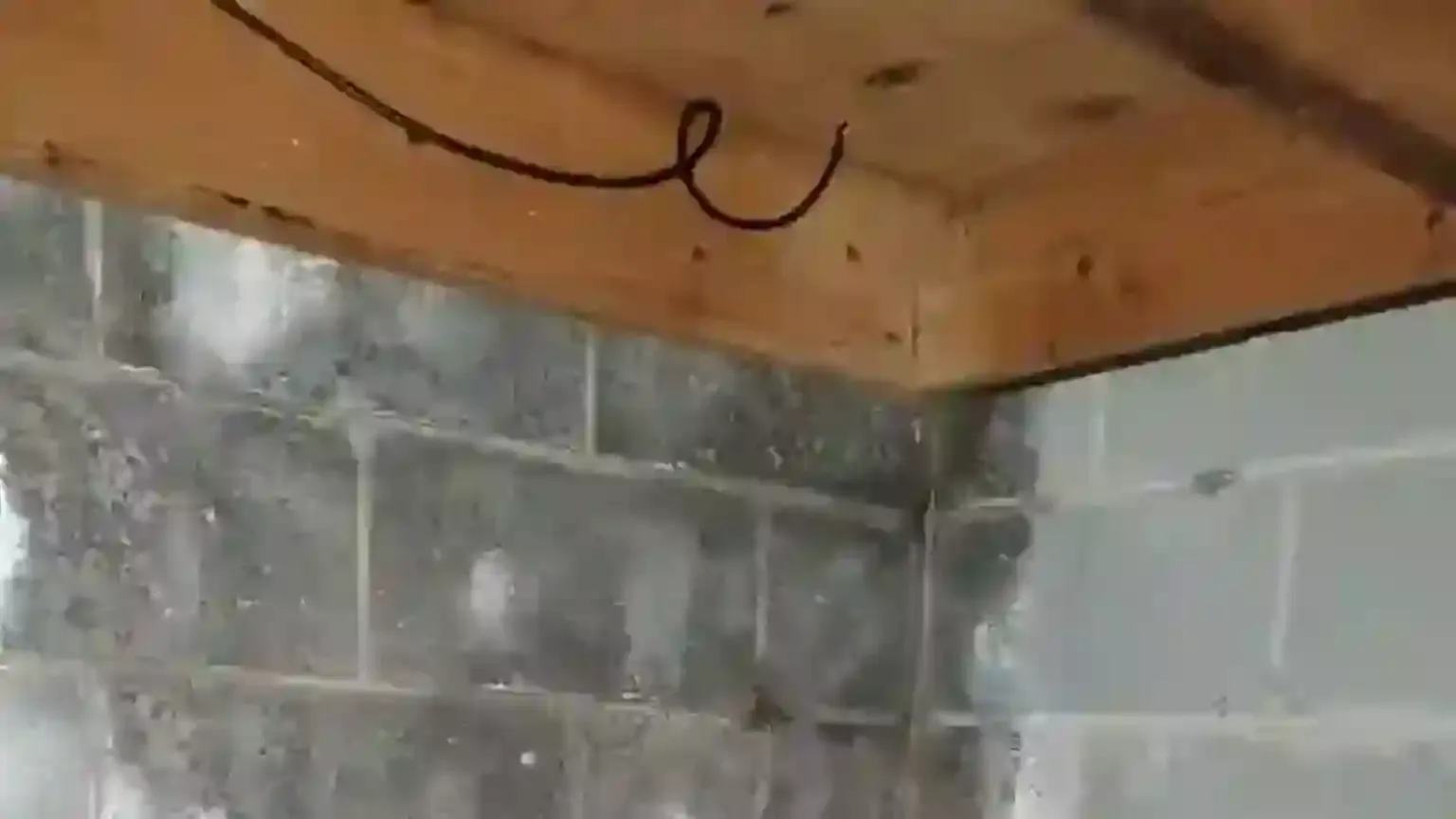
So how does it actually get fixed?
Simpler than most people expect. The old approach fought water at the wall with coatings and patches, which is a raincoat on a submarine. Modern interior systems do the opposite — they collect water below the slab and send it to a sump before it ever reaches your floor. Here’s the sequence, plainly.
- Find the source outside first. Downspouts, grade, patios, drain field. Sometimes the whole fix lives in the yard.
- Read the foundation. Poured concrete and block behave differently, so the plan should match what you actually have.
- Open a narrow strip of slab. Only along the affected walls, and only for a day of noise.
- Set perforated pipe in clean stone, below floor level. Depth is the whole ballgame.
- Route it to a sump basin. The pump sends water well away, not back into the flower bed for a second try.
- Close it up. Fresh concrete, wall liner where it’s called for, and our mess in our truck.
Most systems here run two to four working days, plus a day if the space is finished. Pricing tracks scope more than anything else, so our waterproofing cost breakdown walks through what moves the number. The basement waterproofing page shows exactly what gets installed, start to finish.
Want the number that changes how this looks?
One inch of rain on a 2,400-square-foot roof produces roughly 1,500 gallons of water. Not per storm season — per inch. That’s about thirty bathtubs landing on your house in an afternoon, and every drop of it has to leave your property somehow.
Once you picture that, a wet basement Dacula homeowners dread starts to look different. Yours isn’t weak. It’s just standing at the bottom of a very large funnel, and nobody ever aimed the funnel somewhere else. Spring is when we hear about it most, which lines up with the outlooks the National Weather Service office in Peachtree City publishes for our area.
Better yet, that number explains why small fixes work so well. Extending two downspouts twelve feet moves hundreds of gallons away from a wall in one storm. Homeowners near Hamilton Mill Golf Club have called after a heavy weekend just to say the corner finally stayed dry.

What does life look like once it’s dry?
Quieter, mostly. The smell fades within days once the moisture source is cut. Your sump cycles after storms, which is the system working rather than a problem. By the second weekend, people are carrying boxes back downstairs without thinking twice about it.
A year in, you stop checking after rain. One homeowner who takes her kids to Dacula Park on Saturdays told us the strangest part was realizing she hadn’t thought about her basement since spring. Ten years in, the pipe and stone below the slab are still doing their job, because nothing down there wears out. Only the pump has a service life, similar to a water heater.
And the room comes back. That’s the part we like — you get to walk somebody through your house and feel good about all of it, basement included. Some homes out here have a crawl space instead, and in that case crawl space encapsulation is usually the better system. If you’re comparing notes across the county, our Sugar Hill wet basement guide covers how a tighter lot changes the math.
Where we work around Dacula
We’re based in Lawrenceville, roughly twelve minutes west, so we’re out this way constantly. That includes Dacula, Grayson, Buford, Auburn, Winder, Braselton, Snellville, Suwanee, Sugar Hill and the wider Gwinnett area. Big lots, septic fields and long driveways are normal work for us — not a surprise we charge extra to be surprised by.
Questions Dacula homeowners ask us
It usually helps in two ways. First, a documented, warrantied system removes a question mark that buyers and inspectors always ask about. Second, a dry basement is square footage you can actually finish and use, and finished space carries real weight on a listing.
Usually within a few days, and often sooner when the weather has been busy. We answer live from 7 a.m. to 8 p.m., seven days a week, so you’re not leaving a message into the void. The inspection and the estimate are both free.
It depends on how much wall is affected, how deep the drainage has to run, and whether the real fix is outside. A short run along one wall sits at the low end, while a full perimeter with a sump sits much higher. We won’t quote a flat price over the phone, because a guess isn’t a number you can plan around.
Most jobs run two to four working days. Add a day when the space is finished, and add another if exterior grading or a new discharge line is part of the plan. You’ll get the schedule in writing before we start, so nothing sneaks up on you.
Only what sits along the walls we’re working on, roughly a three-foot strip. Everything else stays put, and we cover it. If heavy items are in the way, tell us ahead and the crew will help slide them clear.
Let’s find out what your Dacula basement really needs
We’ll walk the property with you, show you where the water starts, and explain the fix in plain language — big lots and septic systems included. The inspection is free, the estimate is free, and nobody pressures you at the end of it.
(678) 914-5112Serving Dacula and all of Metro Atlanta · $500 off projects over $3,500 · Live support 7am–8pm, 7 days a week