

Waterproofing Options Sugar Hill Homeowners Weigh on a Hillside Lot
Interior drainage or exterior work? A fair side-by-side for steep-lot homes — and a straight recommendation at the end.
Somebody made a decision about your house in about ten minutes, years before you ever saw it. A builder stood on a slope, looked at the fall of the land, and set the foundation where the grade made it cheapest to build. That single call is why you’re now comparing waterproofing options Sugar Hill contractors offer, with a damp corner as your reminder.
Good news, though: you have real choices, and neither one is a mystery. There are two honest paths here, and once you see how each behaves on a hill, the right one usually picks itself. So let’s walk both, fairly.
Option A: what does exterior drainage actually do?
Can you stop water before it ever meets the wall? On a slope, often yes — and that’s the whole idea behind exterior work. Instead of dealing with water at your foundation, you catch it uphill and send it around the house.
The work varies. Sometimes it’s a French drain cut across the high side of the lot, packed in stone and daylighted downhill where gravity does the rest. Sometimes it’s regrading, longer downspout lines, or a failing retaining wall rebuilt so it stops aiming water at your house. On bigger jobs, we excavate to the footing, coat the wall with a membrane, and set a proper footing drain.
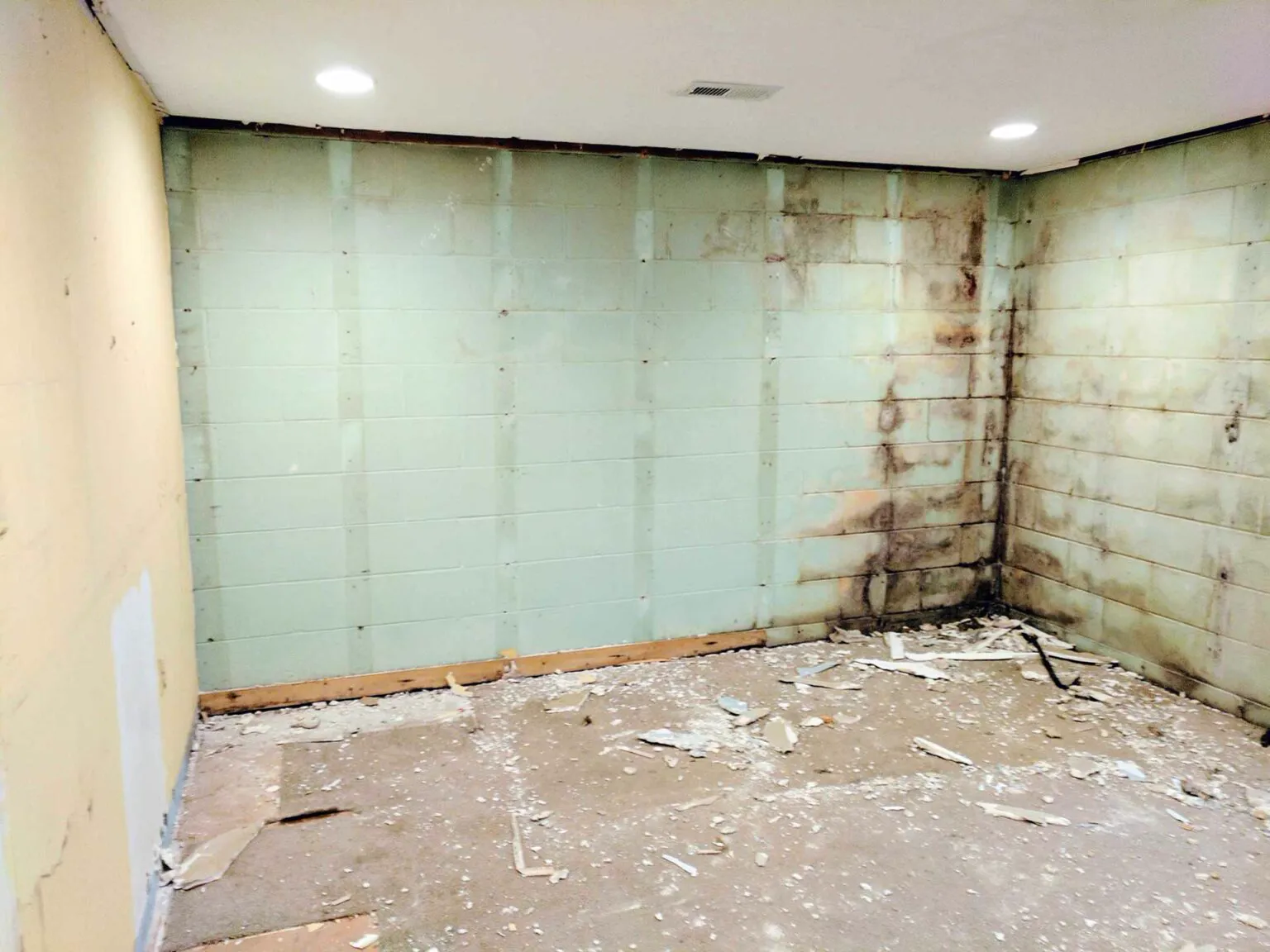
Here’s why this matters so much locally. Sugar Hill is named for a hill, and it earns it — the land drops hard toward Lake Lanier and toward the Chattahoochee below Buford Dam. Water on terrain like this doesn’t sit and soak. Instead, it runs, and it runs toward whatever is downhill of it, which is frequently the back wall of a daylight basement.
When most of your water is uphill runoff, intercepting it above the house is genuinely the smarter first move. It’s also the more satisfying one, because the problem stops being your problem before it arrives.
Worth knowing
Concrete is porous. Water passes through a solid, uncracked wall by capillary action, so a damp wall doesn’t mean you missed a crack. If you hunted with a flashlight and found nothing, you’re not losing your mind.
Option B: how does an interior system work?
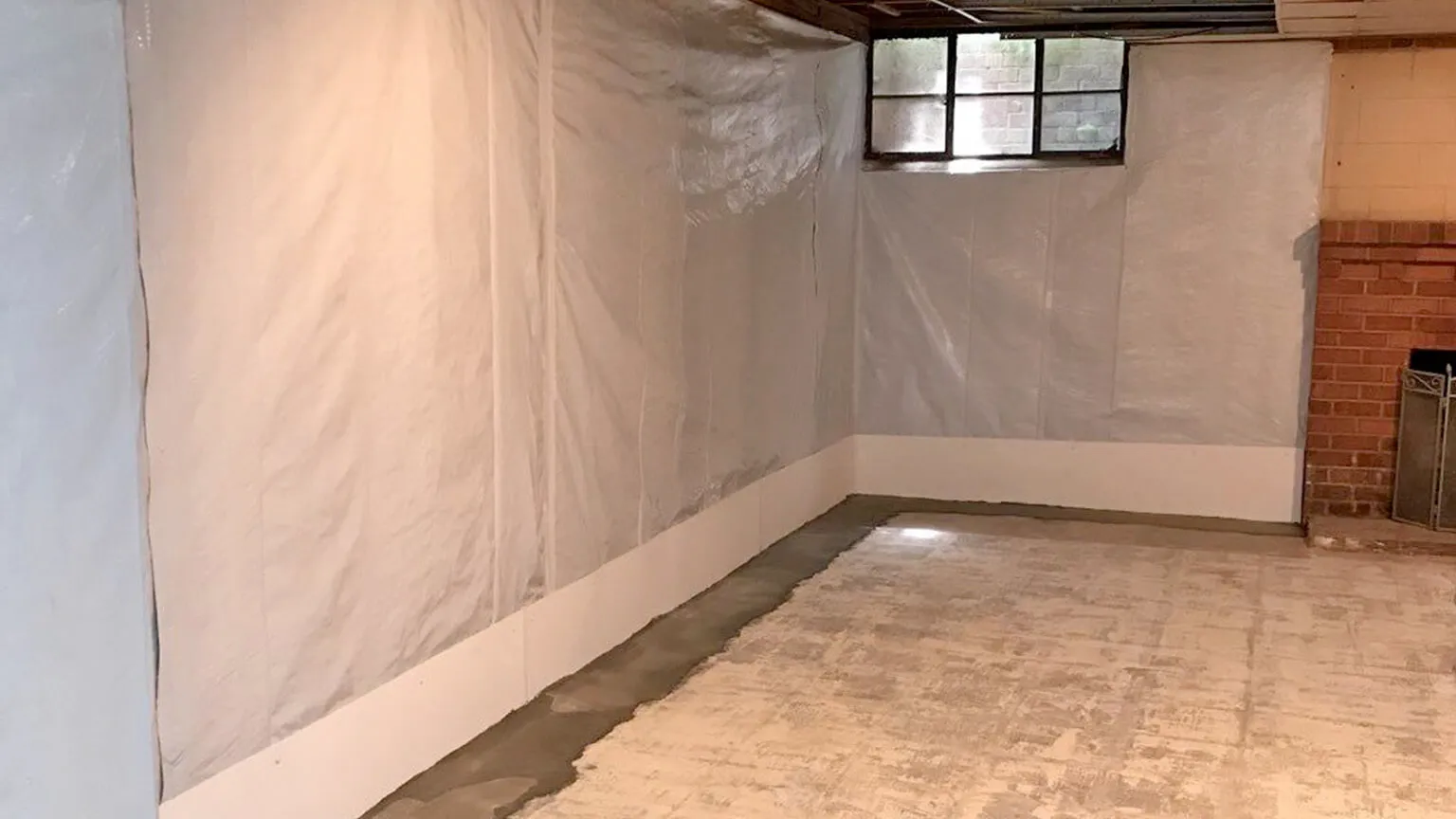
Ever wonder why so many crews start indoors? Because an interior drainage system doesn’t try to block water at all. It collects water below the slab and routes it to a sump before it ever reaches your floor, instead of fighting it at the wall.
The crew opens a narrow channel in the slab along the walls that leak. Perforated pipe goes in, packed in clean stone, set lower than the floor. Everything drains to a sump, and the pump carries water well away. After that, fresh concrete closes the channel back up.
That has one big advantage on a hillside: it doesn’t care where the water started. Uphill runoff, a seasonal high water table near the lake, or water sliding sideways along shallow rock — the system treats it all the same. Around Level Creek, shallow rock is a regular guest. Water hits stone a few feet down, quits going deeper, then travels sideways straight into the block.
Patch or fix? Here’s where they split
Ready for the part that decides everything? Both options have a cheap cousin, and that cousin is where most disappointment starts. A patch treats the symptom you can see, while a fix treats the path water is taking.
Outside, the patch is a bag of dirt and a coat of sealer. Inside, it’s hydraulic cement pushed into a seam. Both feel great for a season. Still, pressure never quits, so water finds the next weakest inch.
We stopped trying to block water and started routing it. Blocking is a fight you win temporarily. Routing is a system that keeps working while you forget it exists.
A real fix has somewhere for water to go. That’s the whole test, and you can apply it to any estimate you’re handed. If nobody can tell you where the water ends up, you’re buying a patch at a fix’s price.
We had a homeowner up near the Lanier Golf area who had sealed the same wall three times. He wasn’t doing anything wrong — he just kept treating the exit instead of the route. Once we daylighted that water downhill, the wall stopped being interesting. His words, not ours.
Side by side, no spin
Enough theory. Here’s how the two stack up when we’re standing in your basement with a flashlight and a level.
Exterior drainage
- Catches uphill water before it reaches the foundation
- Uses gravity, so many hillside lots need no pump at all
- Fixes grading, retaining walls and downspouts at the same time
- Excavation on steep, rocky ground costs more and takes longer
- Rain pauses the work, and spring storms here are serious
- Landscaping, patios and driveways get disturbed
Interior drainage
- Works indoors, so weather never delays the schedule
- Typically finished in one to three days
- Handles groundwater and lateral seepage the same way
- Your yard, trees and hardscape stay untouched
- Includes a sump pump, which needs service over time
- Doesn’t correct what’s happening on the surface above
Notice neither column says “better.” Because on any given house one of these is usually obvious after twenty minutes outside, and the other becomes a conversation we can skip.
What decides it on a Sugar Hill lot?
Four questions, mostly. They come up on nearly every inspection we run between downtown and Gary Pirkle Park.
The deciding factors
- Where does the water come from? Surface runoff off a slope points outside. Water rising at the floor seam points inside.
- Can a machine get uphill of the house? Steep grades, rock and tight side yards answer this fast.
- Is there a place to daylight? A hillside lot with fall below it is a gift, because gravity replaces a pump.
- How old is the original system? Many 1990s and early-2000s homes are running drainage that has quietly reached retirement age.
That last one shows up constantly in Riverside and similar established streets. Nobody built these houses badly. Drain lines silt up, though, and fall leaf drop off Level Creek Road buries the surface drainage these lots lean on. So the house didn’t change — its drainage just quietly stopped draining.
So which one do we actually recommend?
Straight answer: on a genuinely steep lot with room to work uphill, we recommend exterior drainage first. Intercepting water above the house solves the cause, and gravity does the maintenance for free. That’s a rare combination, so we take it when the lot offers it.
But the trade-off cuts both ways, and we’d rather say so than sell around it. Steep ground with rock near the surface makes excavation slower and pricier. On a tight lot with a retaining wall and mature landscaping, that exterior job can cost well more than an interior system finished in two days.
So we recommend interior drainage when access is bad, when water is rising rather than running, or when your basement is finished and you want it back this week. For a fuller technical read on the systems themselves, our basement waterproofing page walks through each one.
And sometimes we tell people they need neither. If water only shows during heavy storms and your gutters are packed with pine straw, start with a Saturday and a ladder. We’ll say so even though it’s a smaller invoice, because a bill you didn’t need is a bad way to earn a neighbor.
The number that reframes the whole decision
Here’s a figure worth sitting with. A roof over a 1,500-square-foot footprint sheds roughly 900 gallons during a one-inch rain. Not for the season — for one ordinary afternoon storm.
Now put that on a hill. It all lands within a few feet of your foundation, and gravity gives it a direction. Suddenly downspout extensions stop sounding like a small detail. If you like the science, the U.S. Geological Survey’s groundwater primer explains where it goes next.
That number is also why spring is our busy season. Storms arrive fast and heavy here, and you can watch them line up on the National Weather Service Peachtree City forecast page. Volume plus grade equals pressure, every time.
Picture the after, though. The floor stays dry through a night of hard rain, and that smell at the bottom of the stairs disappears. Downstairs becomes a room again instead of storage you apologize for. Better yet, you’ll walk into your next estimate knowing exactly what to ask for.

Why terrain experience matters more than a brochure
Because a hillside house asks different questions than a flat lot, and the answers aren’t in a sales script. Twenty-plus years around Metro Atlanta taught us to read the ground first and the wall second. So we look uphill before we look at your basement, which surprises people.
You’ll get the same crews, the same trucks, and a written warranty before anything starts. Weighing a similar decision elsewhere in Gwinnett? Our breakdown of Lilburn waterproofing options covers flatter ground, our guide to picking a waterproofing company lists the questions worth asking, and if your home sits over a vented crawl instead, crawl encapsulation is the better conversation.
Where we work around Sugar Hill
We’re based in Lawrenceville, twenty minutes south, so we’re up this way constantly — from The Bowl at Sugar Hill out to the neighborhoods along the lake. That includes Sugar Hill, Buford, Suwanee, Cumming, Gainesville, Duluth, Dacula, Lawrenceville, Flowery Branch and Braselton, plus the wider Gwinnett area. Odds are we’ve already worked on a house near yours.
Questions Sugar Hill homeowners ask us
Often, yes — a leaking crack gets sealed and injected as part of the work. But a crack that’s moving is a structural question, not a water one, so we measure it first. If it needs foundation repair instead, we’ll tell you that plainly rather than waterproof over it.
It depends on where your water starts. If runoff is coming down a slope at the house, exterior interception usually wins. If water is rising at the floor seam or access is too tight to dig, an interior system is the better buy — and on some lots we do a little of both.
The stone and pipe don’t wear out, so the drainage itself is built to outlive the rest of the house. Pumps are the moving part and get replaced on a normal service cycle. Surface drains simply need cleaning after leaf drop, which takes minutes.
Yes, and you get it in writing before work begins, not after. Coverage varies by system, so we walk through exactly what’s included and what isn’t. It’s also transferable, which helps later if you sell.
Usually. We need about four feet of clear perimeter along the walls being treated, so most built-ins and finishes stay right where they are. Where something must be opened, you’ll know which sections before we start.
Let’s find out what your Sugar Hill basement is really doing
The inspection is free, the estimate is free, and nobody pressures you. We’ll walk the slope, show you where water is getting in, compare both approaches, and tell you honestly if the smaller fix is the right one.
(678) 914-5112Serving Sugar Hill and all of Metro Atlanta · $500 off projects over $3,500 · Live support 7am–8pm, 7 days a week