

Waterproofing Options Lilburn Homeowners Are Weighing: Inside or Outside?
An honest look at interior drainage versus exterior excavation on a seventies block basement — and a real recommendation.
Come down the stairs with us a minute. Before we say a word about the waterproofing options Lilburn homeowners get quoted, we stop on the third step and just look. That pause tells us more than any brochure could, because a basement writes down everything that ever happened to it.
Good news, too: the decision is smaller than it looks. There are really only two families of fix. So let’s lay both out fairly, then we’ll tell you which one we’d pick.
What are we looking at on the way down?
First stop is the floor seam, where the slab meets the wall. Water rarely enters mid-floor, but it loves that joint, and a faint gray line there is a story by itself. Then our light goes up the block, corner by corner.
Next we check the block for a horizontal crack about halfway up. Finally we ask when the basement was finished, since so many Lilburn basements became bedrooms before anybody solved the moisture underneath.
Here’s the thing about this town. Lilburn homes were mostly built in the seventies and eighties, back when waterproofing meant a coat of tar and hoping for the best — and fifty years is a long time to hope. That coating is gone now. Not failing, just gone, which changes the math you’re about to see.
Worth knowing
Saturated red clay can press on a basement wall with thousands of pounds of force. That push has a name — hydrostatic pressure — and it drives water straight through solid concrete. So a wall can be wet with no crack at all.
Option A: how does interior drainage work?
An interior system doesn’t try to stop water at the wall. Instead it catches water below the floor and carries it off before it reaches your living space. Think of it as a gutter under the slab.
Our crew opens a narrow channel in the concrete along the walls that leak. Perforated pipe goes in, packed in clean stone, set lower than your floor. Everything routes to a sump, and the pump pushes water well away from the house. After that, the channel closes up and the room is yours again.
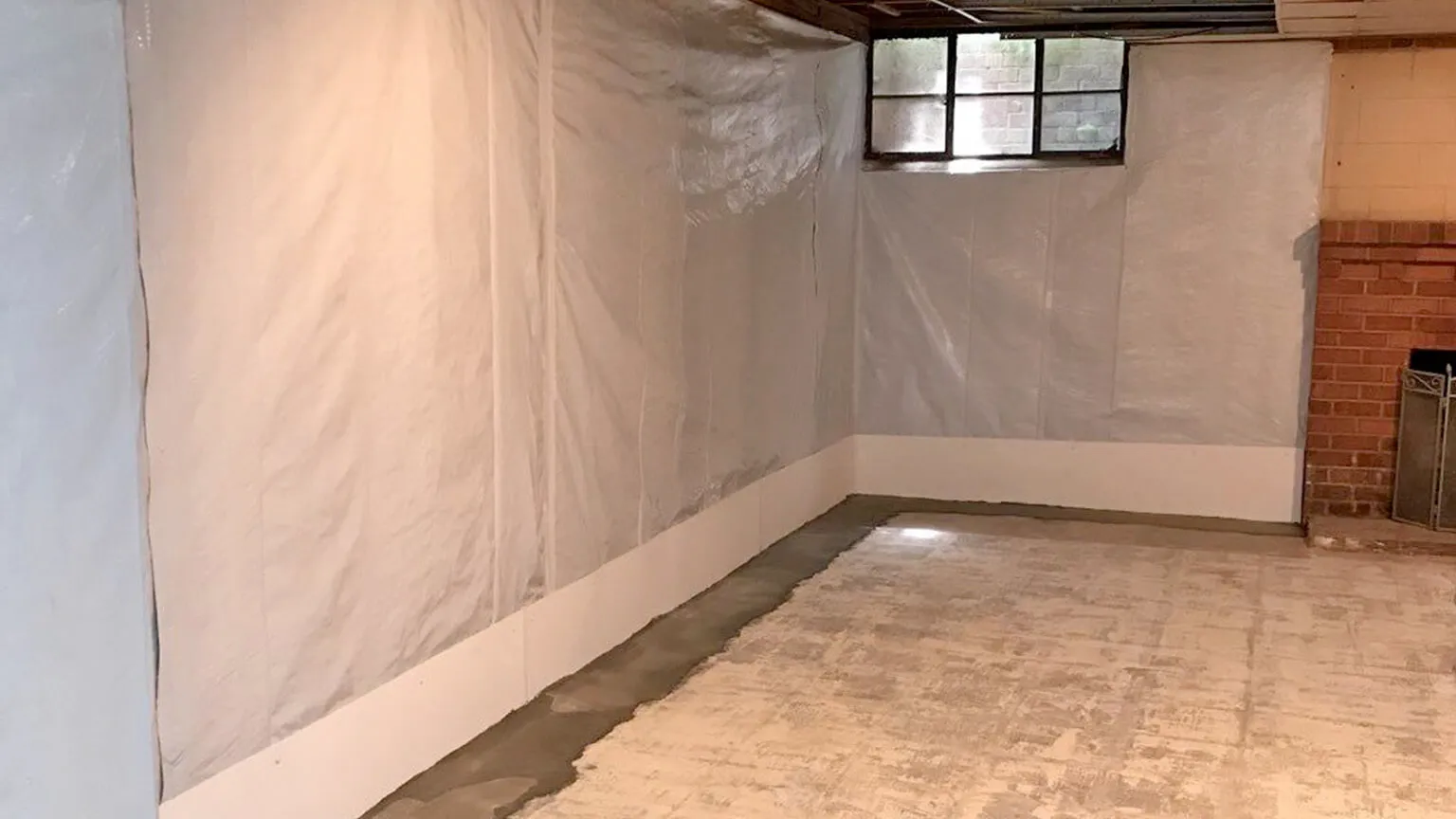
Why does this suit so many homes off Rockbridge Road? Because interior drainage doesn’t care what your foundation is made of, or what’s growing on top. The system sits below everything, so roots, driveways and patios stay put.
Cost moves with how much wall is involved and how hard the room is to reach. A short run in an open basement sits at the low end, while a full perimeter under a finished level sits at the high end.
Option B: what does exterior waterproofing involve?
Exterior work goes after water earlier, before it touches your foundation. Soil gets dug out to the footing, the wall gets cleaned and coated with a membrane, and a new drain line goes in at the base. Then the trench is backfilled and the grading gets corrected.
On paper it’s the more complete approach, and we’ll say so plainly. Water never reaches the wall, so the wall never has to fight. For a block foundation with tired mortar joints, that’s real value.

But exterior work is also the disruptive one, and here that’s not theoretical. Fifty-year-old hardwoods sit close to these houses, and their roots run wide. Lots in Killian Hill and Arcado are often tight on one side, so a machine has to fit between your wall and the property line. Sometimes there’s no path in.
There’s a second wrinkle specific to seventies construction. On most Lilburn homes, exterior work isn’t repairing a system — it’s building the first real one this house has ever had, since the tar is gone and the footing drain is silted solid. That’s an honest argument for going outside, and it’s why the price is what it is.
The question that tells you somebody actually diagnosed it
Want a shortcut for judging any estimate, including ours? Ask this: “Where exactly is the water entering, and how did you decide that?” Then stop talking and listen.
A real answer sounds specific. It names walls, not the whole basement. It mentions the floor seam versus the wall face, which way the yard falls, and where your downspouts dump. Vague answers, on the other hand, jump straight to a product.
If nobody can tell you where the water gets in, they can’t tell you what will keep it out. The rest is guessing with a warranty stapled to it.
Real talk: a patch feels great for about two rainy seasons. So we’d rather lose a job to someone who diagnosed it properly than win one by sealing a wall that needed a drain. Good news is the diagnosis is free here, and the reasoning comes in writing either way.
Side by side, honestly
Enough theory. Here’s how the two compare, standing in your basement.
Interior drainage
- Happens indoors, so rain never delays it
- Trees, patios and landscaping stay untouched
- Usually done in one to three days
- Works on block, poured or stone walls
- Includes a pump, which needs occasional service
- Handles groundwater and water already at the footing
Exterior waterproofing
- Stops water before it reaches the wall
- Requires digging to the footing outside
- A longer job, and weather pauses it
- Costs more, mostly for digging and yard repair
- Often impossible where roots block access
- Also corrects grading and the wall face
Notice that neither column says “better.” Once we’ve seen your lot, one usually becomes obvious and the other becomes a conversation we can skip.
What actually decides it on a Lilburn house?
Four things, more or less. These come up on nearly every inspection we run between Lilburn City Park and the BAPS Shri Swaminarayan Mandir.
The deciding factors
- Can equipment get back there? Mature canopy and a narrow side yard often answer that before we do.
- Where is water entering? Wall-face seepage points outside. Water at the floor seam points inside.
- Is the wall moving? A horizontal crack or slight bow means support, not only drainage.
- What’s already down there? A finished basement changes the plan, though rarely as much as people fear.
That last one deserves a moment. Plenty of homes near Sweetwater got beautiful basement finishes, and behind the drywall somebody rolled on a sealer and called it handled. Then the smell comes back — not from carelessness, but because a coating was asked to do a drain’s job.
The fix is less brutal than it sounds. We usually need about four feet of clear perimeter along the treated walls, so most built-ins survive. One homeowner near Killian Hill braced for losing a whole wall of shelving, and instead we opened a narrow strip and put it all back.

So which one do we recommend?
Of the waterproofing options Lilburn homes typically qualify for, we recommend interior drainage first — paired with outside corrections that don’t need a machine. Longer downspout extensions, regrading the low side, and clearing the yard drains that fall leaf drop buries do a surprising amount of work.
We recommend full exterior work in two cases. If the lot has clean access and the block face is deteriorating, going outside is worth it. Likewise, if you’re already digging for a patio or a foundation repair, that’s the moment, because the expensive part is the hole.
Sometimes we tell folks they don’t need either one. If water shows up only in hard storms and the gutters are packed with fifty years of canopy, start there. A morning of gutter work has quietly saved more basements than anyone admits, and we’ll say so even though it’s a smaller invoice. Curious how the same call goes one town over? Our breakdown of Norcross waterproofing options covers a different mix of housing stock.
The rooms nobody connects to this
Ready for the part that surprises people? A damp basement isn’t really a basement problem. It’s a whole-house one, and the symptoms show up two floors from the water.
Air in a house rises. Warm air escapes through the attic, which pulls replacement air in from the lowest point — your basement. So the air you breathe upstairs started its trip beside that damp block wall. That’s why a second-floor closet can smell musty when it’s bone dry up there.
Moisture rides along with it. Hardwood floors cup at the seams. Doors stick in July and fit fine in October. Homeowners chase each separately, yet it all traces back to one source, and the EPA’s guide to moisture in the home explains it well.
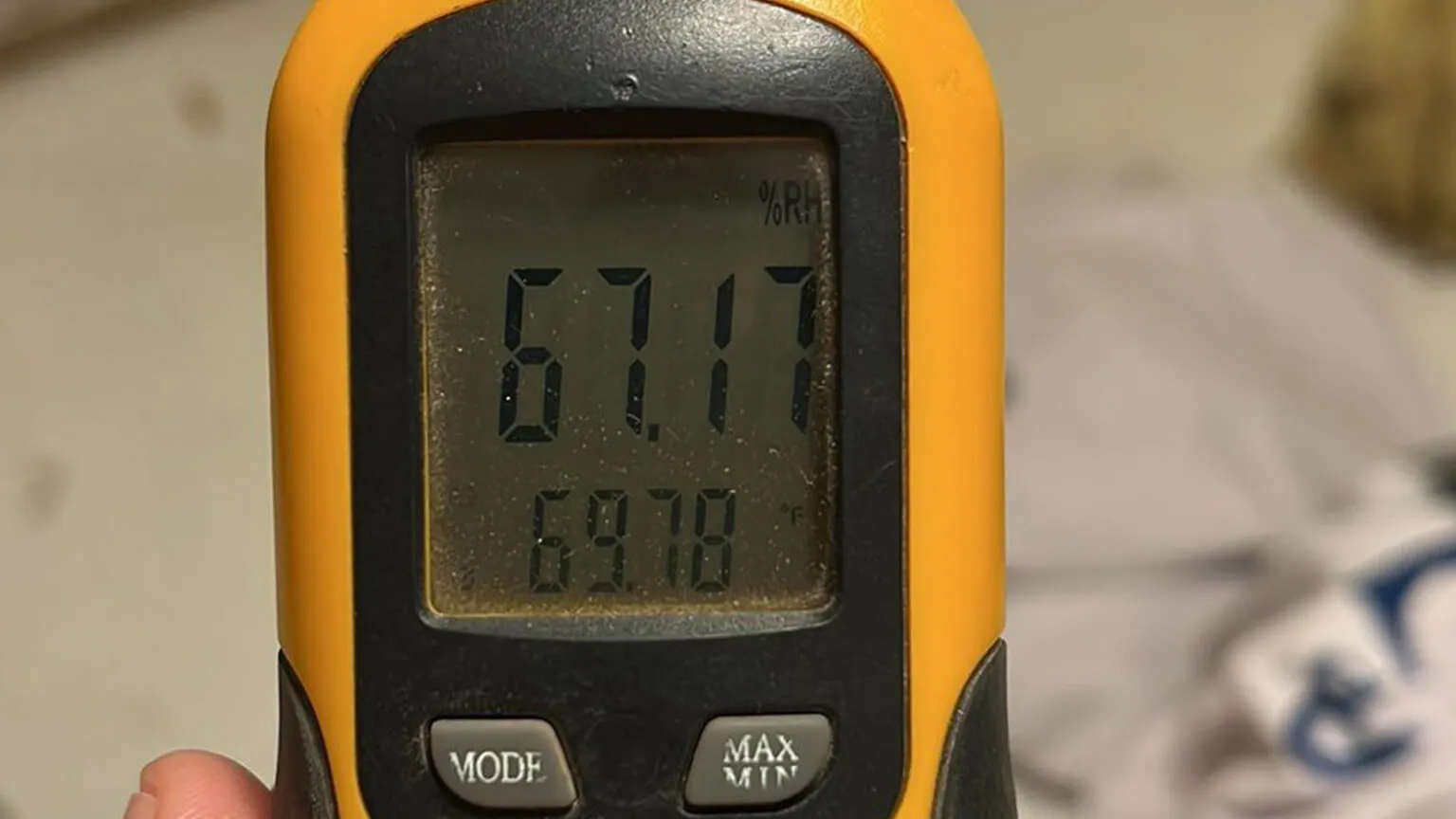
Now picture it handled. The floor stays dry through a hard spring storm, and you can watch those line up on the National Weather Service Peachtree City forecast. That smell at the stairs is gone. Better yet, the downstairs bedroom is a bedroom again.
Why hire people who know these houses?
Because a 1978 block basement asks different questions than a 2015 poured wall, and the answers aren’t in a script. These homes have held up for decades, so the fix should respect how they were built. We work with the block, and we say honestly when something is fine as-is.
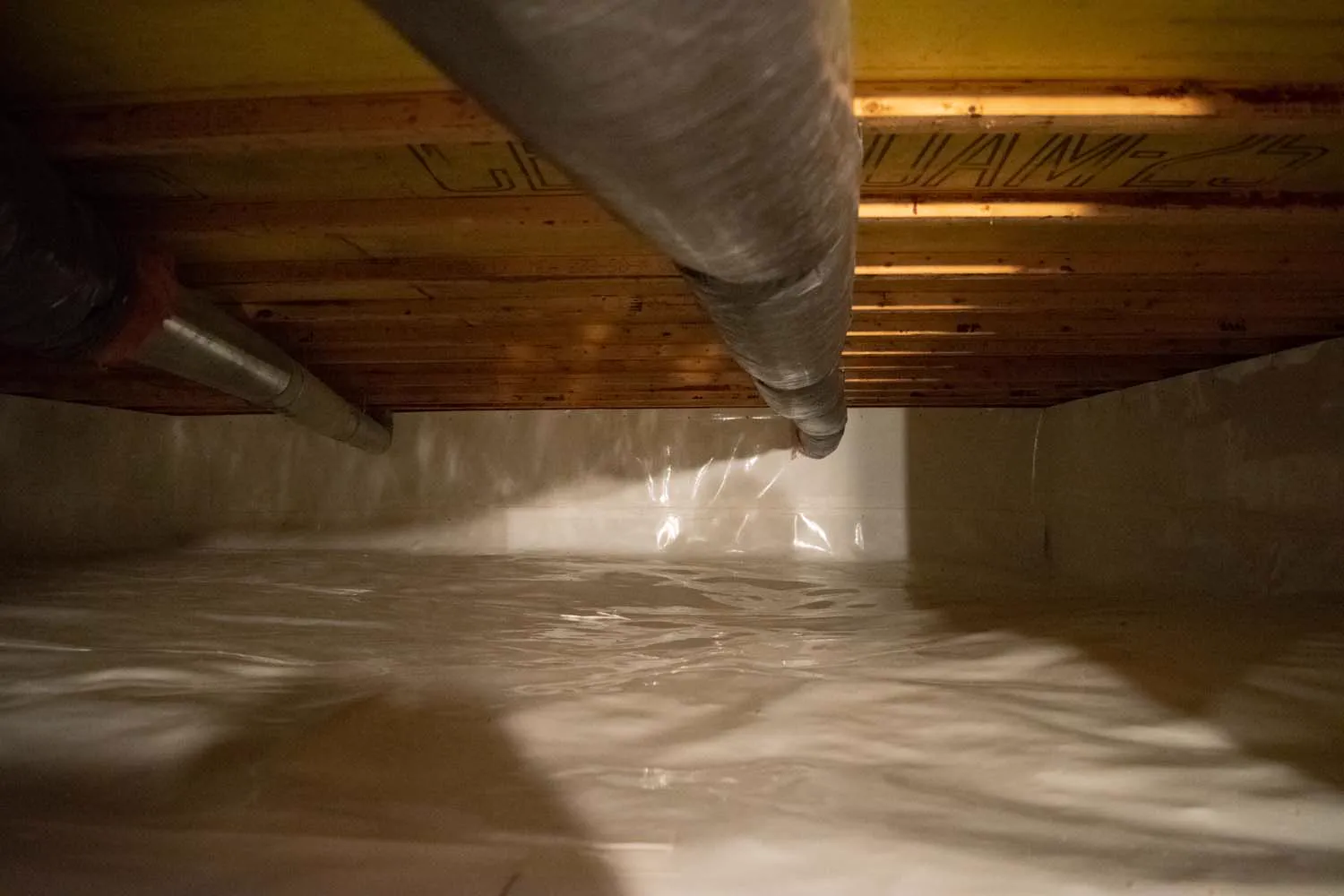
You get the same crews, the same trucks, and a written warranty up front. For the technical read, our page on basement waterproofing lays out the systems, our guide to the best basement waterproofing approaches goes further on seventies foundations, and if your home sits on a crawl space, crawl space encapsulation is the right conversation.
Where we work around Lilburn
We’re based in Lawrenceville, about fifteen minutes northeast, so we’re in this part of Gwinnett constantly. That includes Lilburn, Snellville, Norcross, Tucker, Stone Mountain, Duluth, Suwanee, Grayson, Loganville, Dacula and Berkeley Lake.
Questions Lilburn homeowners ask us
On most homes here, interior drainage wins, because mature trees and tight side yards make excavation hard and the old exterior coating is long gone anyway. Exterior work is the better call when a machine has clean access and the wall face is breaking down. We tell you which one your house is after we’ve seen it.
The drainage itself is stone and pipe, so there’s nothing in it to wear out. The sump pump is the one part with moving pieces, and pumps run for years before they need replacing. Keeping the discharge line clear is about all the upkeep.
Yes, and you get it in writing before we start, not after. It covers the system we installed and the walls we treated, in plain language. Since we’re local and licensed, you’re calling the same company that did the work.
Usually, yes. We need about four feet of clear perimeter along the walls we’re treating, so built-ins and most drywall come back the way they were. Where a section must be opened, you’ll know which one before day one.
It helps in two ways. A dry lower level is space buyers will actually count, which matters where the basement is real living area. Plus a transferable warranty removes a question that shows up in every inspection report.
Let’s find out what your Lilburn basement is really doing
The inspection is free, the estimate is free, and nobody pressures you. We’ll show you where water gets in, walk you through both approaches, and say straight out if the smaller fix is right.
(678) 914-5112Serving Lilburn and all of Metro Atlanta · $500 off projects over $3,500 · Live support 7am–8pm, 7 days a week