

Waterproofing Options Dacula Homeowners Weigh: Fix the Yard, or Fix the Basement?
An honest side-by-side of exterior grading and interior drainage on a big Dacula lot.
One inch of rain on a single acre drops about 27,000 gallons of water. That’s not a scare number, it’s just math — and it’s why the waterproofing options Dacula homeowners consider look different than they do closer to town. Out toward Dacula the lots get bigger, and so does the amount of water that has to go somewhere when a storm rolls through.
Good news? The choice in front of you is smaller than the internet makes it feel. There are really two families of fix, and once you see how each behaves, picking gets simple. So let’s lay both out fairly, then we’ll tell you what we’d actually do.
Option A: what does exterior grading and drainage do?
This option never touches your basement. Instead, it changes how water travels across your property before it reaches the house. Think of it as giving all that rain a job and a route.
The work usually means regrading soil so it slopes away from the foundation, extending downspouts past the backfill, and adding buried drain lines where the yard holds water. On acreage we’re often building a path where one never existed. Big lots on former farmland tend to shed water instead of soaking it up, because equipment packed that red clay tight years ago.
Cost lands lower than most people expect, since nobody cuts concrete. What moves the number is distance, slope and how much dirt has to move. So a downspout correction is one morning, while a full plan across an acre is bigger.
When does this option win? When the water clearly starts at the surface. Roof runoff dumping at a corner, a low spot by the walkout, a septic field uphill keeping soil wet — those get solved outside.
Option B: how does an interior drainage system work?
An interior system takes the opposite approach. Rather than blocking water, it catches water under the floor and carries it off before it reaches your living space. Basically, it’s a gutter that lives beneath the slab.
Our crew opens a narrow channel in the concrete along the walls that leak. Perforated pipe goes in, packed in clean stone, sitting lower than your floor. All of it routes to a sump, and the pump pushes water well away from the house. After that, the channel closes back up with fresh concrete.
Worth knowing
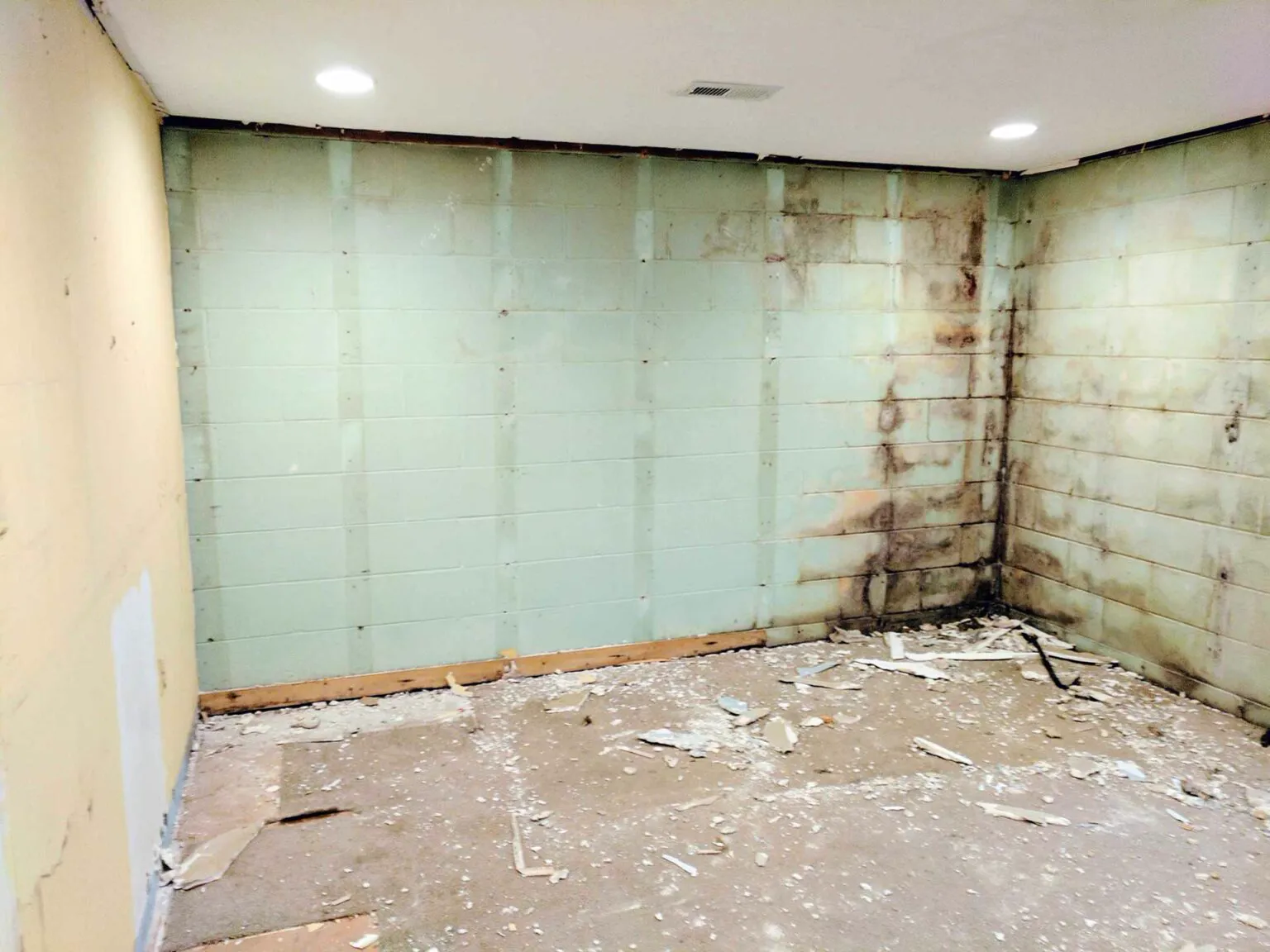
The cove joint — the seam where your basement wall meets the floor slab — is the most common water entry point in a Georgia home. It isn’t a crack or a defect. It’s simply where two pours meet, and water under pressure finds it. An interior system relieves that pressure.
Option B wins when water arrives from below rather than above. Homes near the Apalachee and Mulberry basins can sit over seasonal high groundwater, so the table rises in spring and pushes up. In fact, that’s the one case where yard work alone won’t get you there.
Real talk: where does all that water end up?
Here’s the part of this job that decides whether it lasts, and nobody puts it in a brochure. Both options collect water. Neither one destroys it. So the discharge point — where the water gets released — matters more than the system itself.
We’ve walked properties where a previous crew did tidy work, then let the line dump twelve feet off the wall on ground sloping back toward the house. Water took the hint and returned. That isn’t a product failure, it’s a routing failure — and it’s very fixable.
We stopped asking where the water gets in and started asking where it goes when it leaves. On an acre, that second question is the whole job.
Big lots are a gift here. A homeowner over in Providence Club had room to run a discharge line far downhill to daylight — no pump fighting gravity, no line freezing at a splash block. Since you’ve got land, we can use it.

One more Dacula note: we map the septic tank and field lines before anything gets trenched. Nobody wants a drainage project that surprises the septic system.
Side by side, honestly
Enough theory. Here’s how the two compare once we’re in your basement with a flashlight.
Exterior grading and drainage
- Stops surface water before it reaches the wall
- Costs less, because no concrete gets cut
- Nothing inside your house is disturbed
- Fixes standing water in the yard at the same time
- Rain delays the work, since it all happens outside
- Can’t do anything about a rising water table
Interior drainage system
- Handles groundwater and cove-joint seepage directly
- Works indoors, so weather never stops the schedule
- Typically finished in one to three days
- Works on block, poured or older stone walls
- Includes a pump, which needs a look now and then
- Costs more, and yard drainage still needs its own plan
What decides it on a Dacula lot?
Four things, more or less. They come up on nearly every inspection we run between Harbins Road and the Apalachee.
The deciding factors
- When does the water show up? During the storm points outside. Two days later, or all spring, points below.
- Where does it appear? A wet floor seam is classic cove joint. A wet upper wall is usually roof runoff.
- How does the land sit? Slope, septic position and low spots tell us most of the story.
- What’s already down there? Finished basements and older crawl spaces change the plan quickly.
That last one deserves a moment. Plenty of older farmhouses on the rural edges have crawl spaces with bare dirt and no vapor barrier. Ground moisture rises straight into the floor system, which is why a house can smell damp while nothing looks wet. Sealing that ground with a real liner solves it, and the air upstairs changes fast.
So which one do we recommend?
On most Dacula properties, we recommend exterior grading and drainage first. That surprises folks who expect us to sell the biggest system on the truck. But on acreage with a defined slope, moving surface water is usually the highest-value dollar you can spend.
We recommend an interior system when the water is groundwater. Seepage at the floor seam, a basement that stays damp long after the sky clears, a home sitting in a low fold of the terrain — those need drainage below the slab. Grading a hillside won’t lower a water table, so we’d rather say that on day one.
Sometimes both make sense, though rarely at once. A homeowner in Apalachee Farms started with downspout extensions and regrading in the fall, watched it through a wet spring, then added a partial interior run on one wall. That order saved real money. For the deeper technical read, our page on basement waterproofing walks through each system, while our guide to the best basement waterproofing approaches goes further on newer subdivision homes.
When would we tell you to skip the bigger system?
More often than you’d think. If water only shows up in heavy storms and your gutters are packed with pine straw, start there. A morning of gutter work has quietly saved more basements than this trade admits.
Same goes for one low spot by a walkout door. Fix the grade, extend the line, and watch a season. Should it come back, you’ve lost nothing. That said, seepage at the floor seam every spring just repeats itself while you wait. The EPA’s guide to moisture in the home is a solid, non-salesy read while you decide.
Your once-a-year checklist after it’s fixed
Here’s something homeowners rarely get handed: the short list that keeps your system working. None of it is hard, and it all fits in one Saturday morning.
Once a year, ideally in fall
- Clear the gutters, and check every downspout still empties past the backfill
- Walk the discharge line so its outlet isn’t buried in leaves or mulch
- Pour a bucket into the sump pit, then confirm the pump runs and shuts off
- Look at soil against the foundation — it should slope away, not sit level
- Check the dehumidifier drain is clear and the filter is clean
- Peek in the crawl space, if you have one, for a torn liner
Fall is the right season for this in Gwinnett, because you get ahead of spring storms while the ground is still workable. Plus the yard is dry enough to walk. Rather not crawl under the house? We’ll do the walkthrough with you — no charge, no pitch. And if you want the science behind the seasonal part, the U.S. Geological Survey’s groundwater primer explains why the water table rises and falls.

Why hire people who know these lots?
Because an acre behaves differently than a quarter acre, and the answer isn’t in a script. We’ve worked homes backing up toward Little Mulberry Park and out past Tribble Mill Park, so we know how this terrain sheds water and where it pools. Which means we can also tell you when something is fine as-is.
You get the same crews and trucks every visit, plus a written warranty before work starts. If your problem turns out to be under the house instead of in the basement, crawl space encapsulation is probably the right conversation. Wondering how this plays out one town over? Our breakdown of Sugar Hill waterproofing options covers tighter lots, where the math shifts.
Where we work around Dacula
We’re based in Lawrenceville, roughly twelve minutes west, so we’re out this way constantly. That includes Dacula, Lawrenceville, Grayson, Buford, Auburn, Winder, Braselton, Hoschton, Bethlehem, Snellville and Loganville. Odds are we’ve already worked a house near yours, maybe even in Daniel Park.
Questions Dacula homeowners ask us
Not everything. We need about four feet of clear space along the walls we’re working on, so most of the room can stay put. We’ll tell you which areas to clear before the first day, never after we show up.
It depends on the crack. A hairline shrinkage crack can be sealed during the work, and drainage takes pressure off it either way. But a crack that’s widening or stepping through block is a structural question, so we’d look at that separately and explain what we see.
Neither is better in general — it comes down to where your water starts. Surface runoff gets solved outside, while groundwater and floor-seam seepage get solved inside. On larger Dacula lots we usually suggest the exterior work first, because it often handles the whole problem.
The drainage itself is stone and pipe, so nothing in it wears out. Pumps are the moving part, and they get replaced eventually like any appliance. With the yearly checklist above, most systems keep working quietly in the background.
Yes, and you get it in writing before any work begins. The terms depend on the system we install, so we walk through them with you at the estimate. Nothing gets buried in fine print, because that helps nobody.
Let’s find out what your Dacula basement is really doing
The inspection is free, the estimate is free, and nobody pressures you at the end. We’ll show you where the water starts, walk you through both approaches, and tell you straight if the smaller fix is the right one.
(678) 914-5112Serving Dacula and all of Metro Atlanta · $500 off projects over $3,500 · Live support 7am–8pm, 7 days a week