

Standing Water Basement Snellville: What It Means and How It Gets Fixed
Where the puddle came from, how to read it, and why this is one of the more fixable problems a house can hand you.
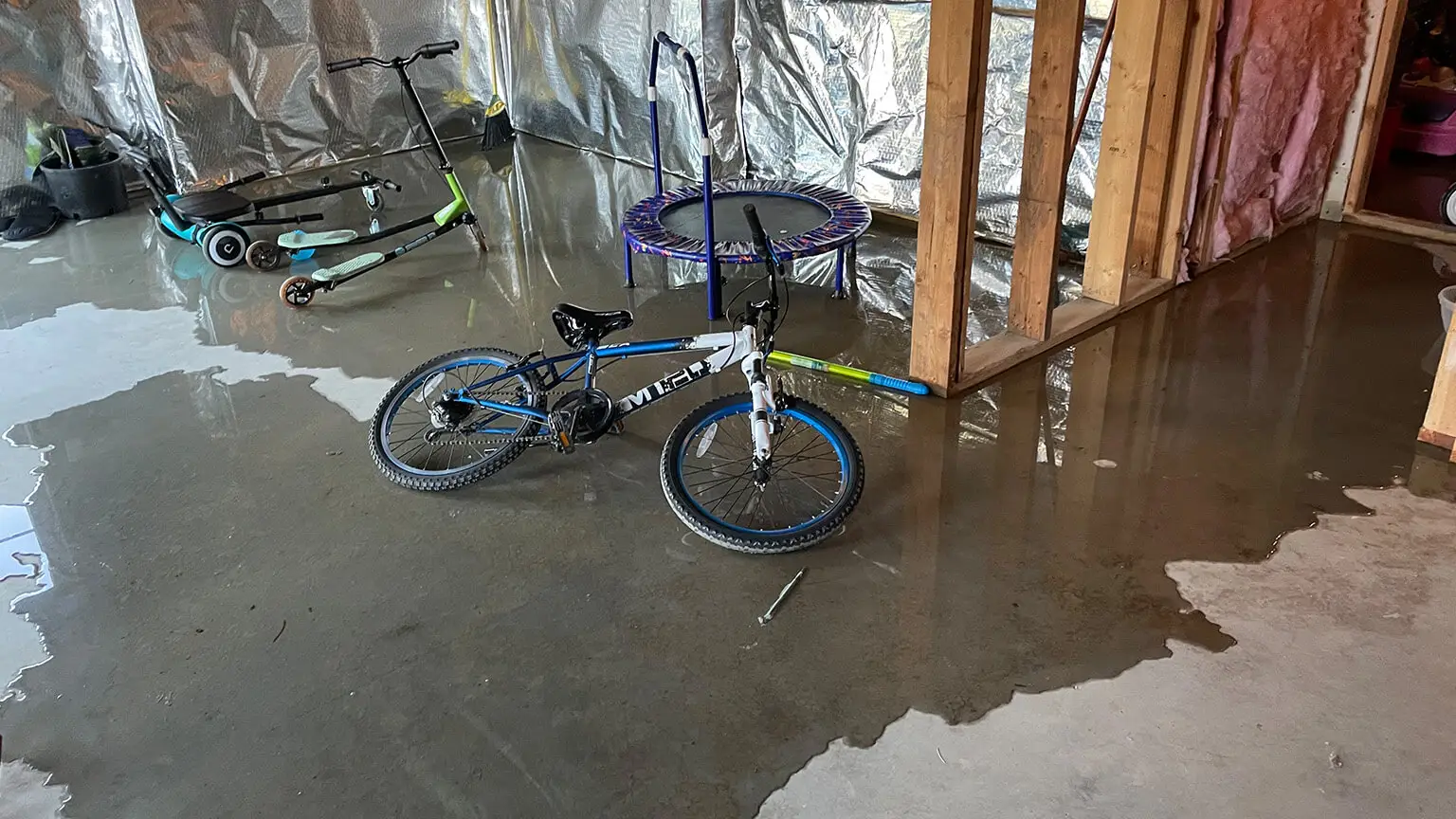
Water on a floor isn’t leaking. It’s being pushed. Soaked clay outside your wall behaves like a heavy liquid, and it leans on everything below grade until it finds the easiest way through — which is why a standing water basement Snellville homeowners wake up to is almost never a mystery once you know where to look. Bulk water like that means an opening, not humidity.
Good news, and we mean it: this is one of the most common calls we take, and it’s very fixable. A puddle doesn’t say your house is failing. It says water found a door, and doors can be closed.
So where does bulk water actually come from?
There’s a real difference between damp and wet. Damp air fogs a window and makes a room smell like an old paperback. Standing water is volume arriving from outside, and volume only comes from a few places.
The first is the cove joint — the seam where your wall meets the floor slab. Those two pieces of concrete got poured on different days, so they never really bonded. As a result, a hairline gap runs your whole perimeter, and water under pressure treats it like a doorway rather than a crack.
Next is a sump pump that quit. Then a drain line packed with silt or roots, so the system fills instead of empties. Last is a window well with no working drain, which becomes a very effective bucket aimed at your glass. Your basement shouldn’t come with its own water feature.
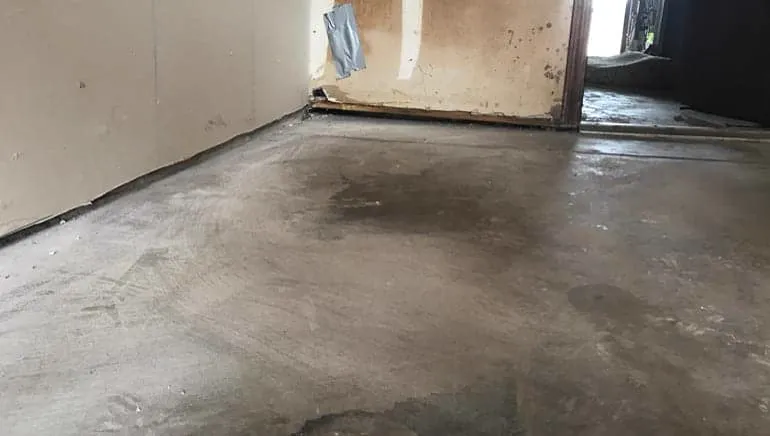
Now add Snellville dirt. Red clay doesn’t drain — it holds. After a long rain, that clay stays saturated against your foundation for days, so pressure keeps building after the sky clears. On block walls, water then travels through the hollow cores and comes out low. Homes near Kingsley Creek see this pattern constantly.
Before you go down there
Never step into standing water while the power is on. Shut the circuits off at the panel first, and if you can’t reach the panel without crossing water, call your electrician or the utility. It’s simply the right order to do things in.
What is the puddle actually telling you?
Here’s the thing — where water sits is real information, and you can read it yourself in about two minutes. It’s the same first read we do.
Water in one corner, or along one short run of wall, points to a local entry. Maybe a downspout dumps right there, or one window well fills. Either way, that’s the smaller conversation, and often the cheaper one.
Water spread thin across the whole slab tells a different story. That’s pressure under the floor pushing up through the cove joint everywhere at once. Most of the standing water basement Snellville calls we run look like this, and it simply means the fix has to cover the whole perimeter instead of one spot.

Then there’s timing. Water during the storm points to surface water and gutters. Water a day or two after the storm points to groundwater, because the clay had to load up first. That one detail changes what we recommend more than almost anything else.
What happens if it’s left alone? Plainly: it repeats, and each round costs a bit more, because water keeps meeting the same drywall. Mold can begin on wet organic material in roughly 24 to 48 hours, so drying fast matters — the CDC’s guidance on mold cleanup after flooding is a short read. The concrete is rarely what’s at stake. The finished room is.
Why does most advice stop right here?
Search this problem and you’ll get the same three tips everywhere. Clean the gutters. Extend the downspouts. Regrade the soil. Good advice, honestly — and all of it stops one step short of the answer.
Because those tips only handle water that hasn’t soaked in yet. Once clay is saturated eight feet down, no downspout extension reaches it. That’s the gap nobody online closes, and it’s why folks feel like they did everything right and still got a wet floor.
Real talk: this is where the math helps. One inch of water across a 1,000-square-foot basement is more than 600 gallons. That’s why the wet-vac feels hopeless at midnight — you’re not losing because you’re slow, but because it’s 600 gallons and the source is still open.
Advice also skips the sump pump, which fails in boringly predictable ways. Power drops during the exact storm you needed it. A float sticks. The pump was undersized from day one, or there’s no check valve, so half of what it lifts slides back down. Sometimes the discharge line outside is crushed and the pump runs fine into nothing.
Good news? Every one of those is a known part with a known fix. When we find a stuck float in a house off Lenora Church Road, that’s a great day — cheap, fast, and the homeowner goes from worried to relieved in an hour.

What does the real repair look like?
Let’s walk it, so nothing is a surprise. The idea is simple: quit trying to block water, and give it an easier path than the one through your floor.
- Find the source first. Outside — grading, gutters, window wells — then inside. Sometimes the answer is smaller than expected, and we’ll say so.
- Open a channel at the perimeter. A narrow strip of slab comes up along the affected walls. Loud and dusty for a day, then done.
- Set drainage under the floor. Perforated pipe in clean stone, below the slab, so water gets collected before it reaches your floor.
- Run it all to a proper sump. Right-sized pump, check valve, and a discharge line that carries water well away from the house.
- Close it up clean. Fresh concrete over the channel, wall liner where it belongs, and our mess hauled off.
Notice what’s missing? Paint. Sealers are decent products, but a coating can’t beat pressure — it’s a raincoat on a submarine. That’s why a drainage system gets a written warranty and a bucket of sealer never should.
A lot of Snellville basements were finished in the nineties, and the drywall has been quietly wicking water ever since. The fix isn’t more drywall — it’s stopping the water first.
Curious what it runs? It depends on how much wall is involved, whether a pump is part of it, and how easy the space is to reach — so we walk it before we quote it. Our breakdown of basement flooding cost covers what moves the number, and the systems are explained on our basement waterproofing page.

Want the one that wasn’t what they thought?
A homeowner in the Norris Lake area called us sure the foundation had cracked. They’d found half an inch of water across the slab two springs running, and a previous crew had smeared hydraulic cement on every wall in reach. Understandably, they expected bad news.
What we found was a buried drain line, original to the house, packed solid with silt about fifteen feet out. The wall was fine. Water simply had nowhere to go, so it backed up and came in at the seam — like a sink backing up, only underground.
That one turned into a new discharge run, a right-sized pump, and interior drainage along two walls. No structural work at all. When we told them, they laughed out loud, and so did we — relief is a good sound. Over in Stonecypher we’ve had nearly the same call, right down to the cement patches.
Here’s why that story matters to you. People assume standing water means something broke, when usually it means something clogged, quit, or was never installed right. That said, we’d rather look than guess, because guessing is how homeowners pay for the wrong repair twice.
Picture the other side for a second. Heavy rain rolls through, and you don’t think about the basement at all. Instead of a room you apologize for, you get a room you actually use. That’s the real product — a house looking after your family instead of the reverse.
Why does hiring local matter for this?
Because Snellville houses share a story. Most of this city went up between the mid-seventies and the mid-nineties, so we see block basements under split-levels and ranches, many with original systems that have done their twenty-five years.
We also know the ground here. The land rolls toward the Yellow River and Big Haynes Creek, so groundwater sits higher on some streets than others. We’ve worked homes minutes from Eastside Medical Center and plenty within walking distance of the Snellville Towne Green. Our shop is fifteen minutes north in Lawrenceville, so the crew doing the work is the crew answering in year six.
One more thing worth your time: the National Weather Service flood safety guide is a good read before storm season. If you’re also seeing cracks or sticking doors, our page on foundation repair explains how we tell water apart from movement. Folks up the road get the same treatment — here’s our take on a Buford standing water basement.
Where we work around Snellville
Snellville is a short hop from our shop, so we’re out this way most weeks. We also cover Lawrenceville, Grayson, Loganville, Lilburn, Stone Mountain, Tucker, Centerville, Dacula and Norcross, plus the wider Gwinnett area. Off Highway 78 or toward Scenic Highway, odds are we have a truck nearby.
Questions Snellville homeowners ask us
Yes, as long as the repair targets the source instead of the symptom. Under-slab drainage routed to a working pump gives water a permanent path out, so it stops choosing your floor. The drainage lasts the life of the house, and the pump is the only part with a service life.
It lands in a wide range, because one bad window well and a full perimeter system are very different jobs. What moves the number is how many linear feet of wall are involved, whether a pump and discharge line are part of it, and how easy the space is to reach. We walk it, then put a real number in writing.
Then you have time, and that’s genuinely good news. Twice a year usually means it takes a long, heavy rain to load the soil enough to push water in. It’s still worth an inspection, because occasional flooding tends to become regular flooding as drain lines silt up and pumps age.
For drying out, they help a lot, so keep using them. For fixing it, no, because the vacuum works on water that already got in and does nothing about the pressure that sent it. Think of it as mopping while the faucet runs.
Mold can begin on wet organic material like drywall, carpet pad and cardboard in roughly 24 to 48 hours. That’s why we push drying and airflow right away, before any repair gets scheduled. Pull wet cardboard out first, since it holds moisture longer than almost anything else.
Let’s find out where the water is getting in
The inspection is free, the estimate is free, and nobody pressures you at the end. We’ll show you the entry point, explain the fix in plain English, and put the scope in writing — even when the answer is simpler than you expected.
(678) 914-5112Serving Snellville and all of Metro Atlanta · $500 off projects over $3,500 · Live support 7am–8pm, 7 days a week