

Basement Flooding Sugar Hill Homeowners Deal With: The Cause, and the Fix
Where the water is coming in, what the puddle is telling you, and why this is a normal repair on a hill like ours.
Here’s the good part first: a flooded basement is one of the most fixable problems in your whole house. Nothing is broken, and the repair is ordinary work we do most weeks of the year. So before you lose a night to it, know that basement flooding Sugar Hill homes see almost always traces back to one or two plain causes — and both have a straight answer.
Worth saying out loud, too: this is common here. If your street sits on a slope, plenty of your neighbors have a version of the same story. They just never mention it.
Where is the water actually coming in?
Flooding isn’t the same as dampness. Damp is vapor — humid air, a musty smell, a clammy wall. Flooding is bulk water arriving through an opening in real volume. That difference narrows the list fast.
Usually the source is one of four things: pressure pushing water through the cove joint, a sump pump that quit, a blocked drain line, or a window well with no working drain, quietly filling like a bucket outside your glass.

Let’s back up a second on that first one, because it’s the big one. The cove joint is the seam where your basement wall meets the floor slab. Those two pours happened on different days, so they never truly bonded. In other words it isn’t a crack — it’s a seam, and it runs your entire perimeter.
When wet soil builds pressure, water takes the easiest opening available, and that seam is always the easiest opening. Which means water pours in through a wall that looks perfectly fine, while homeowners hunt for a crack that was never there. Good news? A known path is also a known fix.
Safety first, calmly
Never step into standing water while the power is still on down there. Go to the panel, kill the circuits that feed the basement, then go look. Thirty seconds, and the question is settled.
Why does the hill matter so much?
Sugar Hill is named for a hill, and it earns it. On terrain like this, water doesn’t sit — it runs, and it runs toward whatever is downhill of it. Sometimes a creek. Sometimes your foundation wall.
The land drops hard toward Lake Lanier and the Chattahoochee below Buford Dam, so walkout and daylight basements are the norm here. That’s great for square footage and daylight. It also means one wall is buried deep while the other opens to the yard, and the buried side takes the whole load.
Then there’s what’s under the grass. Georgia red clay holds water against the wall instead of draining it away, so pressure keeps climbing for a day or two after a long rain. On the steeper streets around Level Creek there’s shallow rock too, and water travels sideways along it until it meets something solid. Frequently that something is a basement wall.
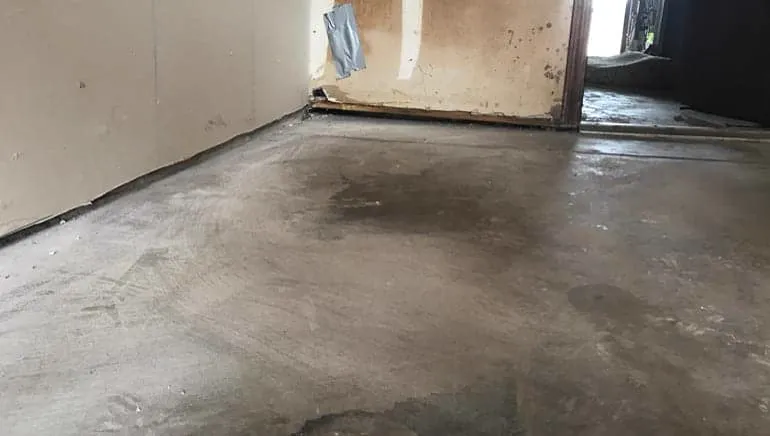
Timing plays a part too. Much of the housing here went up between the 1990s and the mid-2000s, so original systems are aging out on roughly the same schedule. A homeowner over in Sycamore Farms isn’t unlucky — their drainage worked for twenty-five years and is now asking for a turn.
What’s the myth we hear on almost every estimate?
It goes like this: “We’ll just seal the walls and it’ll be fine.” Almost everybody has heard it, plenty have tried it, and it’s worth clearing up gently, because it costs homeowners real money.
Sealers are decent products for what they are. Still, a coating is a surface and pressure is a force. Asking a coating to hold back pressurized groundwater is like putting a raincoat on a submarine — not a bad raincoat, just outmatched.
There’s a second half to it, too. Water rarely comes through the middle of a wall where you can paint it. It arrives at the cove joint, or through the hollow cores of block walls that fill like straws and spill out at the bottom. Coating the visible part doesn’t touch either path.
We stopped trying to block water years ago. Now we assume it’s coming, and we build it a better way out.
So the modern approach is drainage, not resistance. Give water a path that’s easier than your floor and it takes that path every time, because water is lazy and predictable. That’s also why a proper system carries a written warranty and a bucket of sealer doesn’t.
How do you tell mild from serious?
Fair question, and you deserve a straight answer instead of a sales pitch. Honestly, the puddle tells you a lot before anyone shows up.
A puddle in one corner points to a local entry — a window well, a pipe penetration, one bad spot at the seam. That’s the smaller conversation, and often the cheaper one.
Water across the whole slab points to pressure underneath, pushing up along the full perimeter. Bigger scope, same fix, and still not an emergency.
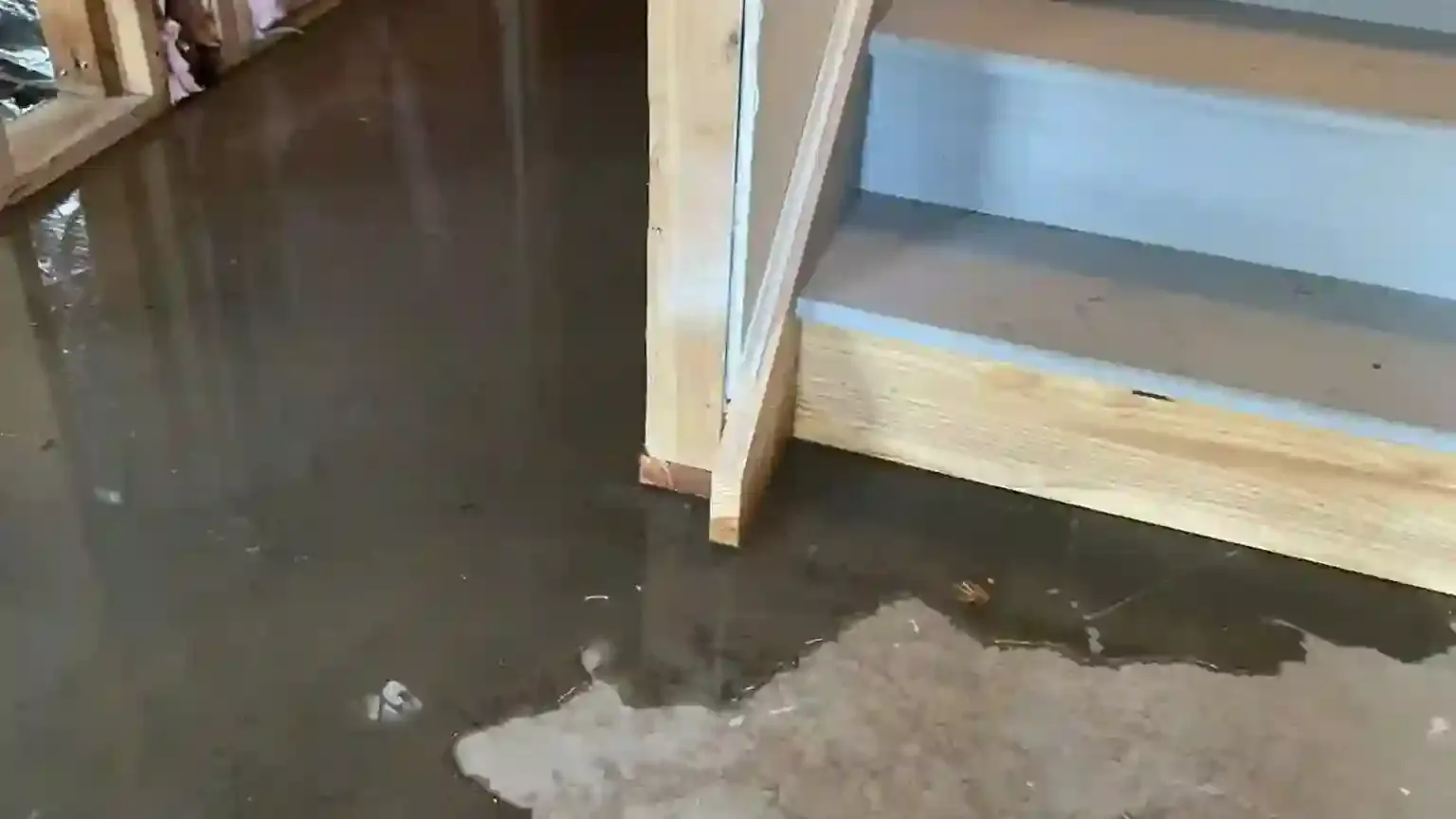
Sump pumps fail in the same handful of ways, too. Power drops mid-storm, right when the pump is needed. A float sticks. The pump was undersized from day one. There’s no check valve, so water it pushes up runs back down. Or the discharge line outside is clogged.
What happens if it’s left alone? Plainly: water keeps arriving on the same schedule, and the damage shifts from the concrete to everything touching it. Mold can begin on wet organic material — drywall, carpet pad, cardboard — in roughly 24 to 48 hours. The National Weather Service flood safety guide is a calm read on the rest.
Here’s the number that explains the sinking feeling, though. One inch of water across a 1,000-square-foot basement is more than 600 gallons. No wonder a shop vac feels hopeless — you’re not losing at cleanup, you’re just badly outnumbered.
What does the real fix look like?
Let’s walk it so nothing feels like a surprise. The idea is simple: catch water before it reaches your floor, then send it somewhere useful.
- Find the source first. We walk the grade, check downspouts, then read the inside. Sometimes the answer is smaller than expected, and we say so.
- Open a channel at the perimeter. A narrow strip of slab comes up along the affected walls. Loud and dusty for a day or two, then done.
- Set drainage below the floor. Perforated pipe in clean stone, catching water at the cove joint instead of after it’s already inside.
- Handle the block cores. We relieve the hollow cores so trapped water drains into the system rather than spilling out at the base.
- Set a pump that fits the lot. Right size, check valve, sealed lid, discharge routed well away downhill. Battery backup where power loss is the real risk.
- Close it up clean. Fresh concrete over the channel, wall liner where it’s called for, and our mess hauled off.

Curious what it runs? It depends mostly on how much wall is involved, whether the space is finished, and how tough the access is — so we walk it before we quote it. Our breakdown of flooding cost covers every factor that moves the number, and the systems are explained on our basement waterproofing page. If you’re seeing wall cracks too, foundation repair is the page to read next.
What should you do every year once it’s fixed?
Great question, and almost nobody asks it — which is why we like it. A system this durable still earns about an hour of attention a year. Think oil change, not project.
- Test the pump each spring. Pour a five-gallon bucket into the pit and watch it kick on, run, and shut off. If it groans, call before storm season.
- Walk the discharge line. Follow it outside. It should be clear, pointed downhill, and not buried under mulch or leaves.
- Clean gutters twice. Fall matters most here, since steep lots depend on drainage staying open.
- Check downspout extensions. Water should land at least six feet from the wall. Mowers bump these constantly.
- Look at the grade. Soil should slope away. Beds built up over the years quietly tilt water back toward the house.
- Peek in the window wells. Leaves, mulch, and a tennis ball or two. Clear them so the well drain can breathe.
That’s the whole list. FEMA’s building science resources go deeper if you like the technical side.

Picture the next hard spring storm. Rain hammers the roof, the creek along the Suwanee Creek Greenway comes up, and you go to bed without thinking about the basement once. That’s the real product — not pipe and stone, but a Saturday you get to keep, plus a room you can finally use.
Why does hiring somebody local matter here?
Because slope changes everything, and we’ve spent twenty-plus years on these lots. We’ve handled walkout doors taking water near Nelson Brogdon Boulevard, downhill homes in the Sugar Mill area catching runoff from three yards uphill, and block walls filling minutes from the E Center. Our shop sits twenty minutes south in Lawrenceville, so the crew that does the work is the crew that answers in year six.
You also get the boring stuff right: written scope, proof of insurance, a real warranty, a clean site. If a relative down the road sees something similar, we cover the Lilburn standing water basement crowd too.
Where we work around Sugar Hill
Sugar Hill is a quick run up from our shop, so we’re out this way constantly. We also cover Buford, Suwanee, Cumming, Gainesville, Duluth, Lawrenceville, Dacula, Braselton and Flowery Branch, plus the wider Gwinnett area. Near Lake Lanier or off Peachtree Industrial, odds are we already have a truck close by.
Questions Sugar Hill homeowners ask us
Mold can begin on wet organic material in roughly 24 to 48 hours. That means drywall, carpet pad and cardboard boxes, not the concrete itself. So the goal is simply to get water out and air moving quickly, and you’re generally in good shape.
Kill the power to the basement at your panel before you step into standing water. After that, get anything you can lift up off the floor and take photos for your records. Then call us and we’ll help you sort the source from the cleanup.
Because red clay holds water against the wall instead of draining it, pressure builds for a day or two after a long rain. Once that pressure passes a certain point, water pushes through the cove joint at the floor. Normal rain never builds enough push, so the floor stays dry.
It depends on the source. Many policies cover sudden failures like a burst pipe, while groundwater seepage usually needs separate flood coverage or a sump pump rider. Call your agent and ask specifically about water backup and groundwater, since the wording varies a lot.
Aim for the first day or two. Pull up wet carpet pad, run fans and a dehumidifier, and open up anything holding moisture behind it. Drying fast keeps a water problem from turning into a materials problem.
Let’s find out where that water is getting in
The inspection is free, the estimate is free, and nobody pressures you at the end. We’ll show you the entry point, explain the fix plainly, and put the scope in writing — even if the answer is simpler than you expected.
(678) 914-5112Serving Sugar Hill and all of Metro Atlanta · $500 off projects over $3,500 · Live support 7am–8pm, 7 days a week