

Flooded Basement Repair in Suwanee: What It Costs and How the Job Goes
You’ve decided to fix it. Here’s the honest version of what that looks like.
Which room did you quietly give up on? For a lot of folks, it’s the one downstairs — the space that was going to be a playroom, and now it holds plastic bins on cinder blocks. If that’s your house, this guide to flooded basement repair Suwanee homeowners can actually budget from was written for you.
Good news right up front: you’re not looking at a mystery. Water got in somewhere specific, for a specific reason, and both can be found and fixed. What follows is the plain version — how the work goes, what drives the price, and what you get in writing.
Is a flooded basement the same as a damp one?
Nope, and that changes the whole repair. A damp basement is seepage — slow moisture working through concrete, leaving a stain or a musty smell. Flooding is bulk water. It arrives fast, it moves, and it means something is either pushing water in or failing to carry it away.
When we see real standing water, it’s usually one of four things: hydrostatic pressure in the soil, a sump pump that quit, a blocked drain line, or a window well with a drain that gave up years ago. Four suspects beats a hundred.

The most common doorway is the cove joint — the seam where your basement wall meets the floor slab. It isn’t a crack, and that trips people up. It’s a seam between two pours, so there’s nothing broken to patch. Once water under the slab has pressure behind it, that seam is simply the easiest way in.
Before anything else
If there’s standing water in the basement, cut the power to that circuit at the panel before you step in. Once the power’s off, the rest of this is just work.
Our red clay plays a role too. Georgia clay soaks up a long rain and then holds it against the wall, so pressure builds instead of draining off. On block walls, that water finds the hollow cores and travels down inside them. It’s why a basement can flood two days after the storm ended, when the sky is perfectly blue.
So what does the actual repair involve?
Most flooded basement repair Suwanee jobs follow the same shape, so you can picture it before anybody parks a truck out front:
- Water out, fast. Standing water gets pumped and extracted. Then wet carpet, pad and soaked drywall come out, because those hold moisture no fan can reach.
- Then we dry it properly. Air movers plus dehumidification, not a box fan in the doorway.
- We find the source. Outside first — grading, downspouts, window wells, where roof water lands. Then inside, reading the entry points.
- We open a channel at the perimeter. A narrow strip of slab comes up along the walls that need it. Dusty, loud, usually a day or two.
- Drainage goes in below the slab. Perforated pipe in clean stone, set below floor level, so water gets caught before it reaches your floor instead of after.
- Everything routes to a sump. New basin, right-sized pump, a check valve so water can’t run back down, and a discharge line that ends well away from the house.
- We close it up. Fresh concrete over the channel, wall liner where it’s needed, and our mess leaves in our truck.
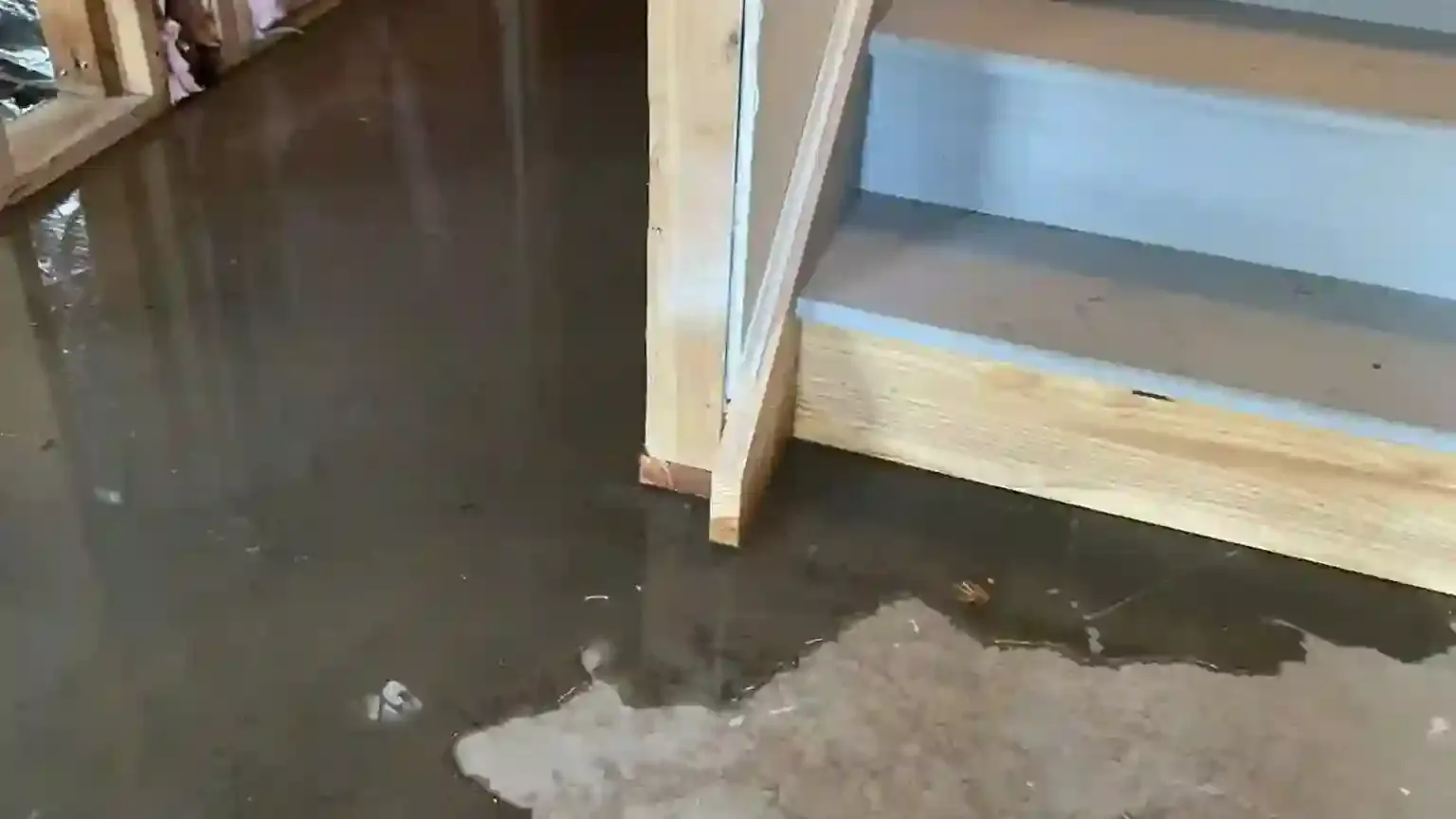
Why the push on drying? Because mold can begin growing on wet building materials within roughly 24 to 48 hours. That’s not a scare line, just a clock — and it’s one you win easily by getting the water and wet organics out early. The CDC’s guidance on mold cleanup after a flood covers the same ground.
Twenty years in, the lesson is simple: you don’t beat water by blocking it. You beat it by giving it an easier road that doesn’t go through your house.
Why is this happening on so many Suwanee streets at once?
Here’s the thing about this city’s homes specifically. Suwanee grew up in one fast wave in the late nineties and early two-thousands, so a whole town’s worth of original waterproofing went in inside about a ten-year window. All of it is hitting its first real failure at roughly the same time. Your neighbor’s timing isn’t a coincidence.
Add the terrain. The land here rolls toward Suwanee Creek and the Chattahoochee, which is why walkout basements are everywhere. A walkout gives you a door, a big window, and two more places water can try. Meanwhile grading that was fine in 2001 has settled and now tips gently back toward the house.
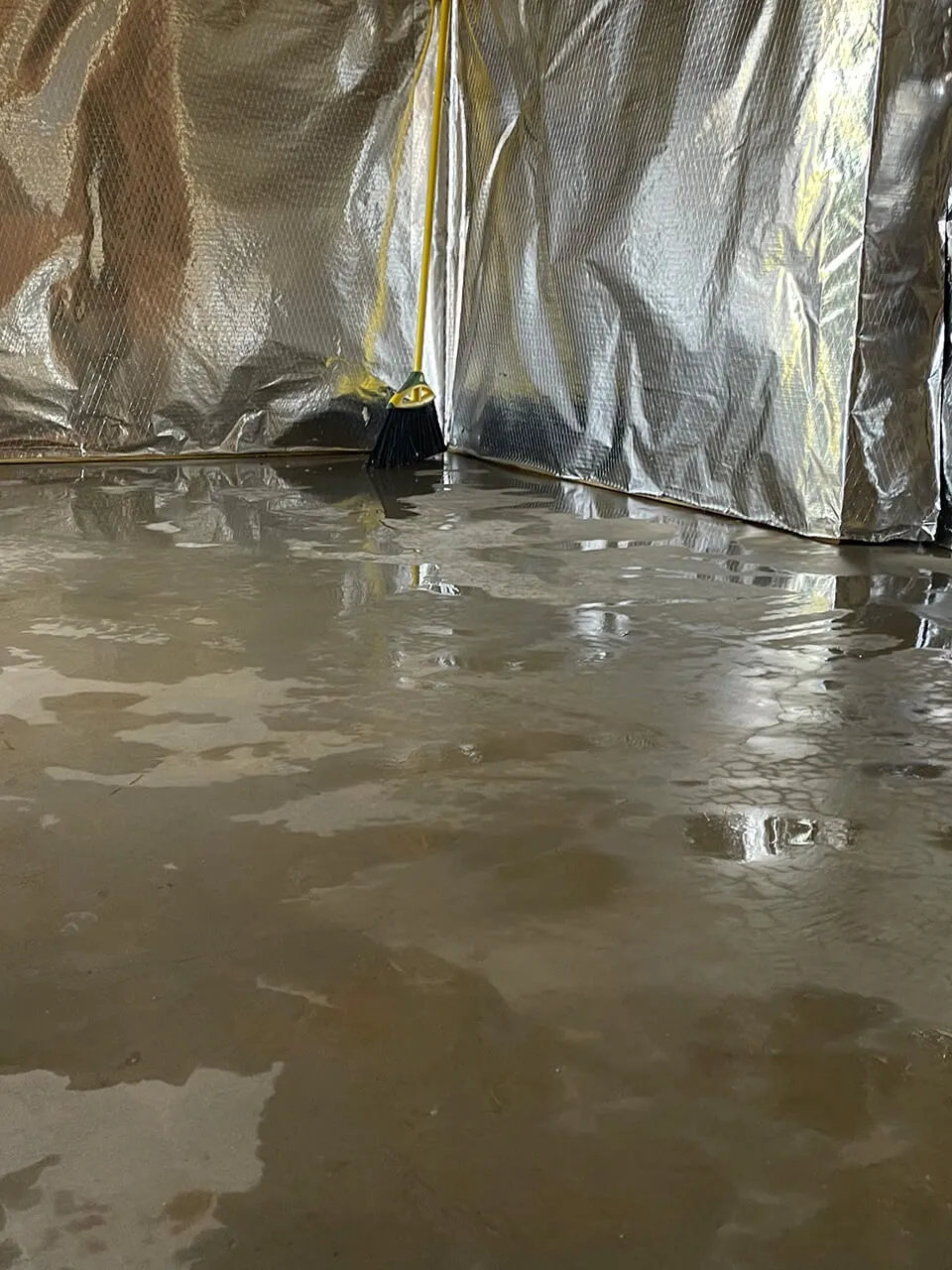
Then there’s the sump pump story we hear constantly. Original builder pump, no battery backup, and it dies during the exact storm that knocks the power out. That’s not bad luck — it’s one weather system doing both jobs. We’ve had that call from The River Club, Laurel Springs and Olde Atlanta Club in the same week.
Pumps fail in predictable ways, so they’re easy to plan around: no power, a stuck float, a pump too small for the job, a missing check valve, or a discharge line clogged with silt. Five failure points, all fixable in an afternoon and all checkable before storm season.
What does flooded basement repair cost around here?
Straight answer: it depends on how much wall is involved and how hard that wall is to reach. Anybody handing you a flat number without seeing the house is guessing. Still, here’s exactly what we weigh when we write your estimate.
What moves the number up or down
- Linear feet of drainage. One wall versus a full perimeter is the single biggest factor, by a wide margin.
- Access. An open basement is straightforward. A finished one with built-ins costs more, because there’s careful work before the real work.
- Sump and backup. Some homes have a serviceable basin. Plenty around here still have the original, and a battery backup adds cost while removing the most common failure.
- Water removal and drying. If we arrive to standing water, extraction and dehumidification are part of the ticket.
- What’s happening outside. Regrading, downspout extensions and window-well drains are the cheap end — and sometimes they’re most of the answer.
- Wall condition. Cracks or bowing mean structural work comes first. Drainage over a moving wall is money spent twice.
Drainage corrections and a pump swap land at the low end. A full perimeter system with battery backup, worked around a finished space, sits at the high end. Most flooded basement repair Suwanee projects land in between, and you get a written number with the scope spelled out before anyone starts.
What’s included, and what isn’t?
Included: labor, materials, the concrete we replace, hauling everything out, and the warranty in writing. Not included: rebuilding finished walls we opened, replacing ruined flooring, and structural repair, which is quoted separately. Better you hear that now than read it in fine print.
On insurance, we’ll be honest rather than optimistic. Standard homeowners policies commonly exclude surface flooding, and sump pump failure is usually a separate endorsement you either bought or didn’t. Call your agent and ask about both before you set the budget. For storm and flood guidance, the National Weather Service flood safety pages are a solid, no-sales-pitch read.

The warranty is worth reading twice. Ours is written down before work starts, it names what’s covered, and it’s backed by a company whose shop sits about fifteen minutes south of you. A warranty is only as good as whoever has to honor it in year seven.
What does life look like after it’s fixed?
Let’s walk the timeline, because the payoff isn’t the pipe. Week one, the noise stops and the floor is bare, clean concrete. The air smells like nothing at all, which is impossible to un-notice.
Year one is the season test. Spring storms roll through Gwinnett, the radar lights up, and you sleep. That’s when most folks really believe it. Somewhere in there the space turns back into a room — carpet, a TV, a place kids come in muddy from Sims Lake Park and don’t get yelled at.

Year ten? The stone and pipe under the slab are still doing what they did on day one, since there’s nothing down there to wear out. You’ll have replaced a pump by then, the way you replace a water heater. Plus you’ll be the one on the neighborhood page telling somebody near George Pierce Park what to check first — around here, that’s basically a civic duty.
And that’s the real feeling we’re after. Not relief. Pride. My house is solid, it’s dry, and I’m the one who took care of it.
Why hire a local crew for this?
Because we’ve been under these houses for more than twenty years, and we’re up and down Lawrenceville-Suwanee Road most weeks. We know how the late-nineties block walls behave, which lots off the creek carry seasonal water, and the difference between a house that needs a full system and one that needs a regrade and a real pump. We say the second one out loud even though it’s a smaller invoice.
Same crews, same trucks, same phone number in year six. That’s the whole pitch, and it’s the reason folks send us to their neighbors.
Still sorting out what you’re dealing with? Our guide to standing water basement problems covers what the water itself tells you, and every system we install is on our basement waterproofing page. Comparing notes with family down the road? We cover a Peachtree Corners flooded basement the same way. Seeing cracks or sticking doors too? Start with foundation repair.
Where we work around Suwanee
We’re based in Lawrenceville, so Suwanee is about fifteen minutes up the road. We work throughout Duluth, Buford, Sugar Hill, Johns Creek, Cumming, Lawrenceville, Berkeley Lake, Norcross and Dacula, plus the wider Gwinnett and south Forsyth area. If you’re anywhere near Town Center or the Greenway, odds are good we’ve got a truck close by.
Questions Suwanee homeowners ask us
For most homes, yes — as long as the fix matches the cause. Drainage with a right-sized pump and a backup handles the water that reaches your foundation, while grading and downspout work cuts how much shows up at all. We build for the worst storm we’ve actually seen here.
It ranges widely, and honestly it should. A pump replacement with drainage corrections outside is the low end, while a full perimeter system with battery backup in a finished basement is the high end. We measure, look outside, then hand you one written number with the scope listed line by line.
That’s your call, and here’s the honest math. Twice a year still means twice a year of drying, lost storage and a room you can’t finish, and each event restarts the moisture clock. Most homeowners fix it because they want the space back, not because anything dramatic is happening.
For a small puddle caught early, sure — get it up fast and keep air moving. For real standing water it usually isn’t enough, since a fan moves air but doesn’t pull moisture out, and soaked pad or drywall stays wet underneath. That’s where extraction plus a dehumidifier does the work.
Mold can begin growing on wet building materials within about 24 to 48 hours, which is why drying speed matters more than almost anything else. Get standing water out, pull the wet organics, then run dehumidification until the materials read dry. Move quickly and you usually skip the problem entirely.
Let’s get your Suwanee basement dry and give you the room back
The inspection is free, the estimate is free, and nobody pressures you at the end. We’ll show you where the water gets in, what it takes to stop it, and what it costs — even if the answer is simpler than you expected.
(678) 914-5112Serving Suwanee and all of Metro Atlanta · $500 off projects over $3,500 · Live support 7am–8pm, 7 days a week