

Crawlspace Repair Sugar Hill Homeowners Put Off: Do You Need the Full Job or the Partial One?
Both options, laid out fairly. Then a real recommendation for hillside lots — including the times we’d tell you to skip the big one.
Here’s the question people almost whisper: “Is a little water under the house normal?” Nobody wants to look silly asking it, so it sits in their head for a year. Most crawlspace repair Sugar Hill calls we take start with that exact sentence, usually after a spring storm.
So let’s answer it straight. A damp smell is common here, but standing water is not, and neither one is a mystery. Better yet, the fix comes in two honest sizes.
Option A: what does the full job include?
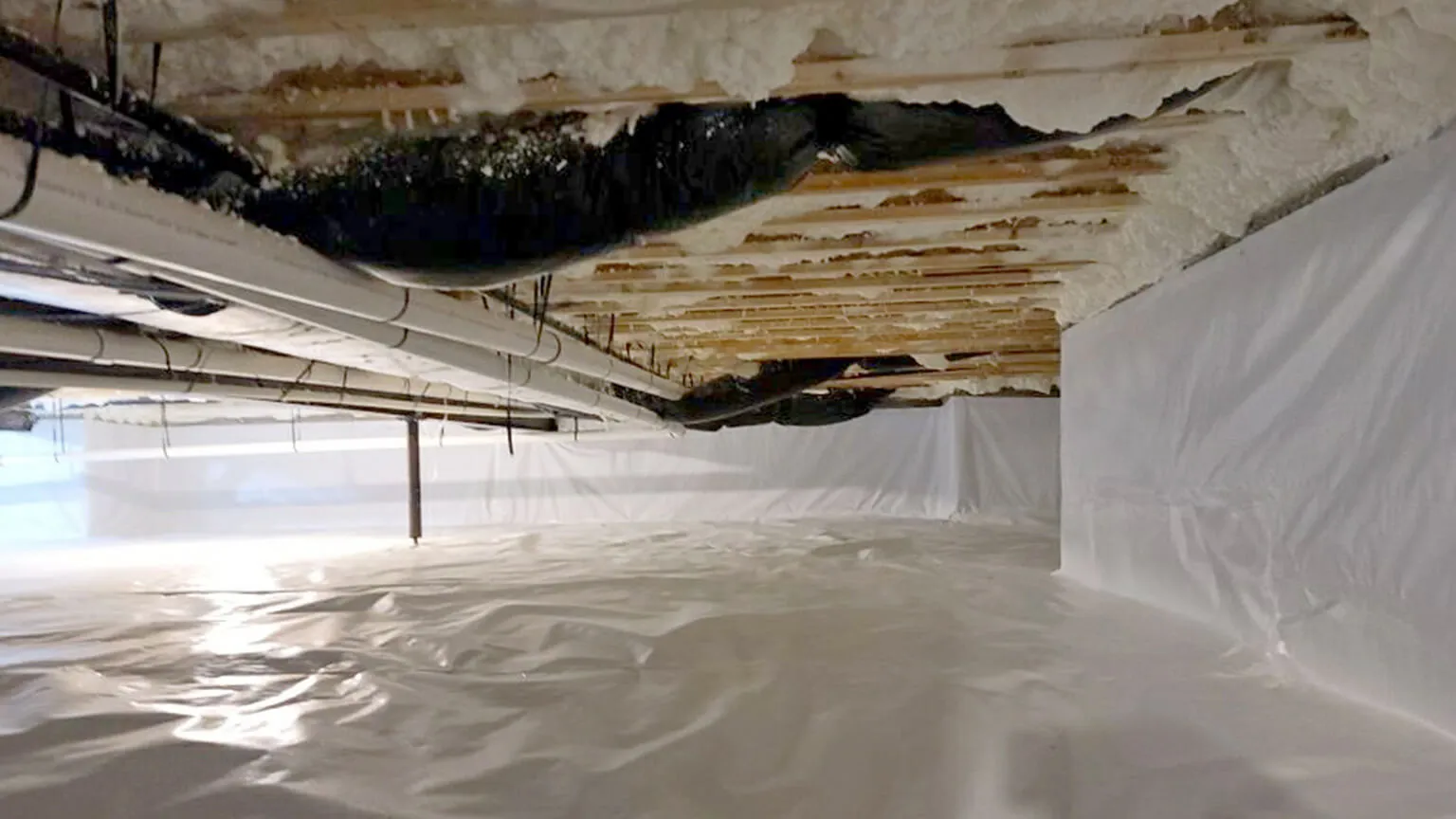
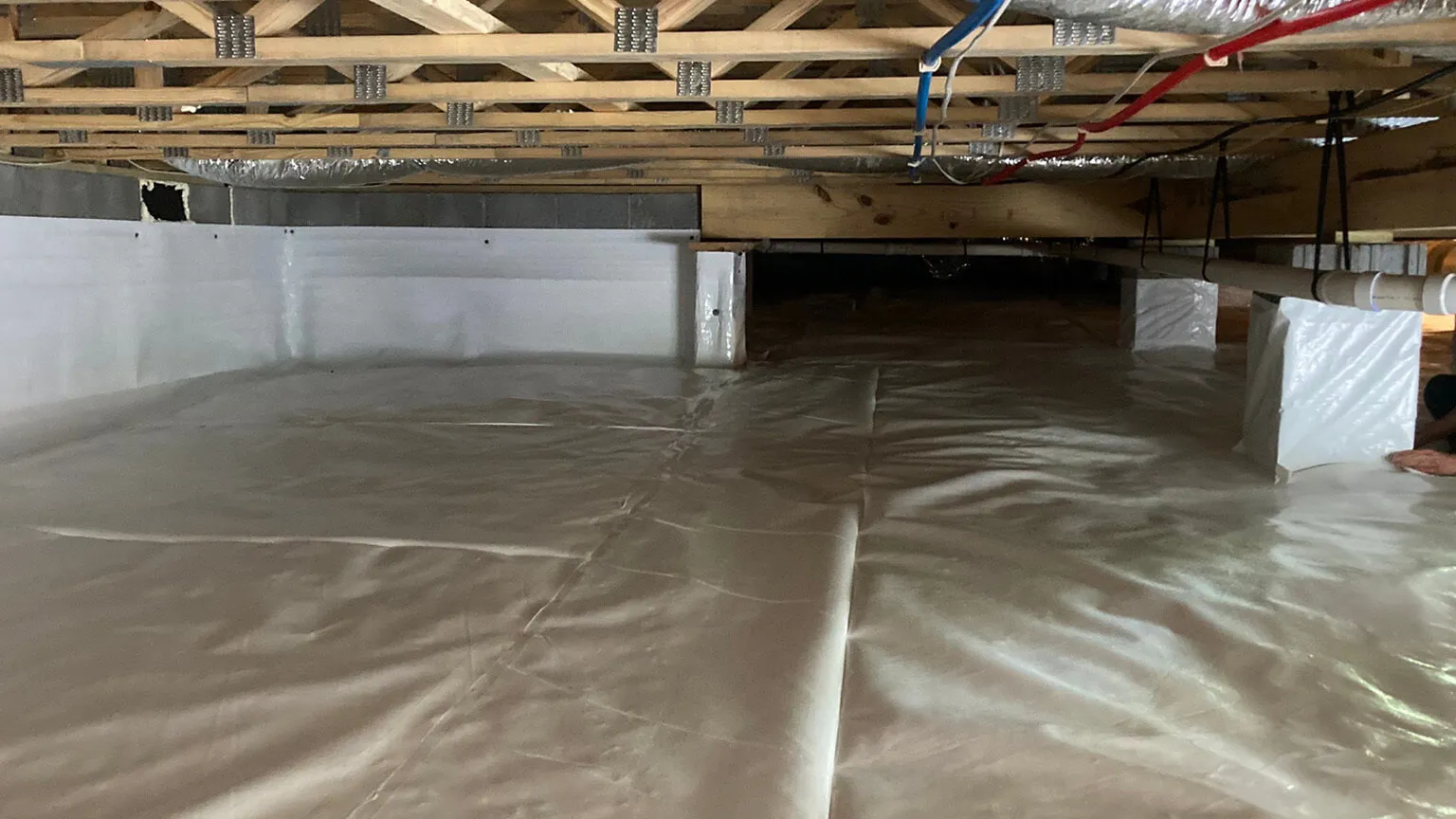
Full encapsulation moves your crawl space inside the house. A reinforced liner covers the dirt floor, then runs up the walls and gets sealed to them, and every pier gets wrapped and taped. That last part matters, because a true encapsulation is a sealed liner bonded to the walls and piers — not loose sheeting laid on the dirt and left to slide around.
After the liner, the vents get closed and a dehumidifier goes in to hold the humidity steady. It drains to the outside or to a pump, so nobody is crawling under the house to empty a bucket. Nobody signs up for that job, including us.
Why close the vents at all? Because in a Georgia July, warm wet outside air hits cool crawl space surfaces and drops its moisture right there. That’s condensation, which is why a vented crawl space can feel soggy during a dry week.
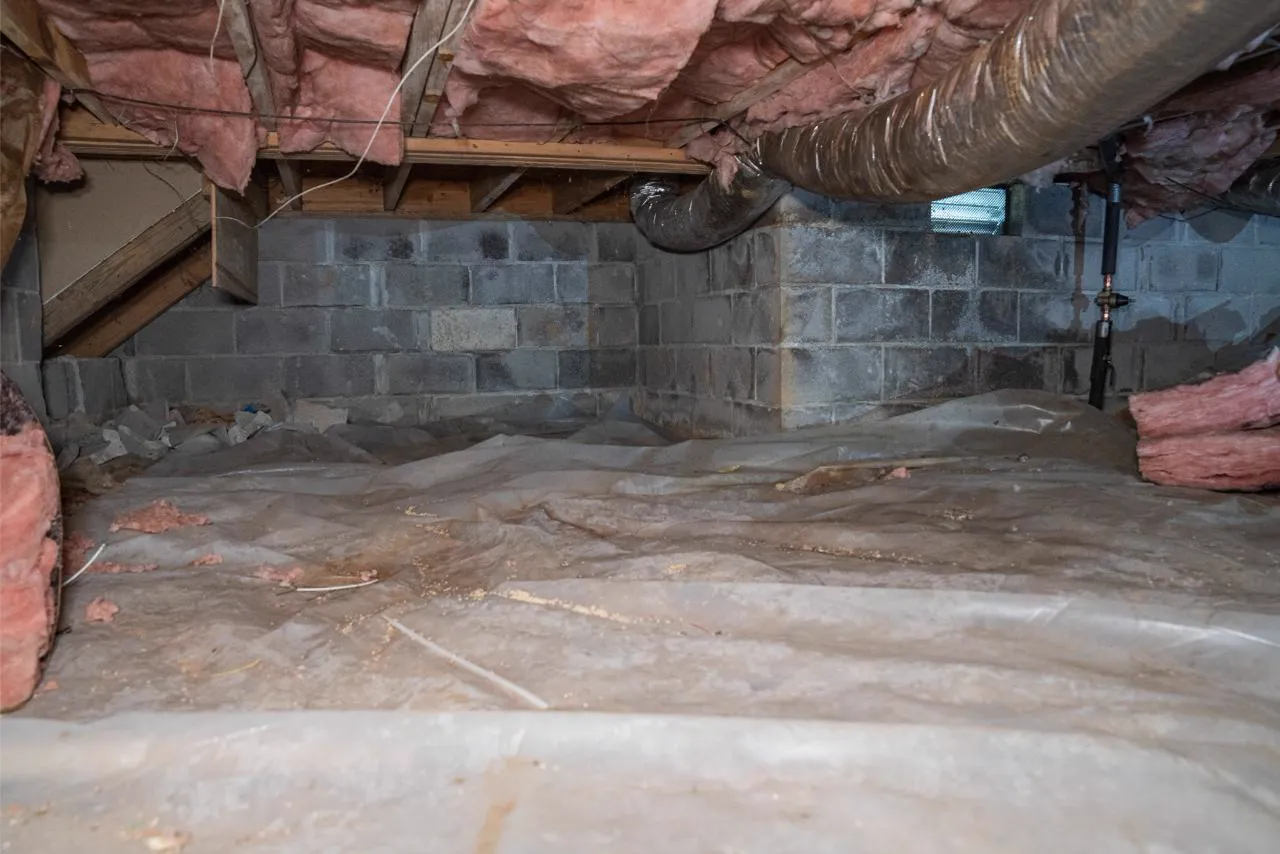
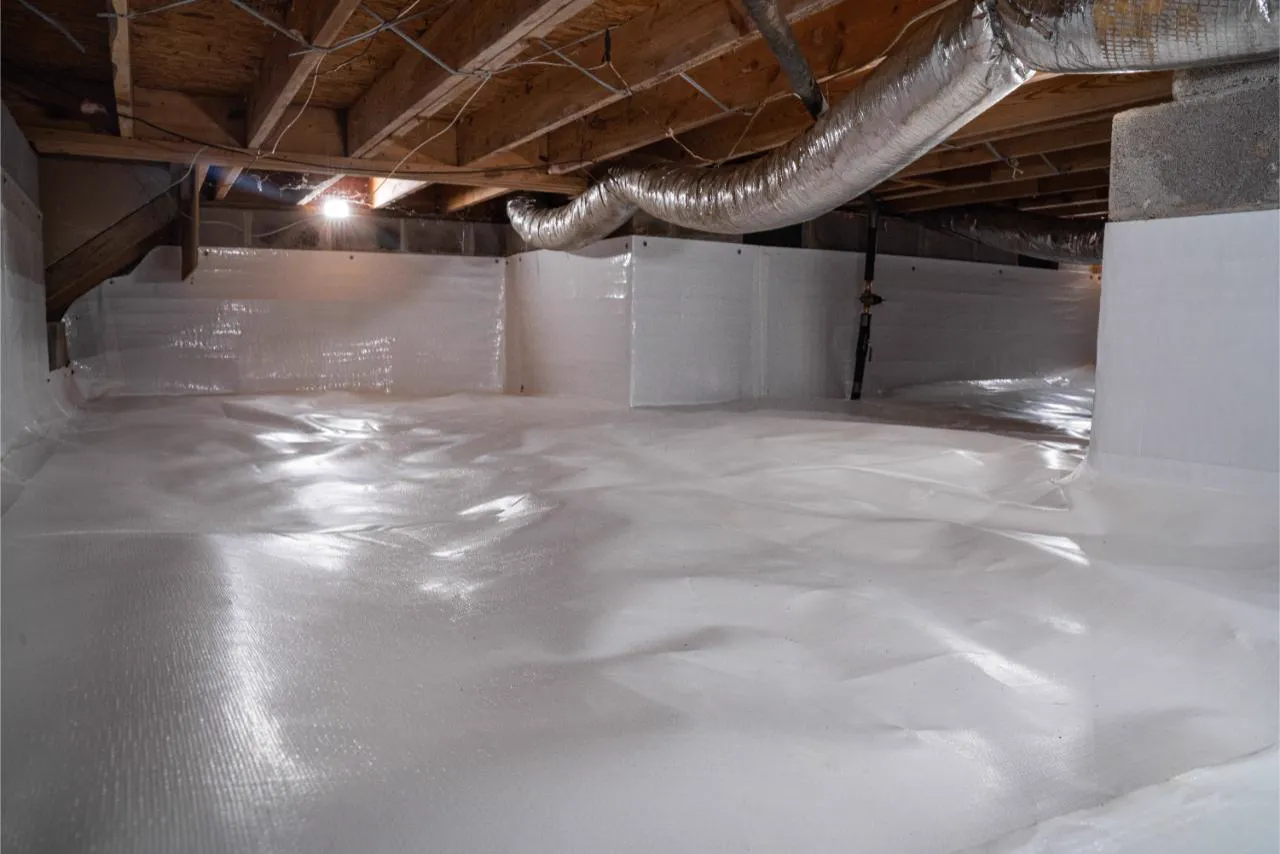
The finished result is a space you’d walk through in clean socks. A homeowner over in Sycamore Farms told us the hallway above hers stopped smelling within about a week.
Worth knowing
Encapsulation is a moisture system, not a drainage system. If water runs in during a storm, that source gets fixed first — otherwise you’ve bought a very nice pond liner.
Option B: is the partial fix ever enough?
Yes, honestly. Plenty of houses need the smaller version, and we’d rather say that than sell you something bigger than your problem. The partial route is a proper floor vapor barrier plus fixing whatever lets water in.
What does that look like in practice? A real barrier goes over the dirt, overlapped and sealed at the seams, not the thin builder plastic somebody tossed down in 1998. Then we chase the water: gutters, downspout ends, grading that leans toward the house, or a foundation vent sitting too low.
Drainage handles the rest. When groundwater pushes into the space, a perimeter drain and a sump move it away — our crawl space repair page walks through those parts one by one.

So why doesn’t every house stop there? Because a floor barrier blocks ground moisture, and it does nothing about humid air rolling in through open vents. On a shaded lot the meter never settles down, and that’s where the bigger option earns its keep.
Want the one question that proves somebody actually diagnosed it?
Ask whoever gives you a quote this: “Where is the water coming from, and how did you decide that?” It sounds simple. Still, it separates a real inspection from a guy who glanced under the house and named a price.
A good answer sounds specific. Uphill runoff from the neighbor’s yard. Groundwater riding along shallow rock and coming out the low wall. Humidity holding near 70 percent with no visible water at all, which is a completely different repair.
If nobody can tell you where the water starts, they’re not fixing water. They’re covering dirt.
Here’s the thing about our terrain. Sugar Hill is named for a hill, and it earns it — on ground like this, water doesn’t sit, it runs, and it runs toward whatever is downhill. That means the source is often nowhere near the wet spot, so the answer to that question matters more here than it would on flat land.
There’s a health side worth knowing too, and it’s calmer than the internet makes it sound. The EPA’s overview of mold and health explains what damp air actually does indoors, while the CDC’s page on mold in the home covers the practical cleanup side. Both land on the same point: control the moisture and the problem loses its fuel.
Side by side, honestly
Enough theory. Here’s how the two paths compare with a light and a humidity meter in hand.
The full job
- Reinforced liner on the floor, up the walls, sealed to the piers
- Vents closed, so humid summer air stays outside
- Dehumidifier holds steady numbers all year
- Works on shaded, low, or hard-to-drain lots
- Costs more up front, and the dehumidifier draws power
- Leaves a space clean enough to store things in
The partial fix
- Sealed floor barrier over the dirt, walls left open
- Water source corrected: gutters, grading, downspouts
- Often done in a day, sometimes two
- Costs noticeably less, with no equipment running
- Won’t control humid air coming through open vents
- Plenty for high, sunny, well-draining lots
Notice that neither column says “better.” Once we’ve read your lot and your numbers, one of them is usually obvious.
Cost follows the same logic. A barrier-only job sits at the low end, a full sealed system with drainage sits at the high end, and headroom, square footage and access move the number in between. Anybody quoting a flat price by phone is guessing.
What decides it on a Sugar Hill lot?
Four things, mostly. They show up on nearly every inspection we run between Nelson Brogdon Boulevard and the water.
The deciding factors
- Where does your lot sit on the slope? Downhill lots collect groundwater plus everybody’s runoff, which pushes toward the full job.
- Is it water, or is it air? Standing water is a drainage problem. A steady 70-percent reading with dry dirt is an air problem.
- Do ducts or an air handler live down there? If yes, sealed and conditioned is the smarter call.
- How old is the original system? Homes from the 1990s and early 2000s are hitting the age where the builder’s plastic and pump quietly retire.
That last one explains a lot of phone calls. Much of this city went up in the same stretch of years, so whole streets reach the same birthday together. Neighbors in the Sugar Mill area compare notes at the E Center and realize they’re all having the identical spring.
Grade decides the rest. A lot that steps down toward the Suwanee Creek Greenway takes water from every yard above it, while newer homes in The Bowl district often sit on reworked ground. Crawlspace repair Sugar Hill crews see the tell all the time: if the space stays wet for days after a storm instead of during it, that’s uphill groundwater — the same pattern behind a flooded basement two doors down.
So which one do we recommend?
On most sloped lots here, we recommend the full job — but only after the water source is handled. Downhill grade, red clay, shallow rock, ductwork underneath, and 20-year-old systems all point the same way. Of the crawlspace repair Sugar Hill homes we inspect, that combination is the common one.
We recommend the partial fix when the house sits high, the yard drains away on all four sides, and humidity behaves through a muggy stretch. A sealed barrier plus gutter and grading work does the job there, and we’ll say so even though the invoice is smaller.
Sometimes we recommend neither, at least not yet. If one downspout is dumping against the foundation, we’ll extend it, hand you the humidity readings, and ask you to call after the next real storm. An afternoon of gutter work has rescued more crawl spaces than anyone admits.
Curious how the same call goes elsewhere? Our Lilburn crawl space repair write-up covers flatter ground with a different mix of problems, and our encapsulation company guide lists what to ask before you sign anything.
Once it’s fixed, what do you do every year?
Short list, because a sealed crawl space is close to maintenance-free. That’s the whole point.
Your once-a-year checklist
- Late fall: clean the gutters after the leaves finish dropping. On a steep lot, clogged gutters undo good drainage fast.
- Same trip: walk the downspouts and make sure every extension still points away from the house. They get moved by mowers.
- Spring: glance at the humidity readout. Anything in the 45 to 55 range means the system is doing its job.
- Spring: rinse or swap the dehumidifier filter. It’s about as demanding as a coffee maker.
- After a big storm: pop the access door, look for puddles, and check the sump discharge line at the far end. Two minutes.
And that’s the feeling we’re actually after. The next big spring storm rolls through, rain hammers the hill, and you keep watching your show — because what’s under the floor is already handled, and it stays handled.
Why homeowners here hire us
Because you get a written scope, proof of insurance, a warranty document, and photos of what we found before anything gets ordered. We’ve been at this over 20 years, and hillside houses are most of our week, so we read grade before we price liner. Same crews, same trucks, every visit.
Where we work around Sugar Hill
We’re based in Lawrenceville, about twenty minutes south, so we’re up this way constantly: Sugar Hill, Buford, Suwanee, Cumming, Gainesville, Flowery Branch, Duluth, Dacula, Braselton, Lawrenceville and the wider Gwinnett area. Odds are we’ve been under a house near yours.
Questions Sugar Hill homeowners ask
In Georgia, closed usually wins — but only as part of a sealed system with a dehumidifier. Open vents let warm, wet summer air hit cool surfaces, and that adds moisture instead of removing it. If your space is still vented and uncontrolled, closing the vents alone can make things worse, so do it as part of the full job.
Almost always, and usually within a week or two. Air moves upward through a house, so a lot of what you breathe on the main floor started under the floor. Dry that space out and the smell loses its source.
Most crawl spaces take two to three days once we start. Add a day or two if drainage work or debris removal comes first, and add a little more for tight access. We give you the real number in the written scope, not a hopeful one.
Often a little, though we won’t promise a number. Dry air is easier to heat and cool than damp air, so the HVAC stops working so hard in summer. The dehumidifier uses some power too, which is why we treat savings as a bonus and comfort as the real win.
If it’s wet, sagging, or falling out of the joists, it comes out — it stopped insulating a long time ago. Dry, intact batts can sometimes stay. In a sealed space, insulation often moves from the subfloor to the walls, since the crawl space is now inside the house.
Let’s see what’s really under your Sugar Hill home
The inspection is free, the estimate is free, and nobody pressures you after. We’ll take photos, show you the humidity numbers, and say honestly if the partial fix is the right call.
(678) 914-5112Serving Sugar Hill and all of Metro Atlanta · $500 off projects over $3,500 · Live support 7am–8pm, 7 days a week