

Basement Flooding Cost Dacula Homeowners Can Plan Around
Two separate jobs, one honest breakdown — the cleanup, the permanent fix, and what moves each number.
Late February through May, our phone does something predictable. The ground out here is already full from winter, then a warm storm parks over Gwinnett overnight, and by morning there’s water across a slab that stayed dry for eight months. So if you’re pricing out basement flooding cost Dacula homeowners actually face, let’s start with the calendar, because the timing explains most of it.
Good news up front: this is fixable, it’s routine work, and it’s usually smaller than the number in your head.
Why spring, and almost never August?
Soil holds a certain amount of water, then it stops accepting deliveries. By late winter the red clay around your foundation is already full, so a spring storm has nowhere to put its rain. The water table lifts, pressure builds under the slab, and water hunts for an opening. That force has a name — hydrostatic pressure — and it moves through solid concrete without needing a crack.
In August, the same storm soaks into dry ground and vanishes. Your basement isn’t broken in spring and healed in summer; the dirt outside just changed its mind.

One inch of water across a 1,000-square-foot basement is more than 600 gallons. That’s why the shop vac feels like emptying a lake with a coffee mug — because it is.
Are you paying for one job or two?
Two, and untangling them makes every estimate easier to read.
Job one is response. Extract the water, pull out anything soaked, then run air movers and a commercial dehumidifier until the concrete and framing test dry. It’s priced by volume and by how much wet material leaves the house.
Job two is prevention. Interior drainage, a proper sump, discharge routed well away, plus whatever grading the yard needs. Buy only job one, and you’ve bought a very expensive rerun.
Worth knowing
We price the two separately, so you can see what each buys. Our rundown of basement drying options goes deeper on response.
What actually happens, in order?
Nobody enjoys surprises when a jackhammer is involved, so here’s the sequence.
- Free inspection. We walk the lot first — slope, downspouts, where runoff collects — then the basement.
- Extraction and demo. Water comes out, then wet carpet, pad, insulation and any drywall that wicked, since wet organic material can’t dry in place.
- Structural drying. Air movers and dehumidifiers, usually three to five days, with daily moisture readings.
- Cleaning. Surfaces get cleaned and treated once dry, because treating a wet surface does little.
- Opening the channel. A narrow strip of slab comes up along the affected perimeter. Loudest day, shortest day.
- Drainage and sump. Perforated pipe in washed stone below floor level, wall liner above it, routed to a basin and pumped well away.
- Close and test. Fresh concrete, haul-off, then we run the system with you standing there.
Where is it getting in?
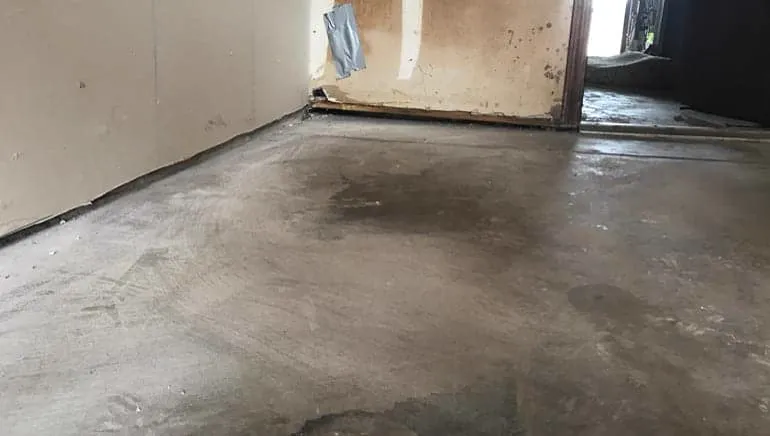
Usually the cove joint, where the wall meets the floor. It exists in nearly every basement because the footing and slab were poured at different times, so under pressure it’s the path of least resistance. When water shows up in a line along the base of the wall instead of dripping from above, that’s your answer.
We stopped trying to beat water at the wall years ago. Now we meet it lower, under the slab, where it arrives with almost no pressure left.
That’s why drainage carries a warranty while a bucket of sealer carries a receipt. For a neutral read on how rising water behaves, the National Weather Service flood safety pages help.
What’s different about Dacula homes?
Out toward Dacula the lots get bigger, and so does the amount of water that has to go somewhere when a storm rolls through. On a quarter-acre lot in town, runoff has a curb waiting for it. Out here it often has nothing but your foundation wall.
Three patterns repeat. Lots in the Apalachee and Mulberry basins see seasonal high water, so homes toward the Apalachee River get a water table that rises to meet them. Much of this housing stock went up between 1998 and 2015, which means first-generation waterproofing is aging out on roughly the same schedule — in Rabbit Hill, along the Harbins corridor, and in the newer Dacula Road construction alike. Many properties also have septic drain fields keeping nearby soil damp.
Then there’s the clay itself. Construction equipment compacted it hard on former farmland, and compacted clay sheds water instead of drinking it, so runoff runs sideways until it finds your backfill. Yards near Hamilton Mill Golf Club prove that every March.
What moves the price?
Straight talk: nobody can price this over the phone. Still, you deserve the levers before we ever walk your basement.
The seven things that set the number
- How much water. A damp corner and four inches across the floor are different projects.
- How long it sat. A few hours is cleanup. Three days is cleanup plus replacement.
- Wet organic material. Carpet, pad, drywall and insulation hold water and have to come out. That volume drives response cost most.
- Linear feet. One wall versus a full perimeter is the biggest factor on the prevention side.
- Finished or unfinished. Built-ins and a basement bathroom mean careful work first.
- Sump and discharge. Some homes have a serviceable basin; plenty of early-2000s pumps don’t.
- What’s happening outside. Sometimes regrading and moving two downspouts handles most of it.
Exterior corrections land at the low end, while a full perimeter system with a new sump, backup power and a finished-basement rebuild sits at the top. Either way, you get one written number with the scope spelled out. Our breakdown of Sugar Hill flooding cost uses the same math on different terrain.

Why do sump pumps quit at the worst moment?
Because they fail in five predictable ways, and four are cheap to prevent. Power drops during the storm — which is exactly the storm that fills basements. A float sticks against the basin wall. The pump is undersized. There’s no check valve, so water drains back and the pump cycles itself to death. Or the discharge is clogged, or dumping three feet from the foundation, which is just a slow loop.
So the fix list is short: a right-sized pump, a check valve, a clear discharge run well away, a battery backup, and a bucket test twice a year.
How long does it take, and what should you do first?
Response work runs about three to five days of drying, plus a day on either end. Interior drainage takes one to three days on site, and fresh concrete wants a few days before you load it up. If both jobs happen, expect a week to ten days.
Speed matters for a real reason: mold can begin on wet organic material in roughly 24 to 48 hours. That’s not cause for alarm — it’s simply why we push to get air movers running fast. Your prep list stays short, though: clear four feet along the affected walls, keep an exterior door reachable, and photograph everything first.
On insurance, we’ll be straight with you. Standard homeowners policies commonly exclude surface flooding, and sump coverage is usually a separate endorsement you have to add on purpose. So read your declarations page or call your agent before assuming either way. FEMA’s building science resources explain the distinction well.
What can you honestly do yourself?
Real DIY wins: extending downspouts six to ten feet out, cleaning gutters twice a year, regrading soil away from the house, clearing window wells, and bucket-testing the sump. On big lots, a swale that gives runoff a defined path does serious work for little money.
What DIY can’t reach: anything below the slab. You can’t set drain tile without opening concrete, and no coating sold in a bucket beats saturated clay. Rental dehumidifiers can’t dry a flooded basement to a measurable standard either. That’s not a skill gap — the water simply isn’t where those products go.
What does a wet basement have to do with the rest of the house?
Here’s the part almost nobody connects. Air drifts upward in a house, and warm air escaping near the roof pulls replacement air in from the lowest point — your basement. So a share of what you breathe upstairs started its trip down by that damp corner.
The evidence shows up in odd rooms. Main-floor closets smell musty. Hardwood over the basement cups along the seams. The upstairs AC runs longer because it’s fighting humidity from below.
Better yet, the fix is the one we already described. Handle water at the source, and humidity drops through the whole house on its own. And if flooding shifted soil enough to open cracks, our page on foundation repair covers what to look for.

How do you know it was done right?
Ask for five things: a written scope naming linear feet and the discharge location, daily moisture readings during drying, photos of the stone and pipe before concrete goes back, a warranty you can read, and a live test while you’re standing there.
After that, proof arrives on its own schedule. The floor stays dry through a hard March storm, the musty smell disappears, and the pump runs ninety seconds and shuts off. Eventually you check the radar out of curiosity instead of dread — which is really what the basement flooding cost Dacula homeowners pay is buying.

We’ve done this for over twenty years, about twelve minutes west of you. Our full range of basement waterproofing systems is laid out on the service page, warranty included.
Where we work around Dacula
Our shop sits in Lawrenceville, a short run west on GA-316, so we’re out this way constantly. Along with Dacula we cover Grayson, Buford, Auburn, Winder, Braselton, Suwanee, Snellville, Loganville and the wider Gwinnett County area. Near Little Mulberry Park, odds are we have a truck close by.
Questions we get from Dacula homeowners
Cut power to the area at the breaker before you step in, then photograph everything for your records. After that, get water moving out and air moving in. Call someone with extraction equipment early, because the first day is when the cheapest version of this job is possible.
Because the soil around your foundation is already full, so rain has nowhere to go but down against your walls. That pressure pushes water through the cove joint and porous concrete. In dry months the same storm soaks in and you never notice.
Sometimes, and it depends on the source and your policy. Standard homeowners coverage commonly excludes surface flooding, and sump pump failure is usually a separate endorsement you have to add. Check your declarations page or call your agent before assuming either way.
Quickly. Mold can begin on wet organic material like carpet pad, drywall and insulation in roughly 24 to 48 hours. Getting air movers and a real dehumidifier running the same day often keeps materials salvageable, which keeps the bill smaller.
That’s the water table rising under your slab and pushing upward, which happens often on lots near the Apalachee basin. It usually appears at the cove joint or through small slab cracks. Interior drainage below the floor relieves that pressure, so water goes to a sump instead.
Let’s find out what your basement actually needs
The inspection is free, the estimate is free, and nobody pressures you at the end. We’ll show you where water is getting in, what it takes to keep it out, and what that costs in Dacula.
(678) 914-5112Serving Dacula and all of Metro Atlanta · $500 off projects over $3,500 · Live support 7am–8pm, 7 days a week