

Basement Drying Options Cumming Homeowners Have After a Flood — and How to Choose
Rent a dehumidifier, or call a crew? Here’s how each one works, what decides it, and when we’d tell you to save your money.
Pin a year of our Cumming calls to a map and a pattern jumps out fast. Most of the basement drying options Cumming conversations we have start in three pockets: the older streets around Castleberry, the steep lots up in the Sawnee Mountain area, and the big full basements across the Lambert district neighborhoods.
What do those three share? Grade and age. Two sit on real slope, so every storm sends uphill water straight at one wall. The third went up in a hurry between the late 1990s and the 2010s, which means a lot of original waterproofing is hitting the same birthday at once.
Here’s the honest version: plenty of Cumming homeowners are shocked to find water in a house that still feels new. Twenty years, though, is exactly when builder-grade waterproofing starts to give up. It’s not bad luck, and it’s very fixable.
Why does this happen in a house that feels new?
Red clay is the short answer. It soaks up rain and swells, then dries and shrinks back. Meanwhile the backfill packed around a newer foundation is looser than the ground it replaced, so it settles and quietly tips the grade back toward the house.
Add a builder-grade sump pump at the end of its run, and one heavy spring storm is all it takes. That’s also why we see settlement cracks in homes only five to twenty years old.

Before anything else
Never step into standing water while the power is on. Kill the basement circuits at the panel first, from dry ground. If the panel is down there or you can’t reach it safely, call your utility and wait.
What’s the easier first step most people miss?
Most folks jump straight to “who do I hire.” But there’s a free step before that: figure out what kind of water you’re looking at, and how long it’s been sitting.
Clean rainwater that came in last night is one situation. Water that sat four days while you were out of town is another. And a sewer backup is a third thing entirely — not a DIY project at any volume, because the problem isn’t the water, it’s what’s in it.
Take photos before you move anything, and note the time it started. Insurance will ask, and so will we.
Option A: can you dry it yourself?
Sometimes, yes — and we’d rather tell you that than sell you something. The DIY kit is a shop vac, a few box fans, and a rental dehumidifier from the hardware store off Post Road. You pull the water out, get air moving across the wet surfaces, and let the dehumidifier work on the room air.
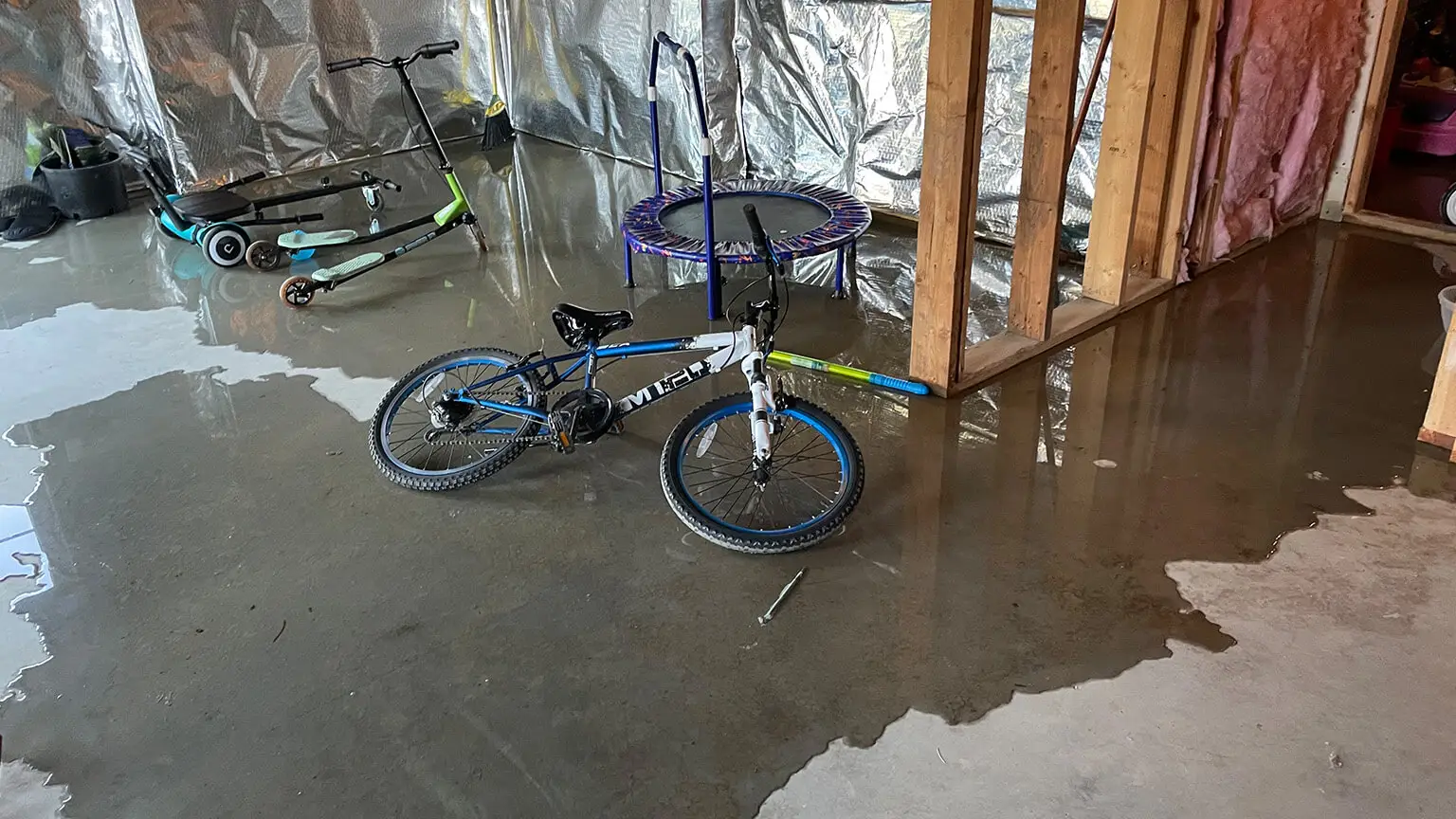
When it wins: a small amount of clean water, caught within a few hours, on bare concrete with nothing organic in the way. An inch of rainwater in an unfinished storage basement is the textbook case.
What it costs: a few days of dehumidifier rental plus a shop vac. That’s the whole appeal, and it’s a real one.
The trade-off: box fans move air but not with much aim, and a home dehumidifier pulls a fraction of what a commercial unit does. So you’re working slower, which matters more than people realize.
Option B: what does professional drying actually involve?
Structural drying is a different animal, and the name gives it away. We’re not drying a room — we’re drying the building, including the parts you can’t see.
It starts with real extraction, not a five-gallon vacuum. Then comes removal of the wet organic material: carpet pad, the bottom edge of drywall, and any insulation trapped inside a finished wall. After that, air movers get aimed at specific wet surfaces at specific angles, commercial dehumidifiers pull water from the air by the gallon, and we take moisture readings until the numbers match dry parts of the house.
When it wins: finished basements, water that sat overnight, anything that came up through a floor drain, and any time the walls are closed up. Cumming has a lot of finished lower levels, so this is the common one here.
What it costs: more, and it swings widely. Square footage, rooms involved, how much has to come out, and days of equipment all move the number. One unfinished room sits at the low end; a finished basement with wet walls sits far above it.
The trade-off: it’s loud, and part of your basement gets opened up before it gets put back. Nobody enjoys that week. Plenty of people are glad they did it.
How do the two compare, straight across?
DIY drying
- Cheap, and you can start tonight
- Great for small, clean, fresh water
- Works best on bare concrete
- No documentation for insurance
- Can’t reach inside a finished wall
- Slower, which is the real cost
Professional structural drying
- Removes the water fast, then the wet material
- Dries wall cavities, not just surfaces
- Moisture readings prove when it’s done
- Handles sewer water safely
- Higher cost, several days on site
- Written record your insurer will accept
Notice neither column says “better.” They’re built for different amounts of water, and picking wrong in either direction costs you something.
What actually decides it?
Four questions, and you can answer them all yourself in about ten minutes.
The four that matter
- How much water? A damp patch and two inches across the slab are different jobs.
- How long did it sit? Hours is a very different answer than days.
- Is wet organic material trapped? Carpet pad, drywall bottoms and wall insulation are the three that hold water out of sight.
- Where did it come from? Clean rain, or a sewer backup? Sewer water means professional handling, full stop.
That third one is where good intentions go sideways. Drying the surface while the cavity stays wet is the classic mistake — the floor feels dry, the room smells fine, and six weeks later there’s a musty smell nobody can find. The fix is simple: open the wall, pull the wet material, dry the space behind it.
Speed beats horsepower. Mold can start on wet building material in roughly 24 to 48 hours, so a modest setup running tonight will beat a great setup that arrives Thursday.
That’s a scheduling note, not a scare line. The CDC’s guidance on cleaning up mold after a flood lays out the same timeline, which is why our first question on the phone is always “when did it start,” not “how big is it.”
So what would we tell you to do?
You want a recommendation, not a shrug, so here it is. If the water is clean, under an inch or so, less than a day old, and the floor is bare concrete with nothing soft on it — dry it yourself. Rent the dehumidifier, run it three or four days, and check the wall base with your hand each morning. That’s a genuinely fine answer, and we say it often.
Call a crew when any one of these is true: the basement is finished, the water sat overnight, it came up through a drain, or it covered more than a room’s worth of floor. One yes is enough. In those cases the money isn’t buying bigger fans — it’s buying the removal and the moisture readings that prove the wall cavity is dry.
And here’s the part people don’t expect us to write down. We’ve walked basements near Fowler Park where the whole problem was a downspout dumping three feet from the foundation. That’s an afternoon with a shovel. We hand over the plan and go home, because selling somebody a package they don’t need is a great way to never get called again.
What does the timeline look like after it’s handled?
Here’s where most articles stop, so let’s keep going.
- Week one. Water out, wet material out, equipment running. By days three to five the readings flatten and match the dry parts of the house, and the equipment goes home.
- Weeks two to six. Rebuild — drywall, trim, flooring. This is also the window to fix the cause, whether that’s regrading, drainage or a new pump. Doing both at once saves a second round of dust.
- Year one. You get a full storm season. Spring rain rolls through, you check out of habit, and nothing has changed. That’s the moment homeowners tell us they stopped worrying.
- Years two through five. Ten minutes twice a year. Pour a bucket in the sump basin and watch it kick on, clear the discharge line, keep the gutters clean.
- Year ten. Pumps have a service life, so plan on one replacement in that stretch. The drainage keeps working, and the basement is just part of the house again.
Planning ahead helps too. The FEMA building science library on protecting property from flooding is worth a read before the next spring storm season.
Why does hiring local matter here?
Because water behaves differently on a Sawnee Mountain slope than on a flat lot near Central Park, and knowing that ahead of time saves a day. We’re thirty minutes south in Lawrenceville, same crews on every job, so if something needs a look in year six you’re calling the people who did the work.
Want to read further? Our page on basement waterproofing covers the systems we install, and our local guide to the best basement drainage setups explains how water gets routed out. If cracks are part of your picture, start with foundation repair. Neighbors down the road can read the same breakdown in our Decatur basement drying options guide.
Where we work around Cumming
We’re based in Lawrenceville, roughly thirty minutes south, so we’re up GA-400 constantly. We also cover Alpharetta, Milton, Suwanee, Buford, Gainesville and Dawsonville, plus Johns Creek, Duluth and the wider Forsyth County area.
Questions Cumming homeowners ask us
Drying and repairing are two separate numbers. Drying depends on square footage, how much wet material comes out, and how many days the equipment runs. The permanent fix depends on how much wall is involved and whether you need a sump pump. You get a written scope either way, never a phone guess.
Twice a year is still a pattern, and patterns usually have a simple cause like grading, gutters or a tired pump. The good news is that occasional water often points to a smaller correction rather than a full system.
For a small amount of clean water on bare concrete, caught the same day, yes. It stops being enough when the basement is finished, when the water sat overnight, or when anything soft got wet. Fans dry surfaces, but they can’t reach the inside of a wall.
Roughly 24 to 48 hours on wet organic material like carpet pad, drywall or insulation. That’s why drying speed matters more than equipment size. Getting air moving the same day makes a bigger difference than waiting for a larger setup.
Turn off power to the basement at the panel before you step into any standing water. Then take photos for insurance, note when it started, and start moving anything soft up and out. After that you can decide between drying it yourself and calling for help.
Let’s figure out what your Cumming basement actually needs
The inspection is free, the estimate is free, and there’s no pressure at the end. We’ll show you where the water came in and tell you plainly if the smaller fix is the right one.
(678) 914-5112Serving Cumming and all of Metro Atlanta · $500 off projects over $3,500 · Live support 7am–8pm, 7 days a week