

Foundation Settling Suwanee: How to Read a Crack Before You Spend a Dollar
Which cracks mean movement, which ones don’t, and how to tell the difference on your own before anybody quotes you anything.
Here’s the belief we bump into most: a crack in a foundation wall means the house is failing. Real talk, that one usually isn’t true. Most cracks we get called out to look at are cosmetic, and the foundation settling Suwanee homeowners worry about almost always traces back to something ordinary — the dirt under the footing getting wet, drying out, and doing it again next season.
So your house isn’t the villain, and you’re not behind for missing it sooner. Georgia clay moves, and houses sitting on it move a little too. Once you can read what your walls and doors are saying, this stops being a scary unknown and turns into a decision — and a decision is something you can make well.
Why does the ground here move at all?
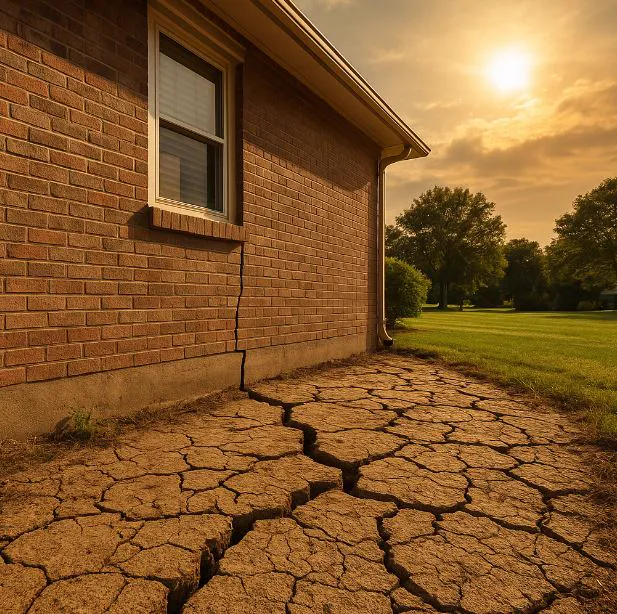
Short answer: red clay. Piedmont clay is expansive, which is a polite way of saying it puffs up like a sponge when it soaks in water, then shrinks back down when it dries. Sand doesn’t really do that. Clay does it every single year.
That swelling happens under your footing too, not just in the flower beds. A soaked March lifts the soil a hair. A baked August lets it drop. Repeat that cycle for twenty-five years and one corner of a house can end up sitting slightly lower than the rest. Nothing snapped. The ground simply kept breathing, and the house went along for the ride. If you want the soil science straight from the source, the University of Georgia Extension keeps readable material on how our soils behave.
Suwanee adds a wrinkle, because of how fast the city got built. Suwanee grew up in one big wave in the late nineties and early two-thousands, so whole streets hit the same twenty-to-thirty-year mark at once. Original grading has flattened out. Gutters and downspouts have aged. As a result, the soil around a lot of these footings isn’t behaving the way it did on move-in day.
What is the crack pattern telling you?
More than most people expect. Cracks aren’t random, and the shape of one narrows things down fast. Here’s the short field guide we use on every walk-through.
Thin vertical cracks in a poured wall. These are usually curing shrinkage. Concrete gives up water in its first year or two and tightens up as it does, which leaves hairline vertical lines. Very common, rarely meaningful, often just worth sealing.
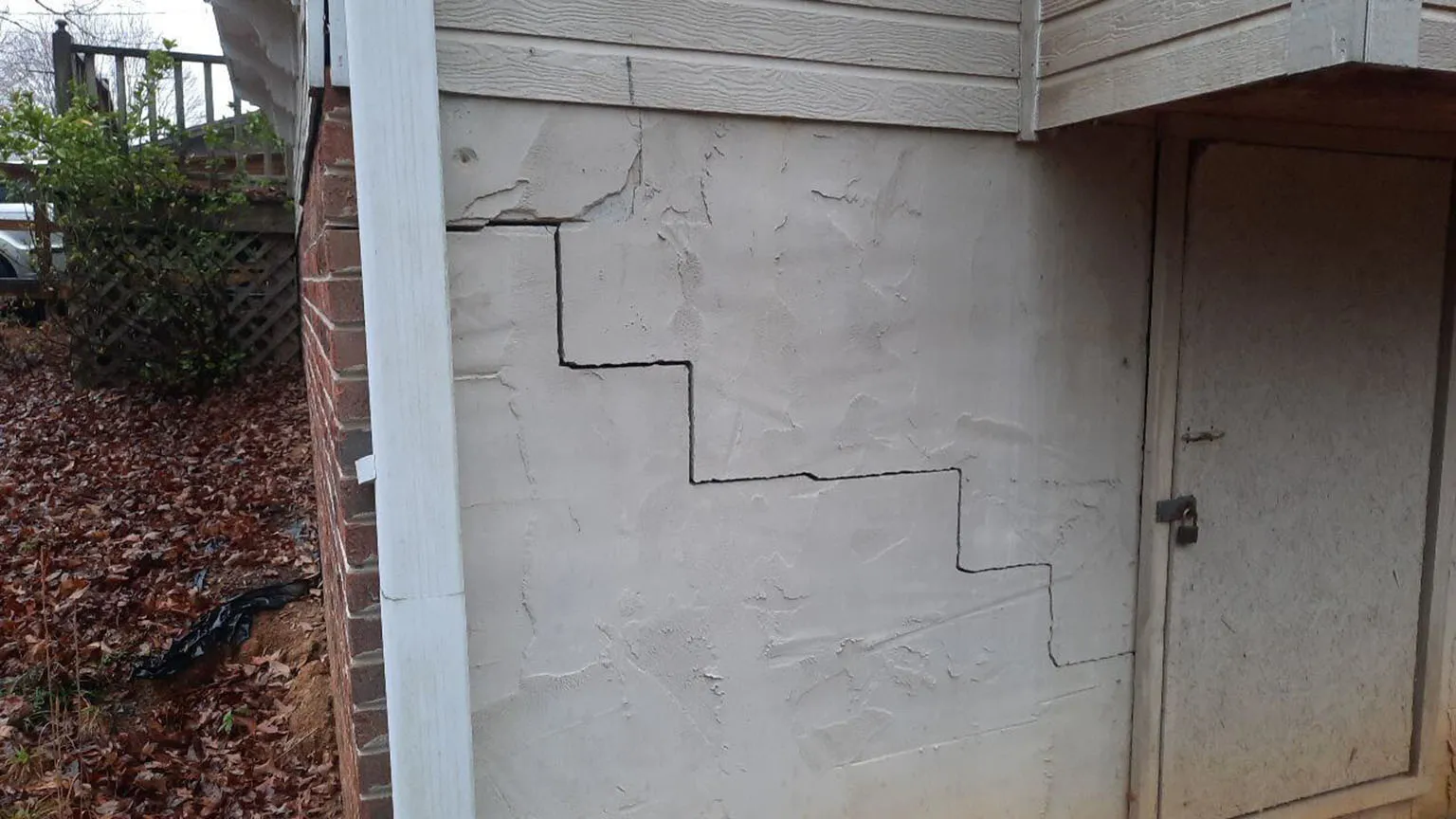
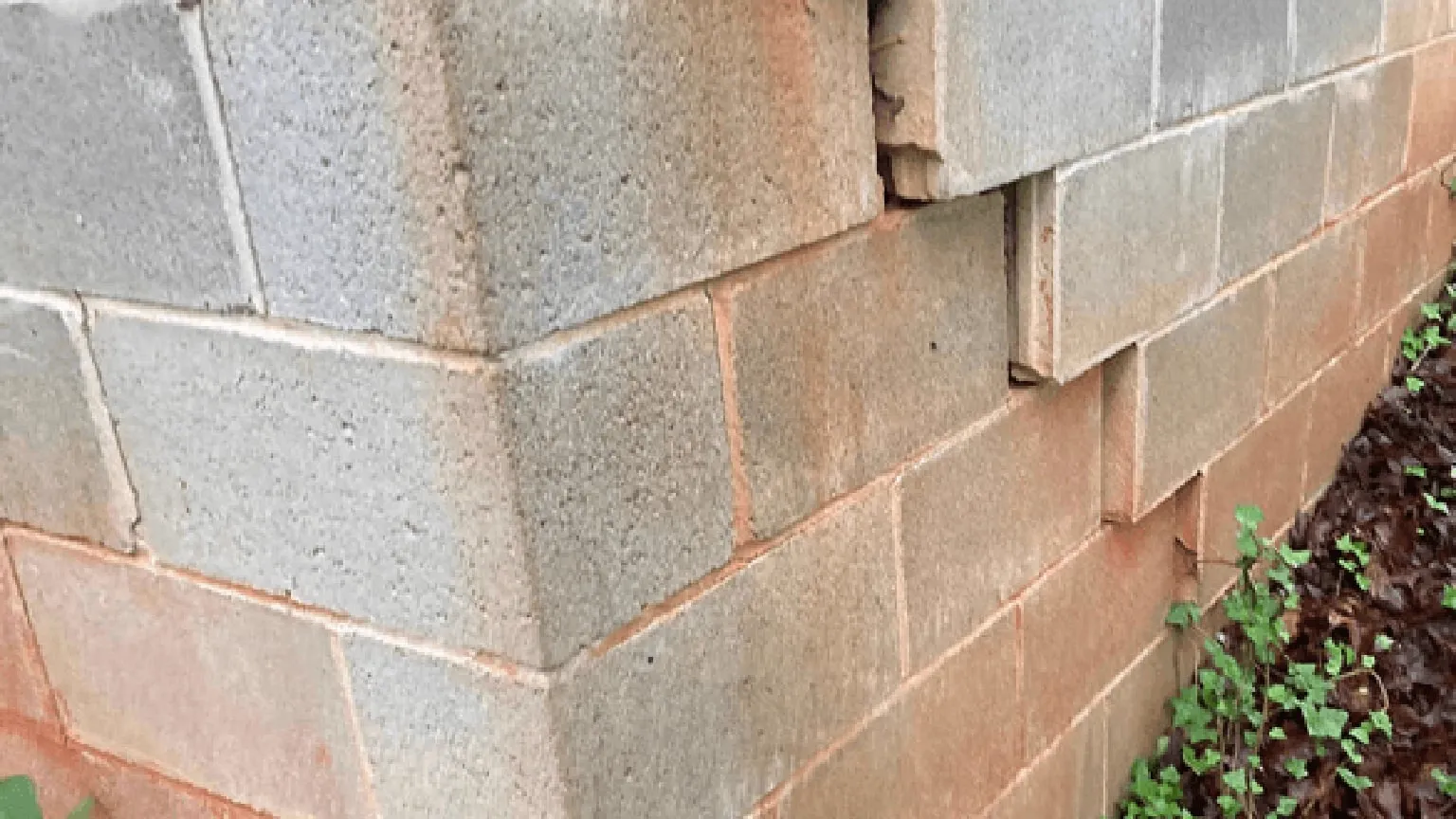
Stair-step cracks along the mortar joints. When a crack climbs a block wall or brick veneer by following the joints like a staircase, that points toward differential settlement — one part of the footing moved more than another part did. This is the pattern that actually earns a closer look.
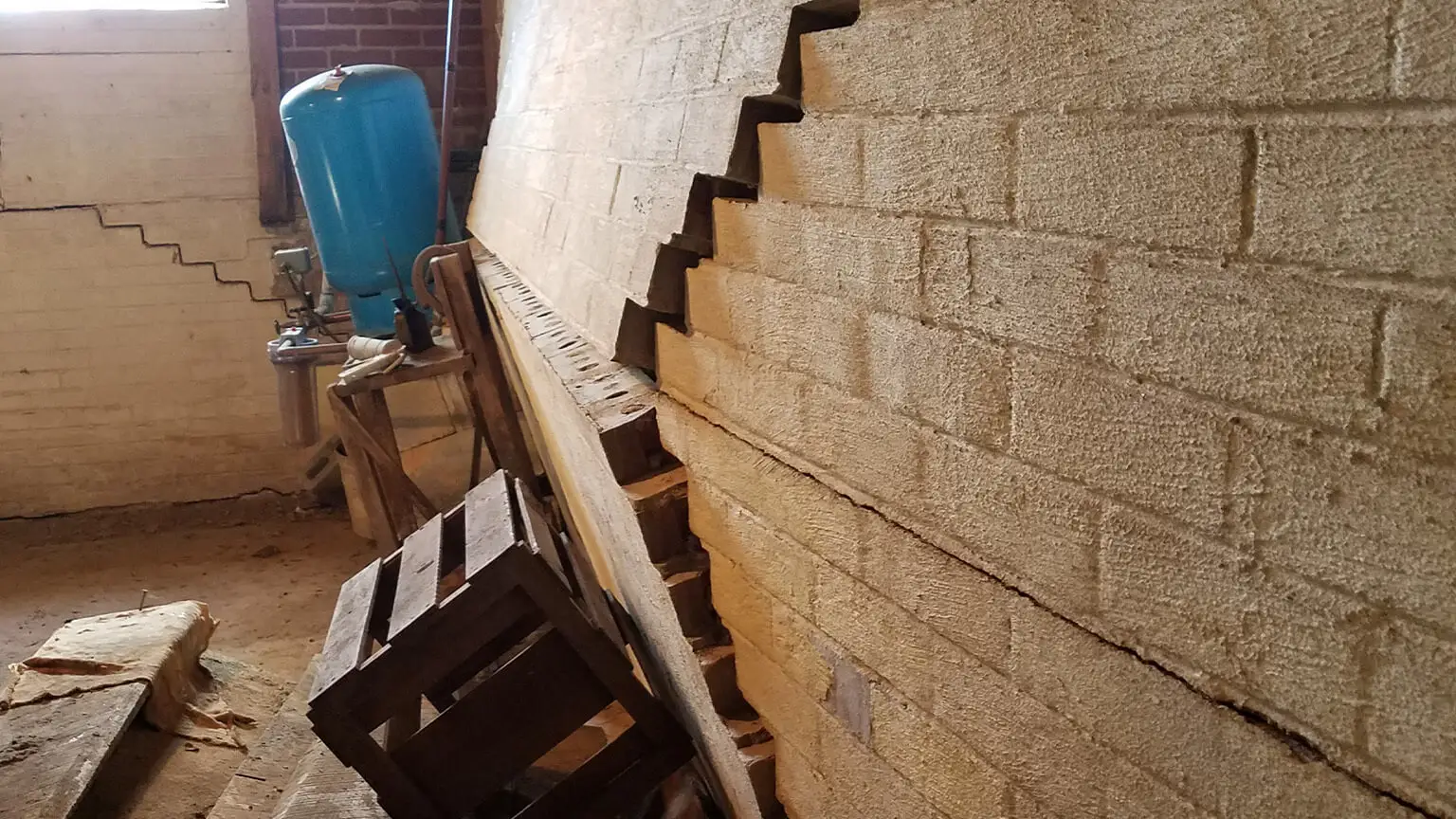
A horizontal crack across a block wall. This one isn’t settlement at all. A long side-to-side crack means soil is pushing in from outside, which is a different problem with a different fix. Worth knowing, because the two get mixed up constantly.
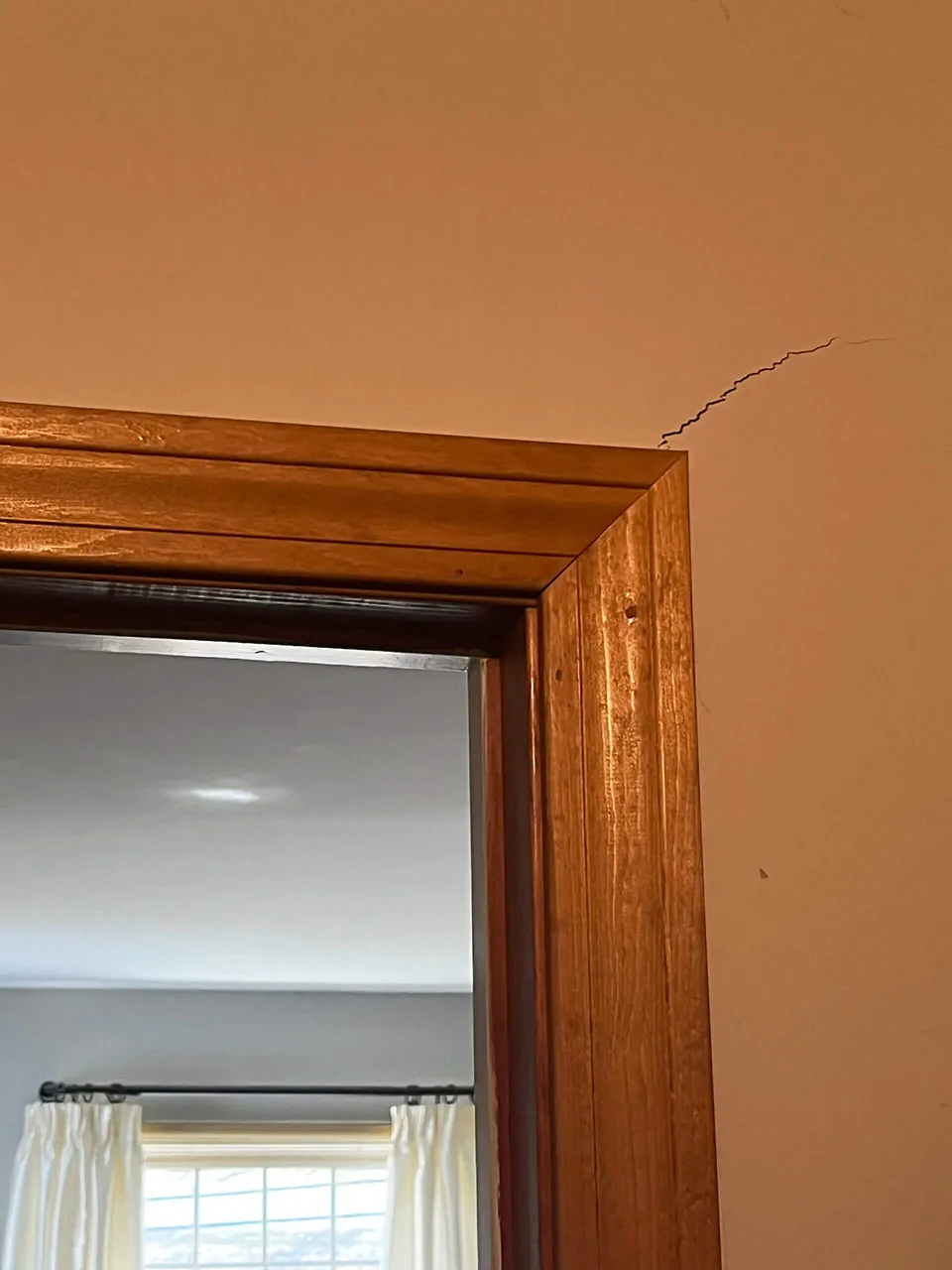
Diagonal cracks from window and door corners. Corners are where stress concentrates, so openings show movement before flat walls do. A short diagonal line running up from a door frame is the drywall version of the same story.
Good news
Nearly every house around here has some cosmetic cracking, and modest movement in the first years after construction is normal. Plenty of the homes we inspect need sealing and a drainage tweak — not piers. We’ll tell you plainly which group you’re in.
Walls aren’t the only place this shows up either. Doors that stick in one season and swing fine in another, a widening gap at the top corner of a door frame, a floor that feels tilted when you set a ball down, brick veneer pulling away at a corner, nail pops marching across the ceiling — those all belong in the same conversation.
What changed our thinking after twenty years of this?
Honestly, quite a bit. Early on, we looked at a settlement crack and thought about steel first — where the piers go, how many, how deep. Piers are still the right call sometimes. But we kept noticing something on repeat visits.
The houses that stayed quiet after a repair weren’t the ones with the most steel. They were the ones where the water around the foundation got sorted out. Because if soil moisture keeps swinging from soaked to bone dry, the clay keeps cycling, and the cycling is what caused the movement in the first place.
So now we start outside. Downspouts dumping right at the wall. Grading that has settled backward over twenty-five years. A walkout basement door or a window well collecting water instead of shedding it, which is one of the most common things we find on Suwanee homes. Fix those, and the soil under the footing finally holds steady instead of doing jumping jacks.
That shift is also better for your wallet. We had a homeowner over near Morningview braced for a full pier job, and the honest answer was three downspout extensions, a regrade along one side, and sealing a dormant crack. Not every visit ends that way, of course. Still, you should know that the drainage question gets asked first here, not last.
How do you tell a dormant crack from a moving one?
You watch it, and the good news is you can do this yourself for free. Mark each end of the crack with a pencil line and write today’s date beside it. Measure the width at the widest point, then check it again once a month for three to six months. A crack that hasn’t budged across a wet season and a dry one is dormant, and a dormant crack usually needs sealing rather than structural work.
Movement shows up as a pattern, not a single bad day. Here’s what tells us it’s worth acting on:
- The crack gets measurably wider over several months, not just longer-looking.
- Doors and windows get worse season to season instead of going back to normal.
- A floor slopes enough to measure with a level, not just enough to argue about.
- Separation you could slip a coin into, especially at a brick corner.
- New cracks appearing in a line, which suggests one section is dropping together.
What if you leave it alone? Calmly stated: active movement doesn’t stop on its own while the moisture cycle keeps running, so it tends to creep along slowly and quietly. Meanwhile, the growing expense is usually the finish work — drywall, trim, tile, doors — rather than the foundation itself. That’s exactly why catching it early is the money-smart move.
What does the repair actually involve?
Less drama than most people picture. There are really four tools, and the right plan often uses two of them together.
- Helical piers. These get screwed down into the ground until they reach soil dense enough to carry the load, and then the foundation’s weight is transferred onto them. Depth is decided by resistance, not by a number somebody picked in advance — so one pier may stop shallower than the pier ten feet away.
- Push piers. Also called resistance piers, these use the weight of the house itself to drive steel down to firm bearing. They shine on heavier structures like full masonry.
- Slab piers. Smaller supports for an interior floor slab that has dropped away from the walls around it.
- Drainage corrections. Grading, downspout extensions, and water management, so the clay around the footing stops swinging wet to dry.
One distinction matters more than any brand name. Stabilizing means the movement stops where it is. Lifting means trying to bring the house back toward level. Lifting is sometimes possible and sometimes not, and pushing too hard for it can open new cracks upstairs. We’ll say which one your home is a candidate for before you sign anything.
Steel in the ground is the easy part. Deciding how much you actually need — that’s the part worth paying us for.
Curious what it runs? It depends on pier count, depth to firm soil, and how hard the work area is to reach, so we walk it before we price it. Our breakdown of foundation repair cost covers every factor that moves the number, the methods are laid out on our foundation repair page, and if your issue turns out to be a single crack, foundation crack repair is a much smaller conversation.
What’s the number that reframes all of this?
Here it is. Expansive clay commonly changes volume by roughly 3 to 5 percent between soaked and fully dried, and around here that active zone runs through about the top six to eight feet of soil. Do that math and a footing corner can rise and fall by more than an inch over a single year.
More importantly, that number explains why two houses on the same street behave so differently. Soil isn’t uniform lot to lot, and you can see the map yourself through the USDA Web Soil Survey. Your neighbor’s quiet foundation isn’t luck, and yours isn’t a lemon — you just got different dirt.
Picture the other side of this. Doors latch again with one hand. You stop checking that crack every time you carry laundry down. When you sell, you hand over a written scope and a warranty instead of a shrug, and the inspector’s question gets answered before it’s asked. Better yet, you’ll know you spent on the actual cause instead of the scariest quote in the stack.
Why does hiring local matter for this?
Because these are the houses we’ve been under for twenty-plus years. We know how the walkout lots around Settles Bridge behave after a wet week, and we know the poured walls in the newer Ivy Falls-era homes crack differently than older block does. Our shop sits about fifteen minutes south in Lawrenceville, straight down I-85, so the crew that does your work is the crew that picks up the phone in year seven.
We’re also in this community, not just driving through it. Half our Suwanee visits happen between school pickup at North Gwinnett High School and somebody’s kid demanding a stop at PlayTown Suwanee. That said, being local means nothing without the basics: written scope, proof of insurance, a real warranty, and a clean job site. If a relative one town over is seeing the same thing, we handle Peachtree Corners foundation settling too.
Where we work around Suwanee
Suwanee is a quick run north for us, so we’re up this way most weeks. We also cover Duluth, Buford, Sugar Hill, Johns Creek, Lawrenceville, Cumming, Norcross, Dacula and Peachtree Corners, plus the wider Gwinnett area. If you’re near Town Center or anywhere along the Greenway, odds are we already have a truck close by.
Questions Suwanee homeowners ask us
Yes, and you get the terms in writing before work starts. Pier systems typically carry a long-term transferable warranty, which matters at resale because it moves to the next owner. Ask any company to explain what’s covered in one plain sentence. If they can’t, that tells you something.
Less than you’d think. Pier work means digging small holes at each pier location along the affected side, not trenching the whole property. We protect the lawn, backfill and tamp the soil, and put sod or mulch back. Grass usually knits back together within a season.
Usually not an emergency, though it is a real structural item worth getting eyes on soon. Bowing comes from soil pressure pushing sideways, which is a different cause than settlement below the footing. Options range from carbon fiber straps to steel beams to wall anchors, depending on how far it has moved. We measure it, document it, and give you the range.
Track it before you spend. Mark and date the ends of each crack, measure the width monthly, and note whether doors get worse through a full wet and dry season. Movement that keeps growing across several months is worth repairing. Movement that holds still is usually a sealing job.
It ranges widely, because the price is driven by how many piers you need, how deep they have to go before hitting firm soil, and how easily equipment can reach the work. A few piers at one corner sits at the low end. A full side of the house with limited access sits much higher. We measure first, then quote in writing.
Let’s find out what that crack in Suwanee is really doing
The inspection is free, the estimate is free, and nobody pressures you at the end. We’ll read the crack pattern, check the drainage, and put the plan in writing — including the times the honest answer is “this one just needs sealing.”
(678) 914-5112Serving Suwanee and all of Metro Atlanta · $500 off projects over $3,500 · Live support 7am–8pm, 7 days a week