

Encapsulation Cost in Roswell: A Step-by-Step Breakdown
The steps in order, what moves the number up or down, and how to tell a real system from plastic on the dirt.
Good news first, since nobody ever leads with it: a damp crawl space is one of the most fixable things in a house. It’s routine work, it’s done in a few days, and once it’s handled it stays handled. So if you’re pricing out encapsulation cost Roswell numbers this week, you’re not looking at an emergency. You’re looking at a project with a clear beginning and a clear end.
Better yet, you can understand every line of the estimate before you sign. Let’s walk the job from the first crawl to the last photo.
Why do Roswell crawl spaces work so hard?
Because of the hills. Roswell is built on them, and water always wins on a hill unless somebody gives it somewhere better to go. That’s the whole job, honestly. Runoff comes down a slope, hits the back of a house, and looks for a way in.
Then there’s what’s under the grass. Red clay sits on granite here, and that shallow rock pushes water sideways instead of down, so it runs along the bedrock until it meets your foundation. Water isn’t picky, just persistent.
Add the housing mix and it gets clearer. The 1970s and 1980s subdivision belt was cut into hillsides with drainage that was fine for 1982, while the old streets near Canton Street sit on stone foundations with dirt-floor cellars. Different eras, same result once water shows up.
One more local wrinkle: retaining walls. Plenty of lots off Woodstock Road have one holding a slope back, and when the wall leans or its drain clogs, it stops holding soil and starts pointing water at the house. We see that a lot around Willow Springs. It looks like a landscaping issue right up until it isn’t.
Worth knowing
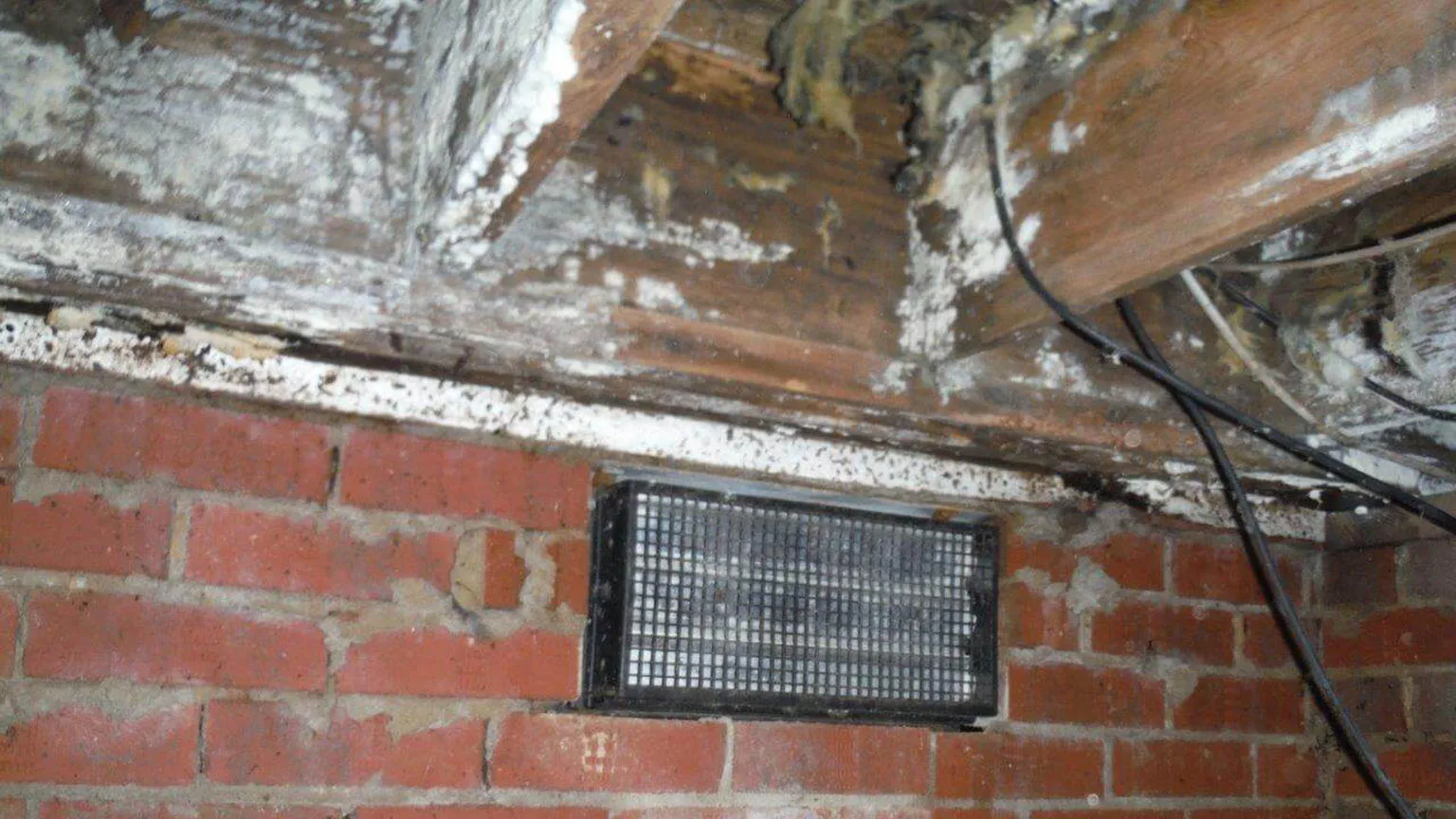
Wood starts supporting mold growth at around 20% moisture content. In a vented Georgia crawl space in July, framing gets there regularly — not because anything is broken, but because warm wet air keeps pouring in.
What does the job actually look like?
Every house is different, but the order barely changes. Here’s the honest version.
- Inspect and measure. We crawl the whole space, measure it, check the framing and read moisture levels. Then you get photos, since most homeowners have never seen down there.
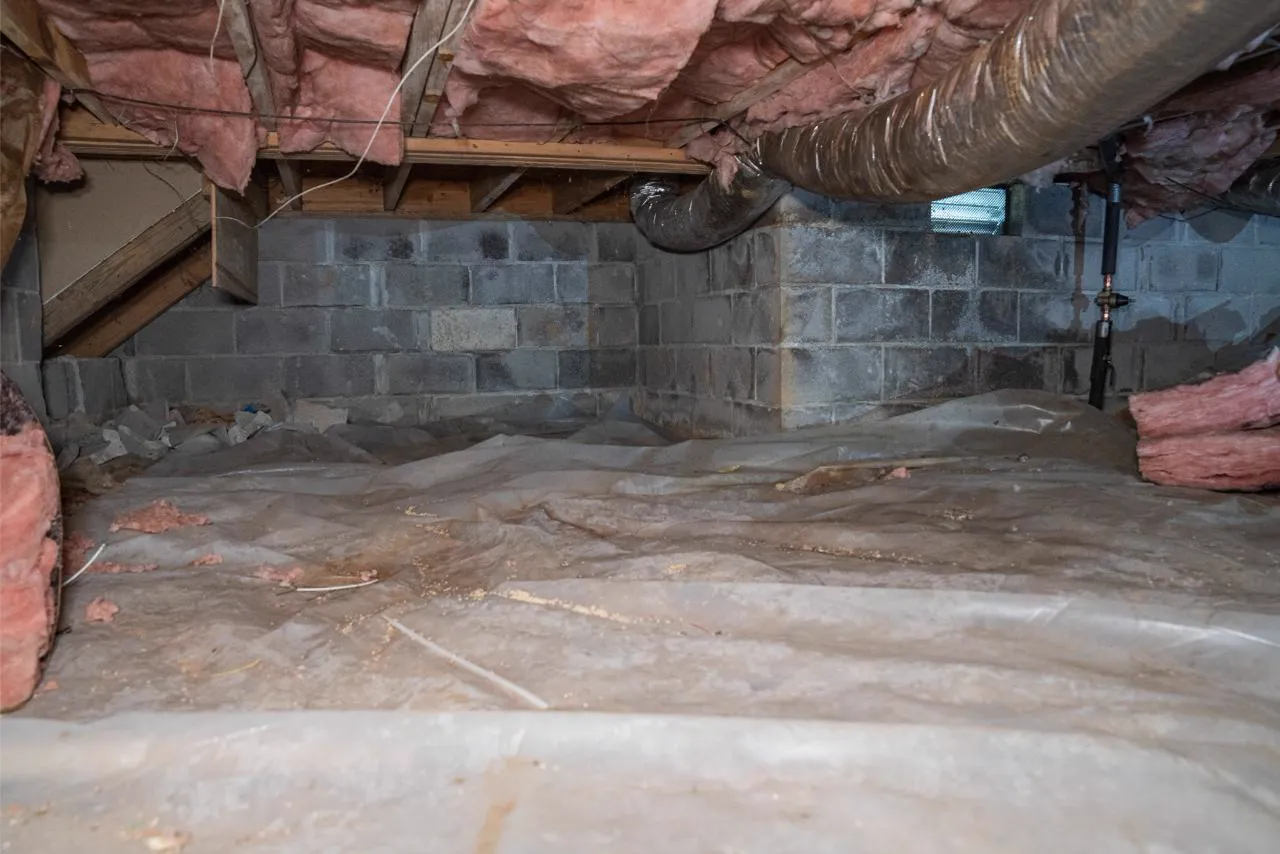
- Clear it out. Fallen insulation, torn sheeting and construction scraps come out first. Nothing gets sealed in.
- Handle the water. If water is entering, that’s solved before anything else — a drain line, a sump pump, or grading and downspout work outside.
- Treat the wood. Surface growth on joists and subfloor gets cleaned while everything is still easy to reach.
- Seal the vents. The openings get closed so outside air stops feeding the problem all summer.
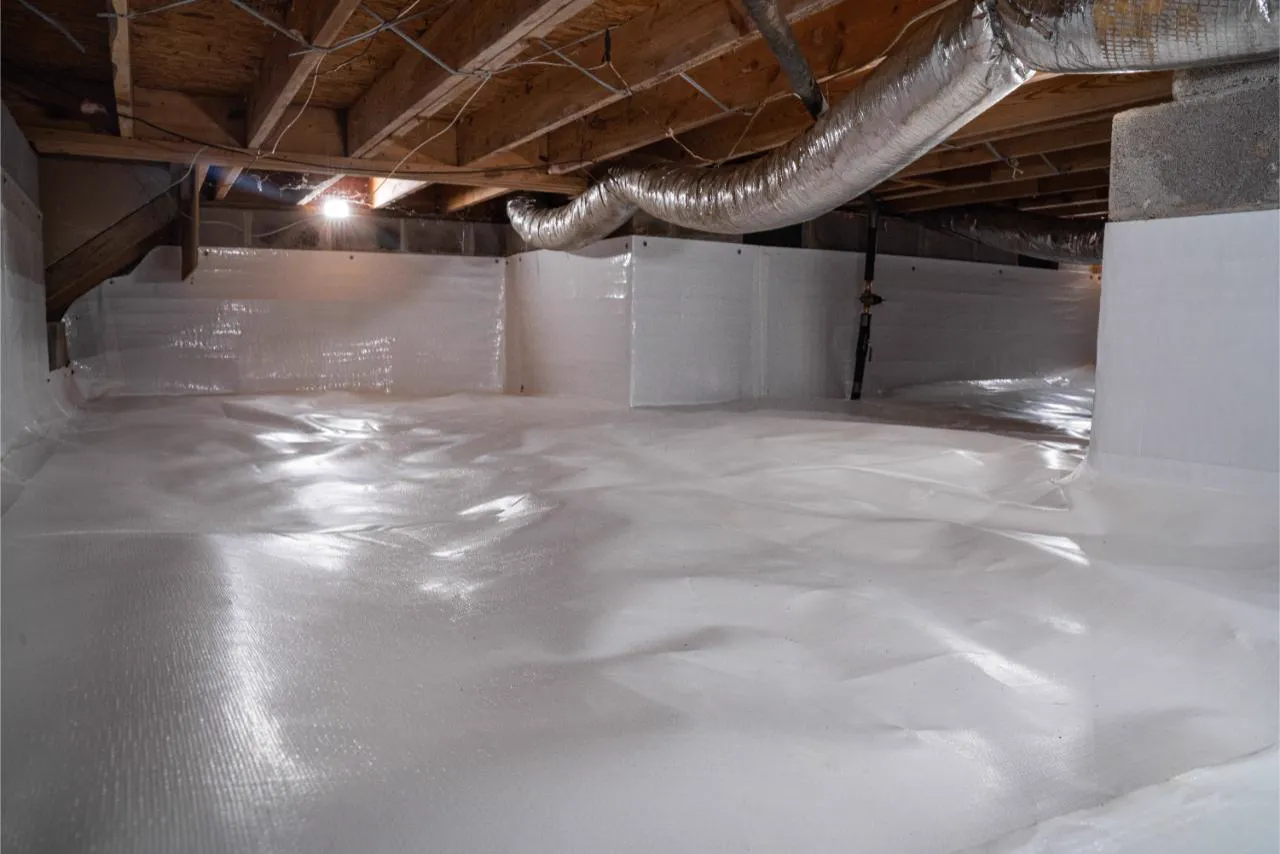
- Install the liner. A reinforced liner covers the ground, runs up the walls and around every pier, sealed at the seams.
- Insulate and condition. Rim joists get insulated, and a right-sized dehumidifier holds humidity steady year-round.
- Walk it with you. We show you the finished space in photos and hand over the paperwork.
How long? Two to four working days covers most Roswell homes. Add a day for heavy debris, and another when drainage is in the scope. Hillside lots sometimes need exterior work too, and that’s weather-dependent — so we’d rather give you a real window than a pretty one.
Your prep is light. Clear a path to the access door, move anything stored right inside it, keep pets in, and plan on a truck in the driveway. That’s genuinely it.
What’s the one distinction to understand before you call anyone?
Here’s the thing most estimates blur: water control and vapor control are two different jobs. They get sold as one product, but mixing them up is how people overpay or underbuy.
Vapor control is the liner. It stops moisture rising out of the ground and keeps humid outside air off your framing. Water control is drainage — a pipe, a pump, a regrade, a downspout run past the slope. One handles damp, the other handles actual water moving downhill at your house.
Sealing over standing water doesn’t fix the water. It just gives it a nicer room to sit in.
Why does that matter to your wallet? Because a house that only needs vapor control costs noticeably less than one needing both. So the first question worth asking anybody is simple: “Where is the moisture coming from, and how do you know?” A specific answer names ground evaporation, humid air through the vents, or roof water dumping at one corner. A vague answer sounds like “crawl spaces are always wet, we’ll wrap it.”
Homeowners here compare quotes line by line, and we like that. Once you know the source, you can see who priced your actual problem. Our guide to crawl space repair covers the diagnosis side.
What really moves the number?
Square footage first, then how hard the space is to work in. We won’t publish a flat price, because a flat price for a crawl space is a coin flip. Instead, here’s what we weigh.
Price drivers, biggest first
- Square footage. More ground and wall means more liner, more seam work, more hours. It’s the biggest swing.
- Headroom and access. A twenty-four-inch crawl costs more than a four-foot one, every time.
- Cleanout volume. Old insulation, torn plastic and stored odds and ends have to leave before step one.
- Standing water. Water pooling down there means drainage and usually a pump. That’s a system, not an add-on.
- Slope and exterior work. On hillside lots, a retaining wall drain or longer downspout runs are often the best line on the estimate.
- Vent count and wall condition. Sealing eight vents in sound block is quick. Crumbling parge or old stone takes real time.
- Dehumidifier and extras. Unit size, rim joist insulation, duct repairs and wood treatment each nudge the total.
So a small, tall, dry crawl space sits at the low end. A sprawling low one with standing water, a full cleanout and exterior drainage sits at the top. Most encapsulation cost Roswell projects land between, and you get a written scope with every line spelled out. Folks comparing towns often check the Milton encapsulation cost page too.

Can you do part of this yourself?
Some of it, genuinely, and we’ll tell you which parts. Clean the gutters. Extend downspouts eight or ten feet out, farther on a slope. Pull soil back so the grade falls away from the house. Those cost almost nothing and cut the water load before anyone quotes you a system. The Department of Energy’s guide to insulation and moisture control is a sales-free place to read up.
Now the honest limit. A roll of hardware-store plastic laid loose on dirt isn’t encapsulation and never was. Real encapsulation uses a reinforced liner sealed to the walls and piers, so moisture can’t sneak around the edges. That’s why one version lasts a season and the other lasts decades.
Sizing a dehumidifier, setting drainage on a slope, and sealing vents without starving a gas appliance aren’t weekend work either. Not because the tools are exotic, but because a wrong choice looks exactly like a right one until August. The EPA’s page on mold and health explains why controlling moisture beats cleaning up after it.
Which other rooms does this quietly affect?
This part surprises people. Air moves upward through a house all day, so a good share of what you breathe in the living room started under the floor. Which means a damp crawl space isn’t a downstairs problem. It shows up in rooms nobody connects to it.
Think about the hardwood in the hall that cupped one summer and flattened the next. The closet that smells like an old cabin. The bedroom that’s always colder in February, and the bath door that sticks in July but swings fine at Christmas. Each has a dozen possible causes — but humidity from below is on the list more often than people expect.
There’s a comfort side too. Your HVAC burns energy pulling moisture out of air it shouldn’t be getting, so it runs longer and the upstairs never evens out. Good news? That improves once the source is sealed. A homeowner near the Chattahoochee Plantation edge called about a smell in a coat closet, then ended up happiest that her floors stopped feeling clammy.
How do you know the job was done right?
Ask for five things. Any straight contractor hands them over without blinking.
Your five-item checklist
- Before-and-after photos of the whole space, not one flattering corner by the door.
- Liner details. Thickness, whether it’s reinforced, and how it’s sealed at seams and piers.
- A humidity target. A real system holds a stated range, and you should be told what it is.
- The water plan in writing — where water enters and where it discharges outside.
- A warranty you can read in one sitting. If it needs a lawyer, it isn’t helping you.
After that, life under the floor gets pleasantly boring. The musty note leaves, the floors stop feeling cold, and the space becomes clean dry storage instead of somewhere you point a flashlight and back away from. Best of all, you stop thinking about it — which is the real product.
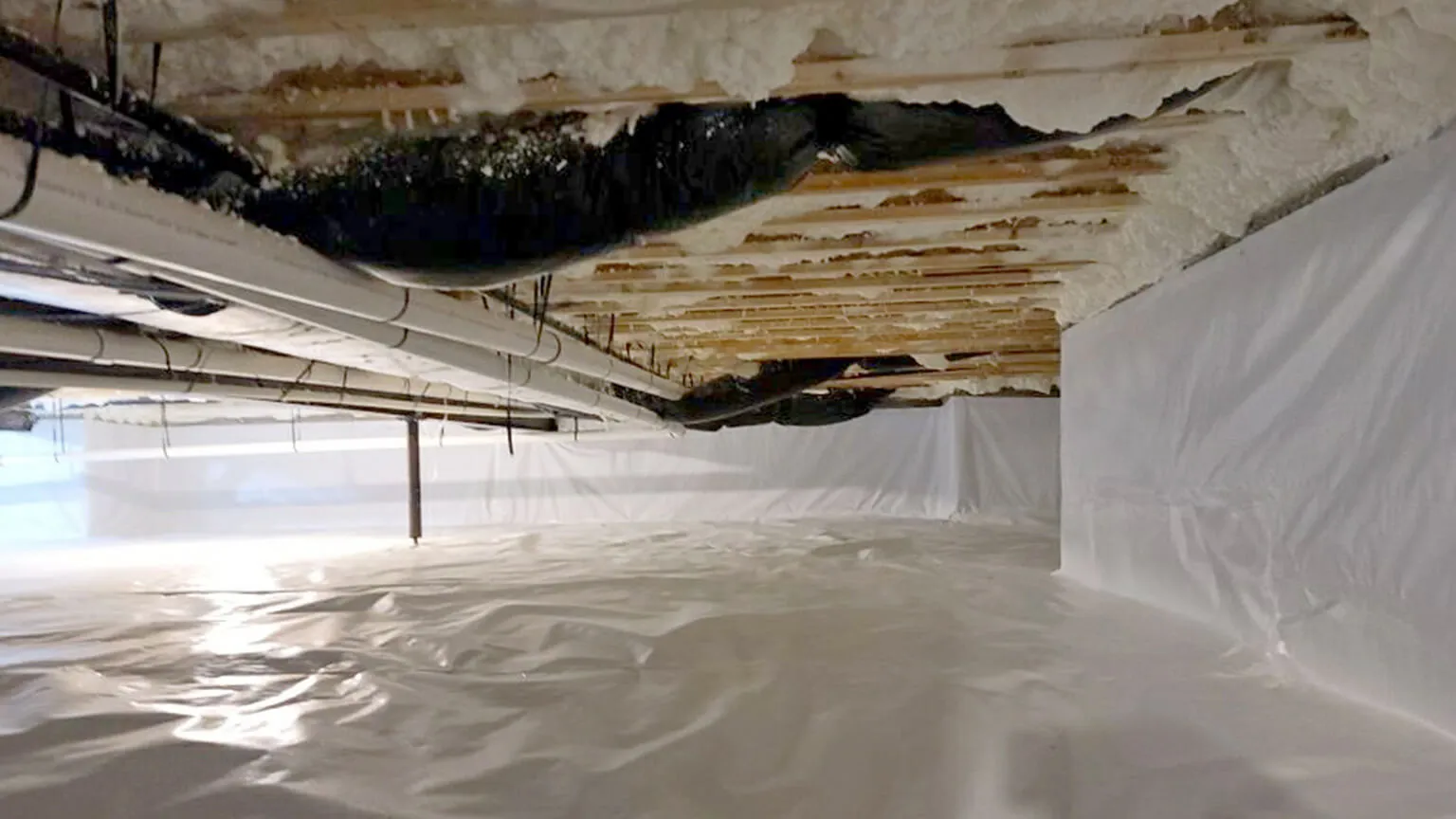
Two local notes before we wrap. Historic homes down by the Roswell Mill and Vickery Creek Falls often have stone foundations, so those get a gentler approach — character stays, moisture goes. Older sections of Country Club of Roswell usually need the exterior water handled first. If your house has a basement instead, our page on flooded basement repair is the better read, and the crawl space repair service page shows what we install.
Where we work around Roswell
We’re based in Lawrenceville, about thirty minutes east, so we’re in this corner of Fulton County most weeks. That includes Roswell, Alpharetta, Milton, Sandy Springs, Johns Creek, Marietta, Dunwoody, Duluth, Peachtree Corners and the wider Fulton area. Steep lot or a few blocks off Canton Street, we know how these houses are built.
Questions Roswell homeowners ask us
In most Georgia homes, yes. The liner stops moisture from the ground, but the air in a sealed space still needs something holding it steady through our summers. A right-sized unit with a drain line does that quietly and costs very little to run. We’ll tell you honestly if your space is one of the few that doesn’t need one.
Closed, if the space is properly sealed and conditioned. Vents were meant to dry a damp space, but in our climate they mostly invite warm wet air onto cool framing, which is backwards. That said, vents should only be sealed as part of a complete system, and any gas appliance down there needs its combustion air handled first.
Usually it does, because that smell is almost always damp air rising from below. Once the ground is covered, the vents are sealed and humidity is under control, the source stops producing it. Most homeowners notice a change within a couple of weeks, though heavily soaked materials sometimes need cleaning too.
Two to four working days for most homes in this area. Heavy debris removal adds about a day, and drainage work or exterior grading can add another. We give you the schedule before we start, and you don’t need to leave the house while we’re there.
It often helps, since your system stops working so hard to wring moisture out of damp air. Sealing the vents and insulating the rim joists also cuts the cold-floor effect in winter. We won’t promise a percentage, because every house is different, but comfort improves almost every time.
Let’s find out what your Roswell crawl space actually needs
We’ll crawl it, photograph it, tell you exactly where the moisture is coming from, and price only what your house needs. Inspection free, estimate free, no pressure at the end.
(678) 914-5112Serving Roswell and all of Metro Atlanta · $500 off projects over $3,500 · Live support 7am–8pm, 7 days a week