

Basement Waterproofing in Milton: What It Costs and What You Actually Get
A walk down the stairs with us — what we look for, how the work is done, and what really moves the number on your estimate.
Take the stairs with us for a minute. Almost every basement waterproofing Milton call starts the same way — you meet us at the door, you walk us down, and you point at the one spot that’s been bothering you. Here’s the part most homeowners don’t expect: we’re barely looking at your spot. We’re reading the whole room.
That’s not us ignoring you. It’s because the wet corner is almost never where the story starts, so the fix rarely lives there either. Good news, though — once you know what we’re looking at, this whole thing stops feeling mysterious. By the end of this page you’ll be able to walk your own basement and read it about as well as we do. That’s the goal.
What are we actually looking for down there?
Six things, in roughly this order. First, the seam where the wall meets the floor, because that joint is the most common way in. Then the walls themselves, hunting for a chalky white bloom called efflorescence — that’s mineral salt left behind after water passed through block, so it’s basically a receipt.
Next we check the smell at the bottom of the stairs, since a musty note means moisture is in the air even on a dry week. After that we look at your finishes: baseboard, drywall bottoms, the back of built-ins. Finally we go outside, and honestly that’s where we spend the most time.
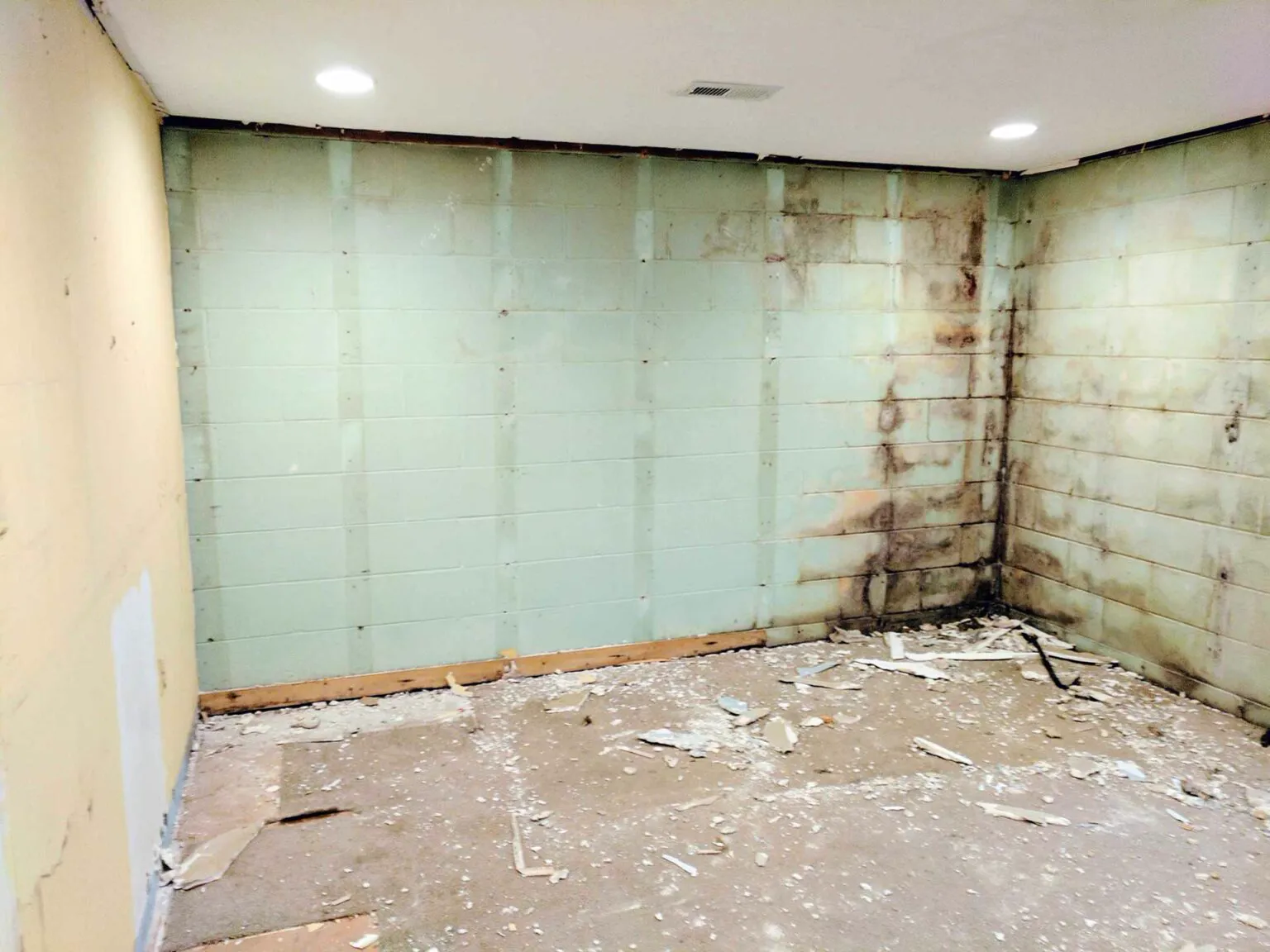
Outside is where Milton gets its own personality. Lots here are big and rolling, with long driveways and real grade changes from one side of a property to the other. So we follow the slope, check every downspout, and look at where the hardscape sends water. Plenty of homes out near the Bethany Bend corridor are quietly funneling half the yard toward the house, and nobody planned it that way.
We also ask about the septic system, which surprises people. A drain field doing its job keeps a wide patch of soil saturated, and if that patch sits uphill of the foundation, the clay around your walls never really dries out. That’s a common find on acreage properties, and it’s very fixable once you know it’s there.
So what is waterproofing, in plain words?
Here’s our version: waterproofing is giving water an easier path than the one it’s using through your house. That’s the whole idea. Water is lazy and endlessly patient, and it always takes the route with the least resistance.
Right now that route runs through your foundation, and the reason is Georgia red clay. Clay swells when it takes on water, and as it swells it presses against your walls. A basement wall can face thousands of pounds of pressure from saturated soil — that force is called hydrostatic pressure, and it’s strong enough to push moisture through solid concrete with no crack anywhere in sight. Concrete looks solid. Under a microscope it’s more like a very dense sponge.
Good news
A wet basement and a failing foundation are two different conversations. Most of the homes we look at only need the first one, and we’ll tell you plainly which one you’re in — before anybody talks about price.
In Milton the stakes are just different, and we should say that out loud. Around here the basement isn’t storage. It’s a finished floor of the house — a theater, a gym, a wine room, an in-law suite — so a small amount of water causes a very large amount of damage. That’s why we treat these jobs slowly and in writing.
What does a real job look like start to finish?
Most interior systems follow the same shape, so you can picture the week before anyone shows up with a jackhammer. Here’s the honest version:
- We find the source first. Grading, downspouts, driveway runoff, the drain field. Sometimes the real fix is outside and costs less than you feared, and we’d rather tell you that than sell you a bigger job.
- We protect the finished space. On a finished basement this step is its own small project — dust walls, floor protection, careful removal of the bottom of the drywall so it can go back cleanly.
- We open a channel at the perimeter. A narrow strip of slab comes up along the affected walls. It’s loud and dusty, but it’s usually a day or two.
- We install drainage below the slab. Perforated pipe in clean stone, set under floor level, so water is collected before it reaches your floor instead of after.
- Everything routes to a sump. The pump then sends water well away from the house, not next to the foundation where it would circle back for another try.
- We close it up and clean up. Fresh concrete over the channel, wall liner where it’s called for, finishes reset, and our mess in our truck.
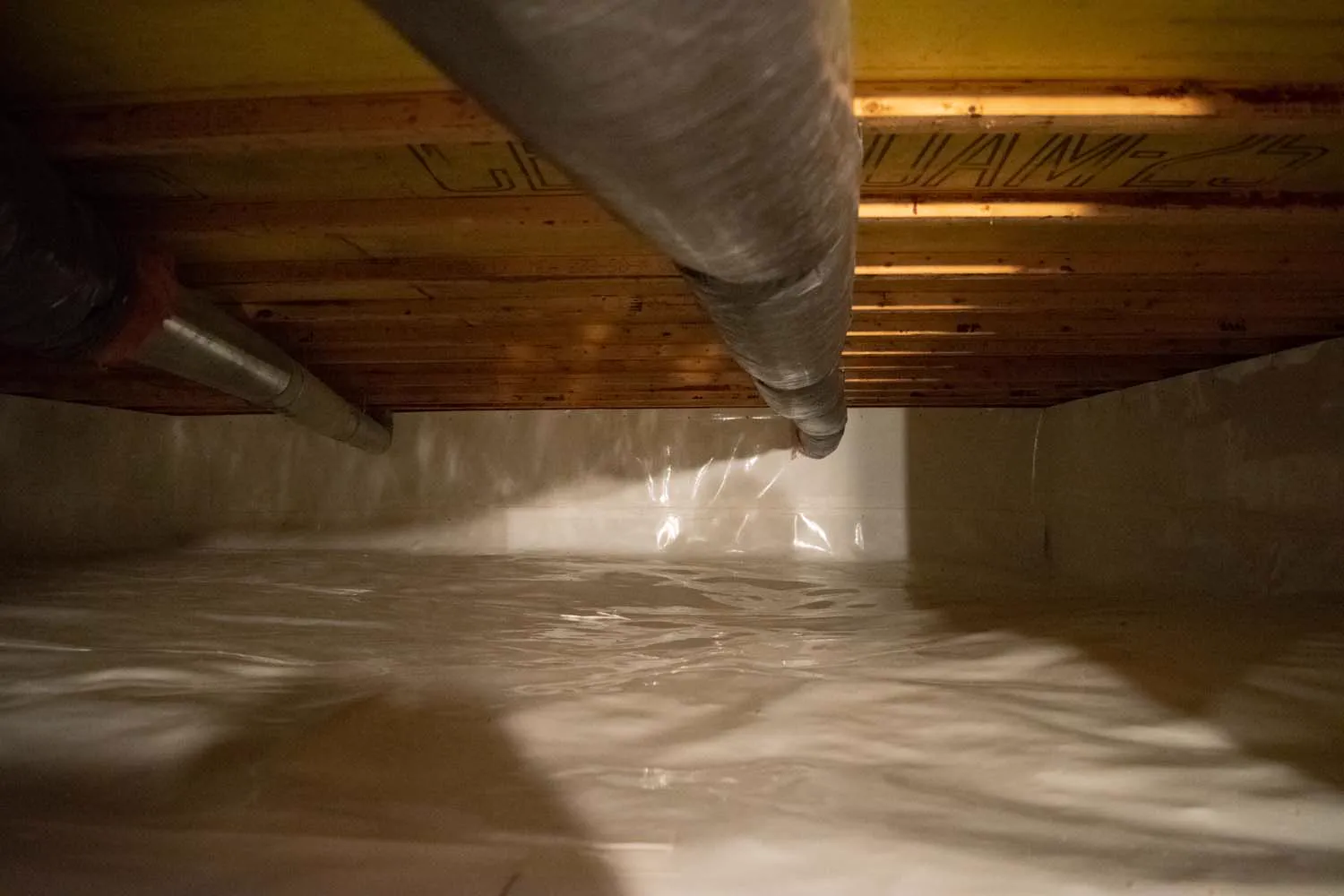
Notice what nobody did in that list? Painted anything. Waterproof paint is a fine product for what it is, but it’s a coating, and a coating can’t beat pressure. It’s a raincoat on a submarine.
Real talk — which part decides whether it lasts?
Not the pipe. Not the brand name on the sump. The part that decides whether your basement is still dry in year twelve is the boring stuff nobody photographs: depth, pitch, and where the water goes when it leaves.
Depth means the drain sits below the bottom of the slab, so it catches water on its way up rather than after it has arrived. Pitch means the pipe actually falls toward the basin instead of sitting flat in a pretty trench. And discharge means the pump line ends far enough from the house that the water can’t simply walk back. Get those three right and the system quietly works forever. Get them wrong and you own a very expensive decoration.
Twenty years in, the thing that changed our thinking is this: we stopped trying to block water and started trying to route it.
That shift is also why the outside work matters so much on large lots. If a downspout dumps at the corner, if the driveway sheds toward the garage side, if the drain field keeps one flank of the house wet all season — those are all volume problems. So we reduce the volume first, then build the system to handle whatever’s left. Less water arriving means less water to manage, which is not complicated, just easy to skip.
One more honest note: this is why we won’t quote a Milton basement over the phone. On a two-acre lot with a long drive and a finished lower level, a phone number is a guess, and you’d be the one paying for it.
So what does it cost?
Straight answer: it depends on how much wall is involved, how finished the space is, and how much work belongs outside. You deserve to see the levers, though, so here’s exactly what we’re weighing when we price a job.
What drives the number up or down
- Linear feet. One wall and a full perimeter are very different jobs. This is the single biggest factor.
- How finished it is. A theater room, a wet bar and built-in cabinetry mean careful work before the real work — and careful work to put it all back.
- Sump and backup power. Some homes have a serviceable basin already. Many need one, and a battery backup runs during the exact storm that takes your power out.
- Exterior corrections. Regrading, downspout extensions, or a yard drain to intercept runoff before it reaches the wall.
- Wall condition. If a wall is cracked or moving, that repair comes first. Waterproofing over a moving wall is money spent twice.
- Access. Long driveways, tight side yards and mature landscaping all change how equipment and spoils get in and out.
Small drainage corrections land at the low end. A full perimeter system with a new basin, battery backup and finish restoration in a large lower level sits at the high end. Most basement waterproofing in Milton falls between those, and after we walk it you get a written scope with a real number — not a range, not a “starting at,” and not a price that changes on install day.
What’s included, and what isn’t
Included: the inspection, the written plan, permits where they’re required, the drainage system, the basin and pump, the concrete work, cleanup, and hauling. Also included is a walk-through at the end where we turn everything on and explain it to you, because a system you don’t understand is a system you won’t maintain.
Not included, unless we spell it out: replacing drywall and flooring that was already ruined, structural repairs, mold remediation beyond normal cleanup, and landscaping restoration on the exterior side. Those get quoted separately so you can see them. Bundling them into one fat line item would make the paperwork prettier and the decision worse.
The warranty comes in writing before work starts, not after, and it’s transferable when you sell. Ask us to explain it in one sentence — if a company can’t do that, that’s useful information about the warranty. You can also read the EPA’s guidance on moisture control for a neutral second opinion on why controlling the source matters more than any product.

What happened at a house off Crabapple Road?
Here’s one that stuck with us. A homeowner in Crabapple, in one of the older homes near Crabapple Road, called about a finished lower level that smelled fine in July and terrible in April. Two companies had already been out. Both quoted a full perimeter system, sight almost unseen.
We walked the outside for close to an hour before we ever went downstairs. Turns out the back half of the lot fell gently toward the house, the two rear downspouts ended about a foot from the wall, and the drain field sat upslope of the whole thing. So the soil on that side stayed loaded all spring, and the pressure did the rest.
The plan ended up being a partial system — drainage on the two affected walls, a new basin with backup power, extended discharge lines, and regrading across the back. Not the whole basement. That’s a smaller invoice than what he’d been quoted twice, and we told him so before we wrote it up.
Two springs later that lower level is dry, the smell is gone, and his kids use the room again. What he actually said he valued most, though, wasn’t the dry floor. It was finally understanding what had been happening in his own house. Once you can explain your own basement, storms stop being suspenseful — they’re just weather. You can look up how much rain our area really gets through the National Weather Service office in Peachtree City, and it’s more than most people guess.

Why does hiring local matter for this one?
Because a warranty is only as strong as the company standing behind it. We’ve been doing this work for more than twenty years, with the same crews and the same trucks, so if something needs attention in year six you’re calling the people who did the job — not a call center three states away.
It also means we already know how water behaves here. We know the newer poured walls along the Bethany Bend corridor act differently than the older block down in Crabapple. We’ve worked the sloped lots over near Providence and around Providence Park, where runoff has a long way to travel and picks up speed doing it. And that same rich red clay that makes the display beds at Scottsdale Farms look so good is the clay pressing on your foundation — beautiful stuff, terrible drainage.
Still working out what you’re seeing down there? Our guide to what causes a wet basement walks through the symptoms one at a time, and the waterproofing systems we install are laid out in full. If your home has a crawl space under part of it, crawl space encapsulation is usually the better answer for that section. Comparing notes with family one town over? We cover the same ground for Cumming basement waterproofing.
Where we work around Milton
We’re about thirty-five minutes from Milton, and we’re up this way constantly. That includes Alpharetta, Roswell, Johns Creek, Cumming, Woodstock, Canton and Sandy Springs, along with Suwanee, Duluth and the rest of north Fulton and Cherokee County. If you’re out past Scottsdale Farms or closer in toward Crabapple, we’ve very likely got a truck nearby already.
Questions Milton homeowners ask us
Usually within a few days, and often sooner outside of a busy storm week. Someone answers the phone from 7 in the morning until 8 at night, seven days a week. The inspection and the estimate are both free, so there’s no cost to just find out.
It depends mostly on how many linear feet of wall are involved, how finished the space is, and whether exterior corrections are needed. Small drainage fixes are modest; a full perimeter system with backup power and finish restoration is a bigger project. We price it after we walk it, then put the scope in writing.
Most interior systems run two to four days on site, plus curing time for the new concrete. Larger lower levels and jobs with exterior grading take longer. You’ll get a day-by-day schedule before we start, because nobody likes guessing when the noise ends.
Only the perimeter. We need roughly four feet of clear space along the walls we’re working on, so furniture and shelving move toward the middle. Heavy pieces are our job, and we cover whatever stays in the room.
Sometimes, but they’re really two jobs. Drainage handles the water, while a crack that’s still moving needs its own repair first. Sealing a wall that’s shifting only buys you a season, so we’ll tell you which situation you’re in during the inspection.
Let’s find out what’s really going on down there
The inspection is free, the estimate is free, and nobody pressures you at the end of it. We’ll show you where water is getting in, what it would take to stop it, and what it will cost — in writing, before anything starts.
(678) 914-5112Serving Milton and all of Metro Atlanta · $500 off projects over $3,500 · Live support 7am–8pm, 7 days a week