

Waterproofing Options Alpharetta Homeowners Compare: Inside or Outside?
Two real fixes, side by side — how each works, what moves the price, and which one we’d pick for your house.
Every year, right around the first long March rain, the calls start. Homeowners walk downstairs on a Saturday, feel that damp cold at the bottom of the steps, and start googling waterproofing options Alpharetta companies offer — usually while standing on a wet floor in socks. It’s a rough way to start a weekend.
Good news, though: there are only two real paths here, and neither is scary. One works from inside the basement. The other works outside, in the dirt. Both stop water. So the question is simply which one fits your house, your yard and your budget — and we can answer that in about an hour on site with you.
Why does spring do this every single year?
Because the ground here doesn’t drain the way people assume. Alpharetta sits on red clay over weathered granite, and clay is stubborn stuff. After a few days of rain it holds water against your foundation walls instead of letting it soak away, and that soaked clay swells and pushes.
Then there’s the shape of the city. The Big Creek floodplain runs through the middle of town, and the subdivisions above it sit on graded lots with walkout basements. Water rolls downhill, meets clay, and stalls. That’s why the lower stretches of the Windward Parkway corridor tend to call first each season.
The Alpharetta thing nobody says out loud
Alpharetta’s boom-era subdivisions are now old enough that the original waterproofing has simply worn out — even on homes that look brand new from the street. A 1996 house with fresh paint still has 1996 drainage. That’s not a defect; that’s a service life ending.
We see it constantly in the mature 1990s neighborhoods, where original block and poured walls are starting to show hairline cracks. Windward and Haynes Manor are full of houses like that, and so is the stretch toward the Country Club of Roswell edge, where grading that worked in 1998 has settled just enough to send water the wrong way.
Option A: what is interior drainage?
Think of it as giving water an easier exit than the one it’s taking through your floor. We cut a narrow channel in the slab around the inside perimeter, set perforated pipe in clean stone below floor level, and route it all to a sump basin. The pump then sends that water well away from the house.
Notice the logic there. We’re not blocking water at the wall, because pressure wins that argument eventually. Instead we collect it and show it the door. Water is lazy but persistent, so hand it an easy path and it takes the easy path.
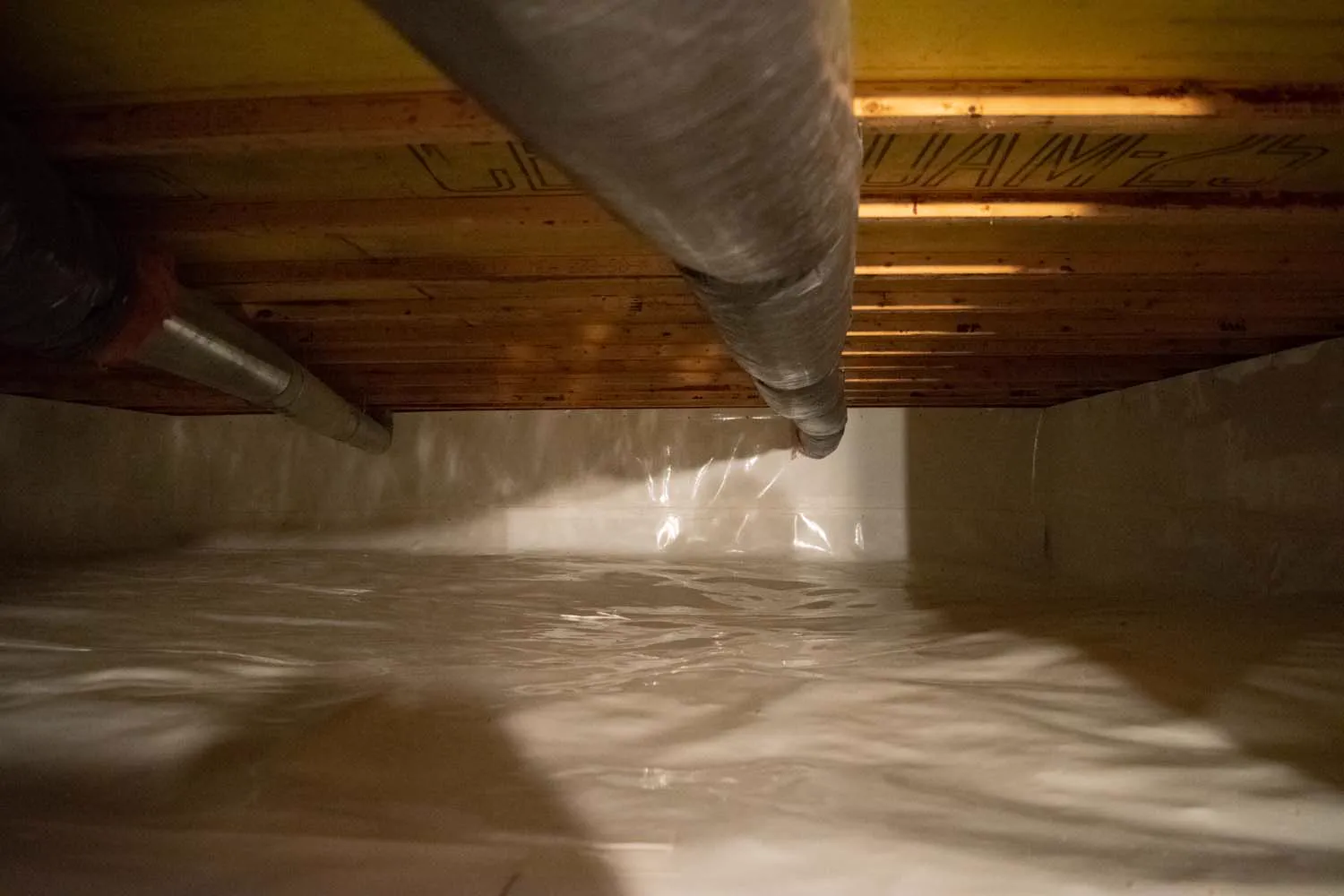
Cost depends mostly on linear feet and access. One wall in an open basement sits at the low end, while a full perimeter with a new sump and battery backup sits at the high end. Either way you’ll get a written scope, not a phone guess.
When does interior win? When the basement is finished, when a deck or patio hugs the house, or when you want it done in a couple of days without your yard turning into a job site. That covers most homes we look at here.
Option B: what about exterior waterproofing?
This one goes after water before it ever touches the foundation. We excavate along the outside wall, clean it, apply a waterproof membrane, and install footing drains in stone. Then the soil goes back and the grade gets corrected so the ground slopes away from the house.
It’s the more thorough approach, and we’ll say that plainly. Keeping water off the wall also keeps it out of the block cores, which matters on older masonry. However, it’s a bigger operation — machines, dirt piles, and a yard that needs a season to recover.
Cost runs higher, because digging costs more than cutting. Depth drives it, and so does what’s in the way. A walkout with clear side access is straightforward, while a wall buried behind a patio, an irrigation line and twenty-year-old landscaping is a different invoice.
Exterior wins when the wall itself is deteriorating, when water comes in high on the wall instead of at the floor seam, or when the grading is genuinely wrong and you’re regrading anyway.
So how do they compare, honestly?
Interior drainage
- Usually done in one to three days
- Lower cost for the same length of wall
- Works year-round, rain or shine
- Yard, deck and patio stay put
- Collects water below the slab, then pumps it out
- Needs a working sump and, ideally, a backup
Exterior waterproofing
- Longer job, weather dependent
- Higher cost, driven by depth and access
- Keeps water off the wall completely
- Landscaping gets disturbed
- Fixes bad grading at the same time
- Best when the wall itself needs help
Neither column is the “cheap” one, and neither is the “real” one. They solve the same problem from opposite sides. For the same comparison in a nearby city, our Duluth waterproofing options guide covers slightly different soil, and every basement waterproofing system we install is listed on our service page.
Here’s the part almost nobody mentions
Ready for the detail that changes this whole conversation? Concrete is porous. Water moves through solid, uncracked concrete by capillary action — it wicks, the way a paper towel pulls up a spill. Which means a wall can be wet with no crack in sight.
Homeowners find that frustrating, and fair enough. You stand there hunting for the hole, and there isn’t one. Real talk: the white chalky bloom on the block is your proof. It’s efflorescence — mineral salt left behind as water passes through.
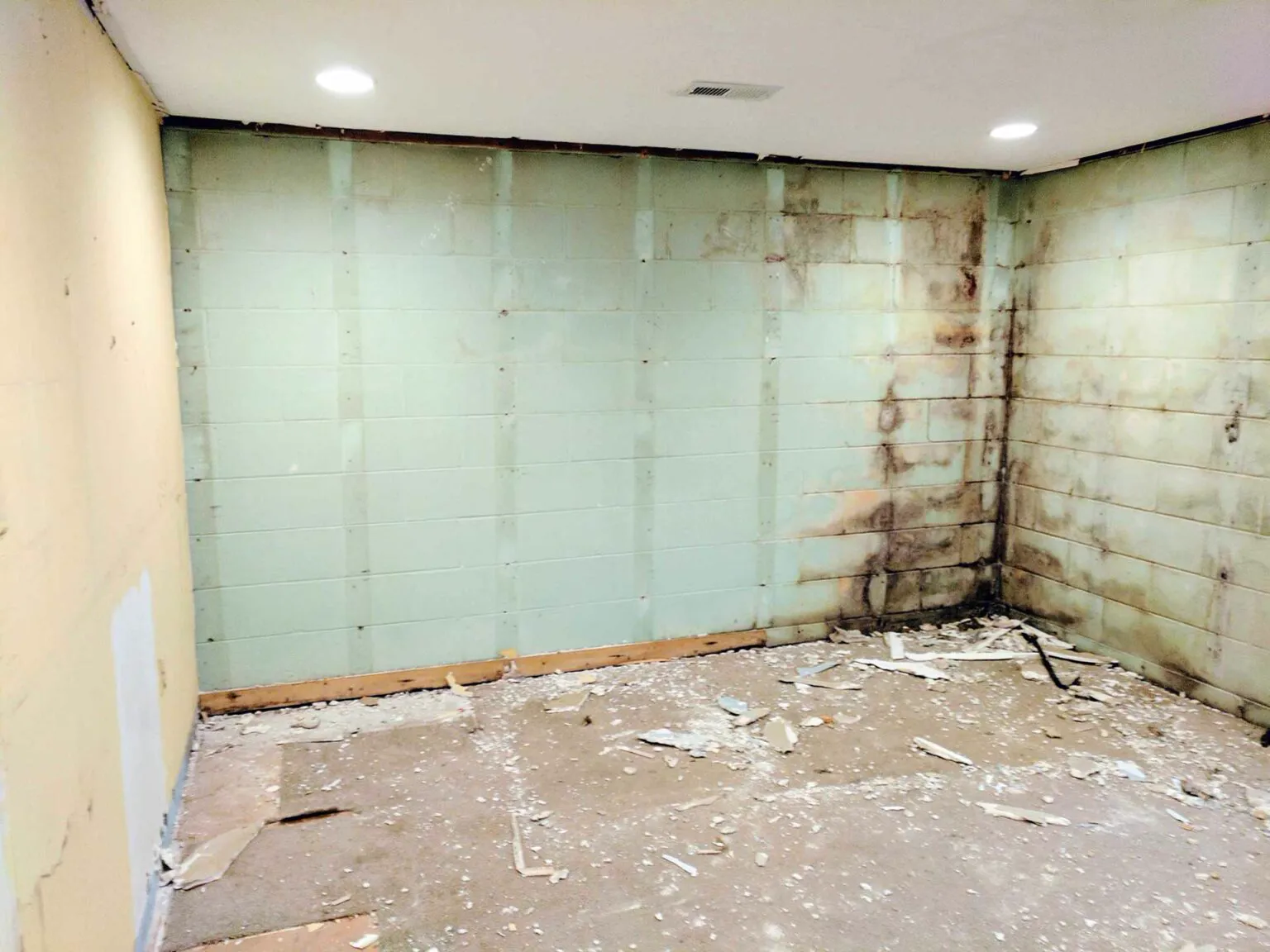
There’s a second half to it: humidity. A damp wall doesn’t just make a stain — it feeds the air. That’s the musty smell at the bottom of the stairs, and it’s why a dehumidifier alone never quite fixes things. The EPA’s guidance on moisture control puts it simply: control the moisture and you control the rest.
Both options handle this, and the relief comes fast. Homeowners tell us the smell is the first thing to go, usually within a couple of weeks.
What tips the decision on Alpharetta homes?
Four things, in this order. First, is your basement finished? A huge share of homes here have a finished basement office, and tearing out drywall changes the math fast. Second, where is the water coming in? At the floor seam points toward interior drainage, while high on the wall points toward exterior.
Third, what’s outside — an open side yard, or a patio and mature plantings? Fourth, how’s the wall itself doing? A wall that’s cracked or moving needs structural attention first, because waterproofing over a moving wall is money spent twice.
We don’t sell the bigger job because it’s bigger. We recommend the one that stops the water and leaves your yard alone if it can.
Our actual recommendation, since you asked for one: for most Alpharetta homes built between 1985 and 2005, with a full basement and water at the floor seam, interior drainage is the right call. It’s less disruptive, it costs less, and it meets the water where it arrives. Of all the waterproofing options Alpharetta homes end up needing, that’s the one we pick most.
And sometimes? Neither. Near downtown Alpharetta City Center we’ve walked houses where the whole problem was two downspouts dumping at the wall. That’s an afternoon of work and a small invoice.
The number that reframes all of this
Want the figure that surprises people most? A bare concrete slab can pass roughly two to four quarts of water a day, as vapor, through every 1,000 square feet — without one visible drop. That’s gallons a week moving through your floor while everything looks perfectly dry.
Suddenly the musty corner makes sense, doesn’t it? Spring storms just make visible what’s been quietly happening all year. You can check regional rainfall through the National Weather Service office in Peachtree City, which covers all of North Fulton.

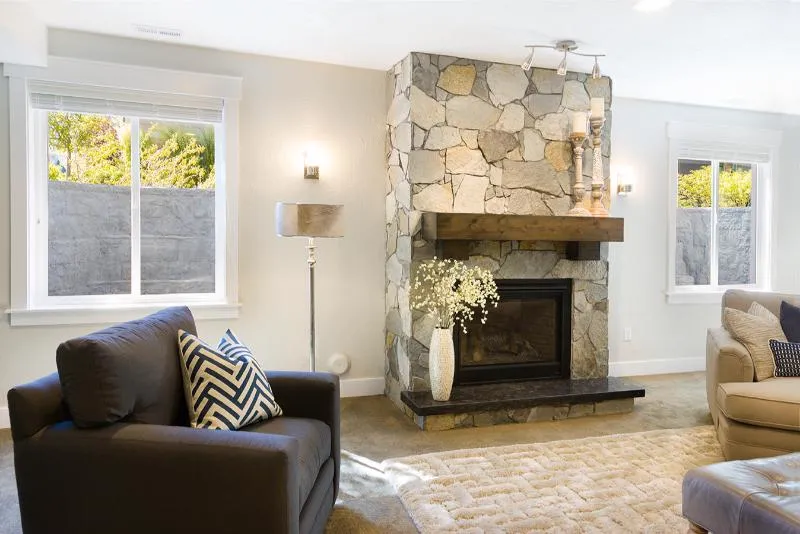
Now picture the other side. A hard April storm rolls through, and you don’t go check. The bottom of the stairs smells like nothing at all. Instead of a floor you’d never put a rug on, you’ve got an office, a gym, or a room where the kids can be loud. That’s the real product — not pipe in the floor, but a storm you get to ignore.
Why hire somebody local for this?
Because we’ve been at this in Metro Atlanta for over twenty years, from about twenty-five minutes east of you in Lawrenceville. So we’ve likely already worked a house in your subdivision. We know the block walls in the older Windward sections, and we know which streets near Avalon sit low.
Also, we answer the phone — live support runs 7 a.m. to 8 p.m., seven days a week. If something needs attention in year six, you’re calling the same crew that did the work. For more on systems and warranties, our guide to the best basement waterproofing approach goes deeper, and if your home has a crawl space instead of a full basement, crawl space encapsulation is usually the better answer.
Where we work around Alpharetta
We cover Alpharetta and everything around it — Milton, Johns Creek, Roswell, Cumming, Duluth, Sandy Springs, Suwanee, Norcross and the wider Fulton County area. If you’re along GA-400 or near the Windward corridor, we’ve usually got a truck nearby already.
Questions Alpharetta homeowners ask us
Usually within a few days, and often sooner outside of peak storm weeks. Call or text and we’ll book a window that works around your schedule. The inspection and the estimate are both free, so there’s nothing to lose by having us look.
It depends on how much wall is involved and how hard it is to reach. A short run of interior drainage sits at the low end, while a full perimeter with a sump and backup in a finished basement sits much higher. Exterior work costs more, because digging costs more than cutting.
Most interior systems take one to three days from start to cleanup. Exterior excavation runs longer and depends on weather, since we can’t dig well in soaked clay. We’ll give you a realistic day count before we start, not an optimistic one.
Just the perimeter. We need about four feet of clear space along the walls we’re working on, so shelves and boxes get pulled toward the middle of the room. You don’t have to empty it, and we’ll help with the heavy things.
Sometimes, but they’re really two different jobs. Drainage handles the water, while a crack that’s actively moving needs its own repair first. We’ll tell you plainly which situation you’re in during the inspection instead of bundling it in quietly.
Let’s figure out which option your Alpharetta home actually needs
The inspection is free, the estimate is free, and nobody pressures you at the end. We’ll show you where the water gets in, walk both paths with you, and say honestly if the smaller fix is enough.
(678) 914-5112Serving Alpharetta and all of Metro Atlanta · $500 off projects over $3,500 · Live support 7am–8pm, 7 days a week