

Wet Basement in Roswell: What’s Causing It, and How It Gets Fixed for Good
You smelled it before you saw it. Here’s what that means, how worried you should actually be, and what the real repair looks like.
The smell got there first. Weeks before you spotted a single drop, there was that faint musty note at the bottom of the stairs — the one you kept blaming on old boxes and a forgotten gym bag. That smell is almost always the opening act of a wet basement Roswell homeowners eventually call us about. Water announces itself early. We just don’t speak the language yet.
Good news, and we mean this: you caught it at a great stage. A smell is cheap to solve. So let’s walk through what’s happening under your house, how to tell a small issue from a real one, and what an honest repair actually involves.
Why does a basement smell before it leaks?
Because moisture arrives as vapor long before it arrives as a puddle. Concrete and block are porous, a little like a hard sponge, so water passes through as damp air first. That damp air raises the humidity in the room, and once humidity climbs, ordinary dust and cardboard start to smell like a basement.
In other words, your nose is a moisture meter. It’s just not a very specific one.
Here’s the encouraging part. At the vapor stage, nothing is ruined yet. Your stored things are fine, the floor is fine, and the repair is usually smaller than what people picture. The EPA’s plain-language guide to moisture in the home makes the same point — control the water, and the rest sorts itself out.
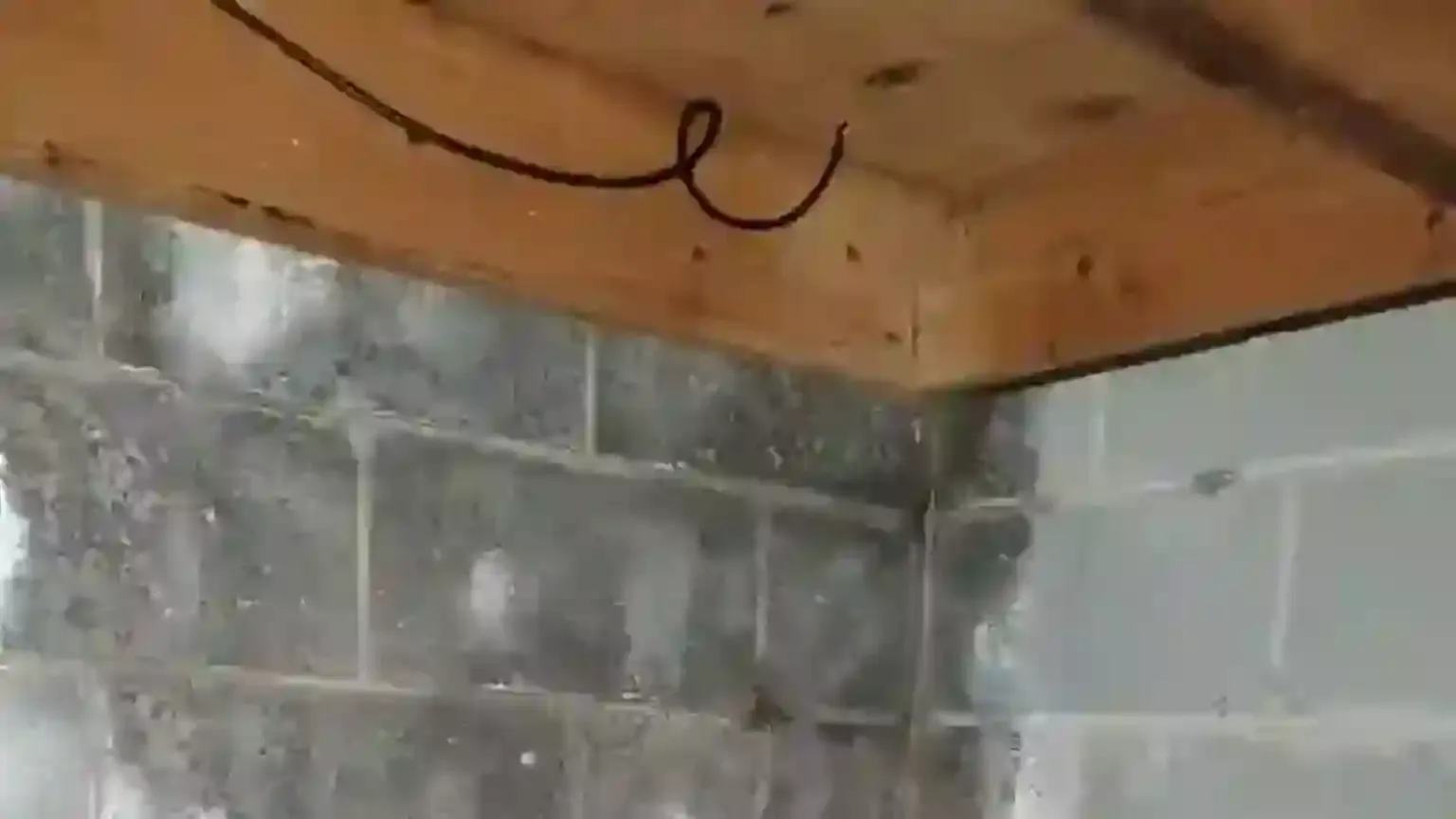
So what’s actually causing it?
In Roswell, the answer is usually the ground your house sits on. This city is built on hills — river bluffs, ravines, and whole subdivisions carved into slopes. Water always wins on a hill unless somebody gives it somewhere better to go, and that, honestly, is the entire job.
Under our red clay there’s a lot of granite sitting close to the surface. Rain soaks down until it hits that rock, and then it can’t go any deeper. So it turns sideways and travels along the top of the bedrock, downhill, until it runs into the first solid thing in its path. On a hillside lot, that solid thing is the back wall of your basement.
That’s why so many of these calls come from the 1970s and 1980s subdivision belt, places like Hembree and Steeplechase, where the original drainage did its job for decades and then quietly gave out. Downhill of Alpharetta Highway (GA-9), we see the same pattern over and over: a fine house, a tired drain line, and a hill that never took a day off.
The force nobody sees
When clay soaks up water it swells, and it presses against your foundation with real weight — a basement wall can face thousands of pounds of pressure from saturated clay. That push is called hydrostatic pressure, and it’s strong enough to move water through solid concrete with no crack involved at all. Which explains the mystery damp spot on a wall that looks perfectly fine.
Historic Roswell has its own version of this story. Around the Canton Street district and the older streets near Bulloch Hall, plenty of homes sit on stone, rubble, or brick foundations that were never waterproofed, because waterproofing wasn’t a thing yet. Those walls seep instead of leak. Even so, they respond beautifully to modern drainage, and the character of the house stays exactly where it belongs.
How do you tell mild from serious?
Fair question, and you can get most of the way there yourself with a flashlight and ten minutes. Nothing on this list means anything is falling apart. It just sorts your situation into “keep an eye on it” or “let’s take a look.”
Walk your basement and check for these
- Musty smell, no visible water. Mild. This is a humidity and vapor problem, and it’s the cheapest stage to solve.
- White chalky powder on the block. Mild to medium. Water is passing through the wall, just slowly.
- A damp stain that grows after storms. Medium. Something outside is aiming water at that spot.
- Water at the seam where the wall meets the floor. Medium. That joint is the natural entry point, so this one’s common and very fixable.
- Standing water after every hard rain. Worth a call soon. Not an emergency, but it won’t improve on its own.
- A crack that’s wider at one end, or a wall bowing inward. Call us. That’s a structure conversation before it’s a water conversation.
Notice that most of that list lands in the mild-to-medium range. That’s not us being nice — it’s just what we find. The large majority of Roswell basements we inspect need drainage, not surgery.
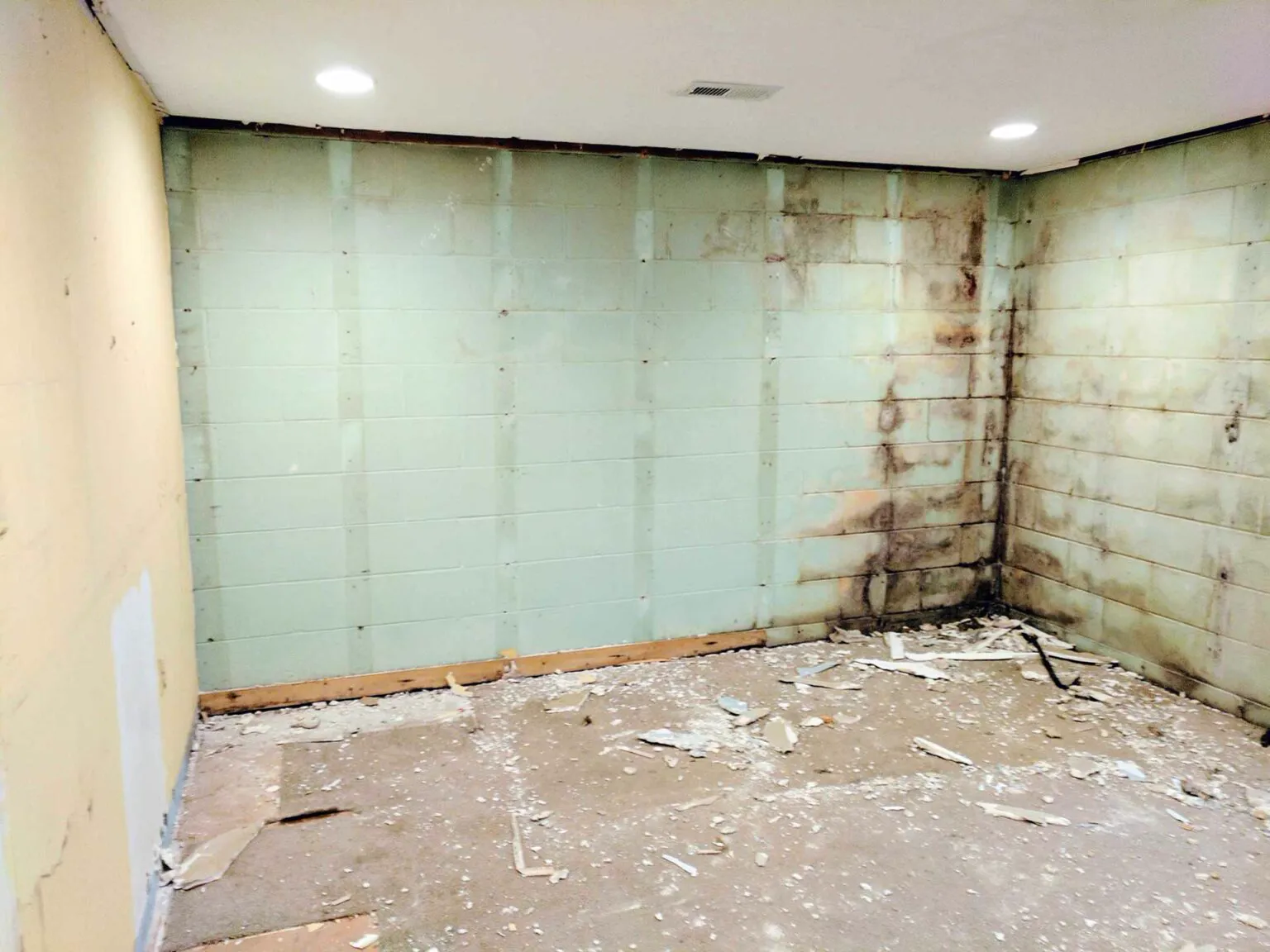
And what happens if you leave it? Nothing dramatic, and no, your house is not in danger tonight. Over time, though, moisture keeps working: humidity climbs, wood trim swells, stored boxes soften, and eventually you get growth like the photo above. Repairs get bigger the longer water has the run of the place. That’s the whole reason we’d rather look at it now, while the fix is still small and boring.
Twenty years in, here’s what changed our thinking: we stopped chasing the wall and started chasing the hill.
Early on, the instinct was to treat the spot you could see. Wet corner? Seal the corner. But on a slope that’s a losing game, because the water was never really about the corner — it was about everything happening uphill of your foundation. Seal one spot and the water simply finds the next weakest point, which might be twelve feet away and a season later.
So the approach flipped. Now we start outside and work our way down: where does the lot slope, where do the downspouts dump, what’s the retaining wall doing, is there rock forcing water sideways? Then we build a path that water actually wants to take. Give it an easy road and it stops being creative about your floor.
That shift is also why we’ll happily put a warranty in writing. You can’t honestly warranty a coating on a wall. You can stand behind a system built around how water really behaves on a hillside.
What does the actual fix look like?
Most interior systems follow the same shape, so you’ll know what’s coming before anyone shows up with a jackhammer. Here’s the honest version, start to finish.
- Find the source first. We walk the outside before we quote anything — grading, gutters, where the runoff lands. Sometimes the answer is outside, and the invoice gets smaller. We’ll say so when that happens.
- Open a channel at the perimeter. A narrow strip of the slab comes up along the walls that are taking water. It’s dusty and loud, but it usually moves fast.
- Set drainage below the floor. Perforated pipe in clean stone, placed under slab level, so water gets caught before it ever reaches your floor instead of after.
- Route it to a sump. The pipe carries water to a basin, and the pump pushes it well away from the house — not right beside the foundation, where it would just circle back for a second try.
- Close it up clean. Fresh concrete over the channel, wall liner where it’s called for, a dehumidifier if humidity needs help, and our mess hauled away.
What’s missing from that list? Paint. Waterproof coatings have their place, but a coating can’t beat pressure — it’s a raincoat on a submarine.

Cost depends mostly on how much wall is involved and how hard it is to reach. A short run along one wall is a different animal than a full perimeter in a finished walkout. If you want the full breakdown of what moves the number, we laid it out in our guide to waterproofing cost, and the systems themselves are explained on our basement waterproofing page.
What should you do every year once it’s dry?
Here’s the part almost nobody tells homeowners, and it’s the part that makes you the person who takes care of their house. A drainage system is not a set-it-and-forget-it appliance. It’s more like a furnace filter: a few small habits, once a year, and it just keeps working.
Your once-a-year, fifteen-minute checkup
- Test the pump. Pour a bucket of water into the basin. If it kicks on and shuts off cleanly, you’re done.
- Clean the gutters, twice. Spring and late fall. Overflowing gutters put water exactly where you don’t want it.
- Check where downspouts end. They should discharge several feet out, pointed downhill, never right at the wall.
- Look at the soil along the foundation. It should slope away. Clay settles over the years, so add dirt where a dip has formed.
- Walk the retaining walls. On our slopes, a leaning wall or a plugged weep hole sends water straight back toward the house.
- Glance at the discharge line after a freeze. A blocked outlet is the most common reason a healthy pump can’t do its job.
Do that list and picture next spring. The storm rolls through, hard and fast the way it does here, and you don’t go check anything. You keep watching the game. Later that week you’re out on the Big Creek Greenway with the dog, and your basement never crosses your mind — because you handled it, and it’s handled.

Why it helps to hire somebody who knows these hills
Because terrain is local knowledge, and Roswell’s terrain is the steepest we work in. We know how water moves through the older block basements in Hembree, and we know the walkout basements around Steeplechase behave differently than the stone foundations near Canton Street. Twenty-plus years in, odds are decent we’ve already been on your street.
That history matters for a plain reason: a warranty is only as good as the company behind it. If something needs attention in year seven, you’re calling the same local crew that did the work.
Want more reading before you call? Homeowners one town over deal with nearly the same slopes, and we cover that ground in our Milton wet basement guide. If your house has a dirt or gravel area instead of a full basement, crawl space encapsulation is usually the better answer. For rainfall totals during our stormy months, the National Weather Service office in Peachtree City keeps the local record.
Where we work around Roswell
We’re about thirty minutes east in Lawrenceville, so Roswell is an easy run for our trucks. We also work throughout Alpharetta, Milton, Sandy Springs, Johns Creek and Marietta, plus Dunwoody, Woodstock, Cumming and the wider Fulton County area. If you’re anywhere between the river and GA-400, there’s a good chance we already have a crew nearby.
Questions Roswell homeowners ask us
It comes down to how many feet of wall are involved, how easy the space is to reach, and whether you need a new sump. A short drainage correction sits at the low end, while a full perimeter system in a finished walkout sits at the high end. After we walk the house you get one written number with the scope spelled out, not a vague range.
Most interior systems are done in one to three days. Smaller drainage corrections often wrap up the same day. Historic stone foundations take a little longer, because we work carefully around original material instead of rushing it.
Just the edges. We need about four feet of clear space along the walls we’re working on, so shelves and boxes move toward the middle of the room. You don’t have to empty anything out, and we’ll help with the heavy pieces.
Sometimes, though they’re really two separate jobs. Drainage handles the water, but a crack that’s still moving needs its own repair first. We’ll tell you plainly which one you’re dealing with during the inspection.
Neither is automatically better — it depends on where water enters and what sits on the soil outside. Exterior work stops water before it touches the foundation, but it means digging, and a deck or a mature slope changes that math fast. On our hillside lots, interior drainage is usually less disruptive and just as effective.
Let’s find out what’s really going on down there, Roswell
The inspection is free, the estimate is free, and nobody leans on you at the end of it. We’ll show you where water is getting in, what it would take to stop it, and what it should cost — even if the answer turns out to be simpler than you expected.
(678) 914-5112Serving Roswell and all of Metro Atlanta · $500 off projects over $3,500 · Live support 7am–8pm, 7 days a week