

Waterproofing Options Johns Creek Homeowners Actually Have — and How to Choose
Inside or outside? Here’s how each one works, what moves the price, and which one we’d point you toward.
Want to see something strange? Pin our Johns Creek service calls to a map and they cluster. Most of the waterproofing options Johns Creek conversations we have start in the same handful of places — the sloped streets in Kingsley Estates, the older walkout lots in St. Ives, the big finished basements in Country Club of the South, and pretty much anything backing up to a creek near Ocee Park.
So what do those places share? Two things. They sit on hills that drain toward the Chattahoochee, and they were built in the same rough window. Johns Creek went up in one big wave, which means a whole city’s worth of original waterproofing is aging out on the same schedule. That’s not bad luck. That’s a birthday.
Good news, though: you’ve really only got two paths forward, and by the end of this you’ll know which one is yours.
Why does it always start at the floor?
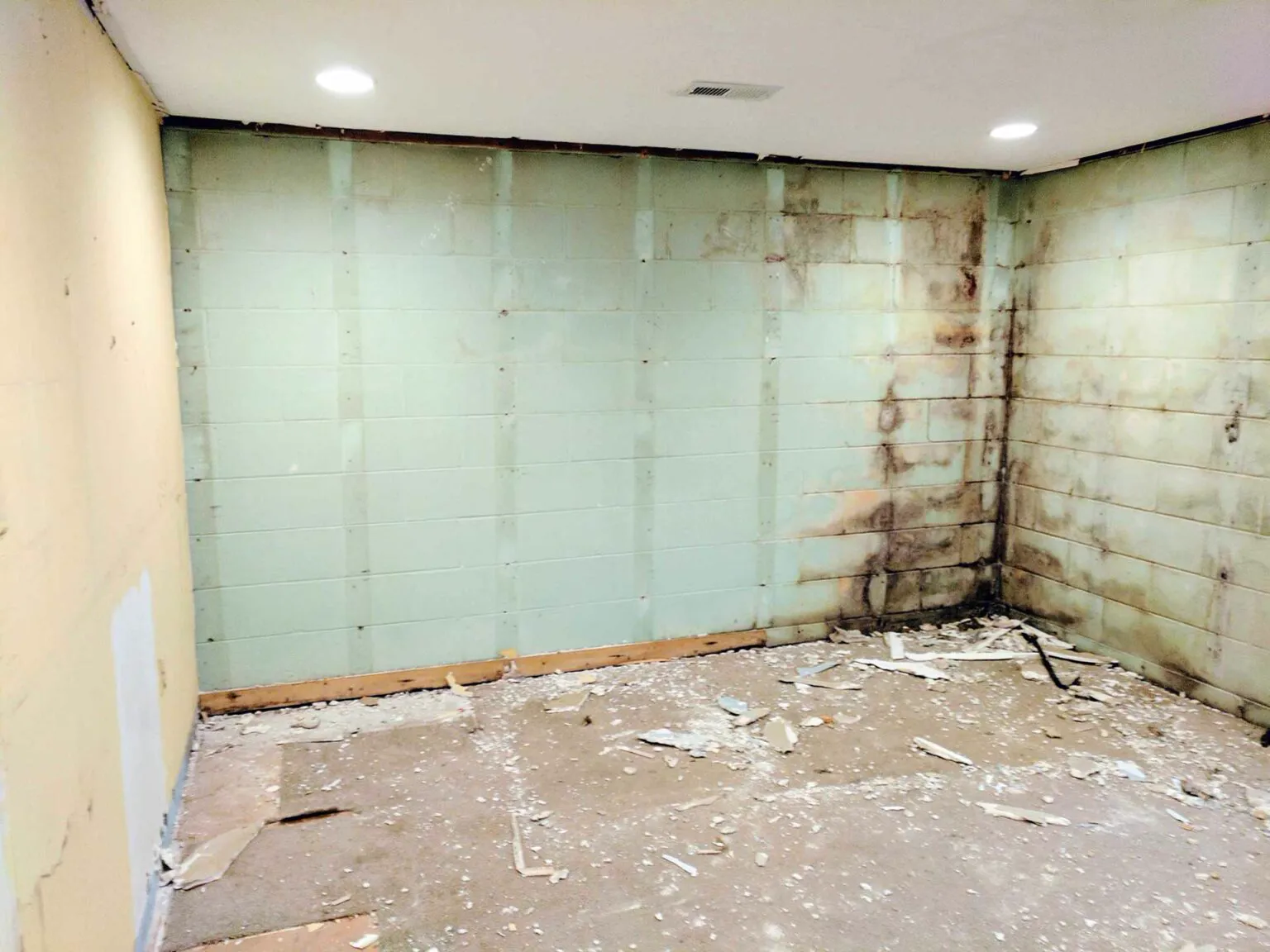
Here’s the thing about our dirt. Georgia red clay soaks up rain and swells, then dries and shrinks. As it swells, it leans on your basement walls. A wall can face thousands of pounds of push from saturated clay, and that force has a name — hydrostatic pressure. It’s strong enough to move water through solid concrete, no crack required.
That’s why the first sign is rarely dramatic. Instead, you get a damp stain, a musty smell, or carpet that feels cool in one spot. The seam where the wall meets the floor is the easiest door in the house, so water uses it. For the plain science on how groundwater moves, the U.S. Geological Survey’s groundwater basics explains it well.

Good news
A wet basement and a failing foundation are two different conversations. Most homes we look at only need the first one, and we’ll tell you plainly which one you’re in.
Option A: what is interior drainage?
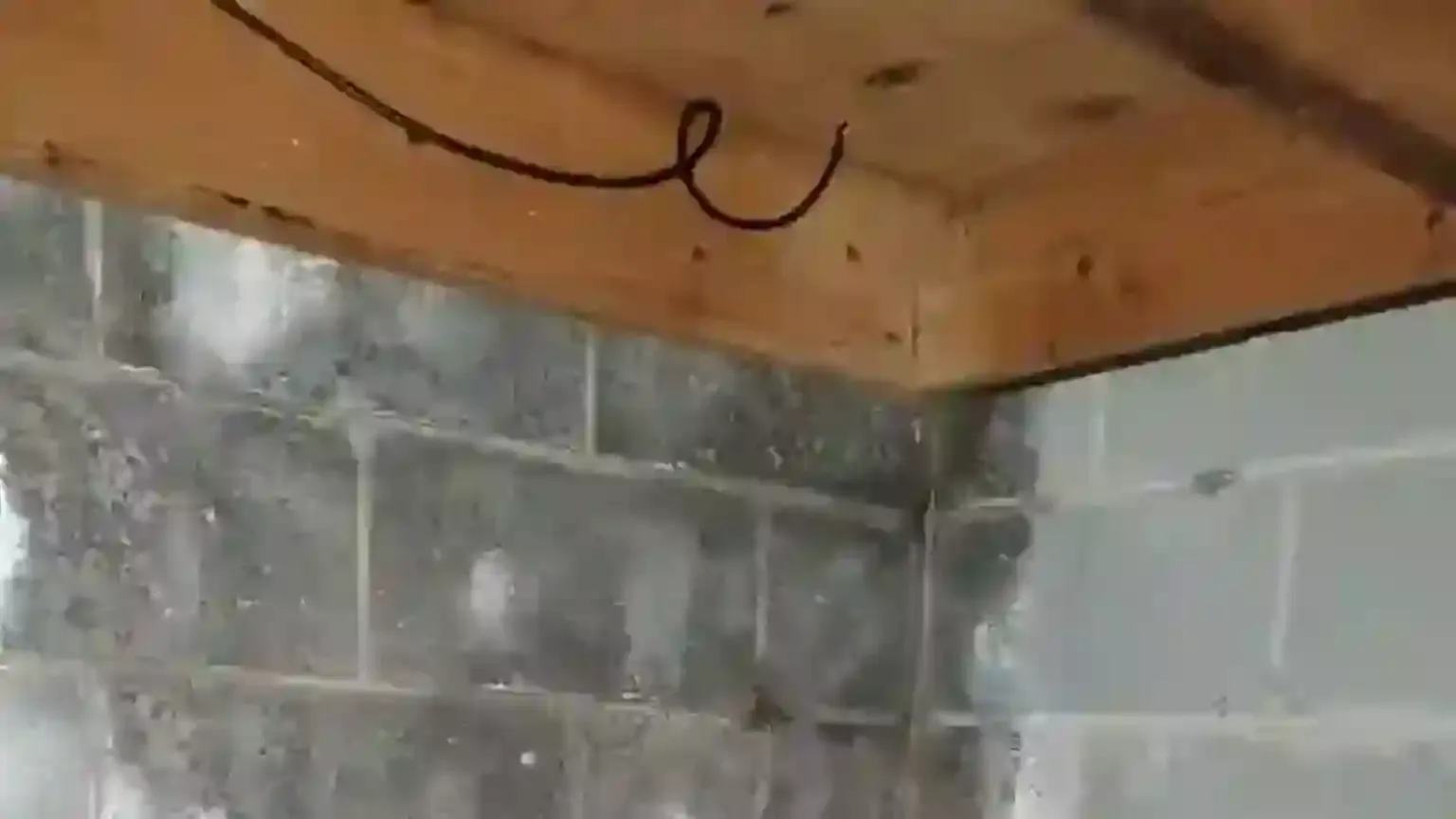
Picture a narrow channel cut into the edge of your basement floor, around the walls that leak. Perforated pipe goes in that channel, in clean stone, below floor level. Water drops into the pipe and travels to a sump basin. Then a pump sends it far from the house instead of dropping it beside the foundation for another lap. Fresh concrete closes the channel back up, a wall liner goes on where it’s needed, and your floor looks like a floor again.
When it wins: most of the time, frankly. Interior work doesn’t care what’s in your yard — decks, patios, a pool, or an HOA that would rather not see an excavator on the lawn.
What it costs: price rides mostly on linear feet of wall. One wall in an unfinished basement sits at the low end. A full perimeter under a finished basement runs much higher, because there’s careful work before the real work.
The trade-off: we’re managing water after it reaches the wall, not before. For a Johns Creek basement, that’s usually fine.
Option B: what does exterior waterproofing involve?
This one is bigger, and it’s exactly what it sounds like. We dig down along the outside of the foundation to the footing. Then the wall gets cleaned, patched and coated with a waterproof membrane. New drain tile goes in at the footing, and the soil goes back with better grading than it had before. Water never touches the wall, because it gets caught in the dirt first.
When it wins: when the outside is clearly the problem. Walkout basements cut into a slope are the classic case, and Johns Creek has plenty. If a hillside dumps into one wall every storm, or the original 1990s membrane has given up, going outside solves it at the source.
What it costs: more, usually a lot more. You’re paying for machines, hauling and putting the yard back together. Depth matters too, since a nine-foot wall is a different dig than a walkout buried three feet.
The trade-off: your landscaping has a rough week. Anything in the way — a deck, a patio, a big holly your mother-in-law planted — has to be moved. That’s where budgets grow.
How do they compare, straight across?
Interior drainage
- Works in almost any basement, finished or not
- Yard, deck and patio stay untouched
- Usually one to three days of work
- Lower cost per foot of wall
- Handles cove-joint seepage well
- Needs a sump pump, which has a service life
Exterior waterproofing
- Stops water before it reaches the wall
- Fixes bad grading and dead drain tile too
- Longer job, heavier equipment
- Higher cost, plus landscaping repair
- Best on walkouts and slope-fed walls
- Blocked by patios, decks and tight lot lines
Notice that neither column says “better,” because neither one is. They solve different halves of the same problem, and the right pick depends on your lot.
Why are two estimates thousands apart?
Alright, this next part is the reason two quotes can look like they’re describing different houses. Homeowners here compare proposals line by line, which is smart — but the lines often measure different things.
What’s really moving the number
- Linear feet. One wall or four? This is the biggest gap between quotes, and it hides in the fine print.
- Depth of the dig. On exterior work, every extra foot of wall multiplies the labor.
- Finished space. Pulling and rebuilding drywall, trim and flooring is real work, and some bids quietly leave it out.
- Sump and backup. A new basin and a battery backup cost more. They also run during the storm that kills your power.
- Landscape restoration. Ask who’s putting the yard back. If nobody says, that’s your answer.
- Wall condition. Cracks or bowing mean structural repair comes first. Waterproofing a moving wall is money spent twice.
So line your proposals up by scope before price. A cheap quote and an expensive one are often the same crew doing different amounts of work.
Twenty years in, here’s what changed our thinking: we stopped blocking water and started routing it. Water wins a shoving match every time. Give it an easier way out and it stops arguing.
So which one would we pick for your house?
You asked for a recommendation, not a shrug, so here it is. For most Johns Creek basements, we’d start with interior drainage. It handles the cove-joint seepage that dominates around here, it leaves your landscaping alone, and it costs less for the same length of wall.
We’d go outside instead when three things line up: the water clearly comes from one slope-fed wall, that wall is shallow or a true walkout, and the yard is already open. Under those conditions, exterior work is the cleaner fix — and we’ll say so even though it’s the bigger ticket.
Here’s the part nobody expects us to write down, though. Sometimes you need neither. We’ve walked basements off State Bridge Road where the whole problem was a downspout dumping four feet from the wall. That’s an afternoon and a fraction of the cost, and if that’s your situation, we’ll hand you the plan and go home.
Homeowners near Jones Bridge Park hear that one a lot, since those lots sit low and surface water is usually the culprit.
What should you do every year once it’s fixed?
Now the part almost nobody hands you at the end of a job: the yearly maintenance list. A good system does the heavy lifting, but ten minutes twice a year keeps it boring — and boring is the goal.
- Test the pump in February. Pour a bucket of water into the basin and watch it kick on. Storm season runs March through May, so test while nothing’s at stake.
- Clear the discharge line. Check that the outlet isn’t buried under mulch or leaves. A blocked discharge turns a great system into a decoration.
- Clean gutters twice a year. Johns Creek is wooded, which is lovely until October. Overflowing gutters drop roof water right where you least want it.
- Check downspout extensions. Each should carry water six feet out. Mowers bump them constantly.
- Look at the grade. Soil should fall away from the house. Clay settles, so add dirt where it’s dished — not mulch.
- Replace the backup battery on a calendar. Batteries fade quietly, so don’t wait for a hunch.
That’s the whole list. Do it and you’ll go years without thinking about your basement, which is exactly the feeling we’re selling. Not a pipe in the floor — a storm you get to ignore.
Timing helps too. Watch the outlook through the National Weather Service office covering our area, since booking in a quiet month means a shorter wait.
Why does hiring local matter here?
Because a warranty is only as strong as the company behind it. We’ve worked in this city for years, so we know how water behaves on these slopes. If something needs attention in year six, you’re calling the people who did the work — not a call center in another state.
Want to compare notes first? Our page on the systems we install covers basement waterproofing in detail, and our local waterproofing company guide explains how we run a job start to finish. Neighbors one town over can read the same breakdown for Alpharetta waterproofing options. If your house has a crawl space instead, start with crawl encapsulation.
Where we work around Johns Creek
We’re based in Lawrenceville, about twenty minutes east, so we’re in Johns Creek constantly. We also cover Alpharetta, Duluth, Suwanee, Roswell, Milton and Peachtree Corners, plus Berkeley Lake, Norcross and the wider Fulton area.
Questions Johns Creek homeowners ask us
It helps in two ways. A dry basement with a transferable warranty removes a common inspection issue during a sale, and it makes the lower level worth finishing. In a city with this many finished basements, usable square footage carries weight with buyers.
Usually within a few days, and sooner outside of spring storm season. Live support runs 7 a.m. to 8 p.m., seven days a week, so you can call after work. The inspection and the estimate are both free.
It depends on how much wall is involved, whether you need a sump, and how much finished space has to come out first. Small drainage corrections sit at the low end, while a full perimeter system in a finished basement sits at the high end. You get a written number with the scope spelled out, never a phone guess.
Most interior systems run one to three days on site. Exterior work takes longer, because digging, coating and backfilling each need their own time. You get a day-by-day plan before we start, so nothing is a surprise.
Only the perimeter. We need about four feet of clear space along the walls we’re working on, so shelves and boxes shift toward the middle. You don’t have to empty the room, and we’ll help with the heavy things.
Let’s figure out which option your Johns Creek basement actually needs
The inspection is free, the estimate is free, and there’s no pressure at the end. We’ll show you where the water gets in, walk you through both paths, and say honestly if the smaller fix is the right one.
(678) 914-5112Serving Johns Creek and all of Metro Atlanta · $500 off projects over $3,500 · Live support 7am–8pm, 7 days a week