

Waterproofing Cost Cumming Homeowners Can Plan For: A Step-by-Step Breakdown
The steps, the timeline, what moves the number, and where DIY stops working.
Here’s a strange kind of comfort: if water showed up in your basement this spring, it almost certainly showed up on your street too. That’s the first honest thing to say about waterproofing cost Cumming homeowners are trying to budget for. You’re not the one unlucky house on the block.
Subdivisions get built in waves. The homes around you were graded in the same season, backfilled with the same dirt, and given the same builder-grade waterproofing on the same schedule. So when one house starts weeping at the floor seam, neighbors usually follow.
A lot of folks here are shocked to find water in a house that still feels new. But twenty years is exactly when builder-grade waterproofing starts to give up. That’s not a defect — it’s a service life running out, the same way a water heater’s does. Good news? This is very fixable.
Why does a whole street get it at once?
Because water follows the ground, and our ground has opinions. South Forsyth sits on red clay, and clay swells when it drinks. As it swells, it presses on your foundation hard enough to push moisture through concrete that looks perfectly solid. Concrete is porous, so you don’t need a crack for water to arrive.
Then add grade. Lots run downhill toward Lake Lanier one way and uphill toward Sawnee Mountain the other, so some homes catch runoff from three yards away. Meanwhile, backfill around newer foundations keeps settling, and as it drops it tips soil back toward the house.

None of that means your foundation is in trouble. A wet basement and a structural problem are two different conversations, and most homes we walk through only need the first. We’ll tell you plainly which one you’re in.
What actually happens, step by step?
Most interior systems follow the same shape, so you can picture the week ahead.
- We find the source. Before pricing anything, we walk the outside — grading, downspouts, where roof water lands. Then we walk the inside with you. Sometimes the fix is outside and cheaper than expected.
- You get a written scope. Not a range, not a “starting at.” Real footage, real materials, one number.
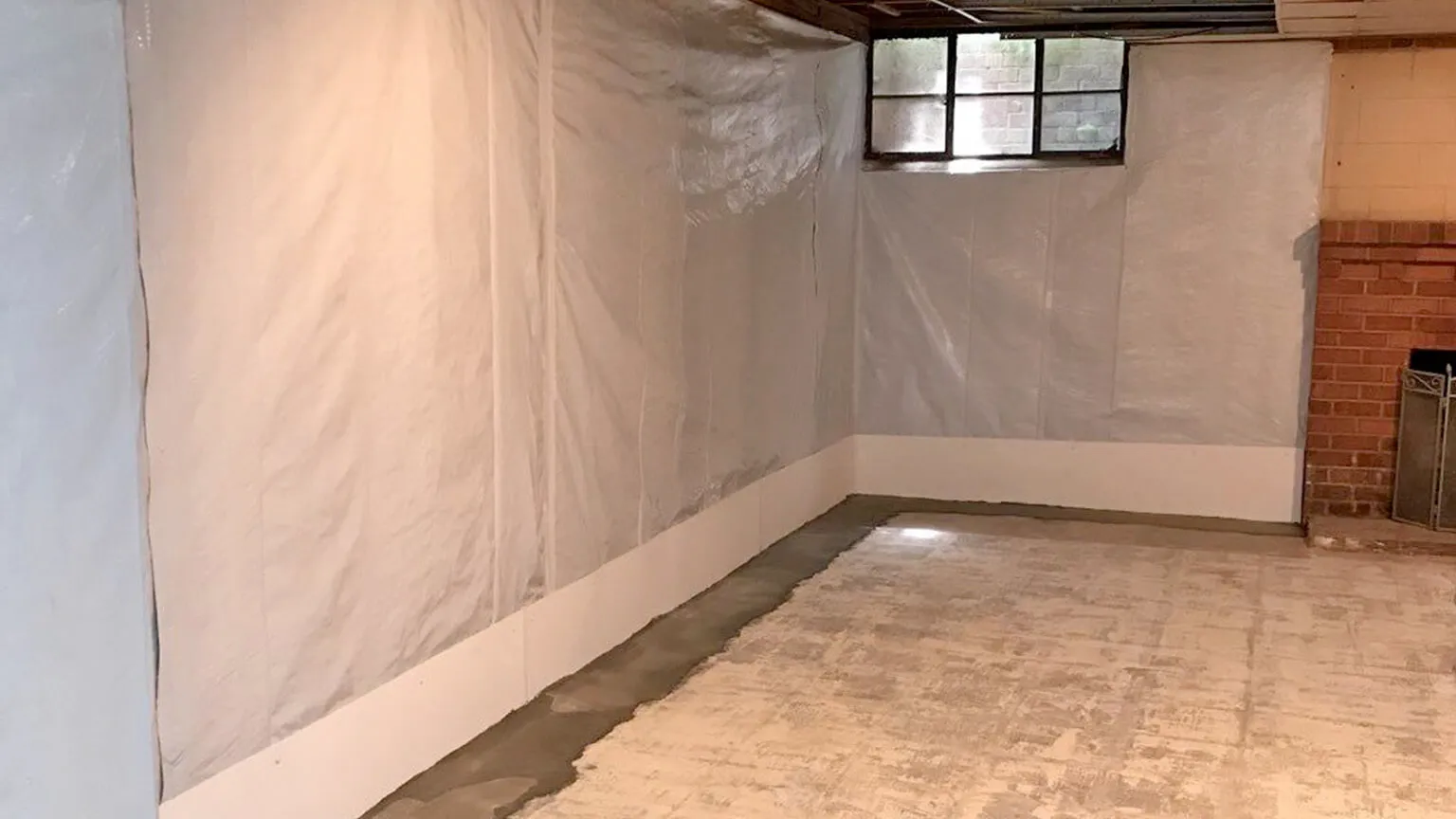
- A channel opens at the perimeter. A narrow strip of slab comes up along the wet walls. It’s loud for a day, so we seal off the rest of the house.
- Drainage goes in below the slab. Perforated pipe sits in clean stone under floor level, which means water gets collected before it ever reaches your floor instead of after.
- Everything routes to a sump. The pump carries water well away from the house — not beside the foundation, where it would loop back for a second try.
- We close up and clean up. Fresh concrete over the channel, wall liner where it belongs, and our debris leaves with us.
Step four is the whole philosophy. Older thinking tried to block water at the wall, but pressure never quits and sealants always age. Instead, we give water an easier path than the one it’s taking. Give it somewhere simple to go, and it stops being creative about your floor.
So what moves the price?
Straight answer: the waterproofing cost Cumming homeowners see comes down to how much wall is involved and how hard it is to reach. Anyone quoting a flat number over the phone is guessing.
What drives the number up or down
- Linear feet. One wall versus a full perimeter is the biggest factor by a wide margin.
- Access. An open basement is simple. A finished one with a bar and built-ins means careful work before the real work.
- Sump needs. Some houses have a usable basin. Plenty built around 2000 are still on the original builder pump.
- Walkouts and window wells. Very common in South Forsyth new construction, and each needs its own detail.
- What’s happening outside. Regrading and moving downspouts sometimes solves most of it. Smaller invoice, and we’ll say so.
- Battery backup. It adds cost, but it runs during the storm that knocks out power — the same storm that fills basements.
Small drainage corrections land at the low end, while a full perimeter with a new sump and backup power sits at the top. Most jobs land between. A free inspection is what turns that waterproofing cost Cumming range into your actual number.
Where do homeowners get steered wrong?
Here’s the part that costs real money, and it usually isn’t the homeowner’s fault. When water appears, the instinct is to seal the spot it came from. So out comes the hydraulic cement — and for about four months it looks like a win.
Then it comes back, often two feet to the left. Water wasn’t really coming through that one crack; it was trying every door on the building. Waterproof paint is a fine product, but it’s a coating, and a coating can’t out-argue pressure. It’s a raincoat on a submarine.
The other detour: a company that quotes exterior excavation no matter what a house needs. Exterior work is legitimate and sometimes exactly right. However, it means digging out landscaping, and on newer lots around the Cumming City Center district a patio often comes out too.
The question isn’t interior versus exterior. It’s where the water gets in, and which fix leaves you with less to rebuild.
That’s why we walk both sides of a house first. Two homes on one street can honestly need two different answers, which is why an estimate has to happen at your address. For the full comparison, our rundown of waterproofing options lays each approach out side by side.
How long does it take, and what do you prep?
Most interior systems run one to three days on site. A single wall can wrap in a day, while a full perimeter with a new sump takes two or three. Concrete then cures a couple of days, so plan on about a week before furniture goes back.
Your prep list is short, which surprises people. We need roughly four feet of clear space along the walls we’re working on, so shelves, bins and the treadmill nobody’s touched since spring move toward the middle.
- Clear a path from the driveway, since equipment comes and goes.
- Plan for noise on cutting day. Dogs especially appreciate a few hours elsewhere.
- Point out anything fragile, and it gets protected first.
What can you honestly do yourself?
Quite a bit, actually. Much of the water in Forsyth County basements starts within ten feet of the house, so weekend work matters more than most contractors admit. Extend downspouts six to ten feet out. Clean gutters twice a year. Build soil up so it slopes away from the wall.
Those moves are cheap, and sometimes they’re the whole fix. The EPA’s guidance on moisture control covers the indoor half well. Watching the weather pattern helps too, since the National Weather Service office in Peachtree City tracks the spring storms that push our phones off the hook.
Here’s where it stops, though. You can’t DIY below the slab. Cutting concrete, setting pipe at the right pitch and routing discharge away from the foundation is equipment work, and a wrong slope undoes all of it. So the honest line is simple: outside is yours, below the floor is ours.
One Windermere basement, and how it turned out
One story sticks with us. A homeowner in Windermere called in early spring with a stain along the back wall and a smell at the bottom of the stairs that no candle was beating. Their house went up in the early 2000s and had never leaked once, so they were sure something serious had broken.
What we found outside was almost boring. Two downspouts dumped right at the corner, and twenty years of settling had tipped the grade toward the wall. Inside, the builder’s original sump still ran, but it ran constantly. Nothing structural — just a system at the end of its life.
So we regraded that corner, extended both downspouts past the bed line, ran a channel along the two wet walls, and set a new sump with battery backup. Three days on site. By the next real storm the floor stayed dry, and the smell was gone before the concrete finished curing. That fall they finished the space.
How do you know it was done right?
Ask four questions and you’ll know more than most buyers do. Does the drainage sit above the slab or below it? Where does the discharge line end, since a pipe stopping three feet out just recycles the problem? What happens when power fails? And can they explain the written warranty in one sentence?
After that, watch the first hard storm. A working system is quiet and boring: the pump cycles, the floor stays dry, the air smells like nothing. Boring is the goal. Better yet, if anything needs attention in year six, a local crew still runs past Fowler Park weekly.
Still sorting out what’s happening at your place? Our walkthrough of basement waterproofing explains each system, and if the trouble sits under a low, musty area instead of a full basement, crawl space encapsulation is likely the better path. Comparing notes with family closer to town? Our Decatur waterproofing cost guide covers the same ground.
Where we work around Cumming
We’re based in Lawrenceville, about thirty minutes south, so our trucks run up GA-400 and across Peachtree Parkway most weeks. Along with Cumming, we work throughout Alpharetta, Milton, Suwanee, Buford, Gainesville and Dawsonville, plus the wider Forsyth area. Whether you’re in newer South Forsyth construction or on a lot draining toward Lake Lanier, we’ve likely worked nearby already.
Questions Cumming homeowners ask us
Neither wins automatically — it depends on where water enters and what sits on the soil outside. Exterior work stops water before it touches the foundation, but it means excavating, so a patio or mature landscaping changes the math fast. Interior drainage is less disruptive and fits most South Forsyth basements well.
The drainage is built to last the life of the house, since it’s stone and pipe below the slab with nothing to wear out. Your pump is the part with a service life, so plan on replacing one around the ten-year mark, the way you’d plan for a water heater.
Yes, and you get it in writing before work begins rather than after. Ask us to walk through what’s covered and what isn’t, because a warranty nobody can explain simply isn’t doing you much good.
Usually, yes. We remove a narrow band of flooring and the bottom of the drywall along the wet walls, then put it back. It costs more than an open basement because of that prep, but your media room and built-ins generally stay put.
It helps two ways. A documented, warrantied system answers the question every buyer’s inspector asks about a Forsyth County basement, and a dry lower level becomes finishable square footage instead of storage nobody trusts.
Let’s find out what’s going on under your Cumming home
The inspection is free, the estimate is free, and nobody pressures you afterward. We’ll show you where water gets in and what it takes to stop it — even when the answer is simpler than expected.
(678) 914-5112Serving Cumming and all of Metro Atlanta · $500 off projects over $3,500 · Live support 7am–8pm, 7 days a week