

Standing Water Basement Cumming: Where It Comes From and How It Gets Fixed
A calm look at the puddle on your slab — what it means, and the repair that ends it.
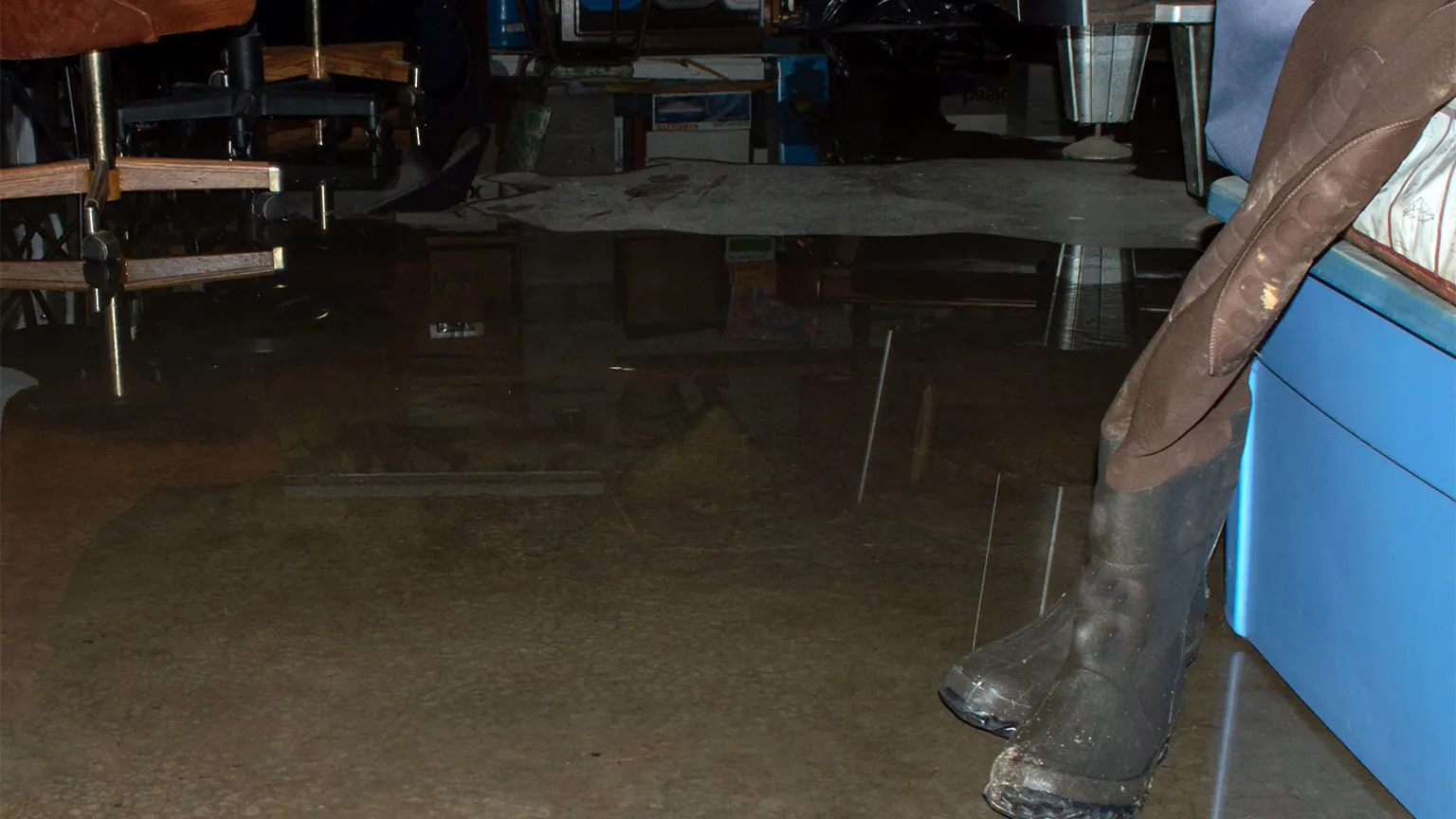
One inch of water spread across a 1,000-square-foot basement floor is about 623 gallons. That’s roughly 5,200 pounds sitting on your slab, and most homeowners walk down and see a shallow puddle. So if you’re dealing with the kind of standing water basement Cumming homeowners find after a big storm, the volume isn’t a sign your house is in trouble. It’s a sign that water found one easy door and kept using it.
Good news? Puddles are one of the most common calls we take, and one of the most fixable. Let’s go through it the way we would standing next to you.
What should you do before you touch anything?
Kill the power to the basement at the breaker panel first. Standing water and live circuits do not mix, so shut that circuit off before you step down, even if the water looks shallow. If the panel sits in the wet area, call an electrician.
Take pictures too — where the water sits, how deep it looks, what it touched. Insurance people love photos, and so do we, since puddles usually drain before we arrive.
Then move air. Wet cardboard and carpet pad can begin growing mold in roughly 24 to 48 hours, which isn’t a reason to panic — just a reason to open a window, run a fan, and get things off the floor today. The CDC’s guidance on mold cleanup after flooding is a short, sane read.
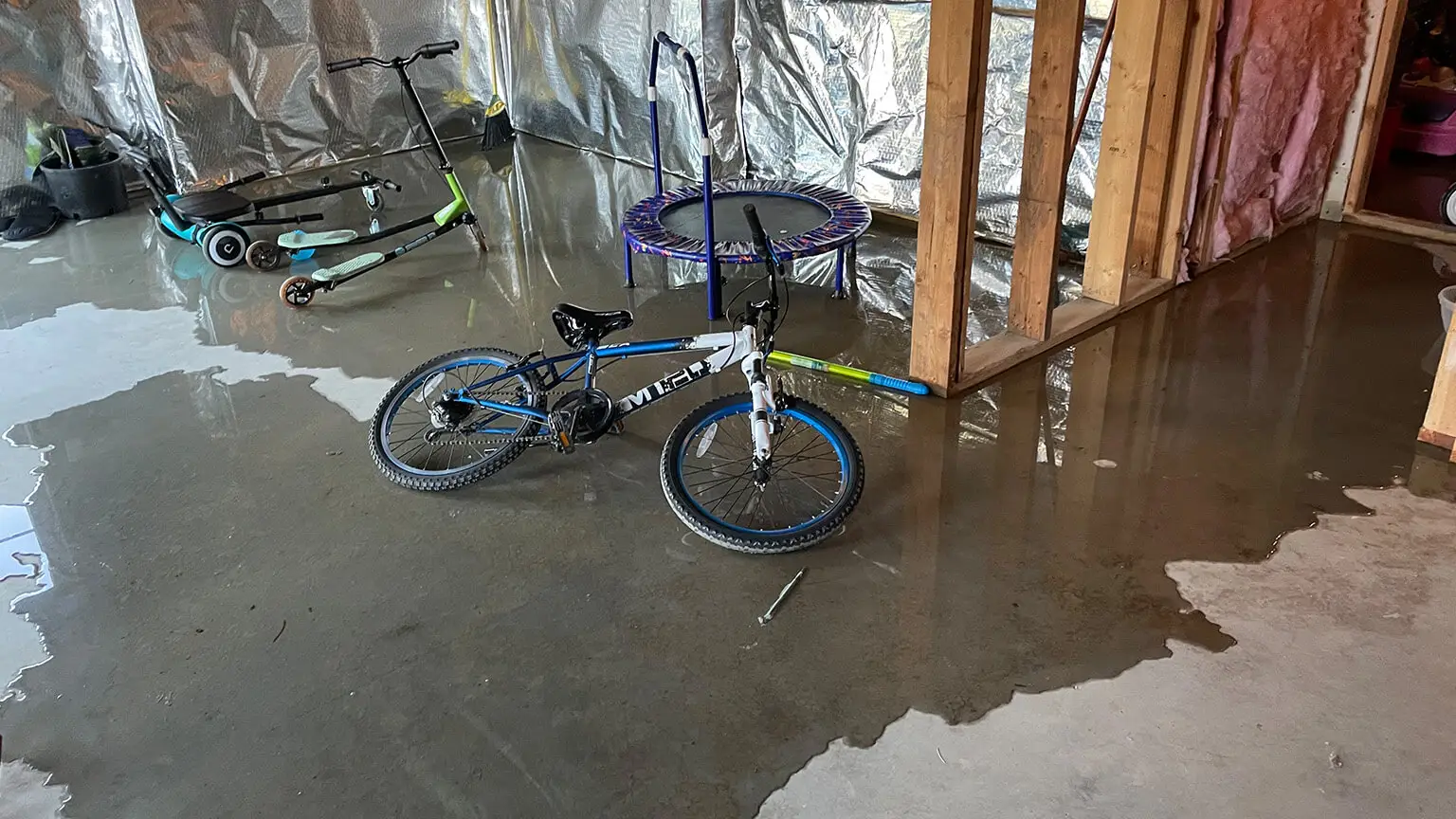
Where is the water actually getting in?
Here’s the thing about puddles: they mean bulk water, not damp air. A musty smell is humidity, but water you can step in came through an opening, under pressure. So we’re hunting a door, not a mystery, and there are four we check first on any standing water basement Cumming call.
The cove joint. That’s the seam where your wall meets the floor slab. Those two pours happened on different days, so they never truly bonded. It isn’t a crack — it’s a seam running your whole perimeter, and water picks the easiest path.
Hydrostatic pressure through block. Georgia red clay holds water against your wall long after the rain quits. As a result, pressure builds and works into the hollow cores of block walls, then exits low, right at the floor. Not dramatic, just patient.
A sump pump that quit. Pumps fail predictably: power drops during the very storm that needed the pump, the float sticks, the pump is undersized, there’s no check valve, or the discharge line is clogged.
A window well with no working drain. Wells fill like buckets once the gravel drain silts up. When water passes the window frame, it comes in fast and lands in one spot.
Read the puddle
Where the water sits tells us a lot. A puddle in one corner points to a local entry — a window well, a pipe penetration, one bad stretch of joint. Water across the whole slab points to pressure underneath. Either way, that’s information, not bad news.
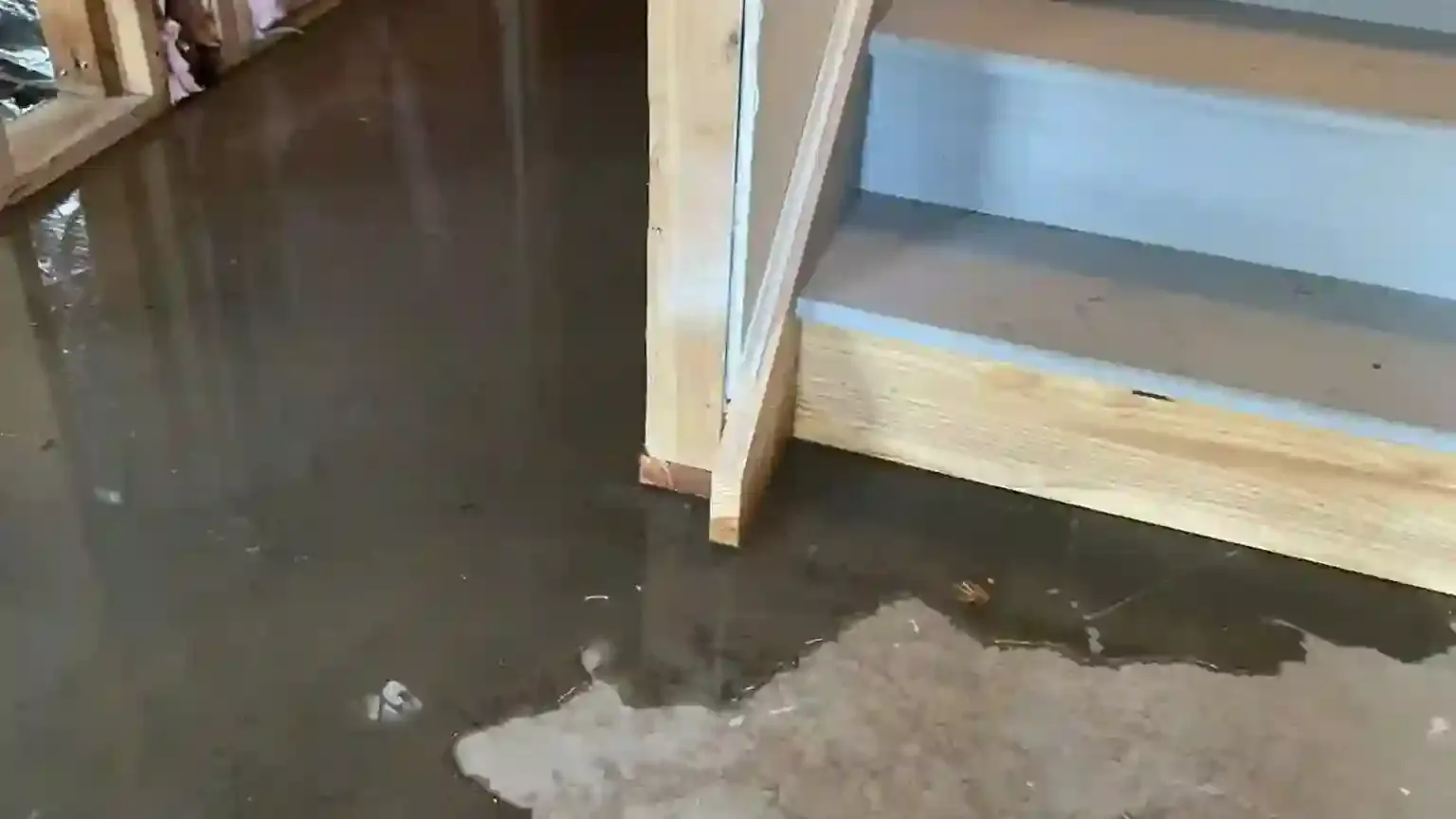
How do you tell mild from serious?
Fair question, and you deserve a straight answer. We sort what we see into three levels, and none mean your house is failing.
Mild is a thin puddle after one heavy storm, gone in a day. Moderate is water every hard rain, plus a stain line along the base of the wall — it arrives on a schedule now. Active means a wide area, or water back within hours of being pumped out. Even active isn’t an emergency, though. The source is simply steady, and guessing is the expensive route.
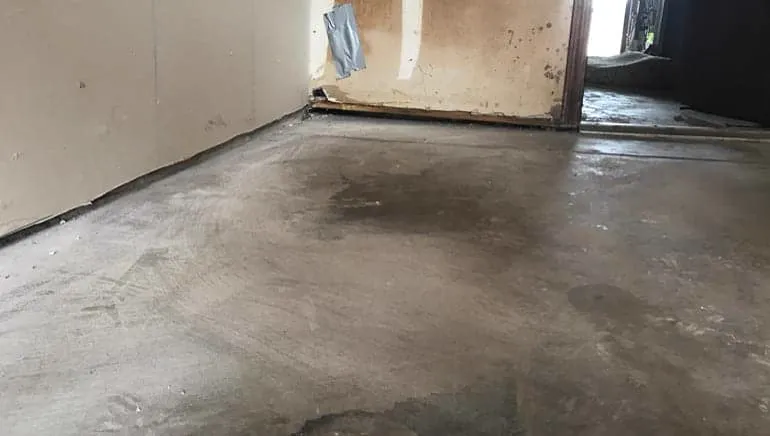
What if you leave it? Honestly, it holds steady a while, then slowly spreads, because clay keeps saturating and the seam keeps opening. The concrete is rarely what costs you. It’s the flooring, the drywall, the boxes down there.
Could the fix be smaller than you think?
Very possibly, and this is the part we wish more people heard first. A basement that floods only in heavy rain almost always has a surface water problem, not a groundwater one — and surface water is usually the cheaper fix. Gutters, downspouts, grading, a window well: that’s a day of work, not a project.
We had a homeowner near Vickery Village sure they needed a full system. Two downspouts were dumping a foot from the wall, and the beds had been built up until the grade tilted toward the house. Fixing the outside handled most of it, so that’s what we quoted.
A lot of Cumming homeowners are surprised to face this at all, because the house still feels new. But twenty years is right about when builder-grade waterproofing gives up — drain tile silts in, the original sump pump ends its life, and backfill soil settles and pulls the grade the wrong way. We see it constantly from the St. Marlo edge over to Hampton Golf Village.
Terrain plays a part too. Forsyth runs from Lake Lanier shoreline to the slopes near Sawnee Mountain, so grade changes are real, and uphill runoff reaches your foundation with help. Meanwhile, some lakeside lots genuinely sit on a high water table after a wet stretch — a different answer entirely.
What does the real repair look like?
Let’s walk it, so nothing surprises you on install day. The idea is simple: stop blocking water, and give it an easier path than the one it’s using.
- Find the source first. We walk the outside — gutters, grade, where roof water lands — then read the inside. If the answer is small, we say so.
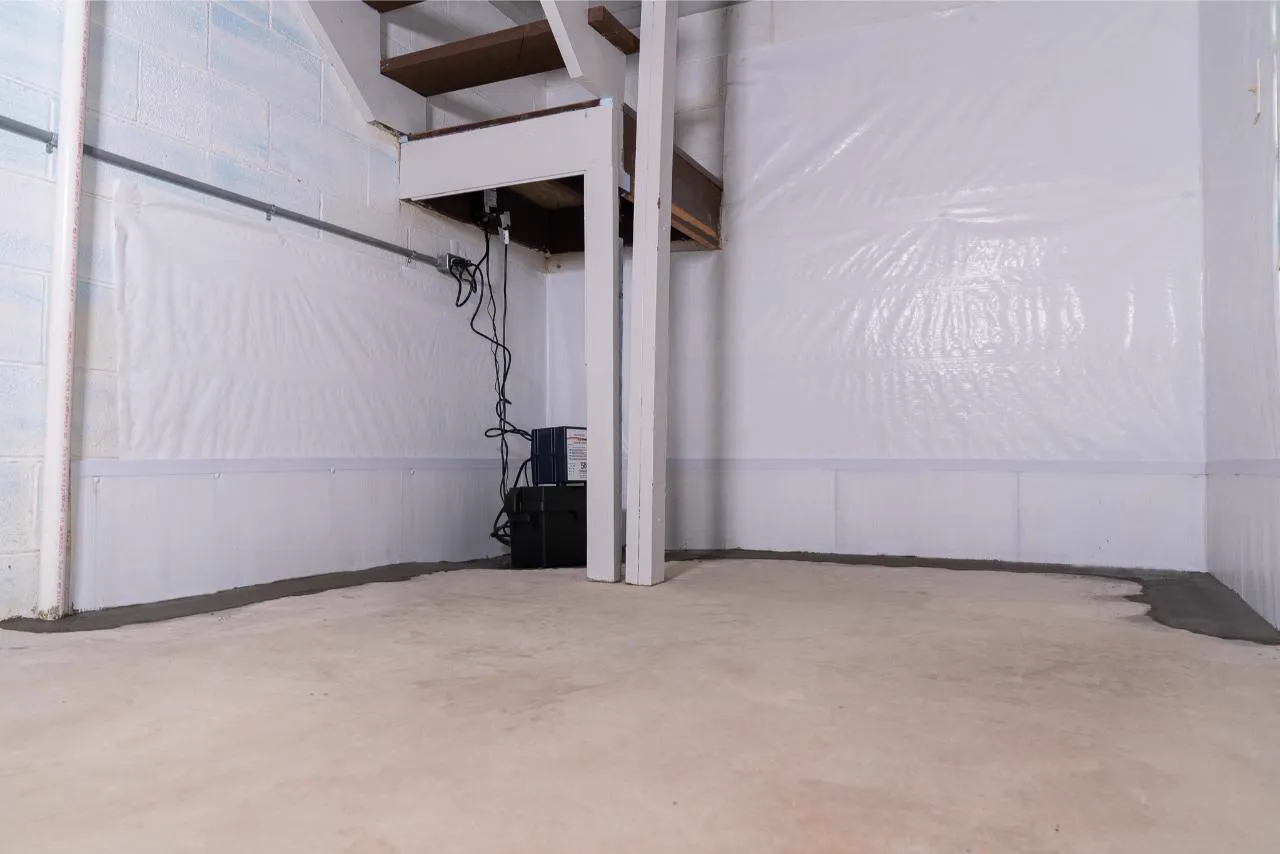
- Open a channel at the perimeter. A narrow strip of slab comes up along the affected walls — loud and dusty for a day, then done.
- Set drainage below the floor. Perforated pipe in clean stone, so water is collected before it reaches your floor.
- Relieve the block cores so trapped water drains into the system instead of pushing out at the joint.
- Route it to a properly sized sump. Right pump for the lot, sealed lid, check valve, battery backup where power loss is a real risk.
- Close it up clean. Fresh concrete over the channel, wall liner where called for, and our mess hauled off.
Notice what’s missing? Paint. A coating can’t beat pressure — it’s a raincoat on a submarine. That’s why we warranty drainage in writing, not a bucket of sealer.
We quit trying to hold water back years ago. Now we assume it’s coming, and we build it a better way out.
Wondering about the number? It moves with wall footage, wall type, access, depth, and whether a pump is part of it — so we walk it before we quote it. Our breakdown of basement flooding cost covers every factor, and the systems are explained on our basement waterproofing page. Seeing stair-step cracking too? Foundation repair is a separate look, and here’s the Decatur standing water basement version for folks inside the perimeter.
What keeps it dry after we leave?
Here’s the annual checkup we hand every customer. It takes an hour each spring, and it separates a system that runs for decades from one that quietly stops.
- Test the sump pump. Pour a five-gallon bucket into the pit and watch it kick on, run, and shut off. If it hesitates, call before storm season.
- Walk the discharge line to the end, checking for crushed pipe, packed mulch, or a critter that moved in.
- Check the battery backup. Batteries have a service life, and since power loss and heavy rain love showing up together, this one earns its keep.
- Clean gutters twice a year, then confirm every downspout carries water at least six feet from the foundation.
- Look at your grade. Soil should fall away from the house, and mulch piles up over time, so reset it.
- Clear window wells of leaves, and make sure the gravel still drains instead of holding water.
That puts you ahead of most homes, and it’s the kind of ahead you feel — one less thing your family thinks about when the National Weather Service flood outlook lights up on your phone.
Why does hiring somebody local matter here?
Because these houses aren’t strangers to us. We’ve spent twenty-plus years on Metro Atlanta basements, plenty of them minutes from The Collection at Forsyth or Cumming City Center, and we’ve worked steep wooded lots and flat cul-de-sacs off Post Road in the same week. So we know how South Forsyth walkouts behave, and which builder-era sump setups are done.
You also get the boring things that matter: a written scope, proof of insurance, a real warranty, and a crew that cleans up. Our shop sits thirty minutes south in Lawrenceville, so the crew doing the work answers the phone in year six.
Picture the other side. It rains hard all night, and in the morning you don’t go check. Instead of a room you apologize for, you have a room the kids use — and a house looking after your family instead of the other way around.
Where we work around Cumming
Cumming is an easy run up GA-400, so we’re in Forsyth County most weeks. We also cover Alpharetta, Milton, Suwanee, Buford, Gainesville, Dawsonville, Johns Creek, Duluth and Roswell. In South Forsyth or out toward the lake, odds are we have a truck nearby.
Questions Cumming homeowners ask us
It depends where the water came from. Most standard policies help with a sudden failure like a burst pipe, but groundwater and surface water usually need separate flood coverage. Many carriers also sell a sump pump failure rider. Call your agent and send the photos you took.
Aim for the same day. Mold can begin growing on wet material in roughly 24 to 48 hours, so getting boxes and rugs off the slab matters more than chasing every drop. Fans, a dehumidifier and an open window handle most of it.
Because saturated clay pushes from below as well as from the side. When that pressure has nowhere to go, it lifts water through the cove joint where wall meets slab, and sometimes through the slab itself. It’s a seam doing what seams do, not a structural failure.
Yes, in the practical sense. A properly built interior drainage system with a correctly sized pump collects water before it reaches your floor, and the stone and pipe under the slab last the life of the house. Only the pump wears out, so plan on replacing one around the ten-year mark.
It ranges widely, because the drivers are linear feet of wall, wall type, access, depth, and whether a new pump is included. An outside drainage correction sits at the low end, while a full perimeter system with a pump sits at the high end. We walk it, then put a real number in writing.
Let’s find out where that water is getting in
If there’s standing water in your Cumming basement, we’ll come look for free, show you the entry point, and explain the fix plainly — even when the answer is smaller than you expected. No pressure at the end.
(678) 914-5112Serving Cumming and all of Metro Atlanta · $500 off projects over $3,500 · Live support 7am–8pm, 7 days a week