

How to Choose the Best Basement Drainage Grayson Homeowners Can Actually Rely On
What the four drainage options really do, how to compare two bids, and the questions that sort a diagnosis from a sales pitch.
Here’s the part nobody tells you when you start shopping for the best basement drainage Grayson has to offer: the cheapest correct fix is often outside the house. Not a system in your basement at all. Just water landing where it shouldn’t and running the wrong way. Good news — that’s the kind of answer a homeowner loves to hear, and an honest crew will say it out loud.
Drainage is the permanent half of a wet-basement problem. Sealing handles the symptom, while drainage decides where the water goes for the next twenty years. So it’s worth ten minutes to understand what you’re buying before three companies hand you three very different numbers.
What are you actually choosing between?
Four things, mostly. Each solves a different entry route, which is exactly why comparing bids on price alone goes sideways so fast.
An interior perimeter drain runs a channel under the slab edge and carries water to a sump pump. An exterior footing drain catches water in the soil before it touches your wall, but it means digging along the foundation. Regrading reshapes the dirt so the yard sheds water away. Downspout extensions move roof water — a shocking amount of water — well past the foundation instead of beside it.
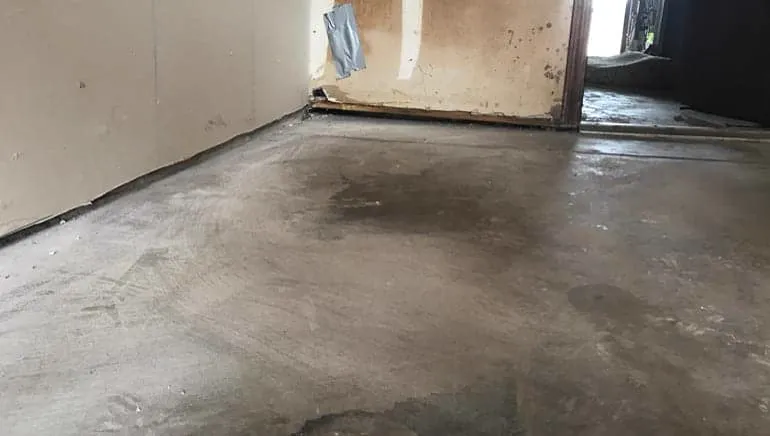
About that joint. Where your wall meets your floor there’s a seam called the cove joint, and it’s the weak spot when wet soil pushes water toward the house. Water doesn’t need a dramatic crack — it takes the seam, because that’s the easy path. An interior perimeter drain relieves exactly that pressure, which is why it’s the workhorse fix here.
But if the water only shows up during heavy rain, you may have a surface water problem instead of a groundwater one. A basement that floods “only when it really pours” is usually fed by the yard and the roof. That’s the cheaper fix, and it’s the one we’d rather sell you.
What makes a Grayson home different?
Start with the yards. Bigger yards in Grayson are great — until a heavy rain, and you realize all that water has to go somewhere, and your foundation sits downhill of it. Lots toward Herrington Trace and Wisteria Park have real open ground, so runoff builds a head of steam before it reaches the house.
Then there’s the dirt. Georgia red clay drains slowly, so after a long rain it holds water against the wall like a sponge nobody wrung out. That’s why grading and downspouts matter more here than homeowners expect. Clay doesn’t forgive a yard that slopes the wrong way by an inch or two.
Good news
A wet basement and a failing foundation are two separate conversations. Most Grayson homes we walk only need the first one, and we’ll tell you plainly when that’s the case.
Age plays a part too. Much of Grayson went up between the mid-1990s and about 2012, so original waterproofing is aging out on the same schedule. Neighborhoods like Grayson Downs have settled two decades’ worth, and grading that was perfect at closing rarely still is. Your basement didn’t fail — it just turned twenty-five.
Terrain adds the last piece. Lots near the Alcovy River and Big Haynes Creek tributaries carry seasonal water, so that soil stays wetter longer. Full basements and walkouts are the norm here, which means more wall in the ground — and more chances for water to find the seam.

Why do two estimates come back thousands apart?
This next part is why two bids for the same basement can differ by thousands, and it has nothing to do with greed. It’s the diagnosis. One company decided water is coming through the cove joint under pressure, so they priced a full interior system with a sump. Another decided your gutters are dumping roof water beside the back corner, so they priced grading and two extensions.
Same stain, same house, very different invoices — and only one of them stays dry. So compare the reason first and the number second.
The best compliment we get isn’t “great work.” It’s “you talked us out of the bigger job.”
Here’s the trap. A company that installs only one system will find a reason to install it in every house, and that’s usually training rather than dishonesty. When a crew is taught to install instead of diagnose, every basement starts to look like a customer.
Sump pumps deserve their own paragraph, because they fail in predictable ways. Power goes out mid-storm. A float sticks. The unit was undersized for the water it’s asked to move. There’s no check valve, so water drains back down the pipe. Or the discharge line clogs. A battery backup is a fair thing to ask about, and a good company brings it up before you do.
Cost, honestly? Downspout and grading corrections sit at the low end. A full interior drain with a new sump and battery backup in a finished basement sits at the high end, and exterior excavation sits above that. Linear feet, access and finished space move the number most. After we walk it, you get one written figure with the scope spelled out — never a “starting at.”
What should you ask before you hire anyone?
Three things separate a real drainage crew from a fast one. Do they find the entry point before quoting? Do they hand you a written scope with measurements? And can they explain why they picked that route over the cheaper one? Three solid answers, and you’re in good hands. That’s really the whole test for the best basement drainage Grayson companies claim to install.
Questions worth asking every company
- Where exactly is the water getting in, and how do you know? A confident answer includes something they saw outside.
- Did you look at my grading and downspouts? On these big lots, that’s where the story usually starts.
- How many linear feet, and why that section? Vague coverage means a vague price.
- Does the drainage sit below the slab? Below floor level is a system. At floor level is a gutter.
- Where does the discharge end up? Well away from the house, not beside the foundation.
- Battery backup and a check valve? Both are cheap, and both matter during a storm.
- Is the warranty transferable, and what voids it? Ask for it in one sentence.
- Who’s doing the work — your crew or a sub? You want whoever signed the warranty.
Red flags get easy to spot after that. Watch for a firm price quoted over the phone before anyone has seen the house, or a discount that expires tonight, since real pricing never needs a countdown. Same goes for an inspection that never leaves the basement, a scope with no measurements, and a warranty that’s described but never handed over on paper.
You don’t have to take a contractor’s word for any of it, either. FEMA’s building science guidance on protecting property from flooding covers drainage basics in plain language. Read a little before your estimates, and you’ll know who’s explaining and who’s performing.

Once it’s fixed, what should you do every year?
Here’s the maintenance list nobody hands you at the end of the job. It takes about twenty minutes a year, and a good system will outlast the folks who installed it.
Clean your gutters twice — once after the spring pollen, once after the leaves drop. Then walk each downspout and confirm the extension still carries water at least six feet out, because mowers and kids move those constantly. After that, pour a bucket of water into the sump basin and watch the pump kick on, so you find a stuck float in April instead of during a July storm.
Next, look at the soil right against the foundation. Clay settles, so a low spot forms over time and quietly aims water back at the wall. Add a few shovels of dirt and slope it away. While you’re out there, check that the discharge outlet isn’t buried under mulch or packed with silt.
Last one: glance at the cove joint after the next hard rain. Dry is dry, and a damp line means call somebody, because small changes are cheap to correct. If dampness has been sitting a while, the CDC’s guidance on cleaning up mold after flooding is a straightforward read.

Why we might be the right fit
We’re in Lawrenceville, about twelve minutes up the road, and we’ve been at this more than twenty years. So we’ve worked plenty of streets between historic Grayson downtown and the neighborhoods past Grayson City Park, plus older lots along Ozora Road. Familiar housing stock means a faster diagnosis, which usually means a smaller job than you were bracing for. If you want the best basement drainage Grayson neighbors have already put to the test, we’ve likely worked a street near you.
Picture the after. A hard March storm rolls through, the floor stays dry, and the musty smell at the bottom of the stairs is gone for good. Your basement becomes a room you use instead of a room you check on. Better yet, you paid for what the problem actually was.

Still sorting out what’s happening down there? Our guide to flooded basement repair covers what to do after the water shows up, and the full range of basement waterproofing options is laid out step by step. Seeing cracks or sticking doors too? That’s foundation repair, a separate conversation. Family one town over? We cover the same ground for Dacula best basement drainage.
Where we work around Grayson
We’re through this part of Gwinnett constantly, from the older streets around historic Grayson downtown out to the newer lots on the east side of town. Beyond Grayson, we work in Lawrenceville, Snellville, Loganville, Dacula, Lilburn, Auburn, Duluth, Buford and Sugar Hill, plus the wider Gwinnett area. Odds are good we already have a truck near you this week.
Questions Grayson homeowners ask us
Sooner is better, and the first day or two matters most. Move what you can, run fans and a dehumidifier, and pull up soaked carpet pad since it holds water longer than anything else down there. Drying quickly keeps a water problem from turning into a materials problem.
Because the seam where the wall meets the floor, called the cove joint, is the easiest path when wet soil pushes water toward the house. Red clay holds water against the foundation after a long rain, and that pressure finds the seam before it finds solid concrete. An interior perimeter drain relieves exactly that.
Yes, as long as the fix matches the actual entry route and gets a little upkeep. Drainage is the permanent half of the problem, so a properly built system plus good grading and downspouts handles it long term. The yearly checkup is what keeps it that way.
It depends on the cause. Grading corrections and downspout extensions sit at the low end, a full interior perimeter drain with a sump and battery backup sits at the high end, and exterior excavation sits above that. Linear feet, access and finished space move the number most, and you get one written figure after we walk the house.
That’s actually encouraging news. A basement that gets wet only during heavy rain almost always has a surface water problem rather than a groundwater one, and surface water is usually the cheaper fix. We’d check grading, gutters and downspouts before recommending anything bigger.
Let’s find out what’s really going on in your Grayson basement
The inspection is free, the estimate is free, and nobody pressures you at the end. We’ll show you where the water is getting in, explain why we’d pick one route over another, and say so plainly when the answer is smaller than you expected.
(678) 914-5112Serving Grayson and all of Metro Atlanta · $500 off projects over $3,500 · Live support 7am–8pm, 7 days a week