

Basement Waterproofing in Lilburn: What It Costs and What to Expect
You’re ready to hire somebody. Here’s the whole picture — the work, the timeline, what moves the price, and what’s covered.
Spring is when the phone rings. Three days of soaking rain roll through Gwinnett, the ground stops taking water, and a basement that behaved all winter suddenly has a wet stripe along the wall. So if you’re pricing out basement waterproofing Lilburn crews can actually stand behind, you’re right on schedule — because March through May is when these houses tell the truth about themselves.
Good news up front: this is fixable. It’s also far more ordinary than it feels at 6 a.m. with a shop vac in your hand.
What is the work, in plain words?
Water sits in the soil around your house and pushes. That push moves water through block and concrete, and here’s the part most folks never hear — concrete is porous. Water travels through solid, uncracked concrete by capillary action, a little like a paper towel soaking up a spill. That’s why a wall can be damp without one visible crack in it.
So the fix isn’t a coating. You don’t out-muscle pressure; you give the water an easier path than your floor. An interior system opens a narrow strip of concrete along the wall, sets perforated pipe in clean stone below the slab, and runs everything to a sump basin. After that, a pump carries it well away from the house.
Exterior work solves the same puzzle from the yard: grading, buried downspouts, drain lines that actually go somewhere. Either way, the goal is a dry floor and a quiet room.
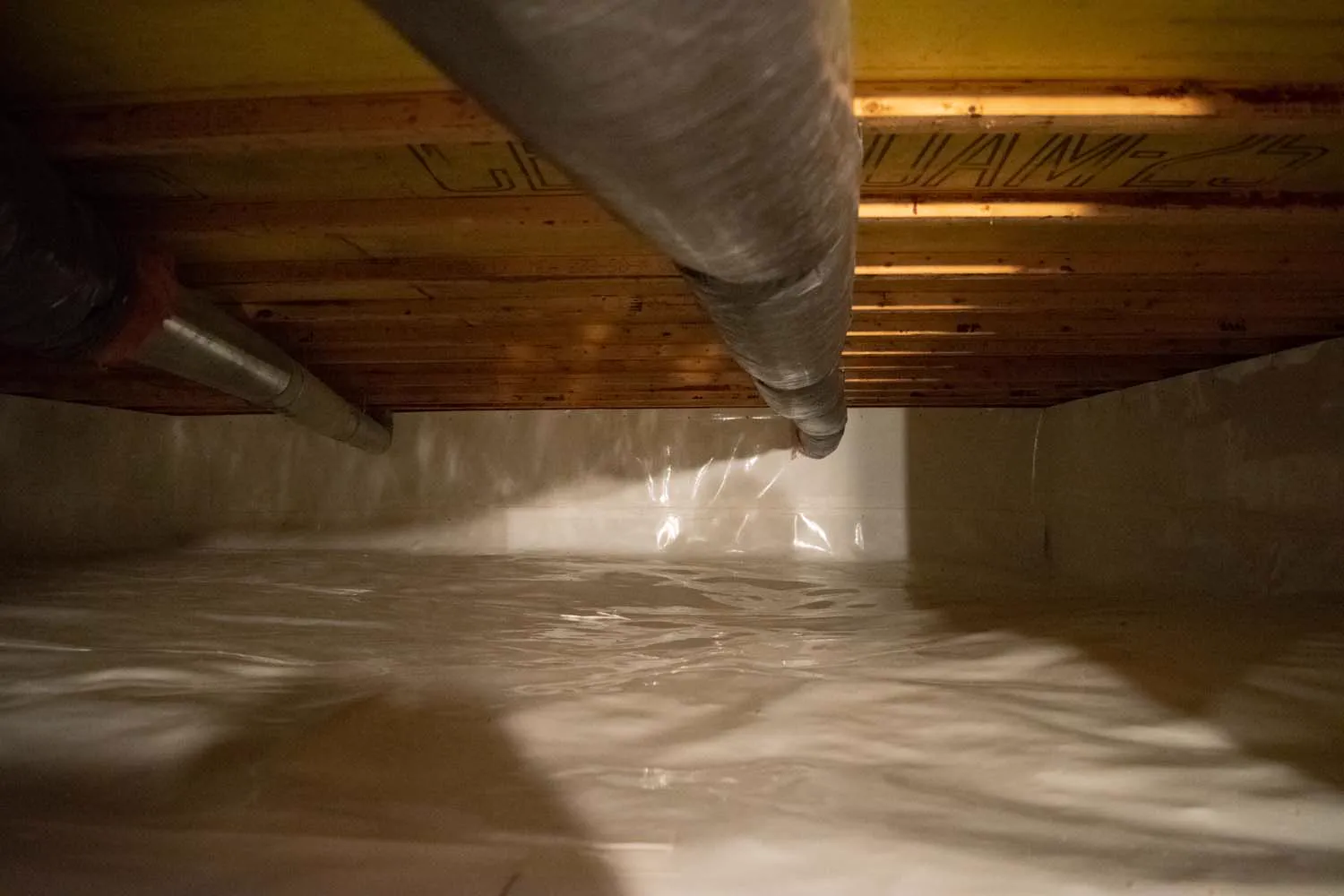
Why do Lilburn basements do this in the first place?
Because of when they were built. Lilburn homes mostly went up in the seventies and eighties, back when “waterproofing” meant a coat of tar on the outside of a block wall and hoping for the best. Fifty years is a long time to hope.
That tar is gone now. Not failing — gone. Meanwhile the footing drain behind it has usually crushed, collapsed, or silted solid with red clay. Add decades of clay swelling and shrinking against the wall, and you get the other pattern we see constantly: horizontal cracks and a slight inward bow near mid-wall.
That sounds worse than it is. A bowing block wall is a well-understood repair, and we handle it with wall anchors or carbon fiber straps depending on the movement. Once it’s braced and the water is redirected, the room goes back to being a room.
Which matters a lot here, since so many Lilburn basements aren’t storage. They’re occupied — a second kitchen, a suite for grandparents, a spot where the kids do homework. When that space is wet, it’s a whole floor you can’t fully use.
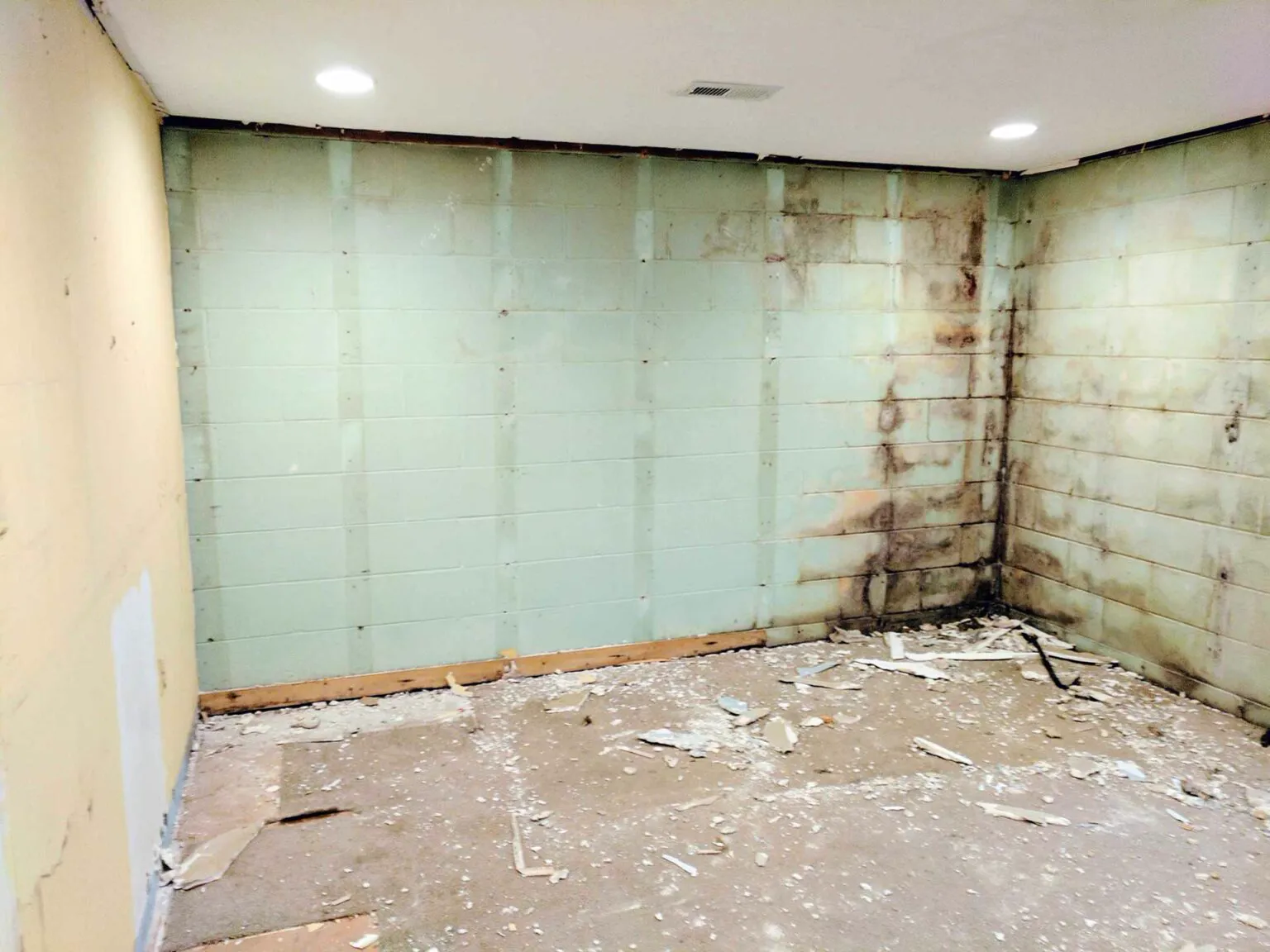
What does a real job look like?
Day zero is the inspection, and it costs you nothing. We walk the outside first, since a good share of the time the answer is in the yard and the invoice gets smaller. Downspouts, grade, old drain lines, that big water oak off the corner — all of it matters before anybody talks about cutting concrete.
Then we come inside and read the walls, checking for bowing with a straightedge instead of a guess. After that you get a written scope: what goes where, and why each wall got what it got.
Install day is loud for a while, then it isn’t. Saw cuts, debris out, stone and pipe set low, sump basin placed, discharge routed away from the house — not politely into the flower bed for a second lap. Fresh concrete closes it up, and the mess leaves in our truck.
Most Lilburn basements run two to four working days. Add a day if the space is finished, and another if a wall needs bracing. One homeowner off the Indian Trail corridor wrapped on a Thursday, and her book club met down there that weekend.
Where do homeowners get steered wrong?
Here’s the thing — Lilburn attracts patch operators, because a fifty-year-old block wall gives them plenty to sell. The three misfires we clean up after are almost always the same, and none of them are your fault for saying yes.
Three fixes that don’t hold
- Waterproof paint on the inside. It looks great for a season. Since the pressure never left, it pushes the coating right off the block, and now you’re patching paint instead of solving water.
- Sealing a horizontal crack and calling it done. A horizontal crack is a pressure message, not a leak by itself. Filling it hides the signal while the wall keeps taking the same load.
- A sump pump with no drainage feeding it. A pump only empties what reaches the basin. Without pipe and stone below the slab, most water still comes in where wall meets floor.
So ask one question of anybody you’re considering: “Where is the water coming from, and how do you know?” A real answer sounds like evidence — this wall, after this kind of rain, because the grade behind it slopes in and the original footing drain is packed with clay. A weak answer sounds like a product name.
Real talk: if nobody walked your yard, that’s a guess, and you’d be paying for it. Anyone confident in a diagnosis is glad to explain it twice. Still sorting out symptoms? Our guide to a wet basement walks through what each sign means.
What actually moves the price?
Mostly how much wall is involved and how hard it is to reach. We won’t publish a flat number, because one price for a bare block basement and a finished in-law suite would be a lie somewhere. Still, here’s the scale we weigh, in order.
Price drivers, biggest first
- Linear feet. One wall versus a full perimeter is the biggest swing by a wide margin.
- Wall condition. A sound block wall is straightforward. Bowing that needs anchors or carbon fiber adds real labor and materials.
- Access. Built-ins, a second kitchen, a finished bath — careful work has to happen before the real work starts.
- Sump and discharge. Some homes have a serviceable basin already. Many seventies builds have none, or one that quietly retired years ago.
- Outside work. Regrading, buried downspouts, replacing a collapsed footing drain. Sometimes that is the whole fix, and we’ll happily say so.
- Tree roots. Mature roots break drain lines around here constantly. Rerouting takes time, though it beats losing the tree.
Small exterior corrections land at the low end. A full perimeter system with wall bracing, a new sump and a battery backup sits at the top. Most jobs land in between, and after we walk it you get one written number with the scope beside it. No surprises later.
Worth mentioning too: our basement waterproofing page shows the systems we install, plus there’s $500 off projects over $3,500.
What’s included, and what’s the warranty?
Included: the inspection, the estimate, the diagnosis, the system, the sump and discharge, the concrete going back, cleanup, and photos of the stone bed and pipe before the floor closes up. Ask for those photos from anyone you hire, because any honest crew already takes them.
Not included, usually: rebuilding finished walls we had to open, replacing damaged flooring, mold remediation, and major plumbing repairs. We flag those during the walkthrough, since nobody enjoys a mid-project plot twist. If moisture reached materials that need removing, the EPA’s guide to moisture and mold is a straight, no-sales-pitch read.
The warranty is plain English and short enough to read in one sitting. It transfers with the house too, which matters in a neighborhood like Rockbridge where homes stay in families and buyers ask sharp questions.

What should you do every year once it’s fixed?
Here’s the part nobody sends you home with. A good system runs for decades on its own, but four small habits keep it boring — and with basements, boring is the whole goal.
Your yearly checklist
- Test the pump each spring. Pour a bucket of water into the basin and watch it cycle. Thirty seconds, once a year, and you’re done.
- Clear gutters twice every fall. Under Lilburn’s mature canopy, leaf drop buries downspouts by November. Folks over near Camp Creek know exactly what we mean.
- Walk the discharge line. Make sure the outlet is still open and still aimed away from the house, since mulch and mowers move things.
- Check the grade after big storms. Clay settles, so pull soil back if it starts sloping toward the wall again.
Spring storms drive most of our calls, and the National Weather Service office in Peachtree City is the honest place to watch what’s heading toward Gwinnett. Run the checklist before storm season, not during it. Better yet, tie it to something you already do — one homeowner near Lions Club Park handles hers the same Saturday she swaps the yard hoses.
Why does a local company matter here?
Because seventies block work is its own skill, and we’ve already met your foundation. Twenty-plus years around Metro Atlanta means we know what the original builders did on these streets and which repairs hold. Same crews, same trucks, no subcontractor roulette.
It also means we’re close. Our shop is about fifteen minutes up the road in Lawrenceville, so a run down Ronald Reagan Parkway puts a truck at your door quickly. We’re in Old Town Lilburn regularly, and if your house sits on a crawl space instead of a full basement, crawl space encapsulation is usually the right answer — different system, same goal. Comparing options across the county? Our Norcross basement waterproofing guide covers what changes just a few exits away.

Where we work around Lilburn
We’re based in Lawrenceville, about fifteen minutes northeast, so we’re through this part of Gwinnett constantly. That covers Lilburn, Snellville, Norcross, Tucker, Stone Mountain, Duluth, Lawrenceville, Grayson, Suwanee and Peachtree Corners. Whether your street sits off Killian Hill or closer to the Yellow River, we’ve worked on foundations built the same year yours was.
Questions Lilburn homeowners ask us
It protects value first, and often adds some. A dry, usable lower level counts as real living space, while a transferable warranty answers the exact question buyers ask about older block foundations.
Usually within a few days, and sooner when water is actively coming in. Lilburn is about fifteen minutes from our shop, so scheduling is easy. Someone answers the phone from 7 a.m. to 8 p.m., seven days a week.
It depends mostly on how many linear feet of wall are involved and whether any wall needs bracing. Small exterior corrections sit at the low end, while a full perimeter system with a sump sits at the top. We won’t quote sight unseen, though after the free inspection you get one written number with the scope beside it.
Most jobs take two to four working days. Add a day for a finished basement, and another if a bowing wall needs anchors or carbon fiber. You get the timeline in writing before we start, so you can plan the week around it.
No, just clear about four feet along the walls we’re working on. Pull things toward the middle instead of hauling them upstairs. We move heavy furniture ourselves and cover whatever stays.
Let’s find out what your Lilburn basement actually needs
We’ll walk the house with you, show you where water is getting in, and explain the fix in plain language — no jargon, no pressure. The inspection and the estimate are both free, so you’ll know your options before anyone talks money.
(678) 914-5112Serving Lilburn and all of Metro Atlanta · $500 off projects over $3,500 · Live support 7am–8pm, 7 days a week