

Standing Water Basement Loganville: What It Means and How It Gets Fixed
Where the water comes in, what the puddle is telling you, and the repair that ends the conversation.
Pin every call we take about water sitting on a basement floor, and a Loganville map fills in fast — along the Highway 81 corridor new construction, through Meadow Glen, and out toward the Ozora corridor. What do those spots share? Big lots, red clay, and ground that leans toward the Alcovy River basin. So a standing water basement Loganville homeowners wake up to after a long rain usually says more about the acre outside than the house itself.
Good news? This isn’t a mystery, and it’s almost certainly not an emergency. Water on a floor is water taking the easiest path it found. Once you see that path, you’re back in charge of your own house.
Where is the water actually getting in?
Short answer first. Standing water is bulk water, not vapor. Damp air and a musty smell are a humidity story, but a puddle is an entry story — and entry stories have an address.
Usually there are four suspects. The cove joint wins most of the time — the seam where your wall meets the floor slab. It isn’t a crack. Those two pieces of concrete got poured at different times, so they never truly bonded, and that seam runs your perimeter like a hairline door.
Then there’s the push behind it. Georgia red clay soaks up a long rain and holds it against the wall instead of draining. As a result, pressure builds, and on a block wall it works into the hollow cores. Water fills them, then arrives low, right where the floor starts.
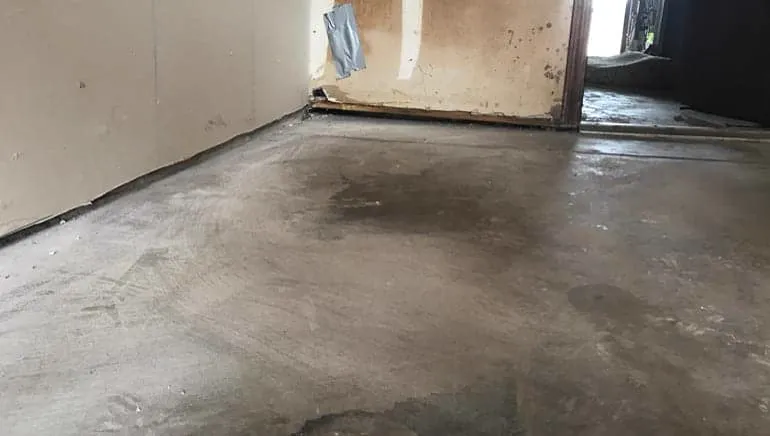
The other two suspects are simpler. One is a sump pump that quit. The other is a blocked drain line, or a window well with no working drain — because a window well with nowhere to send water is a bathtub parked against your foundation.
What is the puddle telling you?
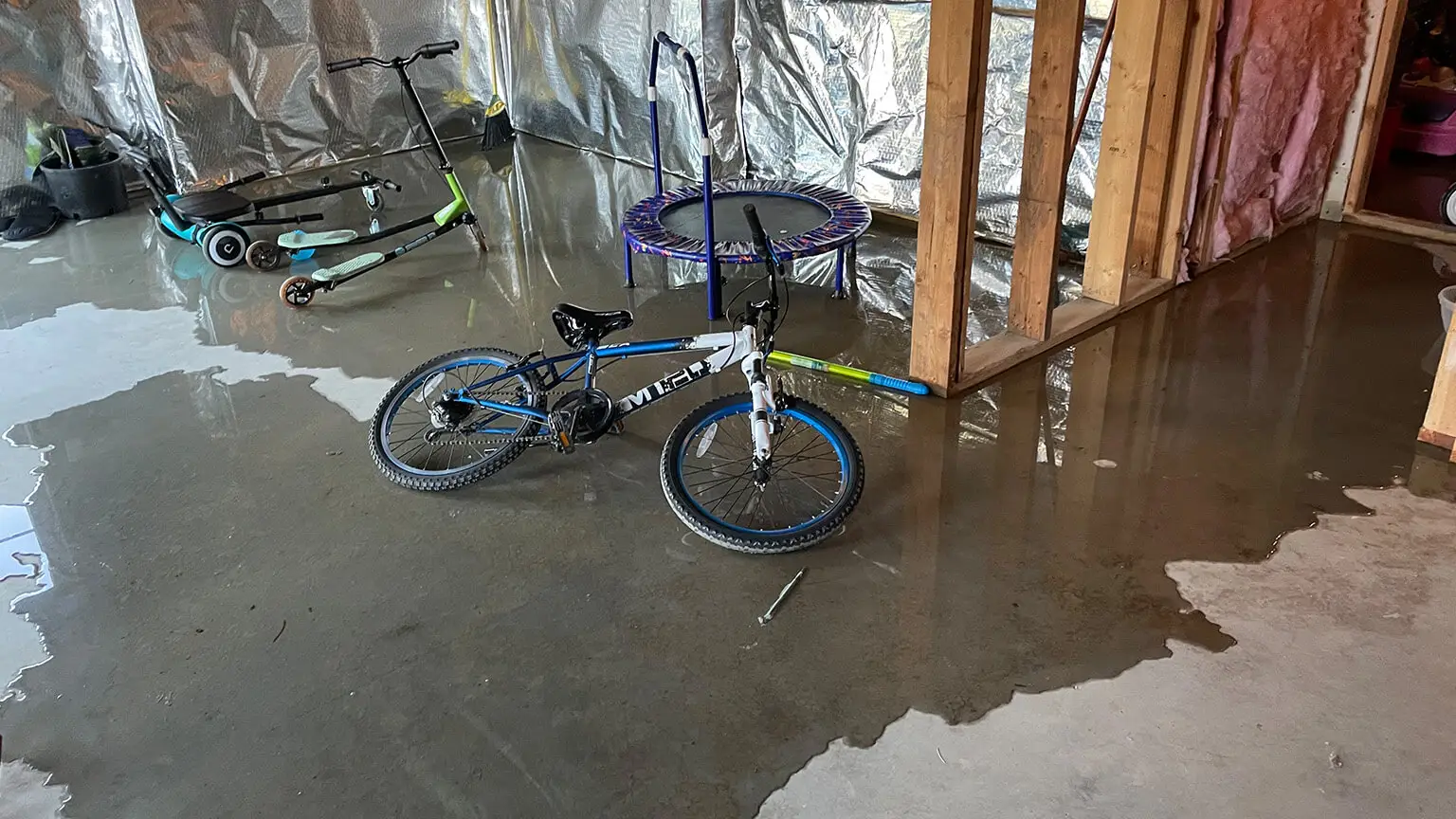
More than you’d think, and you can read it yourself. Water in one corner points to a local entry, like that window well, a pipe penetration, or a downspout dumping above the spot. Water spread evenly across the slab points to pressure underneath it. Either way, you narrowed the search.
One thing first
If water is standing on the floor, shut power to the basement off at the panel before you step down there. Water and live circuits don’t mix. Once that breaker is off, look around and take pictures — they help us a lot.
How bad is it, really?
Fair question, and you deserve a straight answer instead of a sales pitch. We sort what we find into three buckets, and none of them are scary.
Mild. A thin sheet of water after a hard storm that’s gone in a day, and nothing stored down there got soaked. In other words, water showed up, then left.
Moderate. Water returns to the same spot every heavy rain. Baseboards stay soft, and white chalky bloom shows up on the block. At this stage the basement is keeping score.

Active. Inches of water, a pump running nonstop, or water rising through the floor rather than running down a wall. That said, active doesn’t mean urgent. It means we should stop guessing and go look.
What happens if it’s left alone? Honestly, it just repeats, and the soft stuff pays for it — drywall, flooring, boxes. Mold can begin on wet organic material within about 24 to 48 hours, so drying speed matters more than anything you could buy later. Fans and a dehumidifier the same day beat every product on the shelf, and the National Weather Service flood safety guide covers staying safe while water is still there.
What’s different about Loganville homes?
Here’s the thing about houses out this way. Loganville isn’t the Gwinnett core and doesn’t behave like it. Lots are bigger, yards run wide open with no real drainage, and far more homes sit on crawl spaces.
That matters more than people expect. A wet crawl space doesn’t stay down there — damp air rises right up into the house you’re living in, which is why a musty hallway often starts under the floor. So our first question is usually which kind of space we’re talking about.
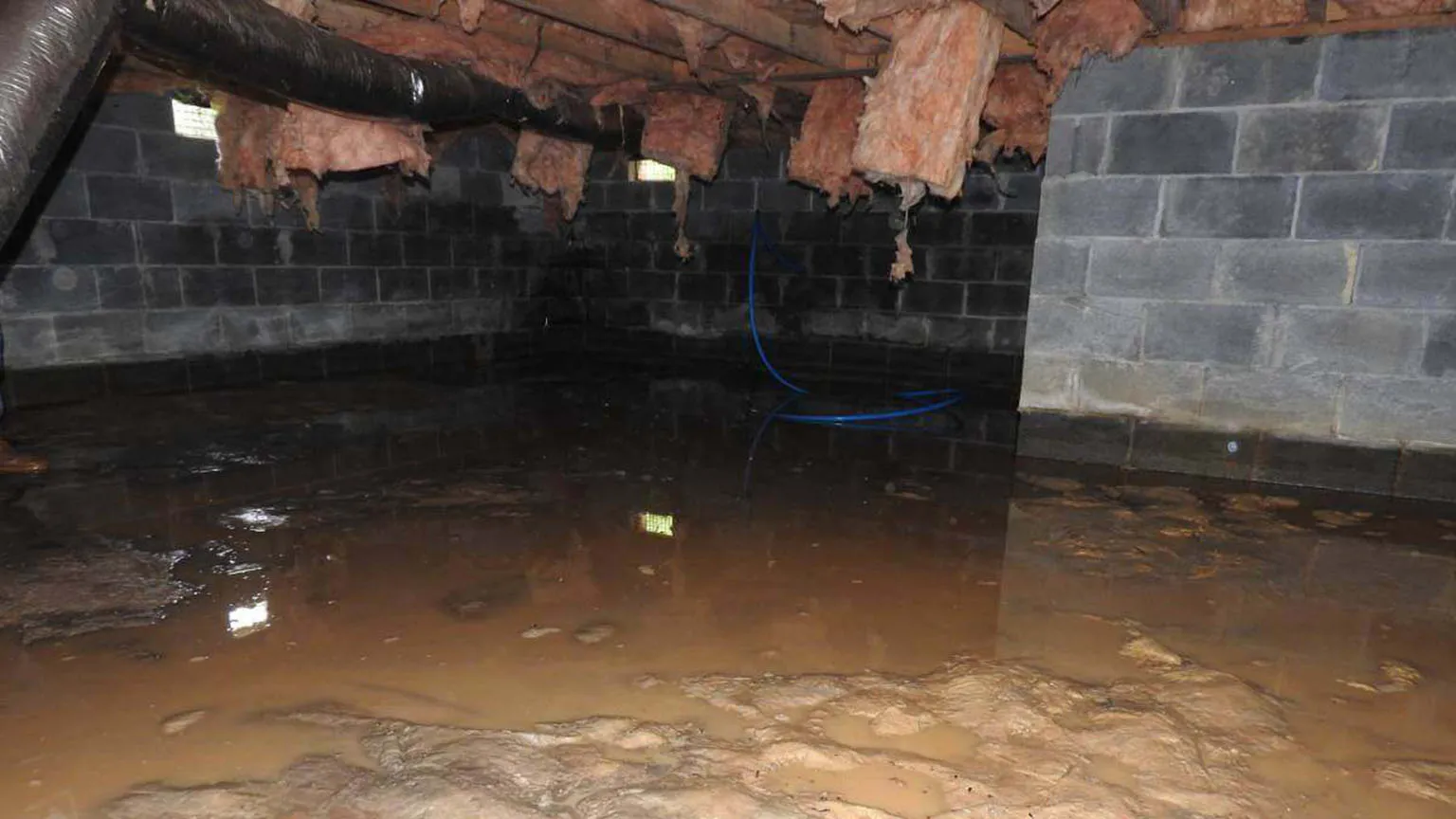
Age plays in too. Most neighborhoods here went up between the mid-nineties and roughly 2015, so a lot of original waterproofing is reaching first-generation failure on the same schedule. Drain lines silt up. Pumps installed with the house hit twenty years and quietly retire. Folks near Meadow Glen aren’t unlucky — their systems are simply the same age.
Then there’s the older rural fringe, the acreage properties that came before the subdivisions. Plenty of those sit on block piers, and when water stands underneath season after season, the framing above softens. It’s very fixable, though that’s a foundation repair conversation as much as a drainage one.
One more local wrinkle: septic. A drain field working hard through a wet spring saturates the soil around it, and if that field sits uphill, your foundation feels it. We’ve seen exactly that on larger lots off Highway 81 and on streets minutes from Loganville City Hall.
So what actually fixes it?
Let’s walk it, so nothing feels like a surprise later. The idea is simple: stop trying to block water, and give it an easier path than the one it’s using.
- Find the source first. We walk the outside — grading, gutters, downspouts — then the inside. Sometimes the answer is smaller than expected, and we say so.
- Open a channel at the perimeter. A narrow strip of slab comes up along the affected walls. It’s loud and dusty for a day, then it’s done.
- Set drainage below the floor. Perforated pipe in clean stone, under the slab, so water is collected before it reaches your floor.
- Route it to a sump built right. Correct pump size, a working float, a check valve, and a discharge line that ends somewhere useful — not six feet from the wall.
- Close it up clean. Fresh concrete over the channel, wall liner where it’s called for, and our mess hauled off.
Notice what nobody did on that list? Paint anything. Coatings are fine products, but a coating can’t beat pressure — it’s a raincoat on a submarine. That’s why we warranty a drainage system in writing instead of a bucket of sealer.
Water isn’t sneaky. It’s lazy. Give it an easier way out than your floor, and it takes the deal every time.
Wondering what it runs? It depends on how much wall is involved, whether a pump goes in, and how hard the space is to reach, so we walk it before we quote it. Our breakdown of basement flooding cost covers what moves the number, and the systems are explained on our basement waterproofing page.
The diagnosis that surprised a homeowner
Want the one that catches people off guard most? A homeowner out toward the Ozora corridor called us certain the foundation had cracked. Every hard rain put a half inch of water across the floor, and a thin line ran down the wall.
Not quite. That line was cosmetic, a shrinkage crack from the week the wall cured. When we traced the sump discharge, though, we found the buried line had silted shut about fifteen feet out. So the pump ran, pushed water into a plugged pipe, and that water drained right back beside the foundation. The pump worked perfectly. It just had nowhere to send anything.
The repair was a new discharge run to daylight, a proper check valve, and drainage tied in correctly. Half a day of work, and far less than they’d braced for. What stuck with them wasn’t the price, though. It was finally understanding their own house.
Here’s what the other side feels like. The floor stays dry through a Saturday of spring storms. That smell at the bottom of the stairs is gone. Instead of a room you apologize for, you get storage you trust, a playroom, maybe a gym. Better yet, the next ugly forecast rolls through and you don’t think about the basement at all.

Why does calling somebody local matter?
Because we’ve spent twenty-plus years on these exact houses, from a shop twenty minutes up the road in Lawrenceville. We know how water moves on land draining toward the Alcovy River. Newer builds along Highway 81 also sit differently than older places on acreage. Most standing water basement Loganville calls we run land within a few miles of each other, so the crew doing your work is the crew answering in year six.
We’ll hand you the boring homework too. FEMA’s guidance on protecting property from flooding lines up with what we recommend outside a house. Plus, if a relative one county over sees the same thing, we handle the Tucker standing water basement crowd too.
Where we work around Loganville
Loganville sits twenty minutes southeast of our shop, and we know it spans both the Walton and Gwinnett sides. We also cover Snellville, Grayson, Monroe, Between, Bay Creek, Dacula, Lawrenceville, Lilburn and Walnut Grove, plus the wider Walton and Gwinnett Counties area. If you’re along the Highway 81 corridor, odds are a truck is already nearby.
Questions Loganville homeowners ask us
Usually not for groundwater or seepage, since most policies treat that as maintenance. Sudden failures inside the house, like a burst supply line, are often covered. Ask your carrier about a water backup endorsement and about separate flood coverage, because those are two different things.
Same day if you can manage it. Mold can begin on wet organic material within roughly 24 to 48 hours, so speed matters more than any product. Pull out wet cardboard and rugs, then run fans and a dehumidifier until the space feels normal again.
Because the pressure is under the slab, not only against the wall. Saturated clay pushes water toward the easiest opening, and the cove joint where wall meets floor is a seam rather than solid concrete. So water arrives at floor level even when the wall looks perfect.
You can’t stop rain, but you can manage where the water goes, and that part holds up long term. Under-slab drainage, a properly built sump, and corrected grading handle the source instead of hiding it. The pump is the only piece with a service life, a lot like a water heater.
It depends on a few things, so we give a real range only after seeing it. The drivers are how many linear feet of wall are involved, whether a pump and discharge line go in, how easy the space is to reach, and what’s already finished down there. The inspection and estimate are free either way.
Let’s find out what’s really going on under your Loganville home
The inspection is free, the estimate is free, and nobody pressures you at the end. We’ll show you where water gets in, explain the fix plainly, and put the scope in writing — even if the answer is simpler than expected.
(678) 914-5112Serving Loganville and all of Metro Atlanta · $500 off projects over $3,500 · Live support 7am–8pm, 7 days a week