

Basement Flooding Cost in Suwanee: What You’re Really Paying For
Two separate jobs, one confusing invoice. Here’s how the money splits, what moves the number, and what you can honestly handle yourself.
One inch of rain on an average Suwanee roof sheds somewhere around 1,200 gallons of water in a single afternoon. That’s not a scare number, it’s just plumbing math — and every gallon has to land somewhere. So when folks ask us about basement flooding cost Suwanee homeowners should plan for, we start there, because the price tag makes a lot more sense once you know how much water was actually moving.
Good news up front: most of that water never wanted to be in your house. It just couldn’t find a better exit.
Why does one flood come with two bills?
Here’s the thing most people don’t learn until the truck is already in the driveway. A flooded basement is really two jobs, and they get quoted separately. Job one is getting the water out and drying the space. Job two is making sure it doesn’t happen again.
Those jobs use different crews and different math, so two quotes can look wildly apart while pricing totally different things. Before you compare anything, ask which job each number covers.
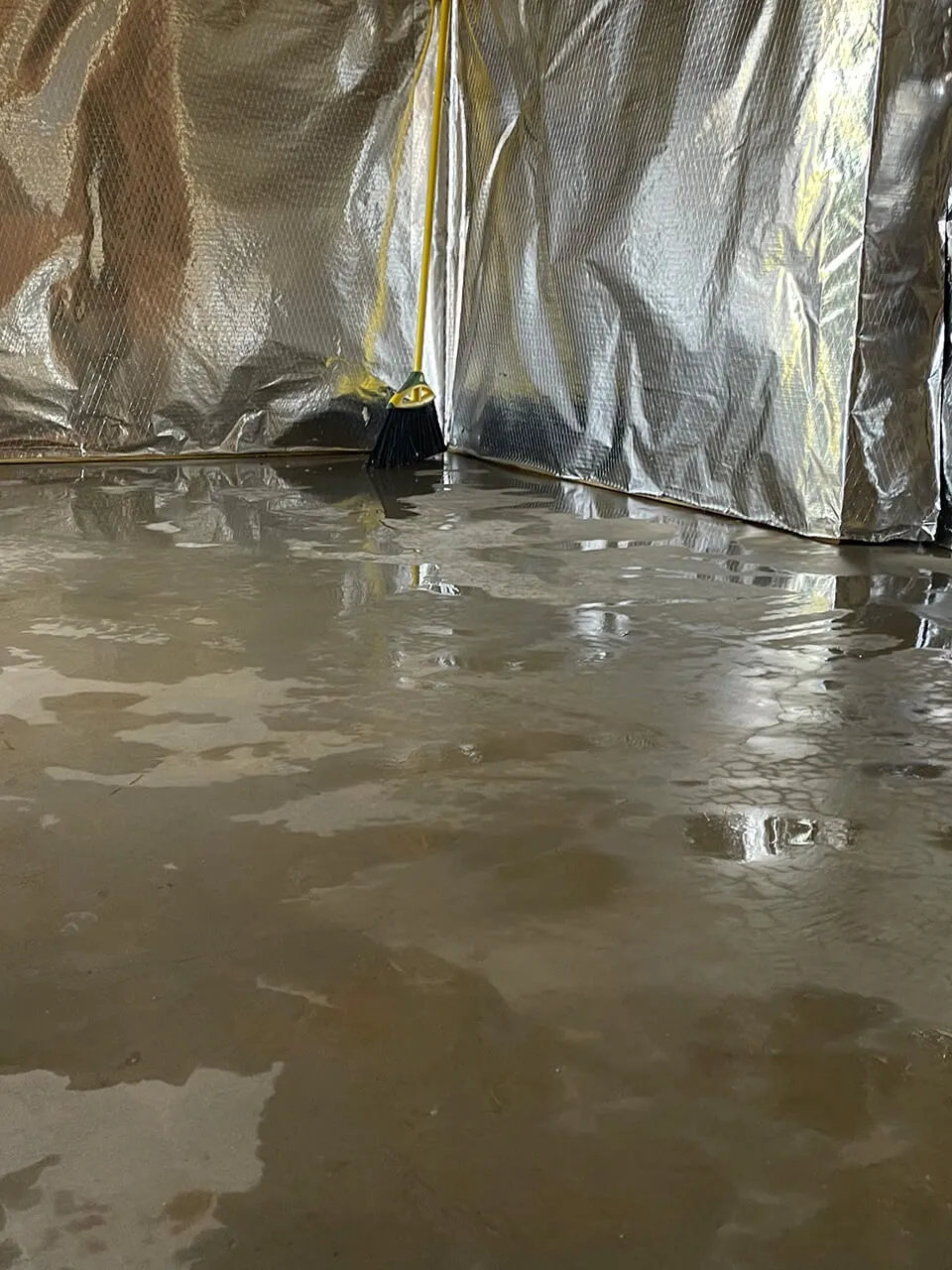
Job one is emergency work, priced by the hour and the truckload. Job two is construction work, priced by the linear foot. Both are fixable, and neither is a mystery once somebody explains it.
Worth knowing
Pay only for job one and you’ll likely pay for job one again. Pay only for job two and wet material stays in the room. Most Suwanee homes need some of both, and we’ll tell you which side carries the weight.
What happens on the cleanup side?
Nobody enjoys this part, so here’s the order it runs in. Knowing the steps takes a lot of the sting out.
- Power and safety first. If water is near outlets, panels or a water heater, the breaker goes off before anybody wades in.
- Extraction. Pumps and truck-mounted vacuums pull the standing water out. It’s usually the fastest step, even though it looks like the worst one.
- Removing wet organic material. Soaked carpet, pad, drywall bottoms and cardboard come out. Organic material holds water, so it drives the drying bill.
- Drying and dehumidifying. Air movers and commercial dehumidifiers run for days while somebody tracks moisture readings.
- Cleaning surfaces. Hard surfaces get cleaned once they’re dry, not while they’re still wet.
- The inspection for job two. With the room empty, we can finally see where water came in.
- Rebuild. Drywall, trim, flooring — after the readings say the room is truly dry, never before.
Step six is worth waiting for. An empty, dry basement tells the truth about entry points, so a lot of expensive guessing disappears right there.
What actually moves the number?
Straight answer: nobody can price a flood over the phone, and anyone who tries is guessing with your money. Still, the drivers are simple enough to understand before we ever knock on the door.
The six things that set the price
- How much water. A damp corner and four inches across a finished floor are different universes.
- How long it sat. Water caught in hours costs far less than water that sat through a weekend away.
- How much wet material leaves. Carpet, pad and drywall are the big line items, because they have to go.
- Finished or unfinished. A bare slab dries fast. A finished basement takes careful demo first.
- Whether drainage is part of the fix. Drain tile and a sump basin add cost, and they’re also what ends the cycle.
- Sump condition. Some homes have a serviceable basin. Plenty of original 1990s pumps around here do not.
Small exterior corrections — regrading, longer downspouts, a cleared window well — sit at the low end of basement flooding cost Suwanee homeowners run into. Full extraction plus a perimeter system with a new sump sits at the top. Most homes land between, and you get one written scope instead of a phone guess.
If you’re weighing your options, our rundown of basement drying options compares the equipment side, and folks shopping across the county line often read our Peachtree Corners flooding cost breakdown for the same math.

What’s the second thing nobody mentions?
Ready for the part that quietly decides your bill? There’s a clock running, and it starts the moment the water arrives. Mold can begin growing on wet organic material in roughly 24 to 48 hours, which means the same flood costs more on Wednesday than it did on Monday.
That’s not meant to rush you — it’s the one piece of information that lets you make a calm call instead of a slow, expensive one. The CDC’s guidance on mold cleanup after a flood lays out the same timing in plain language.
So the cheapest version of this job is usually the fast one. Get air moving the day it happens, and material that would have hit the dumpster stays in the house instead.
We’d rather show up on day one for a small job than on day five for a big one. Same house, very different invoice.
Where the water is getting in
While we’re on the second thing nobody mentions, here’s another. The most common entry point isn’t a dramatic crack in the wall — it’s the cove joint, the seam where your basement wall meets the floor. Wall and slab were poured at different times, so that seam is a natural gap.
Georgia red clay swells when it’s saturated, and swollen clay pushes water sideways with real force. Engineers call that hydrostatic pressure. Water follows the path of least resistance, finds the cove joint, and comes up along the base of the wall — which is exactly why the stain line is always low.
Good news? This one has a clean fix. Interior drainage collects water below the slab and routes it to a sump before it ever reaches your floor. In other words, we stop arguing with the water and just give it a faster exit. Our basement waterproofing page walks through the system types side by side.
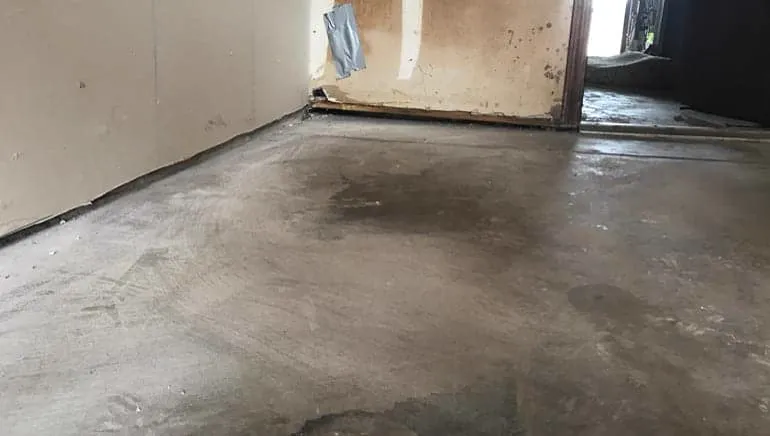
When the pump is the problem
Sump pumps rarely fail creatively. They fail in five predictable ways: the power goes out during the very storm that fills the basin, the float gets stuck against the wall of the pit, the pump is undersized for the volume, the check valve is missing so water drains right back down, or the discharge line is clogged or frozen at the far end.
Every one of those is cheap to prevent. A battery backup, a right-sized pump, a check valve and a discharge line that ends well away from the house cover almost all of it. Pour a bucket of water in the pit twice a year and you’ll know where you stand.
How long does it take, and what should you do first?
Extraction usually happens the same day. Drying typically runs three to five days, and moisture readings decide when it stops — not the calendar. If drainage work is part of the plan, add one to three days on site plus curing time for fresh concrete.
Your prep list is short. Lift what you can off the floor, clear about four feet along the affected walls, and make sure we can reach an exterior door. We’ll handle the heavy items, because nobody should wrench their back to save a truck trip.
Real DIY wins: extending downspouts six to ten feet from the house, cleaning gutters twice a year, regrading soil so it slopes away, clearing window wells, and testing that sump pump. Those five solve a surprising share of minor water complaints. FEMA’s building science resources on protecting property from flooding back up the same basics.
What DIY genuinely can’t handle: anything below the slab, anything involving several inches of standing water near live circuits, and commercial-grade drying. Rental fans move air, but they don’t pull moisture out of the way a proper dehumidifier does. That’s not about skill — it’s about where the water is and what equipment reaches it.
What happened at a Settles Bridge basement
A homeowner over near Settles Bridge called us after a long spring storm, sounding pretty defeated. Their walkout basement door had let water in twice, and both times it stopped on its own once the rain quit. Classic pattern — it only floods in heavy rain.
That detail matters more than it sounds. A basement that floods only during heavy rain almost always has a surface water problem rather than a groundwater problem, and surface water is usually the cheaper fix. We walked the outside first and found the actual culprit: twenty-five years of settling had tilted the grade back toward the house, and one downspout was dumping four feet from the walkout door.
The fix was regrading, extending two downspouts, a small trench drain at the door, and a rebuilt window well. No jackhammer, no perimeter system, no drama. They’ve been through two storm seasons since and the floor has stayed dry — and their kids got a playroom back that beats driving to PlayTown Suwanee on a rainy Saturday.
Not every house lands there, of course — some need the full interior system. Either way, the inspection is what tells you which house you have, and it costs you nothing.

Why so many Suwanee basements are calling at once
Suwanee grew up in one fast wave in the late nineties and early two-thousands. That’s why whole streets in Edinburgh and Morningview are hitting their first real waterproofing failure on roughly the same schedule — original systems, original pumps, original grading, all aging out together.
Add the terrain. Rolling hills drain toward Suwanee Creek, which means walkout and daylight basements are everywhere here, and walkout doors and window wells are where surface water loves to sneak in. Homes on the lower side of a slope near the Suwanee Creek Greenway see it first, while newer builds off Peachtree Industrial Boulevard sit on the same expansive red clay. Clay doesn’t care how new your kitchen is.
How do you know the job was done right?
Ask for four things and you’ll sort good work from fast work quickly. First, moisture readings written down before and after drying. Second, a scope naming what came out, what went in and where the discharge ends. Third, photos of the stone and pipe before concrete goes back down. Fourth, a live water test with you standing right there.
After that, the proof shows up on its own. The floor stays dry through a hard spring storm, that musty smell disappears, and boxes come off the shelf and go back on the floor. Better yet, the next ugly forecast is just weather again.
One more honest note on insurance. Standard homeowners policies commonly exclude surface flooding, and sump pump failure coverage is usually a separate endorsement you have to add. That’s not a reason to worry — it’s a reason to pull out your policy and read the water section before storm season. If cracks or settling are part of your picture too, our page on foundation repair covers that side.

Where we work around Suwanee
Our shop sits about fifteen minutes south in Lawrenceville, so we’re up this way constantly. We also cover Duluth, Buford, Sugar Hill, Johns Creek, Cumming, Peachtree Corners, Berkeley Lake, Dacula and the wider Gwinnett County area. If you’re anywhere near Town Center or along the north side of the Greenway, odds are we already have a truck nearby.
Questions we get from Suwanee homeowners
On wet organic material like carpet pad, cardboard or drywall, growth can begin in roughly 24 to 48 hours. That’s why fast drying is the cheapest version of this job. Get air moving the same day and a lot of material stays in the house instead of the dumpster.
Shut off power to the basement before anyone steps in the water, especially near outlets or a water heater. Then take photos of everything for your records and call for extraction. After that, lift what you can off the floor and open a path to an exterior door.
That pattern almost always points to surface water rather than groundwater, and surface water is usually the cheaper fix. Settled grading, short downspouts, a full window well or a walkout door threshold are the usual suspects. We check the outside of the house first for exactly that reason.
It depends on your policy, so read yours before storm season. Standard homeowners policies commonly exclude surface flooding, and sump pump failure coverage is usually a separate endorsement you add on. A quick call to your agent will tell you exactly where you stand.
Start within the first day if you can, since the drying clock and the cost clock are the same clock. Commercial dehumidifiers and air movers usually run three to five days. Moisture readings decide when the equipment comes out, not the calendar.
Let’s find out what your basement actually needs
The inspection is free, the estimate is free, and nobody pressures you at the end. We’ll show you where water is getting in, what it takes to stop it, and what it costs. The basement flooding cost Suwanee homeowners face varies a lot house to house, and plenty of times the answer is simpler and cheaper than expected.
(678) 914-5112Serving Suwanee and all of Metro Atlanta · $500 off projects over $3,500 · Live support 7am–8pm, 7 days a week