

Encapsulation Cost in Lilburn: The Honest Breakdown
Every step in order, what moves the number up or down, and how to tell a real system from plastic on the dirt.
You went down for the holiday decorations and the box came apart in your hands. Last spring it was fine. Now the bottom is soft, the tape has let go, and the cardboard smells like an old tent. So you’re standing there wondering what changed — and probably searching encapsulation cost Lilburn before you’ve even set the box down.
Good news right away: that soft box is one of the most useful signals a house can give you, and the fix behind it is routine work. Better yet, you can understand every line of the estimate before anyone asks you to sign.
What is that box actually telling you?
It’s telling you the air down there is holding water. Cardboard is a moisture meter you already own, and it fails long before the framing does. That’s a nice thing, honestly — you got the warning early instead of late.
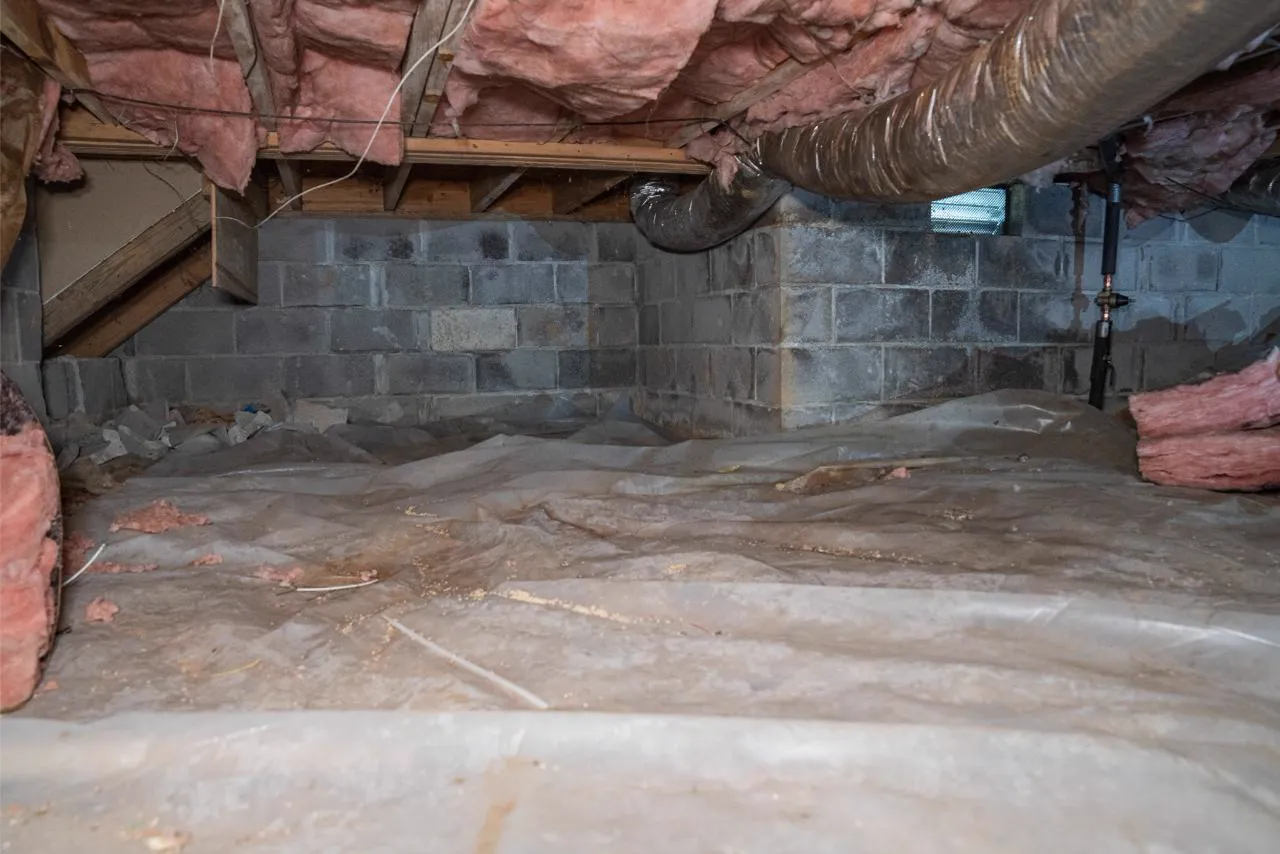
Here’s the local part. Lilburn homes were mostly built in the seventies and eighties, back when “waterproofing” meant a coat of tar and hoping for the best. Fifty years is a long time to hope. So on the older streets around Killian Hill and Arcado, we’re usually looking at original moisture control that has simply aged out on the same schedule as the neighbors’.
Add red clay and old hardwood roots and it sharpens. Clay soaks up rain and gives it back slowly, so bare dirt under a floor is a steady moisture source. On shaded lots draining toward Camp Creek, the ground barely dries out between storms.
Worth knowing
Damp and damaged are two different conversations. Plenty of the crawl spaces we open up are humid while the wood is still sound. We’ll tell you which one you have before anybody talks money.
What does the job actually look like?
Every house is a little different, but the order almost never changes. Here’s the honest version.
- Inspect and measure. We crawl the space, measure square footage and headroom, check the framing, and read the humidity. Then you get photos, because most homeowners have never seen down there.
- Clear it out. Fallen insulation, torn plastic and construction scraps come out first. Nothing gets sealed in.
- Handle the water. If water is getting in, that gets solved first — a drain line, a sump basin and pump, or grading work outside.
- Treat the wood. Surface growth on joists or subfloor gets cleaned and treated while it’s still easy to reach.
- Seal the vents. Those old openings get closed so outside air stops feeding the problem.
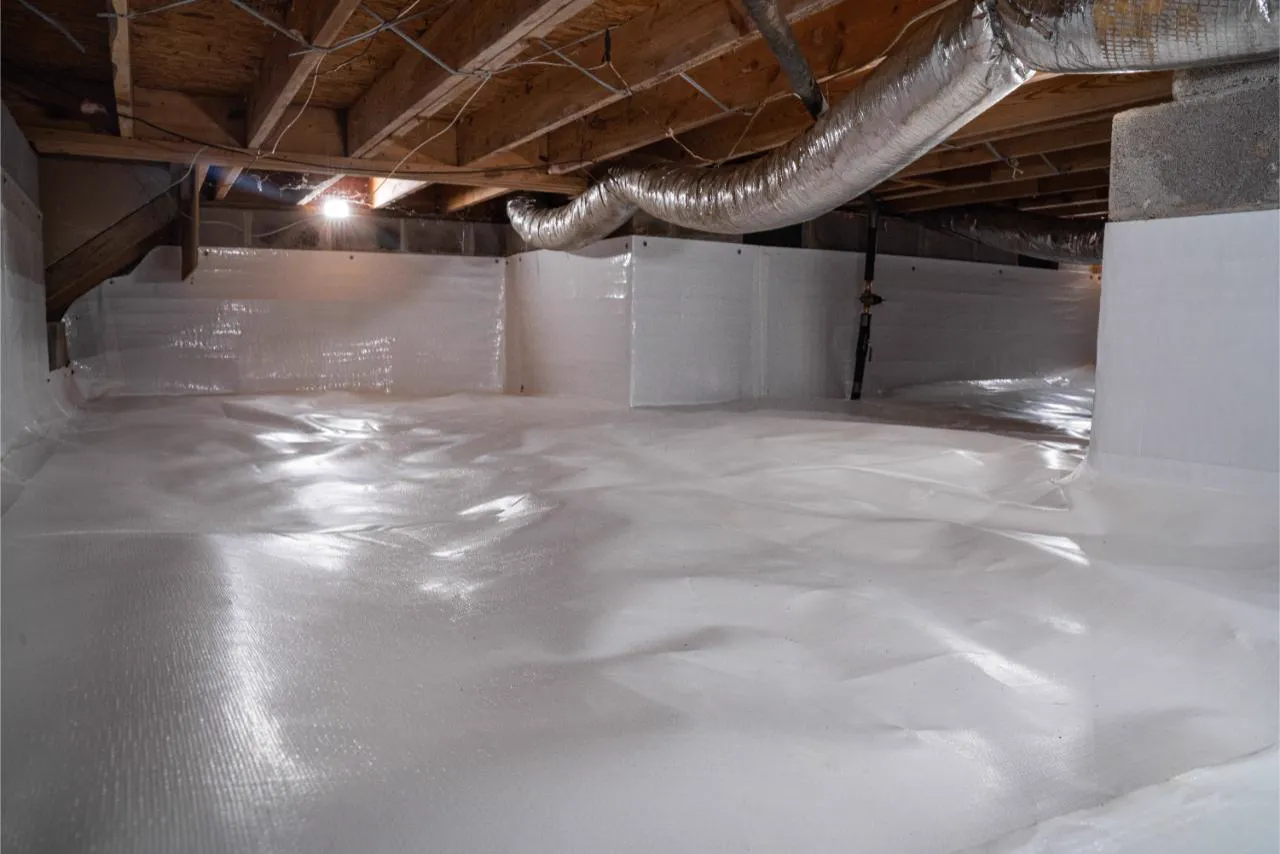
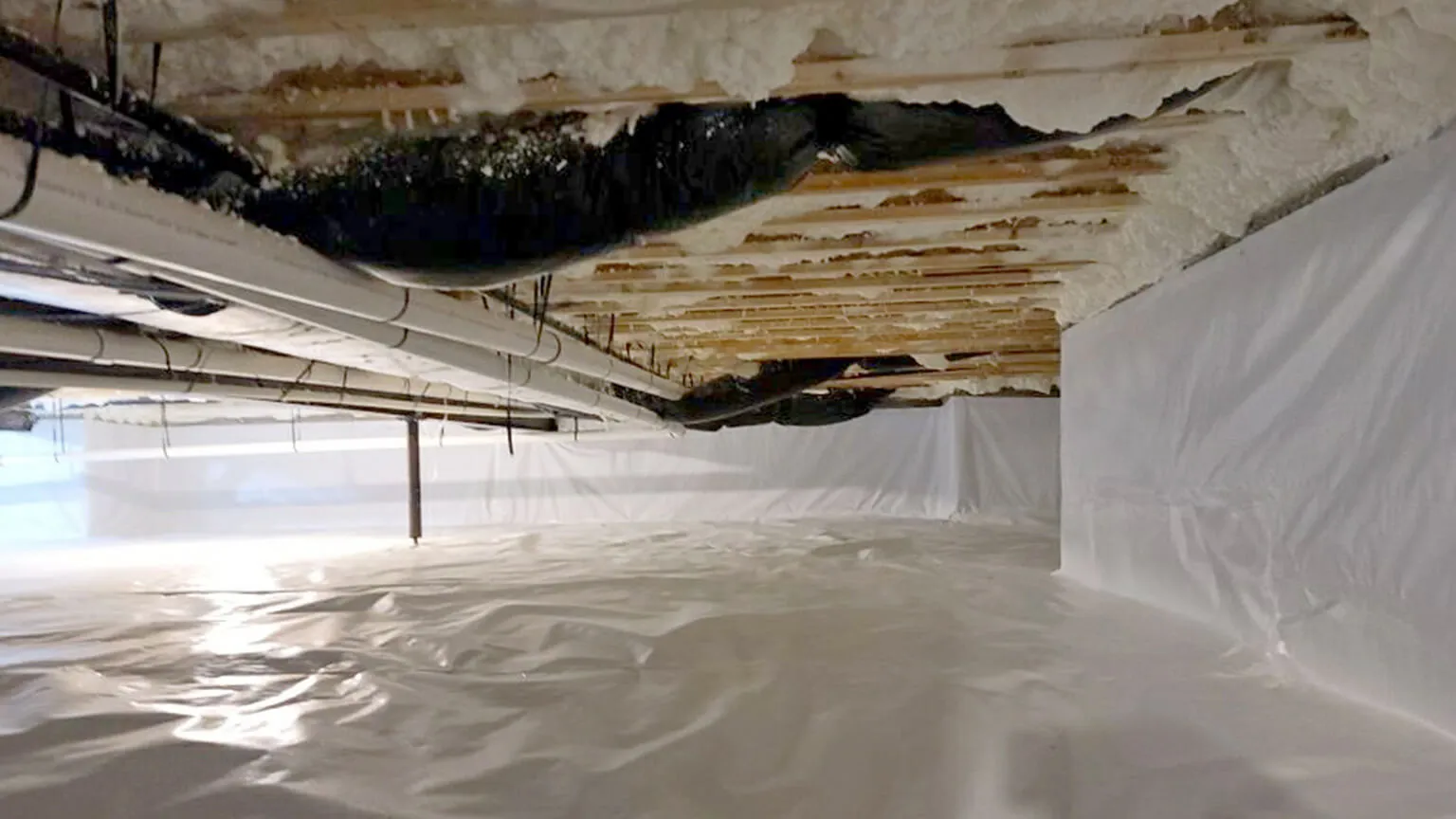
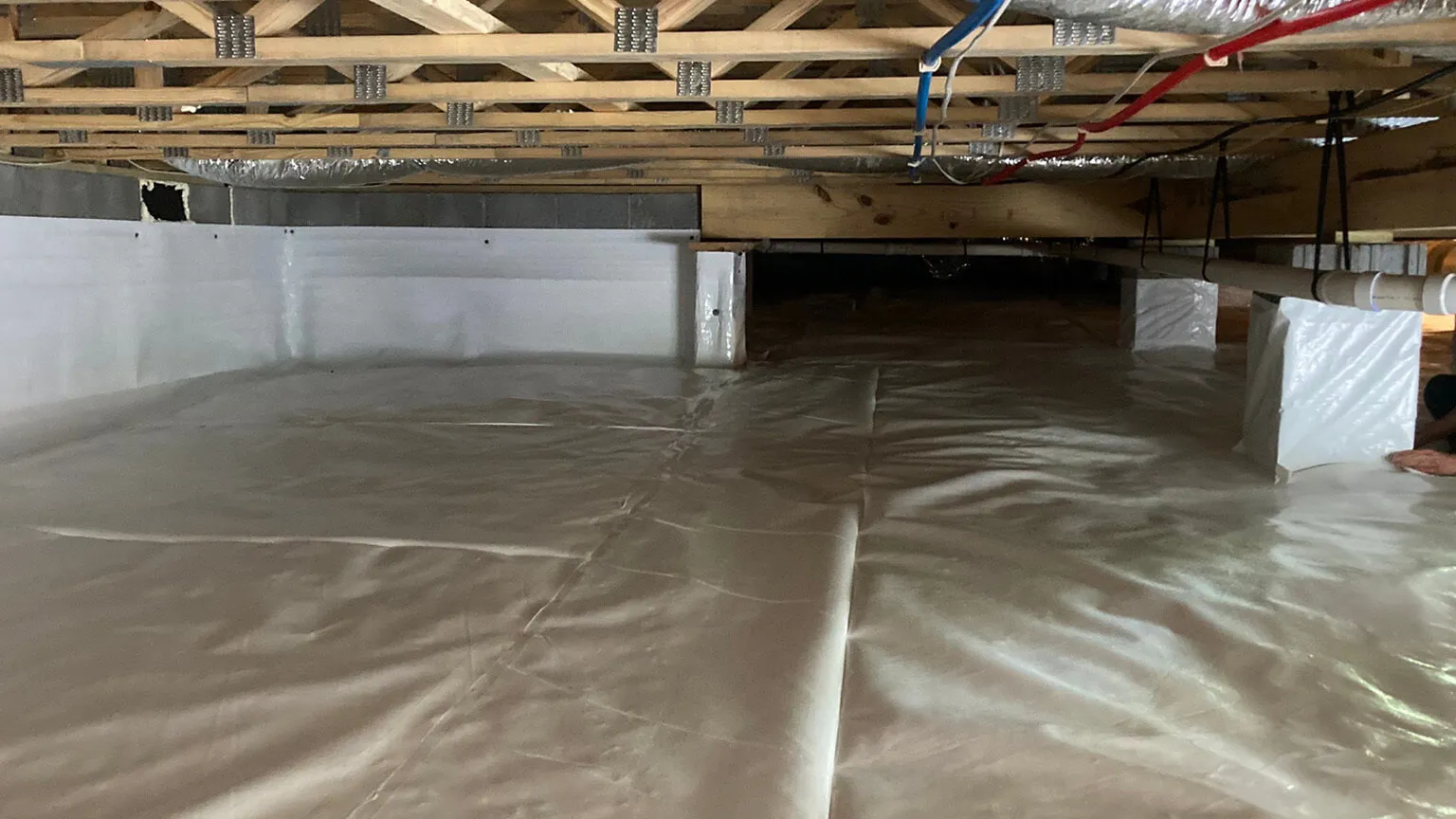
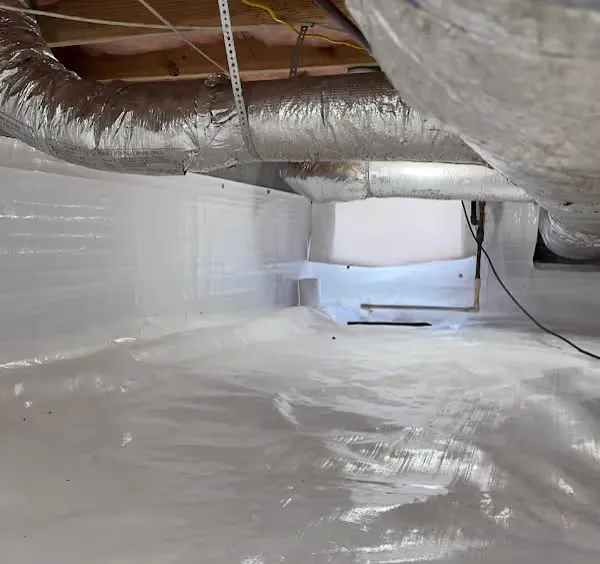
- Install the liner. A reinforced liner goes over the ground, up the stem walls and around every pier, sealed at the seams and fastened along the top.
- Insulate and condition. Rim joists get insulated, and a dehumidifier sized to your space holds humidity steady all year.
- Walk it with you. We show you the finished space in photos and hand over the paperwork.
Timeline runs two to four working days for most homes here. Add a day for a heavy cleanout, another when drainage is in the scope. Your prep is light: clear a path to the access door, keep pets inside, expect a truck in the driveway.
So what happens after the crew leaves?
This is the part almost nobody explains, and it’s the part you live with. A finished crawl space isn’t a thing you install and forget — it’s a small system running quietly under your floor.
Week one, the dehumidifier works hardest. It’s pulling decades of moisture out of the ground, the wood and the block. After that it settles into short cycles and you stop noticing it.
Month one, your nose gets the news. The musty smell in the hallway fades, then it’s gone. Floors feel warmer underfoot too, and that storage corner becomes usable again — you can keep cardboard down there like a normal person.
Long term, maintenance is genuinely small. Rinse the dehumidifier filter a couple times a year, glance at the liner when you’re grabbing something, and keep gutters clear during the fall leaf drop under all that Lilburn canopy. That’s the whole chore list.
The estimate shouldn’t be the first thing that shows up at your house. The diagnosis should.
One more thing to ask any company: “Where is the moisture coming from, and how do you know?” A real answer sounds specific — bare clay, humid air through the vents, roof water dumping at one corner. A vague answer sounds like “crawl spaces are always wet.” Because the source decides the scope, and the scope decides the price.
What actually moves the number?
Square footage first, then how hard the space is to work in. We won’t publish a flat price, since a flat price for a crawl space is basically a coin flip. Instead, here’s exactly what we weigh.
Price drivers, biggest first
- Square footage. More ground and more wall means more liner, more seam work and more hours. It’s the single largest swing.
- Headroom and access. A two-foot crawl costs more to work in than a four-foot one, every time. Everything happens lying down, through one small door.
- Cleanout volume. Old batt insulation, torn sheeting and forty years of stored boxes come out before step one.
- Standing water. If water pools down there, drainage and usually a pump come first. That’s a system, not an add-on.
- Vent count and wall condition. Sealing six vents in sound block is quick. Crumbling seventies parge takes longer.
- Dehumidifier. Whether one is included, and what size, moves the total noticeably.
- Extras. Rim joist insulation, duct repairs and wood treatment each nudge the number.
So a small, tall, clean crawl space with no water sits at the low end. A sprawling low one with standing water, a full cleanout and a dehumidifier sits at the top, and most encapsulation cost Lilburn projects land in between. After we walk it, you get a written scope with each line spelled out. Our guide to crawl space repair in Lilburn covers the related work, and the crawl space repair service page shows what we install.
Can you do part of this yourself?
Some of it, genuinely. Cleaning gutters, running downspouts eight or ten feet out, and pulling soil back so the grade slopes away are real wins for almost no money. What’s more, they cut the water load before anyone quotes you a system.
Now the honest limit. A roll of hardware-store plastic laid loose on the dirt is not encapsulation, and it never was. A true encapsulation uses a reinforced liner sealed to the walls and piers, so moisture has nowhere to sneak around. That one difference is why a season and a few decades cost different money.
Sizing a dehumidifier, setting drainage, and sealing vents without trapping a combustion appliance aren’t weekend work either. Not because the tools are fancy, but because a wrong choice looks exactly like a right one until August. On the air-quality side, the EPA’s page on mold and health explains why controlling moisture beats cleaning up after it, and the CDC’s guidance on mold at home says much the same.
A house off Five Forks Trickum Road
A homeowner near Killian Hill called us about a smell in the back bedroom. The family had finished part of the basement years earlier for grandparents moving in, and the room never felt quite right — one of the most common stories we hear in this town. Basements here get converted to living space without anyone solving the moisture first.
What we found wasn’t dramatic. A collapsed old footing drain on one side, torn sheeting in the crawl portion, and a downspout emptying two feet from the wall. Wood was sound. So we moved the roof water out, restored drainage on the wet side, cleaned the crawl, and encapsulated it with a sealed liner and a right-sized dehumidifier.
Three weeks later she told us that bedroom finally smelled like the rest of the house. Her father stopped running a fan in there, and the closet stopped needing those little moisture buckets. She’d braced for a rescue and got an upgrade instead.
To be fair, it runs the other way sometimes. A place near Arcado looked spotless from the access door, but thirty feet in there was standing water nobody had ever seen.
How do you know it was done right?
Ask for five things. Any straight contractor hands them over without blinking.
Your five-item checklist
- Before-and-after photos of the whole space, not one flattering corner.
- Liner details. Thickness, whether it’s reinforced, how it’s sealed at seams and piers.
- A humidity target. A real system holds a stated range, and you should be told what it is.
- The water plan in writing — where water goes, and where it lets out.
- A warranty you can read in one sitting. If it needs a lawyer, it isn’t helping you.
After that, life gets pleasantly boring. Floors stop feeling cold, the smell leaves for good, and the space becomes clean dry storage instead of somewhere you point a flashlight and back away from. Best of all, you stop thinking about it — that’s the actual product.
One scheduling note: spring storms keep us busiest, so the quieter stretch after the fall leaf drop is an easy time to book. We’re around Lilburn constantly anyway — ballgames at Lilburn City Park, walkers on the Camp Creek Greenway, and plenty of driveways in between. If your home has a full basement taking on water instead, our guide to flooded basement repair is the better read, and folks comparing towns can look at Norcross encapsulation cost.
Where we work around Lilburn
We’re based in Lawrenceville, about fifteen minutes northeast, so we’re in this corner of Gwinnett most weeks. That includes Lilburn, Lawrenceville, Snellville, Norcross, Tucker, Stone Mountain, Duluth, Grayson, Peachtree Corners, Loganville and the wider Gwinnett area. Whether you’re in Old Town or off Rockbridge, we know these houses.
Questions Lilburn homeowners ask us
In almost every Georgia crawl space, yes. The liner stops moisture from the ground, but our summer air still carries plenty of its own. A right-sized dehumidifier holds the space in a steady range year-round, and it’s what keeps the results from drifting back after a wet spring.
Closed, once the space is properly sealed and conditioned. Vents were meant to dry a damp space, but in our climate they pull warm wet air onto cool surfaces, which does the opposite. One caution: if a gas appliance lives down there, venting and combustion air have to be handled correctly, so that’s a job for someone who checks first.
Usually it does, because that smell is damp air moving up through the house from below. Once the ground is sealed and the humidity comes down, the source dries out and the odor fades over a few weeks. If a smell hangs around after that, it’s a sign something else is still wet, and we’ll come back and find it.
Most homes take two to four working days. A heavy cleanout adds about a day, and adding drainage or a sump pump adds another. You can stay home the whole time, since nearly all the work happens under the floor.
It often helps, because your system stops working so hard to wring moisture out of damp air. Sealing the vents and insulating the rim joists also cut the cold-floor effect in winter. We won’t promise a percentage, since every house is different, but most homeowners notice the comfort right away.
Let’s find out what your Lilburn crawl space actually needs
We’ll crawl it, photograph it, tell you where the moisture is coming from, and price only what your house needs. Inspection free, estimate free, and no pressure at the end.
(678) 914-5112Serving Lilburn and all of Metro Atlanta · $500 off projects over $3,500 · Live support 7am–8pm, 7 days a week