

Crawl Space Encapsulation Decatur: What It Costs and What to Expect
You’ve decided to hire someone. Here’s the whole job in plain words — what we do, what moves the number, what the warranty covers, and why a hundred-year-old Decatur house needs a gentler hand than a new build.
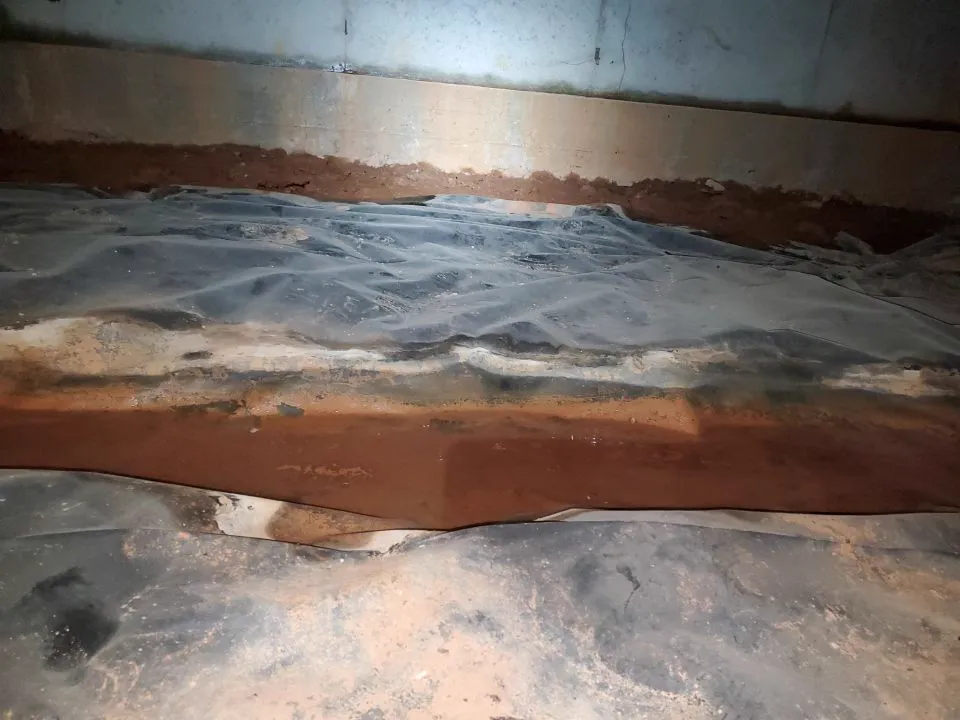
Here’s a number that stops most people cold: a bare dirt crawl space floor can hand ten to fifteen gallons of water a day to the house sitting on top of it. Not through a leak. Just as vapor, rising out of damp red clay, every single day of the year. That’s the honest starting point for crawl space encapsulation Decatur homeowners keep asking us about, because once you know the dirt is the faucet, the fix finally makes sense.
Good news? This is very fixable, and it’s work we do all the time. We seal the space, control the moisture, and hand you photos showing exactly what happened down there. Your crawl space needs fresh air about as much as your sock drawer needs a sprinkler.
Where does all that water come from?
Two places, mostly. First, the ground itself, which around here is red clay that holds moisture like a sponge and gives it up slowly. Second, the vents — those open blocks cut into your foundation wall. For decades, code required them on the theory that outside air dries a crawl space out.
In a humid climate, though, that theory backfires. Warm summer air rolls through the vent, meets cool ground and cool ductwork, and drops its moisture right there. So the vents that were supposed to help are actually delivering water — like a glass of iced tea sweating on a July porch, except under your floor for months.
Old Decatur houses feel this more than most. Many sit close to grade with dirt-floor cellars, and a century of added soil has buried the original grading. Add the enormous oak and poplar roots that run under half this city, quietly pushing on foundation walls and lifting slabs, and water finds paths nobody planned for.
So what is encapsulation, exactly?
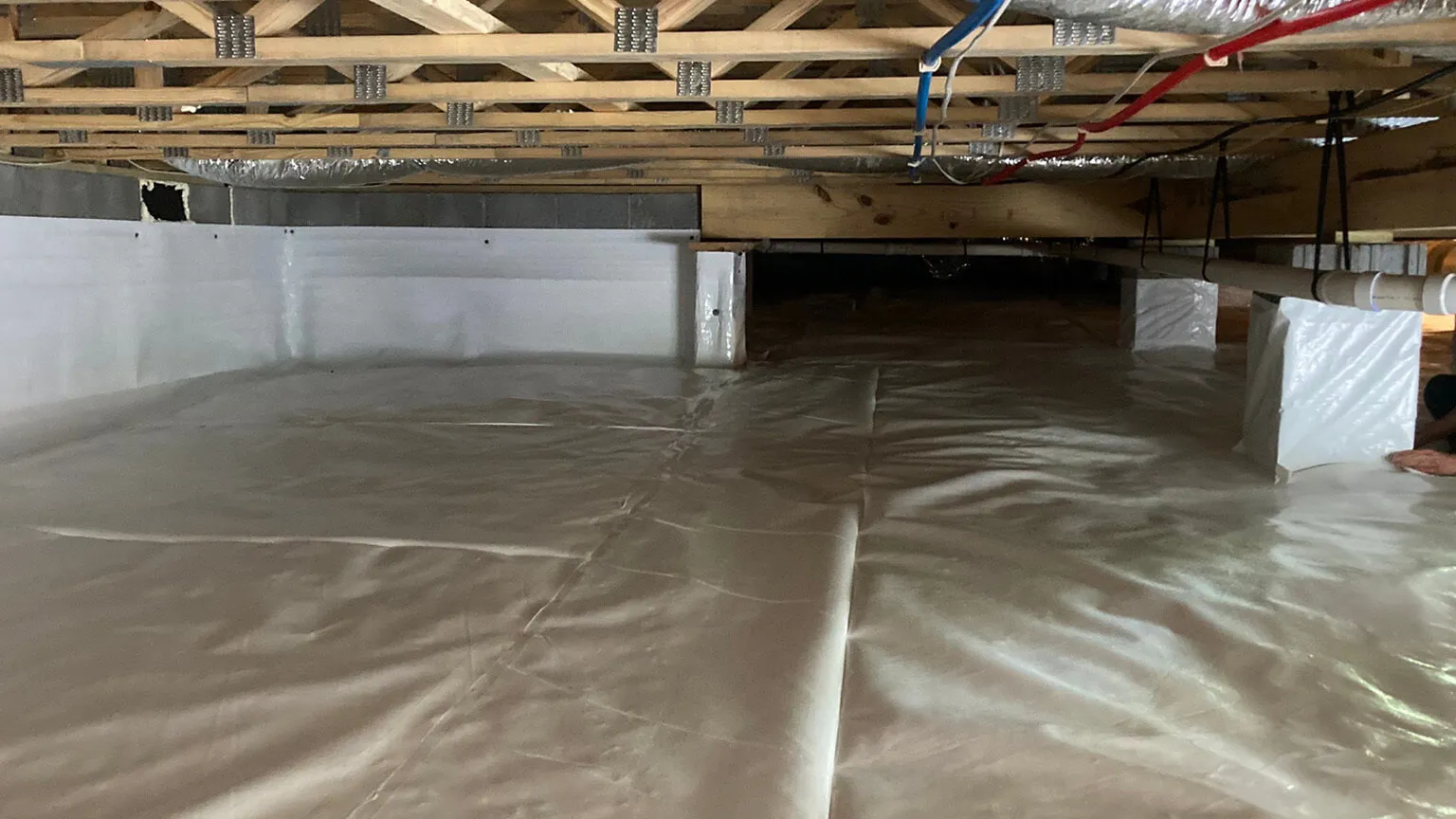
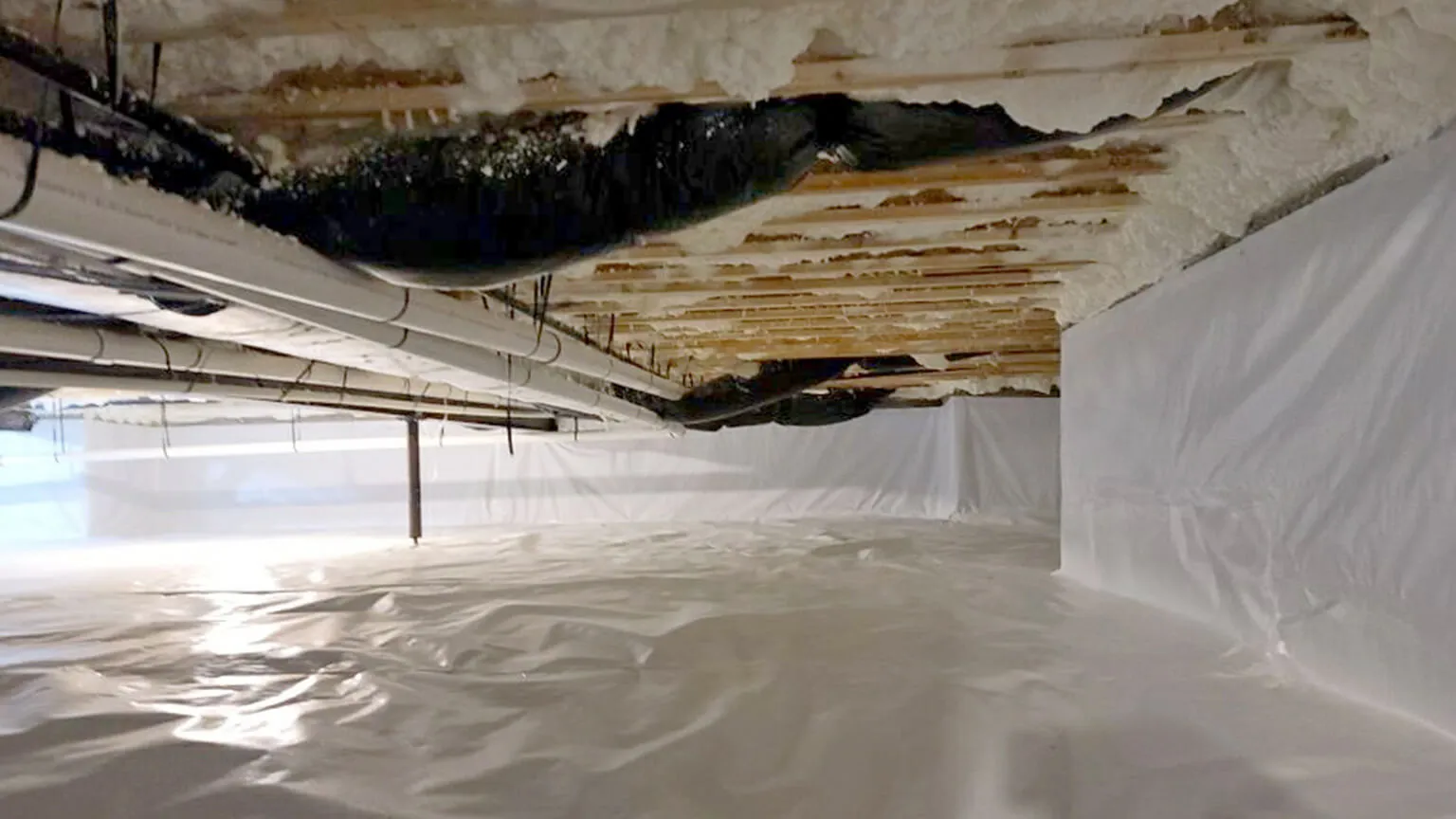
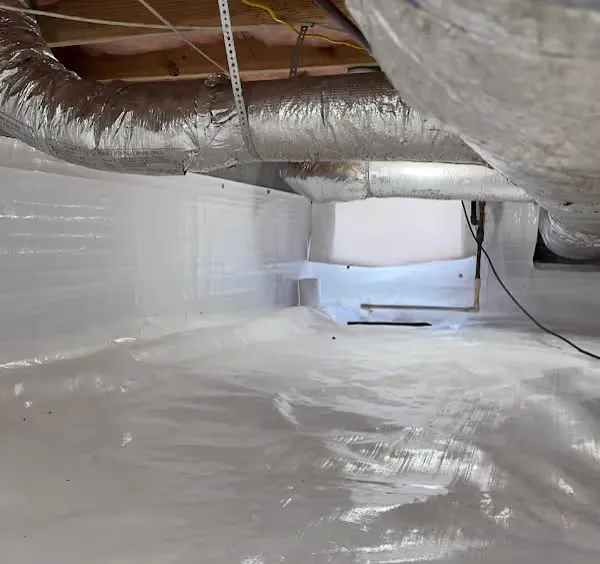
Picture a heavy white liner covering the entire floor, running up the foundation walls, and wrapped around every pier. Seams get overlapped and sealed. The top edge gets mechanically fastened to the wall, so the dirt and the old block stop feeding damp air into the space at all.
After that, we close the vents, seal the access door, and treat the crawl space as part of your house instead of part of your yard. Most homes then get a dehumidifier sized to the square footage, with a drain line that carries water off on its own.
One caution, because order matters: sealing a space that’s actively taking on water just gives the water a nicer place to sit. Drainage goes under the liner in those cases. So if you’re seeing standing water instead of damp air, start with our guide to a wet crawl space.
What does a real job look like, day by day?
Day zero is the free inspection. We crawl the whole space, not the first ten feet past the hatch, and we read the wood. Moisture readings, staining, rusted duct straps and sagging insulation tell us where the water starts.
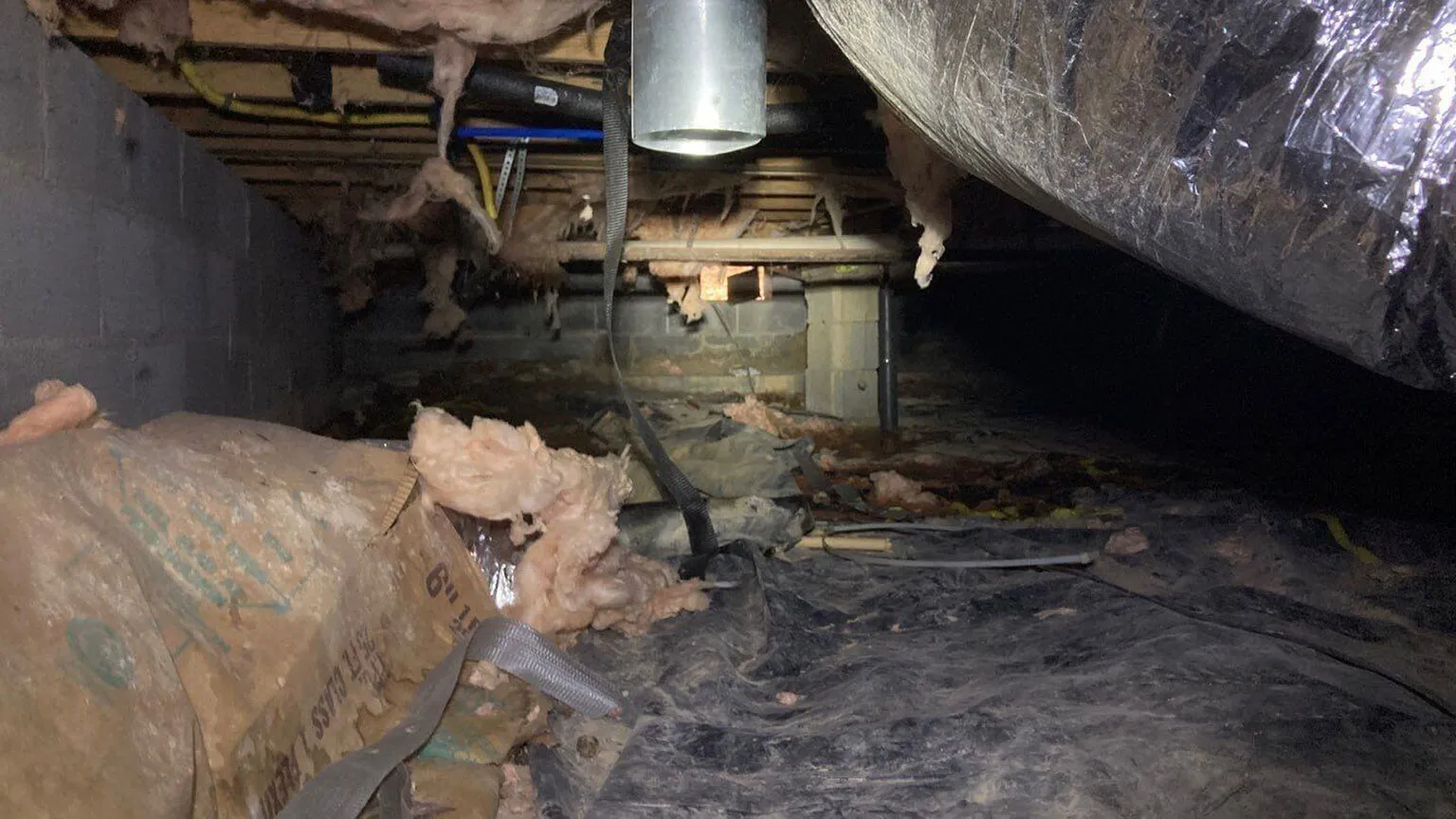
Then comes cleanout. Old batt insulation, debris and torn plastic go out, and the grade gets smoothed so the liner lies flat. Any drainage work happens now, because we don’t cover up a problem we haven’t solved.
Next the liner goes down, up the walls, and around the piers, sealed as it goes. Vents get closed, the door gets sealed, and the dehumidifier gets set and drained. Most spaces take two to four working days. A homeowner over near the Downtown Decatur core told us the loudest part of the whole week was our radio.
What changed our thinking after twenty years?
Honestly, this: the liner is the easy part. Early on, we thought a good job was mostly about materials — thickness, coverage, a tidy finish. Twenty-plus years under Metro Atlanta houses taught us the liner is the last five percent, and everything upstream of it decides whether it works.
So we now spend real time outside before we ever go under. Downspouts, grading, the buried original slope, root paths, an old clay drain line that quit sometime during the Nixon administration. Stop the source first, protect the structure second. That order isn’t a slogan — it’s what keeps a sealed space dry ten years later.
The other shift is how we treat old houses. A Decatur bungalow was built before basement waterproofing existed as a trade, and its hand-laid stone or brick foundation has held for a century. That’s not a flaw to fight; it’s a structure to respect. We work with those walls instead of drilling and jacking through them, which is why a lot of volume contractors skip this part of town.
You see it plainly around the Druid Hills edge, where big lots, huge canopy and old footings all meet. Two houses on one block can need totally different scopes, so we price what your house needs.
Worth knowing
Encapsulation and drainage are two separate conversations. Plenty of crawl spaces we inspect only need sealing and a dehumidifier. Others need water managed first. We’ll tell you which one you have before money ever comes up.
What actually moves the price?
Three things, mostly: square footage, headroom, and how much has to come out first. We won’t publish a flat price for crawl space encapsulation Decatur homes need, because one number covering a tight 800-square-foot cellar and a tall 2,200-square-foot space would be wrong somewhere. Still, you deserve to see what we’re weighing.
Price drivers, biggest first
- Square footage. Liner, labor and crawling hours all scale with floor area. This is the largest swing by far.
- Headroom and access. A space you can duck-walk through costs less to work in than an eighteen-inch belly crawl. That’s real labor, not a surcharge.
- Cleanout. Fallen insulation, old plastic and a century of odds and ends have to leave first.
- Drainage needs. If groundwater shows up, a drain and pump go in under the liner, and the scope grows.
- Foundation condition. Deteriorating mortar in stone or hand-laid block gets addressed before sealing.
- Extras. Subfloor insulation, duct sealing and a new access door are common add-ons — and none of them are automatic.
Small sealed spaces land at the low end. A large space with drainage, a pump and a commercial dehumidifier sits at the top, and most homes fall somewhere in between. Either way, you get one written number with the scope spelled out beside it. If you’re comparing across the metro, our Lawrenceville crawl space encapsulation page walks through the same cost logic.
What’s included, and what’s the warranty?
Included: the inspection, the estimate, the diagnosis, the liner and all sealing, vent and door closure, the dehumidifier and its drain line, haul-off, and photos before we close the hatch. Ask any contractor for those photos. Nobody honest minds.
Not included, usually: mold remediation, joist repairs, HVAC replacement, and plumbing we happen to find. We flag those at the walkthrough instead of mid-project, because surprises belong at birthday parties. Sagging framing becomes a crawl space repair conversation on its own.
The warranty is written in plain English and short enough to read in one sitting. Better yet, it transfers with the house — which matters a lot in a market where buyers and their agents ask sharp questions. Folks selling an Adair Park area bungalow have handed ours straight to a buyer’s agent and gone right back to packing.
What does the first week, first year, and tenth year look like?
Week one is quieter than people expect. The dehumidifier pulls the space to a steady level, and the musty note in the hallway fades within days. Air moves upward through a house, so whatever sits under your floor never politely stays there.
Year one is where comfort shows up. Floors feel warmer in February, the upstairs holds a steadier temperature, and the ductwork stops sweating all summer. Plenty of homeowners say the storage is the real surprise — holiday bins can live down there now.
Year ten matters most, and it’s why we fuss about drainage and grading first. Dry wood doesn’t rot, and dry framing doesn’t invite what damp framing invites. The EPA’s page on mold and health and the CDC’s guidance for homeowners explain that side plainly. A sealed, monitored space keeps your home’s oldest parts protected while you get on with your life.
Why does hiring locally matter here?
Because this housing stock is the oldest we work on, and old houses reward experience. Stone foundations, hand-laid block, half-basements, dirt cellars. In other words, good crawl space encapsulation Decatur homes deserve looks nothing like a subdivision job — and crews that only work new builds tend to guess here.
We’re close by, too. Our Lawrenceville shop is about thirty-five minutes up the road, and we’re along North Decatur Road, near Glenlake Park and around Decatur Square constantly. Same crews, same trucks, so a follow-up visit is a phone call. And if water shows up lower in the house instead, our flooded basement repair guide covers that side.
Where we work around Decatur
We’re based in Lawrenceville and we’re in DeKalb County constantly. That covers Decatur, Avondale Estates, Tucker, Brookhaven, Clarkston, Stone Mountain, Chamblee, Doraville and Atlanta, plus the wider DeKalb area. Whether yours is a 1920s bungalow or a mid-century ranch, we’ve worked on one like it a few streets over.
Questions Decatur homeowners ask us
It depends on size, headroom, cleanout and whether drainage is needed, so we give you one written number after we’ve seen the space. Small, clean spaces sit at the low end, while a large space with a drain, a pump and a commercial dehumidifier sits at the top. The inspection and estimate are free, and projects over $3,500 get $500 off.
Almost always, yes. Sealing stops new moisture from coming in, but the dehumidifier is what holds the space steady year-round. We size it to your square footage and run a drain line, so there’s nothing for you to empty.
In our climate, closed. Open vents were required for decades on the theory that outside air dries a crawl space, but warm humid air condenses on cool surfaces instead. Once the space is sealed and controlled, closing them is the entire point.
Usually it does, because air travels upward through a house and that odor often starts under the floor. Once the moisture feeding it is gone, the smell fades over the following weeks. If anything lingers, that tells us there’s a second source worth finding.
Most crawl spaces take two to four working days. Heavy cleanout adds a day, and drainage work adds another. You get the timeline in writing before we start, so you can plan around the driveway and the dogs.
Let’s find out what your Decatur crawl space actually needs
We’ll crawl the whole space, take real moisture readings, show you photos of what’s down there, and explain the fix in plain language. The inspection is free, the estimate is free, and nobody pressures you at the end of it.
(678) 914-5112Serving Decatur and all of Metro Atlanta · $500 off projects over $3,500 · Live support 7am–8pm, 7 days a week