

Wet Basement in Decatur: What’s Really Causing It, and How It Gets Fixed
Two nearly identical bungalows. One stays dry every spring. The other doesn’t. Here’s the difference — and what a fair estimate should look like.
Picture two houses on the same street near Glenwood Estates. Same year, same builder, same hand-laid block, same big oaks out front. After a long March rain, one basement is bone dry — and the other has a dark line creeping across the floor. That’s the puzzle behind almost every wet basement Decatur search, and the answer is rarely the house itself. It’s what’s happening in the six feet of dirt around it.
Good news right up front: this is one of the most common things we look at, and it’s very fixable. So let’s take it apart slowly, because you deserve to understand your own house before anyone hands you a number.
Why does one house stay dry and the neighbor’s doesn’t?
Usually it comes down to small differences that add up. One house has downspouts carrying roof water ten feet out. The other dumps it beside the wall. One yard still slopes away; the other got raised an inch a year by mulch, beds and a patio somebody added in the nineties.
Then there’s the tree factor, which Decatur has in serious quantity. Enormous oak and poplar roots run under these old lots, so over time they can push a foundation wall or lift a slab from below. Roots also open channels in the clay that carry water down to your footing. That canopy is half the reason people love the streets toward the Druid Hills edge — but it does keep us busy.
Here’s the thing about a Decatur bungalow: it was built before basement waterproofing existed as a trade. Nobody skipped a step in 1928, because there was no step to skip. These houses have stood a hundred years anyway, so the fix has to respect that — not fight it.
What’s actually happening under your floor?
Two words explain most of it: hydrostatic pressure. Red clay soaks up rain and swells, and swollen soil presses hard against everything it touches. Water doesn’t need a crack to get through stone or block, either. Under enough pressure, it moves through solid masonry the same way it moves through a sponge.
That’s why a wall can be perfectly sound and still get damp. In fact, most century-old foundations we inspect are seeping while staying structurally fine. Mortar is the usual soft spot, since old lime mortar was made to breathe and flex, and after a hundred wet springs some joints get tired.
Worth knowing
Seepage and structural movement are two separate conversations. We’ll tell you clearly which one you have — and if it’s only seepage, we’ll say that too, before anybody talks money.
Rainfall matters too. Our spring storms arrive fast and heavy, so the ground goes from thirsty to saturated in an afternoon. If you like tracking that, the National Weather Service Peachtree City office posts the local outlooks worth bookmarking.
Is yours mild, or is it something more?
Fair question, and you can get most of the way there yourself. Nothing here is bad news — it just shows where you sit on the scale.
Reading the signs
- Musty smell, no visible water. Moisture is arriving as vapor. Mild, and often solved outside.
- White chalky bloom on the block. That’s efflorescence — mineral left behind after water passed through.
- Damp corner after heavy rain. Very common, and usually one downspout is doing the damage.
- Water tracking along the floor and wall joint. Pressure is winning at the seam, which points toward drainage.
- Standing water that sticks around for days. Time to have someone look. Still fixable, just a bigger scope.
What if you leave it alone? Nothing dramatic happens overnight, honestly. Moisture problems just widen slowly — stored things get ruined, humidity climbs, and simple repairs get less simple. The EPA’s guide to moisture control explains the indoor-air side clearly, without selling anything.
The second thing nobody mentions
Ready for the part most articles skip? In houses this old, the water often isn’t coming from the sky at all. It’s coming from a pipe.
Original clay sewer and drain lines still serve a surprising number of Decatur lots. After a century, joints separate and roots find them. A line like that can soak the soil right at your footing every day, rain or shine. That’s why a wet basement in Decatur sometimes stays damp through a dry August, which drives homeowners crazy until somebody scopes the line.
Good news, though: this one’s very solvable, and finding it early usually saves money. We look for it during the inspection instead of assuming every damp wall is a groundwater story. Once the source is corrected, the room often calms down on its own.
Most of the time, the wall isn’t failing. Something outside the wall is delivering more water than the ground can carry away — and that’s a much friendlier problem to own.
Buried grading is the other quiet culprit. Walk your foundation and look for soil sitting above the top of the block. That’s common on a century-old lot, and lowering it is often the cheapest fix on the list.
So how does a wet basement actually get fixed?
Simpler than most people expect. The old approach fought water at the wall with coatings and patches, which is a raincoat on a submarine. Interior systems do the opposite — they collect water below the slab and route it to a sump before it ever reaches your floor. Here’s the sequence, plainly.
- Find the source outside first. Downspouts, grade, patios, drain lines. Sometimes the whole fix lives in the yard.
- Read the foundation. Stone, brick and hand-laid block get handled differently than poured concrete. Old mortar gets respect, not a grinder.
- Open a narrow strip of slab. Only along the affected walls, and only for a day of noise.
- Set perforated pipe in clean stone, below floor level. Depth is the whole ballgame.
- Route it to a sump basin. The pump sends water well away, not back into the flower bed for a second try.
- Close it up. Fresh concrete, wall liner where it’s called for, dirt floors capped, and our mess in our truck.
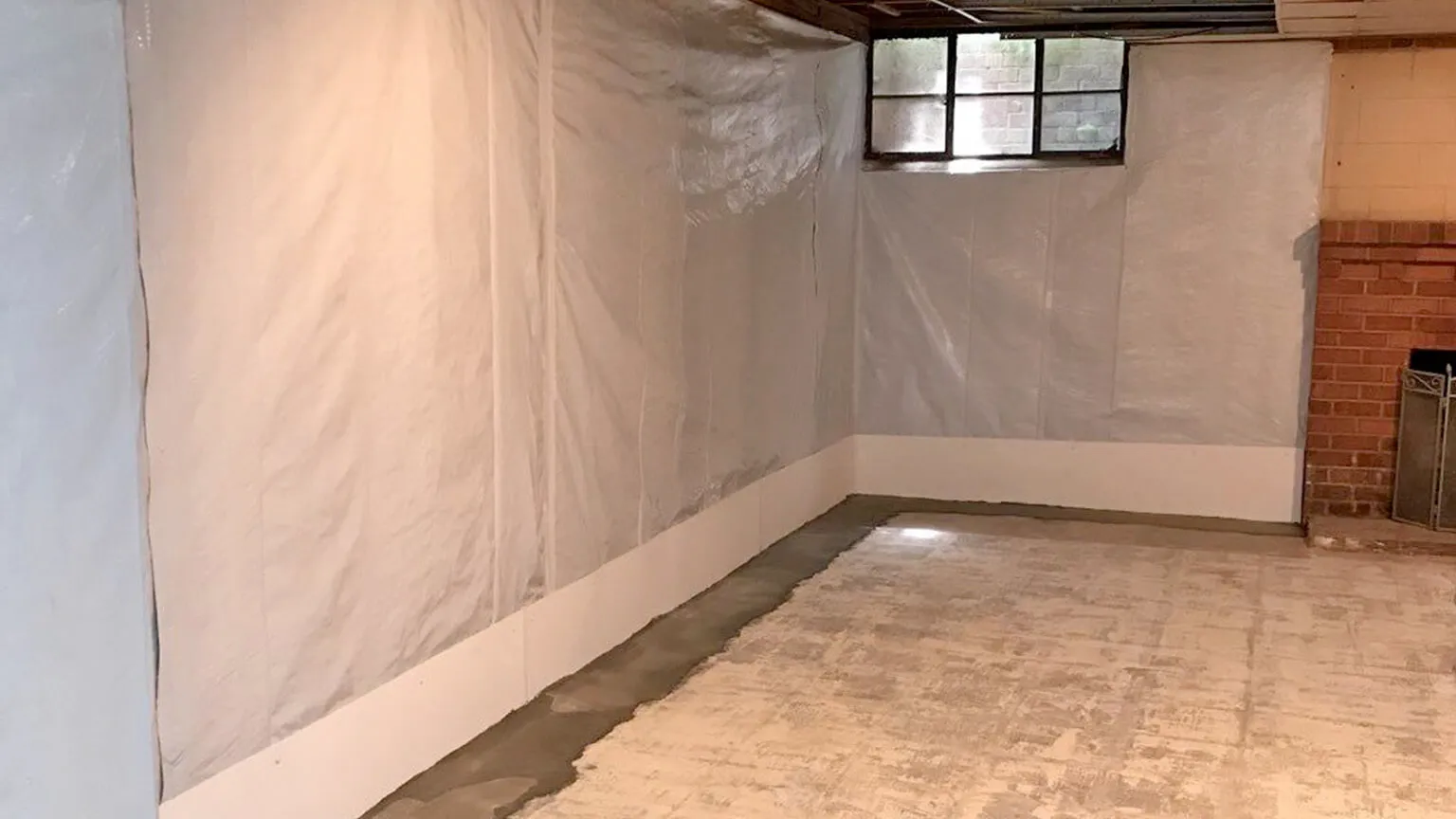
Most interior systems in an older home here run two to four working days. Add a day for a finished space, plus another when a dirt cellar floor needs capping. Pricing tracks scope more than anything else, and our waterproofing cost breakdown walks through the drivers if you want numbers before you call. The basement waterproofing page shows exactly what we install.
The house that wasn’t what anyone expected
Want the story that changes how people think about this? A homeowner near the Downtown Decatur core called us about a soaked wall in a 1930s Tudor. He’d already priced a full perimeter system and made peace with the number.
We walked the outside first, as always. A rebuilt driveway apron off a side street near Scott Boulevard had reversed the slope years earlier, sending every storm down the side yard to that one wall. Above it, a buried downspout line had collapsed and fed the same spot.
The real fix was regrading, a new discharge line, and a short run of interior drainage on that wall alone. Nothing like the job he’d braced for. That’s why we look outside before quoting inside — and why we’d rather hand you the small answer when the small answer is the true one.
What should you ask for in an estimate?
Four things, and any honest contractor hands them over without blinking. First, what they found outside and why they ruled it in or out. Second, the depth and route of the drainage, in writing. Third, where the water discharges. Fourth, a warranty you can read in one sitting.
If a quote arrives over the phone with no walk-through, that’s a guess — and you’d be paying for it. Ask questions, too. Decatur homeowners ask more of them than anyone else we work with, and honestly, we like it.
Some homes here have a crawl space rather than a full basement, especially the smaller lots. In that case crawl space encapsulation is usually the better system. Different approach, same goal. And if you’re comparing across the metro, our Lawrenceville wet basement guide covers how newer construction behaves differently.
What does life look like once it’s dry?
Quieter, mostly. The smell fades within days once the moisture source is cut. Your sump cycles after storms, which is the system working rather than a problem. By the second weekend, people carry boxes back downstairs without thinking twice.
A year in, you stop checking after rain. One homeowner who walks her dog at Legacy Park said the strangest part was realizing she hadn’t thought about her basement since spring. Ten years in, the pipe and stone below the slab are still working, because nothing down there wears out. Only the pump has a service life, similar to a water heater.

Best of all, the space becomes yours again. Families near Glenlake Park have turned theirs into pottery studios, guest rooms, and one very serious model-train setup.
Where we work around Decatur
We’re based in Lawrenceville, about thirty-five minutes northeast, and we’re in DeKalb County constantly. That includes Decatur, Avondale Estates, Tucker, Brookhaven, Clarkston, Stone Mountain, Scottdale, Chamblee, Doraville and Atlanta. Old stone, brick and hand-laid block foundations are normal work for us — not a surprise we charge extra to be surprised by.
Questions Decatur homeowners ask us
Sometimes, but they’re two different jobs. Drainage handles water, while a crack may also need repair or reinforcement depending on what caused it. We’ll look at both during the inspection and tell you plainly whether your crack is cosmetic, active, or worth watching for a season.
It depends on what’s causing the water and what’s around your house. Interior drainage is less disruptive and works well under old foundations, since it collects water below the slab instead of fighting it at the wall. Exterior work makes more sense when grading, drain lines or roof water are the real source, and plenty of homes get a mix of both.
The drainage itself is built to last as long as the house, because pipe and clean stone below the slab have nothing to wear out. The pump is the part with a service life, so plan on replacing it somewhere around the ten-year mark. Everything else keeps working quietly in the background.
Yes, and you get it in writing before the work starts rather than after. Ask us to spell out what’s covered and for how long. If a warranty can’t be summed up in a sentence or two, it isn’t doing you much good.
Usually, yes. We open only the bottom section of wall and floor along the affected perimeter, then put it back. Older finished spaces sometimes hide moisture behind paneling, so we check that first — and if we find something, we’ll show you before we touch anything.
Let’s find out what your Decatur basement really needs
We’ll walk the house with you, show you where the water is coming from, and explain the fix in plain language — century-old foundations included. The inspection is free, the estimate is free, and nobody pressures you at the end of it.
(678) 914-5112Serving Decatur and all of Metro Atlanta · $500 off projects over $3,500 · Live support 7am–8pm, 7 days a week